
SLIDE 1
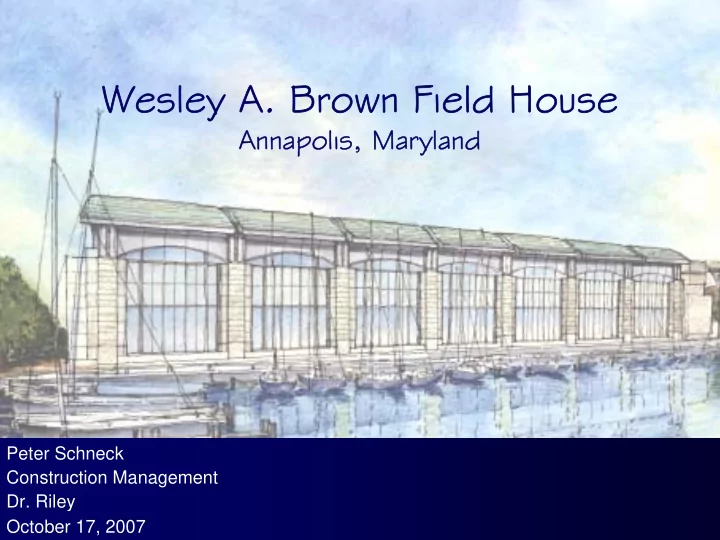
Wesley A. Brown Field House Wesley A. Brown Field House
Annapolis, Maryland Annapolis, Maryland
Peter Schneck
- Dr. Riley
October 17, 2007 Construction Management
Wesley A. Brown Field House Wesley A. Brown Field House Annapolis, - - PowerPoint PPT Presentation
Wesley A. Brown Field House Wesley A. Brown Field House Annapolis, Maryland Annapolis, Maryland Peter Schneck Construction Management Dr. Riley October 17, 2007 Wesley A. Brown Field House Wesley A. Brown Field House Annapolis Annapolis,
Peter Schneck
October 17, 2007 Construction Management
Annapolis Annapolis, Maryland Maryland
Peter Schneck Peter Schneck Constructi Construction Manag
ment
. Riley
Project Overview
Analysis 1 – Fabric Mechanical Distribution Fabric Mechanical Distribution Comparison Comparison
Analysis 2 – Waterproofing Options for the Waterproofing Options for the Wesley A. Brow n Field House Wesley A. Brow n Field House
Analysis 3 – Properties of Concrete Products roperties of Concrete Products w ith Fly Ash w ith Fly Ash
Analysis 4 – Penn State’s Coal Fired Pow er enn State’s Coal Fired Pow er Plant and Uses for its Coal Combustion Plant and Uses for its Coal Combustion Products Products
Acknow ledgements
Questions
Project Overview Analysis 1 – Fabric Mechanical Distribution Comparison Analysis 2 – Waterproofing Options for the Wesley A. Brown Field House Analysis 3 – Properties of Concrete Products with Fly Ash Analysis 4 – Penn State’s Coal Fired Power Plant and Uses for its Coal Combustion Products Acknowledgements Questions
Annapolis Annapolis, Maryland Maryland
Peter Schneck Peter Schneck Constructi Construction Manag
ment
. Riley
Location: United State Naval Academy Annapolis, Maryland Project Cost: $45 million Size: 140,000 Sq. Ft. 2 Levels Duration: 26 months February 2006 – March 2008 Building Function: Collegiate multi-sport complex Support for collegiate athletics and events Project Delivery Method Design-Build
Project Overview
Analysis 1 – Fabric Mechanical Distribution Comparison Analysis 2 – Waterproofing Options for the Wesley A. Brown Field House Analysis 3 – Properties of Concrete Products with Fly Ash Analysis 4 – Penn State’s Coal Fired Power Plant and Uses for its Coal Combustion Products Acknowledgements Questions
Annapolis Annapolis, Maryland Maryland
Peter Schneck Peter Schneck Constructi Construction Manag
ment
. Riley
Project Team – Organizational Chart
Ow ner: Naval Facilities Engineering Command / The United States Naval Academy Construction Manager Hensel Phelps Construction Company Architect
HKS Inc. Mechanical Engineer: Kavocs Whitney & Associates Electrical Engineer: M.C. Dean Structural Engineer: Thorton Tomasetti Fire Protection: National Fire Protection Associate Architect Shalom Baranes Associates
Guaranteed Maximum Price Lump Sum
Project Overview
Analysis 1 – Fabric Mechanical Distribution Comparison Analysis 2 – Waterproofing Options for the Wesley A. Brown Field House Analysis 3 – Properties of Concrete Products with Fly Ash Analysis 4 – Penn State’s Coal Fired Power Plant and Uses for its Coal Combustion Products Acknowledgements Questions
Annapolis Annapolis, Maryland Maryland
Peter Schneck Peter Schneck Constructi Construction Manag
ment
. Riley
Building Footprint
Bancroft Hall McDonough Hall Site Trailer Parking Storage/Staging Storage/ Staging Site Fencing Substation
7 Story Stone Building
4 Story Stone Building Traffic
Site Layout
Space –
Neighboring building
Streets –
Difficult for deliveries
Academy’s Campus –
Security: w orkers and deliveries Project Overview
Analysis 1 – Fabric Mechanical Distribution Comparison Analysis 2 – Waterproofing Options for the Wesley A. Brown Field House Analysis 3 – Properties of Concrete Products with Fly Ash Analysis 4 – Penn State’s Coal Fired Power Plant and Uses for its Coal Combustion Products Acknowledgements Questions
Annapolis Annapolis, Maryland Maryland
Peter Schneck Peter Schneck Constructi Construction Manag
ment
. Riley
Fabric Mechanical Distribution Comparison
Problem: The current mechanical distribution system design in the Wesley A. Brow n Field House has G90 double- w alled pre-insulated ductw ork in the athletic field
40’. The diameter of the ductw ork is up to 58”. This ductw ork is expensive, difficult to install, and requires precious space on the project for lay-dow n Goal: To find an alternative ductw ork system that addresses cost, schedule, and space issues on the Wesley A. Brow n Field. The system needs to satisfy the Naval Academies require for a mechanical system in a state-of-the-art athletic facility.
Project Overview
Analysis 1 – Fabric Mechanical Distribution Comparison
Analysis 2 – Waterproofing Options for the Wesley A. Brown Field House Analysis 3 – Properties of Concrete Products with Fly Ash Analysis 4 – Penn State’s Coal Fired Power Plant and Uses for its Coal Combustion Products Acknowledgements Questions
Annapolis Annapolis, Maryland Maryland
Peter Schneck Peter Schneck Constructi Construction Manag
ment
. Riley
Fabric Mechanical Distribution Comparison A fabric ductw ork system from Ductsox Fabric Air Dispersion Products w as investigated as an alternative to the Steel Ductw ork. Using the Ductsox Fabric Air Dispersion Design Guide, a Ductsox System for the Wesley A. Brow n Field House using the follow ing steps of design.
Project Overview
Analysis 1 – Fabric Mechanical Distribution Comparison
Analysis 2 – Waterproofing Options for the Wesley A. Brown Field House Analysis 3 – Properties of Concrete Products with Fly Ash Analysis 4 – Penn State’s Coal Fired Power Plant and Uses for its Coal Combustion Products Acknowledgements Questions
Annapolis Annapolis, Maryland Maryland
Peter Schneck Peter Schneck Constructi Construction Manag
ment
. Riley
Fabric Mechanical Distribution Comparison
1. Shape – The shape is cylindrical fabric duct, due to the exposed
chosen 2. Design layout – The design layout w as one that closely resembles Wesley A. Brow n’s current Mechanical Layout. The tw o 42,000 cfm Air Handler Units distribute air dow n four 190 foot runs of fabric duct at 21,000 cfm. The maximum velocity for a Ductsox system w ith inlet fittings is 1,400 fpm, how ever reducing the velocity to 1,200 fpm reduces and stress and noise. Using the design chart the diameter of fabric cylinders is determined to be 58” using 1,200 fpm as the inlet pressure.
Project Overview
Analysis 1 – Fabric Mechanical Distribution Comparison
Analysis 2 – Waterproofing Options for the Wesley A. Brown Field House Analysis 3 – Properties of Concrete Products with Fly Ash Analysis 4 – Penn State’s Coal Fired Power Plant and Uses for its Coal Combustion Products Acknowledgements Questions
Annapolis Annapolis, Maryland Maryland
Peter Schneck Peter Schneck Constructi Construction Manag
ment
. Riley
Fabric Mechanical Distribution Comparison
double w alled steel. The porous fabric does not allow of condensation to form in the ductw ork, by creating a layer of protective tempered air.
formula: (Height – 6) x 1.00 = Required Throw For required throw at a height of 40’, it w as determined that 34’ of required throw w as needed. Using the orifice chart 3” holes every 9” on center are required.
w as chosen to support the 58” diameter and for its ability to vary in attachment height
Project Overview
Analysis 1 – Fabric Mechanical Distribution Comparison
Analysis 2 – Waterproofing Options for the Wesley A. Brown Field House Analysis 3 – Properties of Concrete Products with Fly Ash Analysis 4 – Penn State’s Coal Fired Power Plant and Uses for its Coal Combustion Products Acknowledgements Questions
Annapolis Annapolis, Maryland Maryland
Peter Schneck Peter Schneck Constructi Construction Manag
ment
. Riley
Fabric Mechanical Distribution Comparison Cost and Construction Analysis
steel ductw ork
a tw o man crew
Project Overview
Analysis 1 – Fabric Mechanical Distribution Comparison
Analysis 2 – Waterproofing Options for the Wesley A. Brown Field House Analysis 3 – Properties of Concrete Products with Fly Ash Analysis 4 – Penn State’s Coal Fired Power Plant and Uses for its Coal Combustion Products Acknowledgements Questions
Annapolis Annapolis, Maryland Maryland
Peter Schneck Peter Schneck Constructi Construction Manag
ment
. Riley
Fabric Mechanical Distribution Comparison Conclusion: The fabric ductw ork system is cheaper, faster, and safer to install. The Naval Academy w ants a state-of-art athletic facility, and the fabric ductw ork system w ould provide the Academy w ith the performance needed. How ever, the material w ould not be steel. Although the fabric can be purchased in custom colors, the Naval Academy is still receiving a material that does not match the exposed steel structure. The aesthetics in the Wesley A. Brow n Field House are important, but the amount of money and time saved using a fabric duct supports its use.
Project Overview
Analysis 1 – Fabric Mechanical Distribution Comparison
Analysis 2 – Waterproofing Options for the Wesley A. Brown Field House Analysis 3 – Properties of Concrete Products with Fly Ash Analysis 4 – Penn State’s Coal Fired Power Plant and Uses for its Coal Combustion Products Acknowledgements Questions
Annapolis Annapolis, Maryland Maryland
Peter Schneck Peter Schneck Constructi Construction Manag
ment
. Riley
Waterproofing Options for the Wesley A. Brow n Field House
Project Overview Analysis 1 – Fabric Mechanical Distribution Comparison
Analysis 2 – Waterproofing Options for the Wesley A. Brown Field House
Analysis 3 – Properties of Concrete Products with Fly Ash Analysis 4 – Penn State’s Coal Fired Power Plant and Uses for its Coal Combustion Products Acknowledgements Questions
Problem: The Wesley A. Brow n Field House is located near the Santee Basin. Pits in the field house require w aterproofing to protect specialized equipment that are stored in them. Waterproofing can be costly and time consuming, and not all types of w aterproofing lend themselves to all applications. A Bituminous Asphalt w ith fiber system w as specified for the project. Goal: To research different w aterproofing systems to find
requirements than the specified system.
Annapolis Annapolis, Maryland Maryland
Peter Schneck Peter Schneck Constructi Construction Manag
ment
. Riley
Waterproofing Options for the Wesley A. Brow n Field House
Project Overview Analysis 1 – Fabric Mechanical Distribution Comparison
Analysis 2 – Waterproofing Options for the Wesley A. Brown Field House
Analysis 3 – Properties of Concrete Products with Fly Ash Analysis 4 – Penn State’s Coal Fired Power Plant and Uses for its Coal Combustion Products Acknowledgements Questions
The alternative w aterproofing systems investigated:
Elastomeric Bituminous Modified Polyethleyene Fluid Bentonite
Advantages Disadvantages Asphalt w/ Fiber
shapes
Elastomeric Bituminous Modified Polyethleyene Fluid
healing
application
Bentonite
hydrostatic pressure
Annapolis Annapolis, Maryland Maryland
Peter Schneck Peter Schneck Constructi Construction Manag
ment
. Riley
Waterproofing Options for the Wesley A. Brow n Field House
Project Overview Analysis 1 – Fabric Mechanical Distribution Comparison
Analysis 2 – Waterproofing Options for the Wesley A. Brown Field House
Analysis 3 – Properties of Concrete Products with Fly Ash Analysis 4 – Penn State’s Coal Fired Power Plant and Uses for its Coal Combustion Products Acknowledgements Questions
A cost and schedule comparison revealed these results
Labor hours
Annapolis Annapolis, Maryland Maryland
Peter Schneck Peter Schneck Constructi Construction Manag
ment
. Riley
Waterproofing Options for the Wesley A. Brow n Field House
Project Overview Analysis 1 – Fabric Mechanical Distribution Comparison
Analysis 2 – Waterproofing Options for the Wesley A. Brown Field House
Analysis 3 – Properties of Concrete Products with Fly Ash Analysis 4 – Penn State’s Coal Fired Power Plant and Uses for its Coal Combustion Products Acknowledgements Questions
Conclusion: The specified Bituminous Asphalt w ith fibers proved to be the best material the Wesley A. Brow n Field House. Bituminous Asphalt – Slow er than the Bentonite and temperature sensitive. Pits are poured in March, April, and May so temperature is not a concern Elastomeric – both the slow est and most costly. This w aterproofing system could be used, but the Bituminous Asphalt meets the requirements. Bentonite – The fastest application. Important
Wesley A. Brow n Field House is humidity sensitive containing w ooden basketball courts. This could effect the mechanical loads.
Annapolis Annapolis, Maryland Maryland
Peter Schneck Peter Schneck Constructi Construction Manag
ment
. Riley
Problem: The United States Naval Academy’s Request for Proposal allow s for the concrete used in the Wesley A. Brow n Field House to include up to 25% fly ash in the cementitious material. Currently the mix design does not have fly ash. Goal: To investigate the properties of concrete w ith fly ash aggregate to determine if these mixes could be used on the Wesley A. Brow n Field House project.
Properties of Concrete Products w ith Fly Ash
Project Overview Analysis 1 – Fabric Mechanical Distribution Comparison Analysis 2 – Waterproofing Options for the Wesley A. Brown Field House
Analysis 3 – Properties of Concrete Products with Fly Ash
Analysis 4 – Penn State’s Coal Fired Power Plant and Uses for its Coal Combustion Products Acknowledgements Questions
Annapolis Annapolis, Maryland Maryland
Peter Schneck Peter Schneck Constructi Construction Manag
ment
. Riley
Fly Ash – Fly ash is a coal combustion product Pozzolanic material Glassy spheres high in Silica, Alumina, and Calcium Reacts w ith lime and calcium hydroxide to form Calcium Silicate Hyrdrate (CSH)
Properties of Concrete Products w ith Fly Ash
Project Overview Analysis 1 – Fabric Mechanical Distribution Comparison Analysis 2 – Waterproofing Options for the Wesley A. Brown Field House
Analysis 3 – Properties of Concrete Products with Fly Ash
Analysis 4 – Penn State’s Coal Fired Power Plant and Uses for its Coal Combustion Products Acknowledgements Questions
Annapolis Annapolis, Maryland Maryland
Peter Schneck Peter Schneck Constructi Construction Manag
ment
. Riley
In a normal Portland Cement mix, up to ¼ lb of lime can be produced for every 1 lb of Portland Cement used. Lime is draw n out over time through capillaries in concrete causing efflorescence in Portland Cement mixes Fly Ash reacts w ith the lime over time creating more CSH paste and filling capillaries in concrete
Properties of Concrete Products w ith Fly Ash
Project Overview Analysis 1 – Fabric Mechanical Distribution Comparison Analysis 2 – Waterproofing Options for the Wesley A. Brown Field House
Analysis 3 – Properties of Concrete Products with Fly Ash
Analysis 4 – Penn State’s Coal Fired Power Plant and Uses for its Coal Combustion Products Acknowledgements Questions
Annapolis Annapolis, Maryland Maryland
Peter Schneck Peter Schneck Constructi Construction Manag
ment
. Riley
From Headwaters Resources Fly Ash for Concrete Brochure
Strength: Result of reactions:
When compared w ith a Portland Cement mix, Fly Ash concretes typically have less strength at 7 days, equal at 28 days, and more after a year
Durability:
Concrete w ith Fly Ash has more durability than Portland Cement mixes. The reaction betw een the Fly Ash and lime seals capillaries that cause cracks and chemical w ear on concrete
Workability
Due to the spherical shape of fly ash, it creates a “ball- bearing” effect, w hich increases the w orkability of the concrete
Properties of Concrete Products w ith Fly Ash
Project Overview Analysis 1 – Fabric Mechanical Distribution Comparison Analysis 2 – Waterproofing Options for the Wesley A. Brown Field House
Analysis 3 – Properties of Concrete Products with Fly Ash
Analysis 4 – Penn State’s Coal Fired Power Plant and Uses for its Coal Combustion Products Acknowledgements Questions
Annapolis Annapolis, Maryland Maryland
Peter Schneck Peter Schneck Constructi Construction Manag
ment
. Riley
Properties of Concrete Products w ith Fly Ash Conclusion: A concrete mixture that incorporates Fly Ash should be utilized. Fly Ash is a cheap recycled product that can be used effectively as a partial substitute for Portland Cement in
the strength, durability, and w orkability of the concrete w hile decreasing cost. The source and properties of the Fly Ash should be know n and remain constant throughout the project.
Project Overview Analysis 1 – Fabric Mechanical Distribution Comparison Analysis 2 – Waterproofing Options for the Wesley A. Brown Field House
Analysis 3 – Properties of Concrete Products with Fly Ash
Analysis 4 – Penn State’s Coal Fired Power Plant and Uses for its Coal Combustion Products Acknowledgements Questions
Annapolis Annapolis, Maryland Maryland
Peter Schneck Peter Schneck Constructi Construction Manag
ment
. Riley
Penn State’s Coal Fired Pow er Plant and uses for its Coal Combustion Products Penn State’s Coal Fired Pow er Plant Located at Southw est edge of the University Campus 4 Stoker Stoves produce pow er that is consumed by the University Produces tw o Solid Coal Combustion Products
Project Overview Analysis 1 – Fabric Mechanical Distribution Comparison Analysis 2 – Waterproofing Options for the Wesley A. Brown Field House Analysis 3 – Properties of Concrete Products with Fly Ash
Analysis 4 – Penn State’s Coal Fired Power Plant and Uses for its Coal Combustion Products
Acknowledgements Questions
Annapolis Annapolis, Maryland Maryland
Peter Schneck Peter Schneck Constructi Construction Manag
ment
. Riley
Penn State’s Coal Fired Pow er Plant and uses for its Coal Combustion Products Problem: Penn State is currently producing 600 to 800 tons of Fly Ash each year. The pow er plant is also producing 6,000 to 8,000 tons of bottom ash each year. Penn State is paying close to $35/ton to dispose of these materials in regulated landfills. Goal: To investigate the Coal Combustion Products that are produced at Penn State, and to find possible uses for them in the construction industry
Project Overview Analysis 1 – Fabric Mechanical Distribution Comparison Analysis 2 – Waterproofing Options for the Wesley A. Brown Field House Analysis 3 – Properties of Concrete Products with Fly Ash
Analysis 4 – Penn State’s Coal Fired Power Plant and Uses for its Coal Combustion Products
Acknowledgements Questions
Annapolis Annapolis, Maryland Maryland
Peter Schneck Peter Schneck Constructi Construction Manag
ment
. Riley
Penn State’s Coal Fired Pow er Plant and uses for its Coal Combustion Products The use of Coal Combustion Products is regulated by Pennsylvania Law There are only 11 acceptable uses for Coal Combustion Products in Pennsylvania. The
Project Overview Analysis 1 – Fabric Mechanical Distribution Comparison Analysis 2 – Waterproofing Options for the Wesley A. Brown Field House Analysis 3 – Properties of Concrete Products with Fly Ash
Analysis 4 – Penn State’s Coal Fired Power Plant and Uses for its Coal Combustion Products
Acknowledgements Questions
Annapolis Annapolis, Maryland Maryland
Peter Schneck Peter Schneck Constructi Construction Manag
ment
. Riley
Penn State’s Coal Fired Pow er Plant and uses for its Coal Combustion Products
Penn State’s Fly Ash w as looked at in the application of the manufacture of concrete. More specifically it w as investigated as an application in the mix for Autoclaved Aerated Concrete (AAC) Blocks Fly Ash-
Project Overview Analysis 1 – Fabric Mechanical Distribution Comparison Analysis 2 – Waterproofing Options for the Wesley A. Brown Field House Analysis 3 – Properties of Concrete Products with Fly Ash
Analysis 4 – Penn State’s Coal Fired Power Plant and Uses for its Coal Combustion Products
Acknowledgements Questions
Annapolis Annapolis, Maryland Maryland
Peter Schneck Peter Schneck Constructi Construction Manag
ment
. Riley
Penn State’s Coal Fired Pow er Plant and uses for its Coal Combustion Products Mixes containing varying amounts of the follow ing material w ere poured and tested for strength at the Penn State Materials Research Laboratory
Project Overview Analysis 1 – Fabric Mechanical Distribution Comparison Analysis 2 – Waterproofing Options for the Wesley A. Brown Field House Analysis 3 – Properties of Concrete Products with Fly Ash
Analysis 4 – Penn State’s Coal Fired Power Plant and Uses for its Coal Combustion Products
Acknowledgements Questions
Annapolis Annapolis, Maryland Maryland
Peter Schneck Peter Schneck Constructi Construction Manag
ment
. Riley
Penn State’s Coal Fired Pow er Plant and uses for its Coal Combustion Products
Project Overview Analysis 1 – Fabric Mechanical Distribution Comparison Analysis 2 – Waterproofing Options for the Wesley A. Brown Field House Analysis 3 – Properties of Concrete Products with Fly Ash
Analysis 4 – Penn State’s Coal Fired Power Plant and Uses for its Coal Combustion Products
Acknowledgements Questions
(6) 4 in blocks of each of the 6 different mixes w ere tested and averaged for strengths. The test had these results:
Annapolis Annapolis, Maryland Maryland
Peter Schneck Peter Schneck Constructi Construction Manag
ment
. Riley
Penn State’s Coal Fired Pow er Plant and uses for its Coal Combustion Products Plotting the average strength on a graph used to indicate AAC acceptable industry Strengths vs. Oven Dry Density yielded this graph:
Project Overview Analysis 1 – Fabric Mechanical Distribution Comparison Analysis 2 – Waterproofing Options for the Wesley A. Brown Field House Analysis 3 – Properties of Concrete Products with Fly Ash
Analysis 4 – Penn State’s Coal Fired Power Plant and Uses for its Coal Combustion Products
Acknowledgements Questions
Annapolis Annapolis, Maryland Maryland
Peter Schneck Peter Schneck Constructi Construction Manag
ment
. Riley
Penn State’s Coal Fired Pow er Plant and uses for its Coal Combustion Products Results: The Dry mixes feel in the acceptable region of the graph. AAC produced from Penn State Fly Ash could possibly be used as a construction block
Project Overview Analysis 1 – Fabric Mechanical Distribution Comparison Analysis 2 – Waterproofing Options for the Wesley A. Brown Field House Analysis 3 – Properties of Concrete Products with Fly Ash Analysis 4 – Penn State’s Coal Fired Power Plant and Uses for its Coal Combustion Products Acknowledgements Questions
Annapolis Annapolis, Maryland Maryland
Peter Schneck Peter Schneck Constructi Construction Manag
ment
. Riley
Penn State’s Coal Fired Pow er Plant and uses for its Coal Combustion Products Bottom Ash – Penn State’s Bottom Ash w as investigated as a potential material for: Structural Fill used in flow able fill Drainage Material and Pipe Bedding
Project Overview Analysis 1 – Fabric Mechanical Distribution Comparison Analysis 2 – Waterproofing Options for the Wesley A. Brown Field House Analysis 3 – Properties of Concrete Products with Fly Ash
Analysis 4 – Penn State’s Coal Fired Power Plant and Uses for its Coal Combustion Products
Acknowledgements Questions
Annapolis Annapolis, Maryland Maryland
Peter Schneck Peter Schneck Constructi Construction Manag
ment
. Riley
Penn State’s Coal Fired Pow er Plant and uses for its Coal Combustion Products Both the physical and chemical properties of Penn State’s Bottom Ash are not acceptable for Structural Fill or as a Pipe bedding material. The gradation has fines and material that is too large for use as flow able fill.
Project Overview Analysis 1 – Fabric Mechanical Distribution Comparison Analysis 2 – Waterproofing Options for the Wesley A. Brown Field House Analysis 3 – Properties of Concrete Products with Fly Ash
Analysis 4 – Penn State’s Coal Fired Power Plant and Uses for its Coal Combustion Products
Acknowledgements Questions
Annapolis Annapolis, Maryland Maryland
Peter Schneck Peter Schneck Constructi Construction Manag
ment
. Riley
Penn State’s Coal Fired Pow er Plant and uses for its Coal Combustion Products Conclusion: Penn State’s Coal Combustion Products are not being recycled and are costing Penn State money to dispose
Although Penn State’s Bottom Ash is not a suitable material for structural fill or pipe bedding as is, a screening or grinding process could produce a desirable material for these
processes could help alleviate some of the problem at the Coal Fired Pow er Plant
Bottom Ash
Penn State’s Fly Ash can be used in AAC that can be used as a replacement for CMU block in some applications. AAC blocks have great thermal resistance and resist sound transmission as w ell. With thermal and sound tests, Penn State might be able to produce AAC blocks to use here on campus and other projects.
Fly Ash
Project Overview Analysis 1 – Fabric Mechanical Distribution Comparison Analysis 2 – Waterproofing Options for the Wesley A. Brown Field House Analysis 3 – Properties of Concrete Products with Fly Ash Analysis 4 – Penn State’s Coal Fired Power Plant and Uses for its Coal Combustion Products Acknowledgements Questions
Annapolis Annapolis, Maryland Maryland
Peter Schneck Peter Schneck Constructi Construction Manag
ment
. Riley
All my Fellow Architectural Engineering Students: Nate Paist and Steven Todd New sw anger My friends and roommates: Jeff, Shimko, Kaufman, and Big Stu A special thanks to my family: My Mom and Dad and my aw esome sisters Becky and Rachel Penn State Faculty Members:
Professor Prafitt Hensel Phelps Construction Company
Project Overview Analysis 1 – Fabric Mechanical Distribution Comparison Analysis 2 – Waterproofing Options for the Wesley A. Brown Field House Analysis 3 – Properties of Concrete Products with Fly Ash Analysis 4 – Penn State’s Coal Fired Power Plant and Uses for its Coal Combustion Products Acknowledgements Questions
Annapolis Annapolis, Maryland Maryland
Peter Schneck Peter Schneck Constructi Construction Manag
ment
. Riley
Project Overview Analysis 1 – Fabric Mechanical Distribution Comparison Analysis 2 – Waterproofing Options for the Wesley A. Brown Field House Analysis 3 – Properties of Concrete Products with Fly Ash Analysis 4 – Penn State’s Coal Fired Power Plant and Uses for its Coal Combustion Products Acknowledgements
Questions