
SLIDE 1
HPRU EZI Research workshop Nov 22 2019 - LDA presentation
You have to forgive me for feeling slightly jaundiced about this meeting. Don’t get me wrong, it is definitely a Good Thing. You seem to have had a fascinating day yesterday, but patients were excluded. We can go to European TBD conferences (ECCMID, NordTick etc), and speak at them, but are excluded from one in our home
- country. How irrational is that?
How can we provide information to the public and health professionals if we don’t know the state of play? Ah - we can read your abstracts - thanks guys! Our discussions with doctors, patients and researchers throughout N Europe has made clear that we all have a communication problem. Last year we invited some Netherlands speakers to our conference, one of the young scientists had had concerns raised by her supervisor that she would be subject to haranguing from patients, as has happened in the Netherlands. We said our conference is not like that - people come who want to listen. The Netherlands speakers did come and we had a brilliant conference. To reduce conflict and work, and to set research priorities, we all have to reach an understanding of the underlying problems. It would help if we could assess and address a) what patients don’t understand and why they are worried and aggrieved; b) what doctors don’t understand about the science and why they have problems. We have to move this forward. Today is at least a step in the right direction. So on to research priorities We’ve been there and done that! That some people chose not to participate (patients as well as doctors), is not our fault – you were all
- invited. Yesterday you reviewed what you decided in
2017 were the knowledge gaps that you recognised. Last week LDA reviewed the top 10 decided by about 250 people- clinicians, patients and carers. All are still uncertainties 7 years later and 9 are the subject
- f a NICE Research Recommendation.
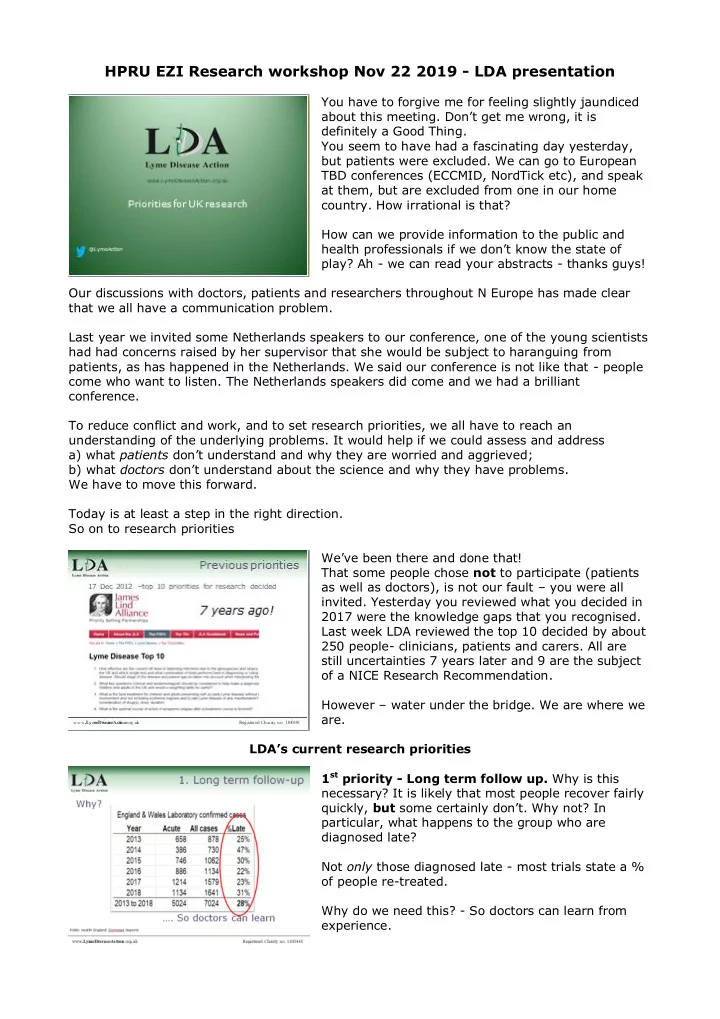
However – water under the bridge. We are where we are. LDA’s current research priorities 1st priority - Long term follow up. Why is this necessary? It is likely that most people recover fairly quickly, but some certainly don’t. Why not? In particular, what happens to the group who are diagnosed late? Not only those diagnosed late - most trials state a %
- f people re-treated.