How to write a successful Research Topic Acceptance Request (RTAR) - - PowerPoint PPT Presentation

how to write a successful research topic acceptance
SMART_READER_LITE
LIVE PREVIEW

How to write a successful Research Topic Acceptance Request (RTAR) - - PowerPoint PPT Presentation

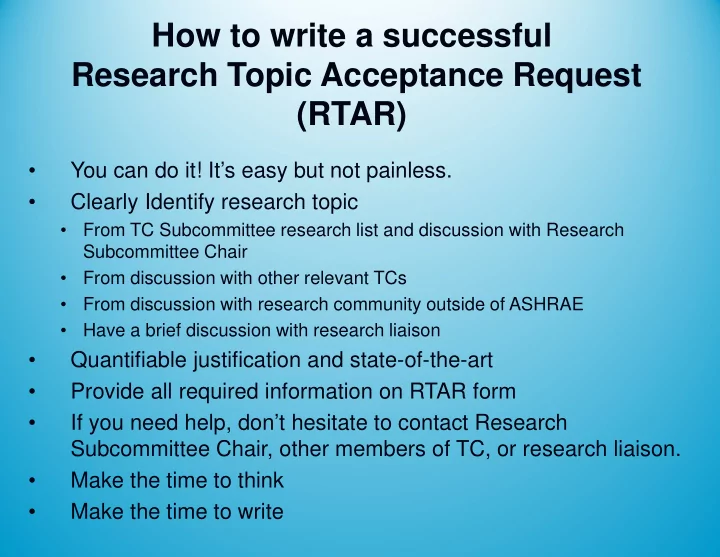
How to write a successful Research Topic Acceptance Request (RTAR) You can do it! Its easy but not painless. Clearly Identify research topic From TC Subcommittee research list and discussion with Research Subcommittee Chair


slide-1
SLIDE 1

How to write a successful Research Topic Acceptance Request (RTAR)

  • You can do it! It’s easy but not painless.
  • Clearly Identify research topic
  • From TC Subcommittee research list and discussion with Research

Subcommittee Chair

  • From discussion with other relevant TCs
  • From discussion with research community outside of ASHRAE
  • Have a brief discussion with research liaison
  • Quantifiable justification and state-of-the-art
  • Provide all required information on RTAR form
  • If you need help, don’t hesitate to contact Research

Subcommittee Chair, other members of TC, or research liaison.

  • Make the time to think
  • Make the time to write
slide-2
SLIDE 2

Relate to ASHRAE research

Focus on the ASHRAE Strategic Plan

for Research

RTARs that identify with the specific Strategic

Plan goals get accepted

Once topic is selected, discuss briefly with

Research Subcommittee Chair and research liaison.

slide-3
SLIDE 3

Clearly Identify research topic and its value

Review key literature - RTARs that demonstrate a firm grasp of

relevant prior work get accepted.

Clearly define the State-of-the-Art and highlight gaps - do not

leave RAC wondering if it’s been done before

Define a valuable and achievable objective – will the make a

significant contribution show RAC that the work is well conceived.

Coordinate with other relevant TCs – this minimizes the chance

that there is overlap with other RTARs and allows for more thorough evaluation of topic.

Discuss topic and objective with research subcommittee chair

and liaison

Actively solicit co-funding - RTARs that have been reviewed by

another funding organization that express support get extra consideration.

It pays to do your homework!

slide-4
SLIDE 4

Make your case

  • Clearly Identify the Research Strategic Plan goals served – RTARs

get accepted that identify specific ASHRAE goals and how research achieves them.

  • Clearly define the Advancement to the State-of-the-Art - RTARs that

provide quantitative estimates of the improvement expected get accepted.

  • Clearly define the Justification and Value to ASHRAE

Identify by number, profession or industry the ASHRAE members

impacted.

State the likelihood that the improvement developed through the

research would be adopted.

Quantify the anticipated time period over which widespread

adoption would take place.

Indicate likelihood of ASHRAE intellectual property.

  • Provide realistic estimated costs and duration
slide-5
SLIDE 5

Work with your Research Liaison

Make sure your research liaison is informed!

Liaisons present arguments for your RTAR to the entire RAC.

A liaison knowledgeable about your project is better able to persuade RAC to approve it.

Briefly discuss topic with liaison before starting RTAR Have your liaison review the RTAR before the TC

vote!

Liaisons can identify reasons the RTAR might be returned

before you vote it and submit it to MORTS/RAC, saving you at least 6 months!

If your project is unusual, controversial, or urgent (or

if you happen to have free time) attend the relevant RAC meeting to speak for RTAR and answer questions.

slide-6
SLIDE 6

Use the RTAR form!!

http://www.ashrae.org /technology/page/39

slide-7
SLIDE 7

Adobe Acrobat Document

slide-8
SLIDE 8

Title: Executive Summary Research Need

Applicability to ASHRAE Research Strategic Plan State-of-the-Art (Background): Advancement to the State-of-the-Art:

Project Objectives Expected Approach Relevance and Benefits to ASHRAE

Applicability to ASHRAE Research Strategic Plan: Advancement to the State-of-the-Art: Application of Results:

Anticipated Funding Level and Duration References

RTAR Outline

slide-9
SLIDE 9
  • !! !
  • " !
  • #
  • $$$%!&
  • '! $(%

$)

  • " $$!!
  • *!!&%!+! %

%&$$$&

  • ! ! !
  • ,-! !
  • .- !!
  • /#

!

slide-10
SLIDE 10

Think about the researcher who will bid on the project.

  • Will they understand what you want from the research?
  • Will they have all the information they need to put together a successful

bid?

Use common sense and the Research Manual Brainstorming, discussion, and gathering information take time – Plan for it. Remember RTAR deadlines:

  • August 15 (for Fall Meeting),
  • December 15 (for winter Meeting),
  • May 15 (for Summer Meeting)

And lastly - You can do it!

At Last - Final comments