How to Participate Today Audio Modes Listen using Mic & - - PDF document

how to participate today
SMART_READER_LITE
LIVE PREVIEW

How to Participate Today Audio Modes Listen using Mic & - - PDF document

6/13/2019 June 13, 2019 1 2:30 PM EDT 1 How to Participate Today Audio Modes Listen using Mic & Speakers Or, select Use Telephone and dial the conference (please remember long distance phone charges apply).


slide-1
SLIDE 1

6/13/2019 1

June 13, 2019 1 ‐ 2:30 PM EDT

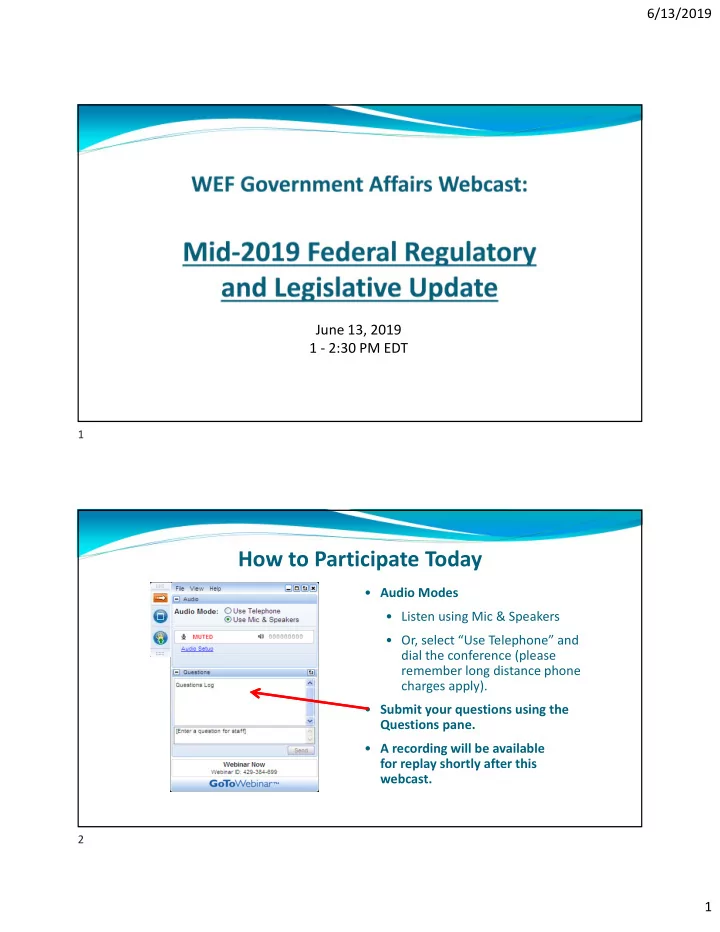
How to Participate Today

  • Audio Modes
  • Listen using Mic & Speakers
  • Or, select “Use Telephone” and

dial the conference (please remember long distance phone charges apply).

  • Submit your questions using the

Questions pane.

  • A recording will be available

for replay shortly after this webcast.

1 2

slide-2
SLIDE 2

6/13/2019 2

Agenda

 Introduction  Regulatory Update – Claudio Ternieden, Senior Director, & Dr. Patrick

Dube, WEF

 Water Reuse Effort – Jeff Lape, US EPA Office of Science and Technology  Peak Wet Weather Rulemaking – Chris Kloss, US EPA Office of

Wastewater Management

 Affordability Report – Janet Clements, Corona Environmental Consulting  Legislative Update – Steve Dye, Legislative Director, WEF  Q&A

Regulatory Topics

PFAS & Biosolids Update – Dr. Patrick Dube Methods Update Rule for Analysis of Effluent Coliphage Criteria Chlorides Criteria Other

3 4

slide-3
SLIDE 3

6/13/2019 3

Version 2.4 – June 12, 2019 Do Not Quote or Cite

DEVELOPMENT OF A DRAFT NATIONAL WATER REUSE ACTION PLAN

JUNE 12, 2019

Agenda

  • Draft National Water Reuse Action Plan (WRAP) Context
  • Building the Draft Action Plan
  • Preliminary Ideas
  • Working Schedule and Next Steps
  • Discussion/Questions/Brainstorming

Version 2.4 – June 12, 2019 Working Draft ‐ Do Not Quote or Cite

6

5 6

slide-4
SLIDE 4

6/13/2019 4

WHAT IS THE DRAFT NATIONAL WATER REUSE ACTION PLAN? THE “WRAP” “The Water Reuse Action Plan will seek to foster water reuse as an important component of integrated water resource management. EPA will facilitate discussions among federal, state, and water sector stakeholders and form new partnerships to develop and deploy the plan. A draft of the plan is scheduled for release and public review in September at the Annual WateReuse Symposium in San Diego.”

– Press Release, February 27, 2019

Water Reuse Action Plan (WRAP) Announcement

Version 2.4 – June 12, 2019 Working Draft ‐ Do Not Quote or Cite

8

7 8

slide-5
SLIDE 5

6/13/2019 5

EPA Seeks Public Input for Development of National Water Reuse Action Plan

“The EPA is seeking public input on the development of an action plan to accelerate the application of water reuse as a safe, reliable, and sustainable way to meet the country’s current and future water demands .” “To facilitate public input... EPA released a Discussion Framework...which provides helpful background...” “EPA will accept public input...through July 1, 2019...” – Press Release, April 18, 2019

Discussion Framework Posted and Docket Open

Version 2.4 – June 12, 2019 Working Draft ‐ Do Not Quote or Cite

9

Discussion Framework (4-18-19)

Version 2.4 – June 12, 2019 Working Draft ‐ Do Not Quote or Cite

10

  • Vision
  • Business Case - Impetus for Action
  • Use Cases – Possible Examples of Types and Fit-for-Purpose Applications of Water Reuse
  • Examples of Efforts Potentially Related to a Water Reuse Action Plan
  • Potential Areas of Focus

— Technological Improvements — Regulatory/Policy Aspects at All Levels of Government — Financing

  • Example Collaborators and Potential Owners of Actions in a Water Reuse Action Plan
  • The EPA Water Reuse Team
  • Informing Development of the Water Reuse Action Plan
  • Water Reuse and Related Forums
  • Relevant Published Literature

— Fit for Purpose — Information about Water Use and Availability — Outreach Opportunities

9 10

slide-6
SLIDE 6

6/13/2019 6

  • Water reuse includes other common terms including: recycled water,

reclaimed water, alternative water supplies, improved water reliability and water resource recovery.

  • Source water for reuse can include municipal wastewater, industry process

water, stormwater, agriculture runoff and return flows, oil and gas produced water, and cooling water.

  • These source waters are reused after they are appropriately treated to meet

“fit for purpose specifications” for a particular end use.

  • Examples of reuse applications include: agriculture and irrigation, potable

water supplies, groundwater replenishment, industrial processes, and environmental restoration.

  • For purposes of this draft WRAP, seawater desalination is not included.

What is the Scope of ‘Water Reuse”?

Version 2.4 – June 12, 2019 Working Draft ‐ Do Not Quote or Cite

1. Advance consideration of water reuse as part of integrated water resources management to support water resiliency, sustainability, and security. 2. Assure public health and environmental protection. 3. Build on the extensive experience, literature, and research that already exists. 4. Use real-life examples of water reuse to inform and serve as models to replicate. 5. Encourage new levels of integration, coordination, and partnerships. 6. Enable more profound progress on water resources protection at the watershed scale. 7. Identify transformative actions at the federal, state, and watershed/community level. 8. Call for Action to create momentum for long-term commitments and action.

Water Reuse Action Plan – Guiding Principles/Goals

Version 2.4 – June 12, 2019 Working Draft ‐ Do Not Quote or Cite

12

11 12

slide-7
SLIDE 7

6/13/2019 7

HOW ARE WE BUILDING THE DRAFT ACTION PLAN?

Version 2.4 – June 12, 2019 Working Draft ‐ Do Not Quote or Cite

Our Working Approach

  • Built a “Discussion Framework” to Create the Water Reuse Context

—Extensive vetting across the water sector —Posted to EPA website on April 18

  • Distill Ideas and Potential Actions from Different Sources

—Docket - Collecting Public Input and Ideas (through July 1, 2019) —Literature Review and Synthesis —Participation in Existing Outreach Forums —WateReuse Association Convenings and Report —International Experiences

  • Identifying Unique and Compelling Examples of Water Reuse (Case Studies)
  • Identify Possible Actions

—Criteria to Assess Action Impact and Utility

Version 2.4 – June 12, 2019 Working Draft ‐ Do Not Quote or Cite

14

13 14

slide-8
SLIDE 8

6/13/2019 8

Federal Partner Profiles

  • Example attributes:

—Overall Mission —Current Water reuse roles and actions —Reuse partners and stakeholders —Points of contact

  • Communication Tool for Externals
  • Basis for Enhanced Integration and

Discussion of New Action

Version 2.4 – June 12, 2019 Working Draft ‐ Do Not Quote or Cite

15

WRAP Quick Stats To Date

Version 2.4 – June 12, 2019 Working Draft ‐ Do Not Quote or Cite

115 Pieces of literature reviewed 17 Federal partner agencies engaged 10 Public forums attended 37 External stakeholder meetings conducted >500 Action ideas identified:

  • >200 from stakeholder meetings
  • >300 from literature review

10 Docket comments received

16

15 16

slide-9
SLIDE 9

6/13/2019 9

Example Outreach and Engagement Forums

Version 2.4 – June 12, 2019 Working Draft ‐ Do Not Quote or Cite

17

Water Reuse Association Convenings

  • Los Angeles, CA (April 18)

—45 attendees, including EPA and USDA-NRCS —Identified over 500 ideas, potential actions, and problems to be solved —Spectrum of use applications (e.g., agriculture, industrial, nonpotable, potable)

  • Alexandria, VA (May 9)

—60 attendees, including EPA, USDA-NRCS, DoE, and FDA —Refining ideas from 1st session and outlined criteria —Convening report expected be posted to the public docket

Version 2.4 – June 12, 2019 Working Draft ‐ Do Not Quote or Cite

18

17 18

slide-10
SLIDE 10

6/13/2019 10

WATER REUSE ACTION PLAN CONTENT: PRELIMINARY IDEAS

  • Length – Less than 30 pages

—Appendices online

  • Inclusive...not exclusively a Federal action plan
  • Action Characteristics

—New and transformative; not an assembly of existing actions —Short, middle, and long term time scale —Reflect the spectrum of partners —Different scales of action: Federal, regional, state, tribal, local, watershed —Geographic diversity —Reflects the full spectrum of water reuse experience and implementation status

  • Encourages leadership, program coordination, and integration
  • Call for Action - Motivates, excites, prompts passion and ideas

Water Reuse Action Plan – Working Ideas of Attributes and Characteristics

Version 2.4 – June 12, 2019 Working Draft ‐ Do Not Quote or Cite

20

19 20

slide-11
SLIDE 11

6/13/2019 11

Draft WRAP Outline

Section 1.0 - Business Case for a National Water Reuse Action Plan

—Section 1.1 - Drivers and Needs for Water Reuse —Section 1.2 - The Opportunity to Reuse Water —Section 1.3 - Scope and Use Cases for Water Reuse —Section 1.4 - Reuse in the Context of Integrated Water Resources Management —Section 1.5 - Public Health & Environmental Considerations —Section 1.6 - Reflections from our International Partners —Section 1.7 - The Building of the Draft WRAP

Version 2.4 – June 12, 2019 Working Draft ‐ Do Not Quote or Cite

21

Draft WRAP Outline (cont.)

Section 2.0 - Actions to Support Considerations of Water Reuse in the Context of IWRM —Section 2.1 -– Enable Integrated and Collaborative Action at the Watershed/Basin Scale —Section 2.2 -– Coordinate and Integrate Federal, State, and Tribal Policies to Support Water Reuse —Section 2.3 -– “Fit for Purpose Specifications” to Protect Public Health, Environment and User Needs —Section 2.4 -– Promote Treatment Technology Development, Deployment, and Validation —Section 2.5 -– Improve Access to and Availability of Water Information (Quality and Quantity) —Section 2.6 -– Enable Financial Support for Water Reuse —Section 2.7 -– Integrate and Coordinate Research on Water Reuse —Section 2.8 -– Facilitate Development of Outreach and Communication Materials that Engender Public Understanding and Acceptance of Water Reuse —Section 2.9 -– Develop Water Reuse Metrics that Create Goals and Measure Progress toward Greater Use of Water Reuse to Achieve Water Sustainability, Security and Resilience

Version 2.4 – June 12, 2019 Working Draft ‐ Do Not Quote or Cite

22

21 22

slide-12
SLIDE 12

6/13/2019 12

Example Types of Actions

1) Technological improvements 2) Policies to address barriers and create incentives 3) Financing enhancements 4) Performance metrics 5) Water information use and availability 6) Public communication and outreach on water reuse

Example Technological Improvement Monitoring and Sensors – Promote development of a new generation of monitoring technologies to collect real- time, robust, quality data to verify that reuse water meets “fit-for-purpose” quality specifications

Version 2.4 – June 12, 2019 Working Draft ‐ Do Not Quote or Cite

23

Early Action Ideas – Potential Examples

  • Apply source control measures (e.g., Pretreatment Program) to protect

water reuse end product quality

  • Enhance pharmaceutical take back programs to discourage disposal of

spent pharmaceuticals and drugs to municipal sewer and private

  • nsite septic systems
  • Assess and integrate water reuse research across the federal and

water sector to optimize its utility and identify critical research gaps

  • Clarify NPDES permit applicability/approaches to recognize reuse
  • Build a compendium of available federal funding sources that can be

used for water reuse

  • Acknowledge water reuse eligibility in Federal funding
  • Compile existing thresholds for water reuse fit-for-purpose

specifications for the spectrum of available end uses.

  • Facilitate State dialogues and compile example State approaches

Example Action Attributes:  Champion  Partners/collaborators  Feasibility  Impact  Significance and Anticipated Outcome  Key Implications  Timeline and Milestones

Version 2.4 – June 12, 2019 Working Draft ‐ Do Not Quote or Cite

24

23 24

slide-13
SLIDE 13

6/13/2019 13

Example Action ‐ Federal Policy on IWRM

  • Frames the importance of federal policies and programs which are

coordinated and integrated to support consideration of water reuse

  • Inset box presents draft policy statement:

—The federal government supports a basin/regional scale integrated water resources management (IWRM) approach developed at the local user level to meet the water needs of sectors including agriculture, industry, drinking water, and ecosystem protection. An integrated approach commonly involves a combination of water management strategies (e.g., water supply development, water storage, water use efficiency, and water reuse) and engages multiple stakeholders and needs, including the needs of the environment.

Version 2.4 – June 12, 2019 Working Draft ‐ Do Not Quote or Cite

25

WRAP Element – Reuse Case Studies

  • Showcase a variety of geographically diverse reuse

applications (e.g., industrial, agricultural, environmental) at a range of scales Key Interests:

—How did the action happen? —Key learnings

  • Examples

—Monterey One Water (CA) —Big Spring (TX) Example attributes:  Compelling story  Successful approaches  Barriers overcome  Lessons/best practices

Version 2.4 – June 12, 2019 Working Draft ‐ Do Not Quote or Cite

26

25 26

slide-14
SLIDE 14

6/13/2019 14

WORKING SCHEDULE AND NEXT STEPS

Working Timetable for Draft WRAP Development

Version 2.4 – June 12, 2019 Working Draft ‐ Do Not Quote or Cite

Action Scheduled Date Completed Date

Press Release and Announcement of Development of Draft Water Reuse Action Plan

  • 2/27

Press Release with Discussion Framework and Public Docket Opening 4/18 WateReuse Association Convening 4/18 and 5/9 4/18 and 5/9 Federal Partner Convening #1 5/10 5/10 Annotated Outline & Early Action Examples 5/22 5/20 Federal Partner Convening #2 5/31 5/31 Compilation of Ideas/Actions from the Literature 6/7 Federal Partner Convening #3 6/21

  • Docket Closes

7/1

  • First Draft

7/10

  • Federal Partner Convening #4

8/9

  • FRN Package for Review and Signature

8/28

  • Federal Register publishes notice and Draft WRAP goes live on Docket

9/3 to 9/6

  • Presentation and Overview of Draft WRAP at WateReuse Conference

9/8

  • 28

27 28

slide-15
SLIDE 15

6/13/2019 15

Water Reuse Portal – Public Input and Updates

  • Website:

https://www.epa.gov/waterreuse/water

  • reuse-action-plan

—Repository for ongoing public and stakeholder input —Relevant updates on WRAP development —Forecast external engagement forums —Forum to post the draft Action Plan

Version 2.4 – June 12, 2019 Working Draft ‐ Do Not Quote or Cite

29

DISCUSSION/NEXT STEPS

29 30

slide-16
SLIDE 16

6/13/2019 16

Discussion

  • Feedback on working organization and themes in the WRAP Outline?
  • Any particularly good outreach and engagement forums we should be aware of?
  • What are the key criteria to assess potential actions against?
  • How do we assure a balanced WRAP?

—Geographic balance and diversity —Sector balance and diversity —Timescale – short, mid and long term actions —Securing actions from a range of partners/stakeholders

  • Identify particularly unique and compelling examples of water reuse?
  • Communication prior to release?
  • Ideal timing for release?

Version 2.4 – June 12, 2019 Working Draft ‐ Do Not Quote or Cite

31

Peak Wet Weather Flow Rulemaking

Chris Kloss

Chief, Municipal Branch – Water Permits Division US EPA Office of Water

31 32

slide-17
SLIDE 17

6/13/2019 17

Janet Clements, Senior Economist, Corona Environmental Consulting

Developing a New Framework for Household Affordability and Financial Capability Assessment in the Water Sector

 WEF, AWWA, and NACWA  Consultant team: Raftelis, Corona Environmental Consulting, and the

Galardi Rothstein Group Hyperlink ‐‐ http://bit.ly/developing‐new‐framework‐for‐affordability‐report‐final

Objectives

 Develop new framework for household affordability and financial

capability assessment

 Provide alternative to Median Household Income as a singular

measure of household affordability in regulatory decision‐making.

 WEF, AWWA, & NACWA hope the report will assist U.S. EPA in

reviewing and modifying its existing affordability policies.

33 34

slide-18
SLIDE 18

6/13/2019 18

Guiding Criteria

Framework should:

 Reflect all/combined water service costs  Reflect the households that are most economically challenged  Reflect local essential costs of living

Report Key Findings

 No household affordability metric is “perfect or clearly better in

every respect.”

 Permittees should be allowed and encouraged to provide

supplemental metrics/information

 Additional analysis is needed to assess the benchmarks associated

with the recommended metrics

 Affordability also requires considering the water system’s financial

capability, meaning its ability to reliably provide service and make necessary improvements over time.

35 36

slide-19
SLIDE 19

6/13/2019 19

Report Recommendations

Two‐part metric to capture household burden and the level of economic stress on households in a community:

 Household Burden Indicator (HBI): Cost of basic water service (i.e.

drinking water, wastewater, and stormwater) as a percent of the 20th percentile of community household income (lowest quintile income)

 Poverty Prevalence Indicator (PPI): Percentage of households in the

community at or below 200% of federal poverty level.

Legislative Update

Infrastructure Package CW SRF Reauthorization FY20 Appropriations Other Key Legislation and Policy Items

37 38

slide-20
SLIDE 20

6/13/2019 20

Water Quality Protection and Job Creation Act of 2019 (H.R. 1497)

Sponsor: Chairman Peter DeFazio (D‐OR) Co‐sponsors: Grace Napolitano (D‐CA), Don Young (R‐AK), and John Katko (R‐NY)

The key provisions of the bill include (FY20 – 24):

 Clean Water SRF reauthorized at $4B/year  State management assistance at $300M/year  Watershed pilot projects at $120M/year  Redefines "alternative water source projects" as wastewater, stormwater, or by

treating wastewater or stormwater and authorizes $75M/year

 Extends authorization for grant assistance for sewer overflow and stormwater

reuse projects from 2020 to 2024.

Fiscal Year 2019 Appropriations

Program FY18 Omnibus FY19 Omnibus

  • Pres. FY20

House FY20 Draft FY20 Ask Function Clean Water SRF $1.7B $1.7B $1.1B $1.8B $2.8B

Wastewater & Stormwater Loans

Drinking Water SRF $1.2B $1.2B $863M $1.3B $1.3B

Drinking Water Loans

WIFIA $63M $68M $25M $45M $50M

All Water Infrastructure Loans

USDA Loans & Grants $1.06B $2.02B $1.7B NA $2.5B

Rural Communities Loans and Grants

Title XVI $54M $59M $3M $67M $100M

Western US Water Recycling and Reuse

AWIA – Sect. 221 Grants $61M $90M $450M

Grants for CSO, SSO, and SW Infrastructure

39 40
slide-21
SLIDE 21

6/13/2019 21

Other Key Legislative and Policy Items

  • Stormwater Infrastructure Funding Task Force
  • Grants ($1M/yr) for water workforce development
  • Grants ($25M/year for 2 years) to non‐profit entities for technical

assistant to POTWs

  • Emergency Supplemental included:
  • $53.3 million for Clean Water SRF
  • $296 million for Drinking Water SRF
  • H.R. 1764 – NPDES permit terms extension legislation

Water Advocates Program

 WEF.org – Advocacy tab  New Website:

 http://wef.org/advocacy/water‐

advocates2/  Joining the Program is easy:

 http://wef.org/advocacy/water‐

advocates2/

41 42

slide-22
SLIDE 22

6/13/2019 22

Questions or Additional Info:

WEF

 Claudio Ternieden

  • Sr. Dir. of Government Affairs

cternieden@wef.org

 Steve Dye

Legislative Director sdye@wef.org

 Amy Kathman

Government Affairs Manager akathman@wef.org

43