How to Participate Today Audio Modes Listen using Mic & S - - PDF document

how to participate today
SMART_READER_LITE
LIVE PREVIEW

How to Participate Today Audio Modes Listen using Mic & S - - PDF document

7/12/2018 How to Participate Today Audio Modes Listen using Mic & S peakers Or, select Use Telephone and dial the conference (please remember long distance phone charges apply). Submit your questions using


slide-1
SLIDE 1

7/12/2018 1

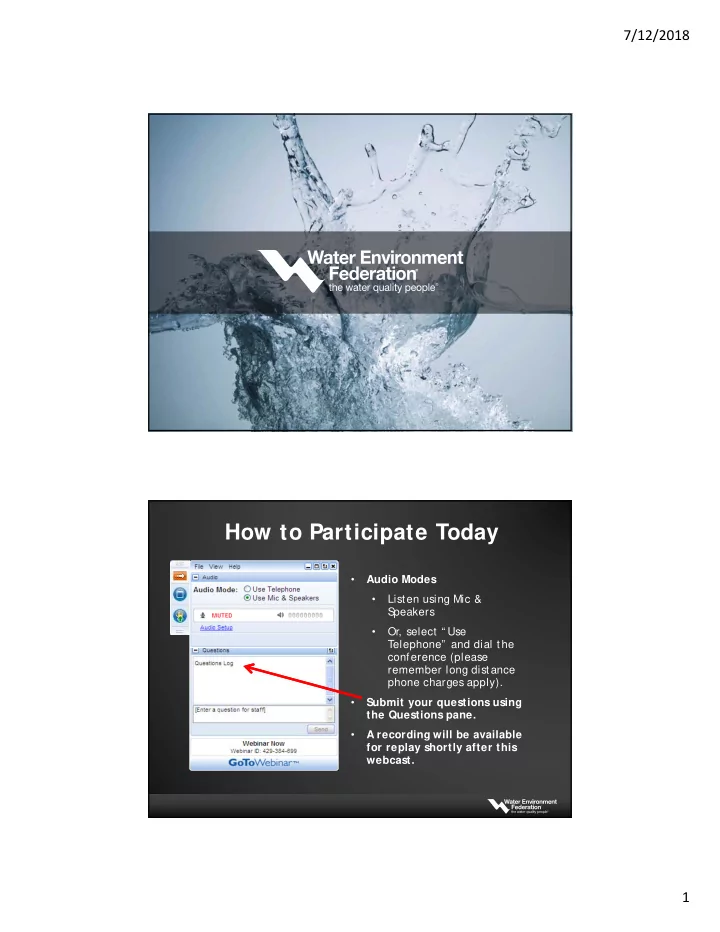
How to Participate Today

  • Audio Modes
  • Listen using Mic &

S peakers

  • Or, select “ Use

Telephone” and dial the conference (please remember long distance phone charges apply).

  • Submit your questions using

the Questions pane.

  • A recording will be available

for replay shortly after this webcast.

slide-2
SLIDE 2

7/12/2018 2

Smart Water Technologies: An Overview of Real World Applications

Thursday July 12 2018 1:00 – 3:00 PM ET

Today’s Moderator

Elkin Hernandez

slide-3
SLIDE 3

7/12/2018 3

  • Joshua Cantone & Jack Chan
  • MWRDGC’s Outcome Driven Approach to S

tormwater Planning

  • Prateek Joshi
  • Operational Analytics for Water Treatment Plants
  • Reese Johnson
  • S

mart S ewers: Using Technology to Improve Wet Weather Operations

Today’s Speakers Our Next Speakers

Joshua Cantone, Ph.D. Jack Chan, Ph.D., P .E.

slide-4
SLIDE 4

7/12/2018 4

MWRDGC’s Outcome Driven Approach to Stormwater Planning

Joshua Cantone, Ph.D. Jack T .P . Chan, Ph.D., P .E.

Demystifying Artificial Intelligence

slide-5
SLIDE 5

7/12/2018 5

An industry word jumble

  • Artificial Intelligence
  • S

mart Networks

  • Intelligent S

ystems

  • Black Box
  • Decision S

upport S ystem

  • Big Data
  • Data Analytics
  • Predictive Analytics
  • Optimization
  • S

mart Water

Demystifying AI…

  • Artificial intelligence is perhaps the best
  • verarching term – optimization is a part of that
  • Two types of AI – narrow (weak) and strong
  • Narrow: non sentient machine intelligence used for

a narrow task

  • S

trong: sentient machine intelligence with consciousness and mind

“STRONG AI” “NARROW AI”

slide-6
SLIDE 6

7/12/2018 6

Real world examples

  • Artificial Neural

Networks

  • Fuzzy Logic
  • Evolutionary Algorithms

In the water industry…

  • Partial Enumeration
  • Best engineering

j udgement

  • Linear, Non-linear, or

Dynamic Programming

  • Linear equation to be

maximized or minimized

  • Linear constraints
  • Examples: Water

resources allocation

slide-7
SLIDE 7

7/12/2018 7

In the water industry…

  • Evolutionary Algorithms
  • Based on nature, population

based approach

  • Examples: Off-line planning

for water distribution systems and wastewater collection systems

  • Artificial Neural Networks
  • Learn from big data in order

to predict or detect events

  • Examples: pipe breaks, flow

prediction, etc.

A burgeoning space…

slide-8
SLIDE 8

7/12/2018 8

AI (Optimization) for Smart Planning

  • Optimization is…
  • applying an analytic process to find the best solution to a problem that has many

possible solutions

  • transparent, unbiased and adaptive approach
  • Optimization is not…
  • black box

Meta-heuristics Inspired by Nature

slide-9
SLIDE 9

7/12/2018 9

Simple Example

Upstream S ewershed Collection S ystem Downstream Waterway Can we reduce Infiltration and Inflow? Design Criteria

  • S

urcharge

  • Velocity
  • Overflow

Costs

  • Capital costs
  • Operating costs
  • Lifecycle Costs

S cenarios

  • Existing/ future demands
  • S

torm events

  • Limited options

New S torage, Pump S tation, S atellite Treatment New pipes. Where? How big? WWTP

Optimization

Planner sets capital improvement and operating

  • ptions and objectives to be met

Creates and evaluates thousands

  • f trial solutions

Evaluate Costs Evaluate Hydraulic Performance and Key Criteria (e.g Risk, Environmental, Social)

Traditional Planning Approach

Trial and error process to develop CIP and operating plans. Only limited number of alternatives can be evaluated and vetted

Find the best solutions to a problem that has many possible outcomes Optimizer™ Approach

Level of Service

Frustrating ? ? ?

slide-10
SLIDE 10

7/12/2018 10

MWRDGC’s Outcome-Driven and Adaptive Approach to Stormwater Planning

MWRDGC Background

  • 2004 the authority for general supervision of stormwater management in

Cook County was conveyed to the District by the Illinois S tate legislature.

  • 2011 Detail Watershed Plans (DWPs) completed for the 6 maj or watersheds
  • f Cook County – Cal-S

ag Channel, Litt le Calumet River, Lower Des Plaines, North Branch of the Chicago River, Poplar Creek, and Upper S alt Creek.

  • Phase I proj ects were identified from the DWPs to address overbank

flooding “ riverine flooding”

  • 2014 the District’s authority was amended to allow for flood-prone

property acquisition and to plan, implement, finance, and operate local stormwater management proj ects.

  • Phase II proj ects involves working with local communities and agencies to

address local drainage problems.

slide-11
SLIDE 11

7/12/2018 11

Stormwater Masterplan Pilots

  • Pilot study areas identified by

four Councils of Government and the City of Chicago

  • S

tudy areas comprised of both separate or combined sewer areas

  • Goal was to identify solutions

to flooding of structures experienced in storms up to and including a 100-year event

slide-12
SLIDE 12

7/12/2018 12

Approach of the Studies

  • Analysis of existing overland flooding and basement backup issues,

including detailed (H&H) modeling of flooding issues and alternative solutions

  • Minimize basement flooding and surface flooding by:
  • Balancing gray and green infrastructure
  • Implementing backflow prevention
  • Outcome driven
  • S
  • ught input from local municipalities, other stakeholders, and

general public through questionnaires, public workshops, and other

  • utreach tools to get full understanding of flooding impacts, and to

identify preferences for green, gray, and/ or private property solutions

  • Public outreach effectiveness was also measured to evaluate the

change in public attitude and willingness to participate in stormwater solutions

City of Chicago (Southeast Side) Pilot - GEOSYNTEC

slide-13
SLIDE 13

7/12/2018 13

11

Study Area

  • 17 square miles
  • 493 catchments
  • 4 major sewersheds
  • 44,053 structures

(excludes garages)

Structures flooded:

  • 5 yr: 25,466 (58%)
  • 25 yr: 32,610 (74%)
  • 100 yr: 41,188 (93%)

Sıngle;Fàmilÿ ( d è v ê !

  • p

e d ) 6% Industriãl ROW Mùlti'Fãmilÿ Open Space 2'X›

slide-14
SLIDE 14

7/12/2018 14

  • 5 year level of

service (only)

  • Northern portion of

Area 4 (only)

  • Structures

removed: 27,131

  • Preliminary

estimate: $255M +

Conceptual Tunnel Alternative

GI Tool Box

slide-15
SLIDE 15

7/12/2018 15

  • Performed intense screening of

GI applicability within the study area

  • Identify viable GI practice

alternatives for urban landscape of Chicago

  • Determine maximum extent of

GI implementation

  • Associated GI practices with

each land use category (defined in model)

Screening

Summary of Unit Cost Estimates and Model Input Unit Costs

**Unit cost of $20/square foot was selected for green roofs based on information provided by local green roof installation companies— Omni Ecosystems and LiveRoof. GI Practice Units Low (-30%) Cost Estimate Model Input Cost Estimate Actual Cost Estimate High (+50%) Cost Estimate P1 Pervious Pavement (Commercial, Industrial, and Institutional) SF $21 $25 $34 $46 P2ƒP3 Pervious Pavement (Roadway ROW and Residential Alleys) SF $20 $24 $32 $45 B1 Bioretention (ROW) SF $29 $35 $45 $62 B2 Bioretention (Commercial, Industrial, and Institutional) SF $18 $22 $27 $38 B3 Bioretention (Residential) SF $19 $23 $31 $43 C1 Aboveground Cisterns on Residential Properties CF $55 $66 $85 $117 C1 Below-Ground Cisterns on Residential Properties CF $75 $90 $100 $150 C1 Alleyway Concept #1—Below-Ground Aluminized CMP with Asphalt Pavement CF $62 $74 $97 $132 C1 Alleyway Concept #2—Below-Ground ChamberMaxx Storm Arch with Asphalt Pavement CF $30 $36 $47 $65 C1 Alleyway Concept #3—Below-Ground ChamberMaxx Storm Arch with Pervious Pavement CF $35 $42 $55 $75 C1 Alleyway Concept #4—Below-Ground StormTrap with Asphalt Pavement CF $44 $53 $69 $94 C2 Cisterns (Commercial) CF $13 $16 $20 $28 G1 Green Roof (Commercial, Industrial, and Institutional) SF $8 $20 $10 $16

slide-16
SLIDE 16

7/12/2018 16

  • Direct representation of GI in combined sewer model
  • Converted City’s trunk sewer model from InfoWorks to SWMM and

incorporated GI into the SWMM model

  • Allowed direct comparison of green vs gray performance
  • Optimization of GI types, coverage, and placement locations
  • 70,000+ combinations (comparing performance & cost)
  • Evaluated targeted scenarios (implementation strategies)

Modeling Approach

53

Total Structures: 44,053 Structures flooded: 73% Cost: $255M Structures flooded: 11% Cost: $1,114M $255M (tunnel) + $809M (GI) + $50M (back flow)

25-Year Storm Event

Tunnel Tunnel + Optimized GI

slide-17
SLIDE 17

7/12/2018 17

Total Structures: 44,053 Structures flooded: 41,188 (93%) Cost: $255M Structures flooded: 32% Cost: $1,114M $255M (tunnel) + $809M (GI) + $50M (back flow)

100-Year Storm Event

Tunnel Tunnel + Optimized GI

Optimizing GI Placement – 25 year

Maximum GI Optimized GI

Structured flooded: (1% ) Cost: $1,752M Structured flooded (11% )

Cost: $1,114M

slide-18
SLIDE 18

7/12/2018 18

Findings

  • Traditional solutions can lack resiliency
  • GI is effective & placement can be optimized

Next Steps – Stormwater Master Planning

  • Evaluate Master Planning needs throughout Cook

County

  • Develop outcome-driven but adaptive approach,

centered on managing local stormwater issues with multi-disciplined teams

  • Establish logical watershed/ sewershed based study

areas and prioritization

  • Create a guidance document to guide master planning

for each study area

slide-19
SLIDE 19

7/12/2018 19

Our Next Speaker

Prateek Joshi

Operational Analytics for Water Treatment Plants

Prateek Joshi CEO, PLUTO AI prateek@ plutoai.com

slide-20
SLIDE 20

7/12/2018 20

Who am I?

Founder of PLUTO AI. Launched in Mar 2016. Author of 8 books on Artificial Intelligence Affiliations: WEF, WE&RF, AWWA, LIFT, TAG

Problem

Energy is the largest expense of operating a treatment plant. No access to data intelligence to reduce the energy consumption.

slide-21
SLIDE 21

7/12/2018 21

Why is it a problem?

Operating reactively as opposed to proactively No info on the future operating conditions of the plant Compliance requirements force treatment plants to make conservative decisions, leading to higher

  • perating costs.

Solution

Real-time operational analytics that can provide operational parameters to maximize throughput and minimize compliance risk, thereby increasing energy efficiency.

slide-22
SLIDE 22

7/12/2018 22

What can AI do?

Extract wisdom from treatment plant data in real time Perform scenario planning based on future conditions Provide step-by-step operational insights

How does AI do that?

It learns the behavior of the plant using historical data It predicts the future conditions It forecasts the values of key operational parameters It performs scenario planning to choose the best path

slide-23
SLIDE 23

7/12/2018 23

Terms (mis)used in the field

Artificial Intelligence is the goal Machine Learning is a vehicle to get there Deep Learning is a type of vehicle that’s fast, winged, and self-driving.

Data requirements for AI

AI needs historical data to learn about the plant’s behavior and build a model AI needs real-time data to predict the future behavior based on the above model

slide-24
SLIDE 24

7/12/2018 24

Deploying AI at a plant

Operators need information that’s actionable The information needs to be accurate Always need to be compliant

Data-centric simulations

Simulations built on static equations only work under ideal

  • conditions. What about real world scenarios?

Need to use data-centric simulations to understand all the future possibilities and pick the best one.

slide-25
SLIDE 25

7/12/2018 25

Digital Twin

Digital equivalent of a physical asset or a process Digital Twin can be used for scenario planning It enables us to visualize multiple future scenarios by varying key input variables

More water with less energy

Key metric: Energy spent per gallon produced Need to correlate data to this metric and build models Computational modeling of energy systems is critical

slide-26
SLIDE 26

7/12/2018 26

Reducing energy footprint

Finds key performance indicators by sifting through data Can find the right values for the parameters to reduce energy footprint for that process

Membrane analytics

Membrane systems like RO Membranes and MBR are energy intensive AI can find the optimal values for operational parameters like driving pressure, permeability, cleaning schedule, lifecycle impact, and more. AI can provide operational oversight to help the

  • perators ensure that there are no shocks in the system
slide-27
SLIDE 27

7/12/2018 27

AI vs. Excel

Excel can’t predict future conditions Excel can’t build simulations Excel can’t learn and adapt

  • Predict. Forecast. Simulate.

Predict the occurrence of an event Forecast the future values of parameters Simulate various events for scenario planning

slide-28
SLIDE 28

7/12/2018 28

Generic AI vs. water AI

One-size-fits-all approach doesn’t work in water. We need AI models that are specifically trained to understand the behavior of water treatment systems

Key takeaways

AI takes real-time plant data and converts it to wisdom AI finds optimal values for key operational parameters AI does scenario planning using data-centric simulations

slide-29
SLIDE 29

7/12/2018 29

THANK YOU

Prateek Joshi CEO, PLUTO AI prateek@ plutoai.com

Our Next Speaker

Reese Johnson, PE, PMP

slide-30
SLIDE 30

7/12/2018 30

Smart Sewers: Using Technology to Improve Wet Weather Operations

Reese Johnson, PE, PMP Metropolitan Sewer District of Greater Cincinnati

Metropolitan Sewer District of Greater Cincinnati, Ohio

  • 800,000+ Residents of

Cincinnati and Hamilton County

  • 290 S

quare Miles

  • 7 Treatment Plants
  • 100+ Pump S

tations

  • 3,000 Miles of S

ewers, Both S anitary and Combined

  • 184 MGD on Dry Days
slide-31
SLIDE 31

7/12/2018 31

The Challenge of Wet Weather

S

  • uthwest Ohio receives

41 inches of rain

per year… Results in approximately

11 billon gallons of

  • verflow in a typical year

Led to a $3.2B Consent

Decree to address the 200+

  • verflow points through:
  • Pipe Upsizing, S

torage

  • S

trategic S eparation

  • Green Infrastructure
  • Dedicated WW Facilities

What if…

… we could use all the conveyance capacity in our pipes before we had a combined sewer overflow? ....we could use a remote storage tank to reduce overflows many miles away? … .we could use real-time information to prioritize treatment?

Could we achieve the same, or better, environmental benefit and build less new infrastructure?

slide-32
SLIDE 32

7/12/2018 32

Cloud-based SCADA Enables a Smart(er) Sewer

Live Data Analysis Historical

WWTPs Flow Monitors Level Sensors Rain Gauges Remote Facilities Stream Gages

  • Improves Treatment

Plant Operations

  • Reduces Overflows

from the Collection S ystem

  • Improved Watershed

Protection

“Smart Sewer” Achieves Results Without Additional Construction

slide-33
SLIDE 33

7/12/2018 33

Improved Ops by Projecting Future Flows to WWTP

Historic Future

Reduced Overflows using a Distant Facility

Mill Creek WWTP

1.4 MG discharge prevented on one day

16 Miles Ohio River in flood stage

slide-34
SLIDE 34

7/12/2018 34

  • 4. Dams Modulate to

Maintain a S afe S torage Level

  • 2. Dams Deflate to Avoid

Upstream Flooding

  • 3. Dams Remotely Reset

by Watershed Operations

  • 1. WW

Flow Begins

… And through Remote Control

Overflow Reduced by 178 MG during a single storm

Prohibiting High Strength Discharge Upstream

  • 1. S

ewer begins to

  • verflow
  • 2. Restricted

Conditions S et in S CADA

  • 3. Visual

S ignal Activated at Customer’s Facility

  • 4. Texts and

emails sent to Drivers, Guards, Operators, etc.

slide-35
SLIDE 35

7/12/2018 35

Quantified Early Benefits of the Wet Weather SCADA System

2.31 1.36 2.65 1.81 2015 2016 Billion Gallons Captured Without WW S CADA With WW S CADA

2-year study of 4 Wet Weather Facilities: 15% improvement with addition of real- time monitoring capabilities 33% improvement with real-time

Smart Sewers Make Dollars and Sense

1.00 0.40 0.23 0.03 0.01

$/gallon

Treat S tore S

  • urce Control

Real Time Control Optimize

At approximately

1¢/gal, the cost

  • f operational
  • ptimization is

significantly less than the typical price point for new wet weather infrastructure

slide-36
SLIDE 36

7/12/2018 36

Reese Johnson, PE, PMP Principal Engineer, MSDGC reese.johnson@ cincinnati-oh.gov

Cincinnati’s Smart Sewers Questions?