
SLIDE 1
How to do research
March 6, 2013 Bill Freeman, CSAIL, MIT Computer Science and Artificial Intelligence Laboratory Massachusetts Institute of Technology The jump from problem sets to research can be hard. We sometimes see students who ace their classes struggle with their research. In little bites, here is what I think is important for succeeding in research as a graduate student.
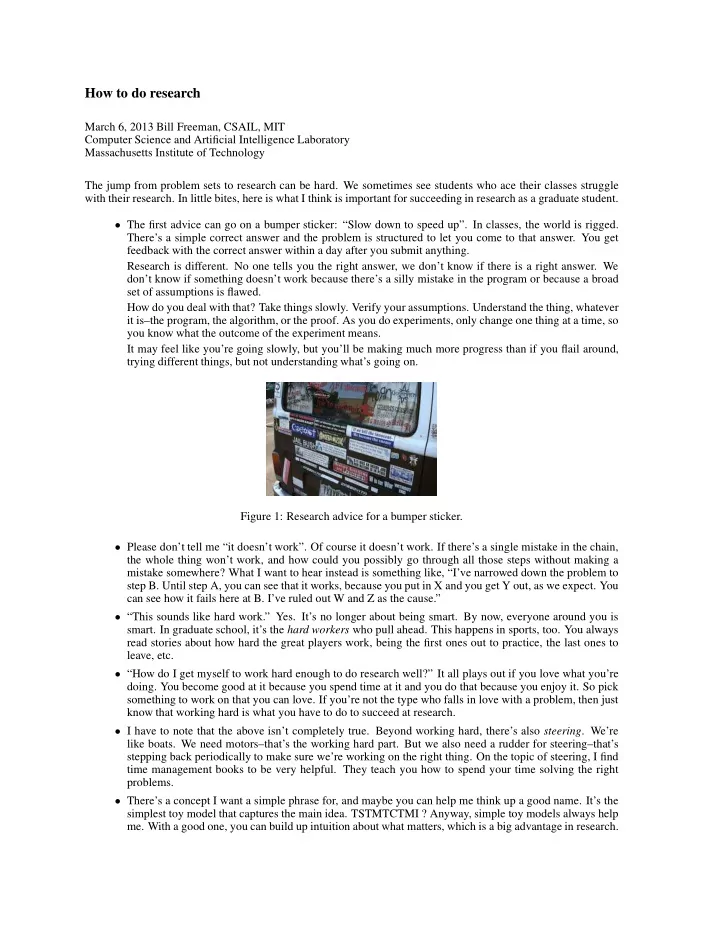
- The first advice can go on a bumper sticker: “Slow down to speed up”. In classes, the world is rigged.
There’s a simple correct answer and the problem is structured to let you come to that answer. You get feedback with the correct answer within a day after you submit anything. Research is different. No one tells you the right answer, we don’t know if there is a right answer. We don’t know if something doesn’t work because there’s a silly mistake in the program or because a broad set of assumptions is flawed. How do you deal with that? Take things slowly. Verify your assumptions. Understand the thing, whatever it is–the program, the algorithm, or the proof. As you do experiments, only change one thing at a time, so you know what the outcome of the experiment means. It may feel like you’re going slowly, but you’ll be making much more progress than if you flail around, trying different things, but not understanding what’s going on. Figure 1: Research advice for a bumper sticker.
- Please don’t tell me “it doesn’t work”. Of course it doesn’t work. If there’s a single mistake in the chain,
the whole thing won’t work, and how could you possibly go through all those steps without making a mistake somewhere? What I want to hear instead is something like, “I’ve narrowed down the problem to step B. Until step A, you can see that it works, because you put in X and you get Y out, as we expect. You can see how it fails here at B. I’ve ruled out W and Z as the cause.”
- “This sounds like hard work.” Yes. It’s no longer about being smart. By now, everyone around you is
- smart. In graduate school, it’s the hard workers who pull ahead. This happens in sports, too. You always
read stories about how hard the great players work, being the first ones out to practice, the last ones to leave, etc.
- “How do I get myself to work hard enough to do research well?” It all plays out if you love what you’re
- doing. You become good at it because you spend time at it and you do that because you enjoy it. So pick
something to work on that you can love. If you’re not the type who falls in love with a problem, then just know that working hard is what you have to do to succeed at research.
- I have to note that the above isn’t completely true. Beyond working hard, there’s also steering. We’re
like boats. We need motors–that’s the working hard part. But we also need a rudder for steering–that’s stepping back periodically to make sure we’re working on the right thing. On the topic of steering, I find time management books to be very helpful. They teach you how to spend your time solving the right problems.
- There’s a concept I want a simple phrase for, and maybe you can help me think up a good name. It’s the
simplest toy model that captures the main idea. TSTMTCTMI ? Anyway, simple toy models always help
- me. With a good one, you can build up intuition about what matters, which is a big advantage in research.