How to Develop a Strategic Plan Managing Performance Remotely - - PDF document

how to develop a strategic plan managing performance
SMART_READER_LITE
LIVE PREVIEW

How to Develop a Strategic Plan Managing Performance Remotely - - PDF document

5/13/2020 Present Present How to Develop a Strategic Plan Managing Performance Remotely Jennifer Amstutz Alan Krieger Jennifer Amstutz Alan Krieger Provided by New York State Office of Victim Services for Victim Assistance Programs


slide-1
SLIDE 1

5/13/2020 1

How to Develop a Strategic Plan

Present Alan Krieger Jennifer Amstutz

Provided by New York State Office of Victim Services

Managing Performance Remotely

Present Alan Krieger Jennifer Amstutz

for Victim Assistance Programs Funded by: New York State Office of Victim Services

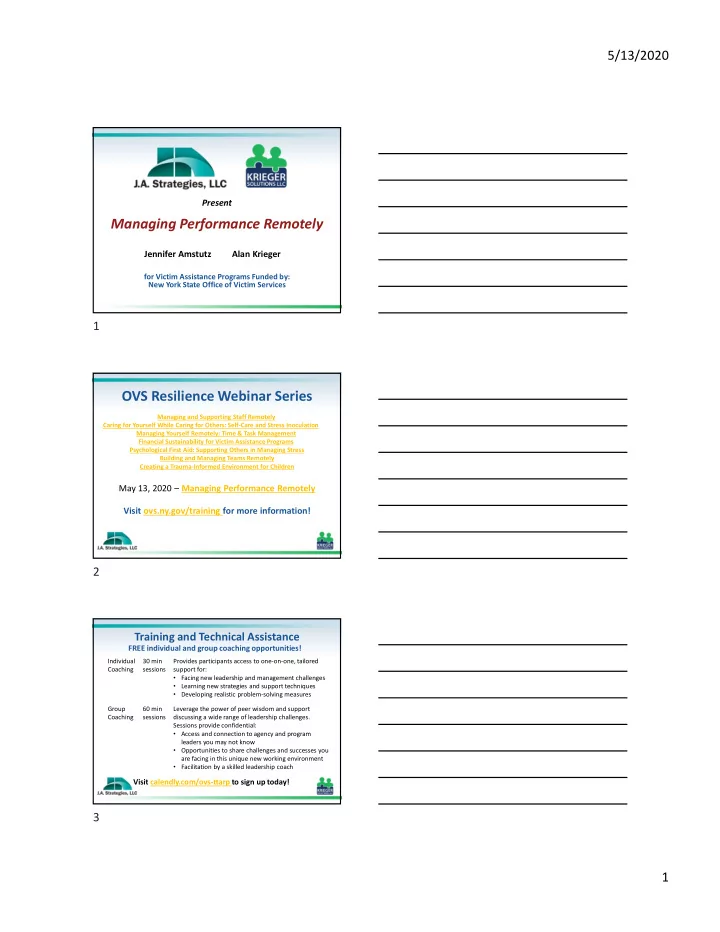
OVS Resilience Webinar Series

Visit ovs.ny.gov/training for more information!

Managing and Supporting Staff Remotely Caring for Yourself While Caring for Others: Self-Care and Stress Inoculation Managing Yourself Remotely: Time & Task Management Financial Sustainability for Victim Assistance Programs Psychological First Aid: Supporting Others in Managing Stress Building and Managing Teams Remotely Creating a Trauma-Informed Environment for Children

May 13, 2020 – Managing Performance Remotely

Training and Technical Assistance

Visit calendly.com/ovs-ttarp to sign up today! FREE individual and group coaching opportunities!

Individual Coaching 30 min sessions Provides participants access to one-on-one, tailored support for:

  • Facing new leadership and management challenges
  • Learning new strategies and support techniques
  • Developing realistic problem-solving measures

Group Coaching 60 min sessions Leverage the power of peer wisdom and support discussing a wide range of leadership challenges. Sessions provide confidential:

  • Access and connection to agency and program

leaders you may not know

  • Opportunities to share challenges and successes you

are facing in this unique new working environment

  • Facilitation by a skilled leadership coach

FREE individual and group coaching opportunities!

1 2 3

slide-2
SLIDE 2

5/13/2020 2

If you move your cursor on the screen the menu below will pop up and the icon for the chat box is the blue one in the center with the balloon in it. (Yours may be gray). Chat box is below Send chat to “all panelists”

Goals For This Session

Learn how, in a remote environment to:

  • Develop clear performance expectations for jobs

that have changed due to remote work

  • Measure performance and give feedback
  • Hold people accountable
  • Do all this in a motivational way

Poll

  • 1. How long have you been a supervisor?
  • Not yet a supervisor
  • Less than a year
  • 1-3 years
  • 3-10 years
  • More than 10 years
  • 2. What is most challenging about managing performance

remotely?

  • Setting clear and specific expectations
  • Adjusting expectations to remote work
  • Being fair about expectations given staff’s different living situations and

pressures

  • Giving corrective feedback remotely
  • Helping turn around poor performance
  • Other (chat box)

4 5 6

slide-3
SLIDE 3

5/13/2020 3

Being responsible for meeting measurable performance expectations.

What Is Accountability? Why Talk About Accountability Now?

Accountability is always a challenge for supervisors In this remote environment it’s even more challenging:

– You’re not able to sit in the same room – Jobs have changed and are still changing – Staff have additional stressors/demands on their time – Clients have additional stressors and needs – Morale is already low

The Right Tools

Clear and precise performance expectations are the critical leadership tool for successful accountability.

  • Constructive feedback techniques
  • Problem solving strategies
  • Remote communication systems

Other important tools include:

7 8 9

slide-4
SLIDE 4

5/13/2020 4

Effective Performance Expectations Have To Be SMART

  • S – Specific
  • M – Measurable
  • A – Agreed upon
  • R – Realistic
  • T – Time bound

Review any changes with HR!

Specific

Measurable Make the expectation behavioral

Skills Knowledge

Action Oriented

Specific and Measurable

Some of your staff’s work is very measurable:

– Number of clients contacted – Number of outreach calls – Number of claims processed

Some is not as easily measured:

– Taking initiative – Being cooperative/team player – Being supportive – How they participate in discussions/meetings

10 11 12

slide-5
SLIDE 5

5/13/2020 5

Joe and Rosa

  • Rosa is project lead
  • Joe is helping
  • Rosa wants more detail
  • Joe feels that it’s enough
  • Joe blows up

Jot down what might have been Joe’s behaviors

Examples of Personal Characteristics, Traits or Internal States… Not-Behaviors Examples of Personal Characteristics, Traits or Internal States… Not-Behaviors

  • Feeling angry
  • Having a bad attitude
  • Being closed minded
  • Not a team player

Which Of The Following Are Examples Of Specific And Measurable Behavior?

Not cooperative Not summarizing what he hears Raising his voice Rude

13 14 15

slide-6
SLIDE 6

5/13/2020 6

Internal States or Traits Include… Behavioral (SMART) Examples Include…

  • Feeling angry
  • Short, abrupt, speaking in an

angry tone

  • Bad attitude
  • Interrupting
  • Making strong negative

comments

  • Being closed minded
  • Rejecting ideas without

exploration

  • Not taking time to listen
  • Not a team player
  • Doesn’t respond
  • Doesn’t take on tasks
  • Doesn’t stay with schedule as

negotiated

The Two Parts of Behavioral Performance Expectations

The task to be done

The quality standard to which it is done

The Task - A Verb and A Noun

  • Register a new client
  • Write a grant
  • Document an incident
  • Develop a new service procedure
  • Clean the floor

For Joe: ―Assist Rosa ―Listen ―Share ideas

16 17 18

slide-7
SLIDE 7

5/13/2020 7

Quality Standard

Task: Quality Standard

  • Assist Rosa
  • Ask questions to fully

understand what Rosa needs

  • Provide the assistance

requested

  • Listen
  • Before responding, reflect

back to what Rosa said to be sure you heard it right

  • Share ideas
  • Facilitate problem solving,

build on Rosa’s ideas

S ∙ M ∙ A ∙ R ∙ T

SMART performance expectation:

Specific Measurable

  • Agreed Upon
  • Realistic
  • Time Bound

A = Agreed Upon

The employee understands what the supervisor means by each standard. The employee agrees with the supervisor’s definition.

e.g. “accurate” = zero errors, all fields complete and all required paperwork attached Or “accurate” = no more than one error per day

Both parties agree on how the employee will report progress to the supervisor and how often the supervisor will check in

19 20 21

slide-8
SLIDE 8

5/13/2020 8

R = Realistic

  • Realistic - reasonable for experienced employee in

a specific position

  • Expectations at the “effective” level
  • How is that different when working remotely

with remote clients? Has “realistic” changed?

T = Time Bound

Time Element

  • Length
  • Frequency
  • Deadline

Again, how is this different when working remotely? Does “time” change?

S ∙ M ∙ A ∙ R ∙ T Performance Expectations

  • Specific
  • Measurable
  • Agreed Upon
  • Realistic
  • Time Bound

22 23 24

slide-9
SLIDE 9

5/13/2020 9

How or why to write a Specific and Measurable, behavior- based performance expectation? How or why to reach Agreement on the expectation? Determining what’s Realistic? How to write a Time element into the expectation?

Any questions about SMART?

Review: Benefits of Specific and Measurable Performance Expectations

  • Motivates employees: increases clarity and confidence in

understanding expectations

  • Makes it easier to give corrective feedback

― More objective / Reduces defensiveness ― Promotes behavioral change

  • Empowers employees/minimizes micro-management:
  • Focuses on end results/outcomes
  • Gives employee room to complete as they think best

Corrective Feedback

  • State the expectation and the problem

behavior

  • Explain why it matters – what’s the

impact?

  • Then switch to listening and facilitate

problem solving Key to effective feedback

25 26 27

slide-10
SLIDE 10

5/13/2020 10

Corrective Feedback

E.g: Joe when talking to Rosa… Expectation:

  • Take time to listen and understand
  • Share ideas to facilitate problem solving

What happened:

– Behavior: When talking to Rosa:

  • your tone of voice was negative and harsh
  • you argued instead of collaborated

– Impact:

  • Rosa felt attacked and unsupported,
  • The project was further delayed

Coaching Joe

  • Once you deliver your feedback, stop and listen
  • Paraphrase / summarize Joe’s response even if you

don’t agree

  • Then let Joe know what you do agree with and what

you don’t

  • Guide Joe through problem solving to come up with

a solution that Joe supports and meets your expectations

SMART can also make Positive Feedback more powerful

Instead of “thanks for helping out the new caseworker” Give feedback based on specific expectations; cite behavior and impact of behavior. Behavior: – Took a moment to check in – Heard what they were finding difficult – Helped them think through the answer Impact: – New staff felt included, respected, cared for – Work performance improved, clients better served

28 29 30

slide-11
SLIDE 11

5/13/2020 11

  • Easier to hold staff accountable
  • Evaluations become a simple yes or no

e.g. they are accurate or not, polite or not If crystal clear about expectations…

Evaluation / Accountability

Feedback is more powerful and motivates toward the exact performance desired.

Additional Training and Technical Assistance Support (TTAR)

For more information about / recordings of past webinars, and to find out more about coaching services, go to: https://ovs.ny.gov/vap-training-center Or to sign up for coaching, go to: Visit Calendly.com/ovs-ttarp For more information about TTAR services, go to

https://ovs.ny.gov/training-technical-assistance-request

Or Email us later:

  • jennifer@JAStrategies.com
  • alan@KriegerSolutions.com

Questions & Concerns?

Type them into the Chat Box

31 32 33

slide-12
SLIDE 12

5/13/2020 12

How to Develop a Strategic Plan

Present Alan Krieger Jennifer Amstutz

Provided by New York State Office of Victim Services

Thank You

for your time and participation!

34