How much colon should be resected? Surgical Standard of Care and - - PowerPoint PPT Presentation

how much colon should be resected surgical standard of
SMART_READER_LITE
LIVE PREVIEW

How much colon should be resected? Surgical Standard of Care and - - PowerPoint PPT Presentation

Colon Cancer How much colon should be resected? Surgical Standard of Care and Operative Techniques Classic teaching 5 cm margin on either side of tumor Concern regarding microscopic intramural spread Shrinkage of margins 45%


slide-1
SLIDE 1

Madhulika G. Varma MD Professor and Chief Section of Colorectal Surgery University of California, San Francisco

Colon Cancer

Surgical Standard of Care and Operative Techniques How much colon should be resected?

Classic teaching 5 cm margin on either side of tumor Concern regarding microscopic intramural spread Shrinkage of margins 45%

Immediate contraction 29% Shrinkage in formalin 24%

Sternberg A J Surg Onc 2008

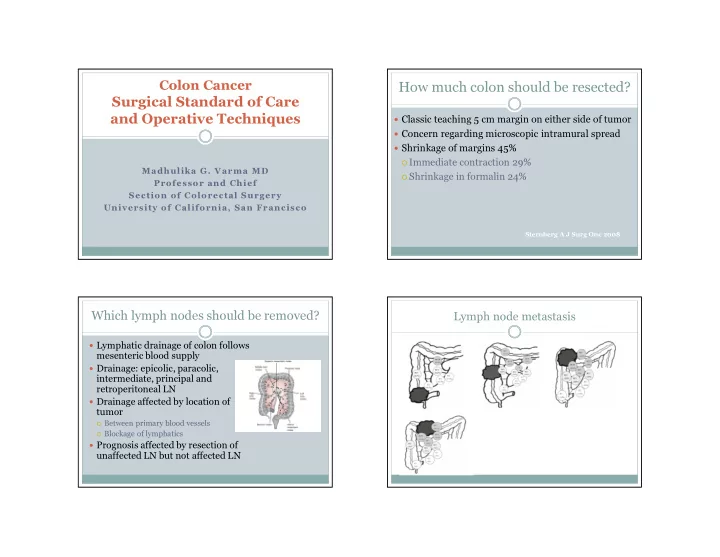
Which lymph nodes should be removed?

Lymphatic drainage of colon follows

mesenteric blood supply

Drainage: epicolic, paracolic,

intermediate, principal and retroperitoneal LN

Drainage affected by location of

tumor

Between primary blood vessels Blockage of lymphatics

Prognosis affected by resection of

unaffected LN but not affected LN

Lymph node metastasis

Park IJ et al Ann Surg Onc 2009

slide-2
SLIDE 2

How many lymph nodes should be removed?

#LN retrieved is considered a quality measure 1996-1997 15% hospitals compliant with 12 LN retrieval

measure

2004-2005 compliance only 38% Most compliant were NCI designated cancer centers(78%)

compared to academic (52%),VA (53%) or community(33%)

Many patient-level studies suggest that retrieval of 12 LN

confers survival advantage

However, use of national database for a hospital –level

study suggests that hospitals with higher LN retrieval rates after colectomy for colon cancer do not have better survival rates

Does LN harvest affect stage and prognosis?

Parsons JAMA 2011 SEER Database 1998-2008 86,3094 patients with colon cancer Evaluate LN number with positivity and hazard of death

What about radial margins?

West NP et al Lancet Oncol 2008

Systematic Review of colorectal resection margins and lymph nodes 107 articles Majority of poor quality

slide-3
SLIDE 3

What about laparoscopic resections?

Localization critical Colonoscopy for cecum with landmarks or

verification by CT

Tattoo at time of colonoscopy or even repeat

procedure to tattoo may be indicated

Distant disease

Can assess peritoneal and liver surfaces Cannot palpate for deeper parenchymal tumors Always need preoperative CT Scan Laparoscopic ultrasound/guided biopsy

Published Trials

NIH sponsored COST trial

Prospective Randomized Controlled Trial Multicenter- 48 institutions 872 patients Early follow up reported (NEJM 2004) 5 yr follow up reported (Ann Surg 2007) Planned follow-up 8 years

Six other international trials

COLOR (RCT) LCSSG (Prospective cohort) CLASSICC

Does laparoscopy affect resections?

COST TRIAL 2004 Laparoscopic Open Bowel Length (cm) 26 27 Proximal Margin (cm) 12 11 Distal Margin (cm) 10 12 Mesenteric length (cm) 9 8 # of Lymph Nodes 12 13

P=NS

slide-4
SLIDE 4

Wound /Port Site Recurrences

Author Yr N Incidence (%) Berends 94 14 21.0 Drouard 95 507 2 .4 Boulez 96 117 2 .5 Franklin 96 191 Melotti 99 163 1.2 Schiedeck 00 399 0.2 Lujan 02 102 2 Lacy 02 111 0.9 COST 04 408 0.5 CLASSICC 07 526 2.5

COST Trial Cumulative Recurrence Rate

3 yr Follow Up 5 yr Follow Up

Nelson NEJM 2004 Fleshman Ann Surg 2007

COST Trial Overall Survival

Overall Survival

Nelson NEJM 2004 Fleshman Ann Surg 2007

3 yr Follow Up 5 yr Follow Up

540 pts each arm

Bonjer et al. Lancet 2009

COLOR Trial

slide-5
SLIDE 5

CLASSICC Trial

Jayne et al J Clin Oncol 2007

CLASSICC Trial Overall Survival

Colon Cancer Open 67% vs Lap 68%

Meta-analysis of RCTs

Jackson et al J Am Coll Surg 2007

All Included Studies

slide-6
SLIDE 6

No Difference in LN retrieval No Difference in Recurrence Rate No difference in Cancer-related Death Meta-analysis of Largest RCTs

Databases of Barcelona, COST, COLOR and

CLASICC

All patients at least 3 years of FU 44 institutions in North America 48 institutions in Europe Primary outcome: overall and disease free survival

Bonjer et al Arch Surg 2007

slide-7
SLIDE 7

Survival

Lap Open OS 82% 84% DFS 76% 75%

Assessment of LN harvest and resection

COST trial analyzed the effect of #LN, length of

resection, mesenteric length and survival in setting

  • f many surgeons who were credentialed and video

audited for adherence to technical standards

No difference in survival based on LN retrieval or

  • ther anatomic factors

There was variability in the surgeons in terms of case

volume but no effect on overall survival

Technical credendtialing can help to standardize

  • ncologic resection regardless of case volume

Mathis et al Ann Surg 2013

slide-8
SLIDE 8

COST Disease Free Survival by Stage

Stage 1 Stage 2 Stage 3

Combined

Quality of Life Measures

Part of NIH trial 449 patients with colon cancer

Inclusion criteria

Adenocarcinoma of only a single colon segment >18 yo

Exclusion criteria

Transverse colon or rectal cancer Obstructed/perforated colon cancer Metastatic disease Scars/adhesions that would prevent laparoscopic surgery Concurrent or previous malignant tumor ASA physical status classification of IV or V Unable to speak English, cognitive impairment, no telephone

(for QOL)

Quality of Life Measures

Scores on the Symptoms Distress Scale (SDS) 13-item scale Nausea, appetite, insomnia, pain, fatigue, bowel,

concentration, appearance, breathing, outlook, and cough

Quality of Life Index 5-item scale Activity, daily living, health, support, and outlook Single-item Global Rating Scale “On a scale of 0-100, with 0 being death, and 100 being

excellent health, which number would you say best describes your state of health over the past 2 weeks?”

Symptom Distress Score

No significant difference in distress scores at 2 days, weeks or months

Single-Item Global Rating Scale

Mean scale at two weeks for Lap vs Open: 76.9 vs 74.4 (P=0.009) All other parameters were equivalent

slide-9
SLIDE 9

Summary

Surgery for colon cancer has advanced

technologically but oncologic principles are paramount to achieving good outcomes

More attention is being paid to the specimen as

  • pposed to how it was removed

Difficulties with laparoscopy for colon surgery

have diminished with new equipment and experience

Newer technologies such as Robotics, single site

laparoscopy and NOTES continue to be tested but have not yet achieved widespread use