How do you; See beyond the obvious, What you were looking for, and - - PowerPoint PPT Presentation

how do you see beyond the obvious what you were looking
SMART_READER_LITE
LIVE PREVIEW

How do you; See beyond the obvious, What you were looking for, and - - PowerPoint PPT Presentation

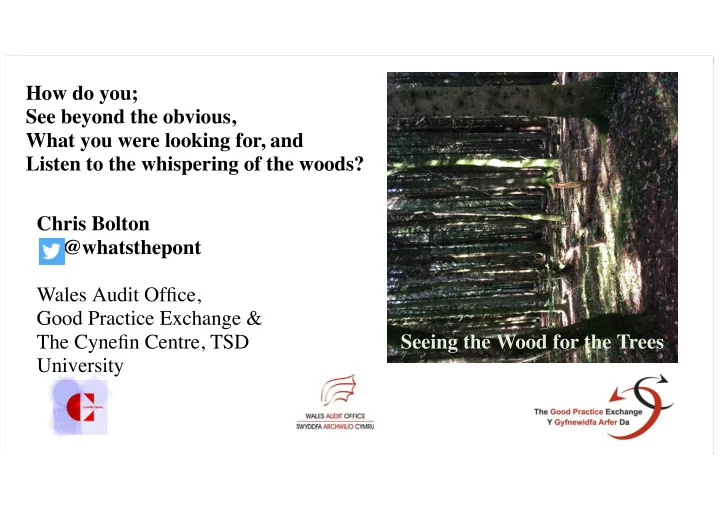
How do you; See beyond the obvious, What you were looking for, and Listen to the whispering of the woods? Chris Bolton @whatsthepont Wales Audit Office, Good Practice Exchange & The Cynefin Centre, TSD Seeing the Wood for the Trees


slide-1
SLIDE 1

Chris Bolton @whatsthepont Wales Audit Office, Good Practice Exchange & The Cynefin Centre, TSD University How do you; See beyond the obvious, What you were looking for, and Listen to the whispering of the woods? Seeing the Wood for the Trees

slide-2
SLIDE 2

How much information do we use?

Coping Mechanisms

  • Pattern recognition (inattentional blindness)
  • Satisfaction of search (first fit v best fit)
  • Retrospective coherence & reporting systems

What gets measured gets done…

slide-3
SLIDE 3

Inattentional Blindness Missing the Gorilla

Seeing only what we are looking for (or expecting to see)

  • Expert Radiographers
  • Chest scans, looking for cancer nodules
  • Abnormalities plus a ‘BIG’ Abnormality (The Gorilla)
  • Looking, but not ‘seeing’…
  • Novices even worse

Reflection… “How many times have I ‘missed a gorilla’ when I’m looking for what I know?”

The invisible gorilla strikes again: Sustained inattentional blindness in expert observers

Trafton Drew, Melissa L. H. Vo, and Jeremy M. Wolfe Psychol Sci. 2013 Sep; 24(9): 1848–1853.

slide-4
SLIDE 4

Satisfaction of Search

Once you have found what you are looking for, you don’t look for anything else.

  • Proof Readers
  • Radiologists (again!)
  • Regulators

But not Inspector Montalbano

  • Be more like Salvo

Reflection…

“How many times have I ‘stopped searching’ when I’ve found what I’m looking for?”

Satisfaction of search in osteoradiology. Ashman CJ1, Yu JS, Wolfman D. AJR Am J Roentgenol. 2000 Aug;175(2):541-4.

slide-5
SLIDE 5

Retrospective Coherence & Reporting Systems

What we observe and actions we take might not be reflected in what gets written down.

  • Life is complex – we make sense of it ‘looking backwards’
  • What gets measured gets done, and
  • What gets written down is ‘what the system requires’
  • Prof Harry Daniels
  • Implications
  • Lost learning opportunities
  • False assurance…

Reflection…

“How many times have I written a report using retrospective coherence to fit the reporting system?”

Learning in and for multi-agency working Harry Daniels Oxford Review of Education, Volume 33, 2007

Success = What I write in the file

slide-6
SLIDE 6

Does this matter in the real world? Yes it does

  • Problem Solving,
  • Reviewing Information,
  • Learning from Practice,
  • Introducing New Initiatives,
  • Assurance, and
  • Decision Making

What can you do about it?

  • Question your assumptions & biases
  • Climb down the Ladder of Inference
  • Chris Argyris
  • Seek contradictory evidence
  • Different sources
  • Different types of evidence
  • More than just the Olive Pips

Easier said than done…

Dangerous Olives of Evidence

slide-7
SLIDE 7

Word Gets Around… Use the Narrative

The Whispering of The Woods

Post Incident Reviews – ‘people knew’

  • Challenger Space Shuttle
  • Deepwater Horizon
  • Mid Staffs Hospital
  • Grenfell Tower
  • etc, etc

What people talk about is important

  • Stories, Anecdote, The Grapevine…
  • But where to draw the line?

How do you ‘listen’ with confidence?

  • Narrative is convincing, but not always accurate
  • Numbers are accurate, but not always convincing
  • Can you combine Narrative and Numbers?

‘See’ things early

  • better to prevent than clean up the mess afterwards

“Standing at the bus stop with my shopping In my hands when I'm overhearing elder Ladies as the rumours start to fly you can Hear them in the school yard, in the scrap yard In the chip shop…” Thousand Trees

slide-8
SLIDE 8

Who uses narrative?

  • Anthropologists & Ethnographers
  • Computer Programmes
  • Experts & (well intentioned) Amateurs &
  • The Cynefin Centre - SenseMaker

Examples of how to use narrative: Staff Surveys and Older Peoples Listening Project Basic Process:

  • Collect narrative fragments
  • Unstructured
  • Unfiltered
  • Everyday Life
  • Self Interpretation
  • Disintermediation
  • Power shift
  • Done by not to
  • Collective Analysis

If a new family was moving into my street, this is what I’d tell them about living here… …unstructured, unfiltered, “this is how it is….” Who has responsibility in what you have said? Move the marker to a place where you are happiest. The closer it is to any label, the more strongly you feel about that label. If you agree with all three, its OK to leave it in the middle of the triangle

slide-9
SLIDE 9

Making sense of Narrative

Data led process – the WHAT

  • Look for patterns or clusters
  • Graphical outputs
  • Triangles, Distributions, Stones
  • Filter using whatever you’ve asked for

Link to Narrative – the WHY Insight through combination

  • Numbers accurate, but not convincing
  • Narrative convincing but not accurate

SenseMaker Analyst Screenshots

slide-10
SLIDE 10

Better insight and understanding

  • Risk Scenarios, Different Context
  • Failure not an option
  • Safe to fail pilots
  • What happens if you transparently report

any failures?

  • Get fired?
  • Get promoted?

How decision makers saw this…

  • We need to clearly set the context
  • Some things cannot fail
  • Some things should fail
  • New ways of working
  • Innovations
  • The tone, language & narrative of decision

making & organisations is influential

SenseMaker Analyst Screenshots

slide-11
SLIDE 11

How could this work in Fieldwork? Cynefin Centre Developments

  • Previous experiences (good & bad) have

known outcomes & well documented

  • Index these using SenseMaker
  • Different perspectives
  • Experts
  • Fieldworkers
  • Students
  • Service users
  • Knowledge Database
  • Collect current experiences (narrative) as part
  • f fieldwork
  • Staff notes (rather than the file)
  • Service user experiences
  • SenseMaker looks for patterns that look

similar to previous situations

  • Sends ‘Anticipatory Alert’
  • Stay 10 mins longer, ask more about…
  • Augment human intuition not replace it
slide-12
SLIDE 12

Managing Risk Seeing the Wood for the Trees

1. Seeing Beyond the Obvious Inattentional Blindness (missing gorillas) Satisfaction of Search (be like Montalbano) 2. Retrospective Coherence Reporting what actually happened 3. Word Gets Around Narrative is essential, BUT It needs to be used properly

Do keep talking: Chris Bolton @whatsthepont www.whatsthepont.com Chris Bolton The Wood, the trees and what was really going on