How Did Our Galaxy Form? Stars & Galaxies NNOUNCEMENTS HOMEWORK - - PowerPoint PPT Presentation

how did our galaxy form
SMART_READER_LITE
LIVE PREVIEW

How Did Our Galaxy Form? Stars & Galaxies NNOUNCEMENTS HOMEWORK - - PowerPoint PPT Presentation

ASTR 1120 REVIEW General Astronomy: How Did Our Galaxy Form? Stars & Galaxies NNOUNCEMENTS HOMEWORK # 6 due Tue. Nov.3 REVIEW REVIEW Our galaxy probably formed from a giant gas cloud Halo stars formed first as gravity caused cloud to


slide-1
SLIDE 1

ASTR 1120 General Astronomy: Stars & Galaxies NNOUNCEMENTS

HOMEWORK # 6 due Tue. Nov.3

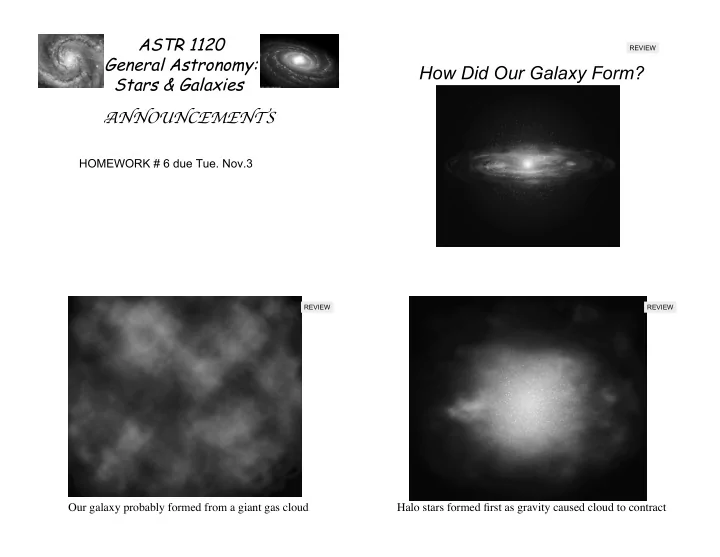
How Did Our Galaxy Form?

REVIEW

Our galaxy probably formed from a giant gas cloud

REVIEW

Halo stars formed first as gravity caused cloud to contract

REVIEW

slide-2
SLIDE 2

Stars continuously form in disk as galaxy grows older - stars remain in disk plane

REVIEW

Detailed studies: Halo stars formed in clumps that later merged

REVIEW

Galactic Creation Summary

  • What clues to our galaxy’s history do

halo stars hold?

– Halo stars are all old, with a smaller proportion of heavy elements than disk stars, indicating that the halo formed first

  • How did our galaxy form?

– Our galaxy formed from a few huge clouds of gas, with the halo stars forming first and the disk stars forming later, after the gas settled into a spinning disk

REVIEW

Measuring Mass Using Orbital Velocities

solar system

Rotation curve: orbital speed vs. distance from the center

slide-3
SLIDE 3

Expectation for the Milky Way

  • There are a lot of stars

in the center but also some outside

  • Rotation curve should

increase at first and then fall although more slowly than for solar system

Reality for the Milky Way

  • Rotation curve is flat
  • r even rising!
  • Most of the mass of

the galaxy is outside the solar circle!

  • But few stars, little

gas there…

  • DARK MATTER !

probably in large halo -- outweighs stars+gas by factor

  • f 3 to 10

Role of dark matter on rotation profile

DARK MATTER

Dark matter halo for galaxies

  • Dark matter extends

beyond visible part of the galaxy -- mass is ~10x stars and gas!

  • Probably not normal

mass that we know of (protons, neutrons, electrons).

  • Most likely subatomic

particles, as yet unidentified (weakly interacting massive particles – WIMPs?)

slide-4
SLIDE 4

Journey to the Center

  • f the Galaxy

~.1 ly

Sgr A*

Infrared light from center Radio emission from center

1000 ly of the MW center

Radio emission from center Swirling gas near center Swirling gas near center Orbiting stars near center

1 Light-year

slide-5
SLIDE 5

A Case for a Supermassive Black Hole at the Galactic Center

  • Doppler shift

measurements

  • f spiraling stars and

gas suggest 3 million MSun black hole

  • Still too far out to

exclude other possibilities…

We need to be able to see closer in to really prove there is a supermasive black hole!

Distance from Sgr A* (pc) Enclosed mass (Mo) Genzel 1996

For Best Results: Use the World’s LARGEST Infrared Telescope

The Keck Telescopes on the Big Island of Hawaii

Stars appear to be

  • rbiting something

massive but invisible … a black hole! Orbits of stars indicate a mass of about 3-4 million Msun within 600 RSchwarzchild

slide-6
SLIDE 6

We Know Exactly Where Sgr A* Is and How Much it Weighs, but What Does it ‘LOOK’ Like?

X-ray flares from Sgr A* suggest that tidal forces of the suspected black hole

  • ccasionally tear

apart chunks of matter about to fall in

Infrared Observations Showed the Same Types of Flares State of Affairs at the Galactic Center

  • Stellar orbits have made our Galaxy one of the

best proofs of supermassive black holes at the center of most galaxies.

– Millions to billions of times the mass of our Sun. Must be created by something entirely different than a massive star supernova.

  • Flares are often observed in X-rays and IR

– Observations of occasional flares are interpreted as the result of occasional “swallowing” of a gas clump

  • r a star by the giant black hole.
slide-7
SLIDE 7

SUMMARY/Questions?

  • What components make up
  • ur Galaxy?

– Disk: mostly flat orbits, population I stars – Bulge & Halo: spheroidal orbits, Population II stars

  • How did our Galaxy form?

– Several VERY massive clouds colliding

  • What goes on in the Galaxy?

– Star-Gas-Star recycling

  • What is most of the Galaxy

mass made of?

– Dark Matter

  • What lives at the MW Center?

– Sgr A*: Supermassive Black Hole

Chapter 20: Galaxies

And the Foundation of Modern Cosmology

What Are The Three Major Types of Galaxies?

Hubble Ultra Deep Field

slide-8
SLIDE 8

Hubble Ultra Deep Field Hubble Ultra Deep Field

Spiral Galaxy

Hubble Ultra Deep Field

Spiral Galaxy Elliptical Galaxy

Hubble Ultra Deep Field

Elliptical Galaxy Spiral Galaxy

slide-9
SLIDE 9

Hubble Ultra Deep Field

Spiral Galaxy Elliptical Galaxy Elliptical Galaxy Irregular Galaxies

Hubble Ultra Deep Field

Spiral Galaxy Elliptical Galaxy Elliptical Galaxy

Spirals ~80% of galaxies

  • Disks (with spiral

arms) +

  • Spheroids

(bulges+halos)

NGC 4414 M100

center

M101

slide-10
SLIDE 10

Barred Spiral galaxies

  • Spiral arms emerge

from central bar

NGC 1300 NGC 1365

HST: Center of barred spiral NGC 1365

IR view

Lenticulars

(lens-shaped)

  • Disks, but less gas

and star formation

  • Note lack of dust &

nebulae

Ellipticals ~15% of galaxies

  • Round or slightly

flattened

  • Very little young

stars

  • Reddish color = old

stars (red giants, red main sequence)

slide-11
SLIDE 11

Giant ellipticals

  • Trillions of

stars!!

  • Supermassive

black hole in the center of M87 estimated at 3 billion MSun

M87

Dwarf ellipticals

  • Dwarfs only contain a few

hundred million stars

  • Most common type of

galaxy?

  • Only know nearby ones

(since faint!) NGC 205 2MASS

Irregulars

  • Galaxies in

formation?

  • Or transition?
  • Or failed?
  • Often LOTS of star

birth

The Antennae Galaxy

slide-12
SLIDE 12

Which type of galaxy contains a high percentage of cool gas and dust?

  • A. Spiral
  • B. Elliptical
  • C. Irregular
  • D. Barred spiral
  • E. Everyone but B

Clicker Question

Which type of galaxy contains a high percentage of cool gas and dust?

  • A. Spiral
  • B. Elliptical
  • C. Irregular
  • D. Barred spiral
  • E. Everyone but B

Clicker Question