How common are DSFGs in galaxy cluster progenitors? z~6 z~3 z~1 - - PowerPoint PPT Presentation

how common are dsfgs in galaxy cluster progenitors
SMART_READER_LITE
LIVE PREVIEW

How common are DSFGs in galaxy cluster progenitors? z~6 z~3 z~1 - - PowerPoint PPT Presentation

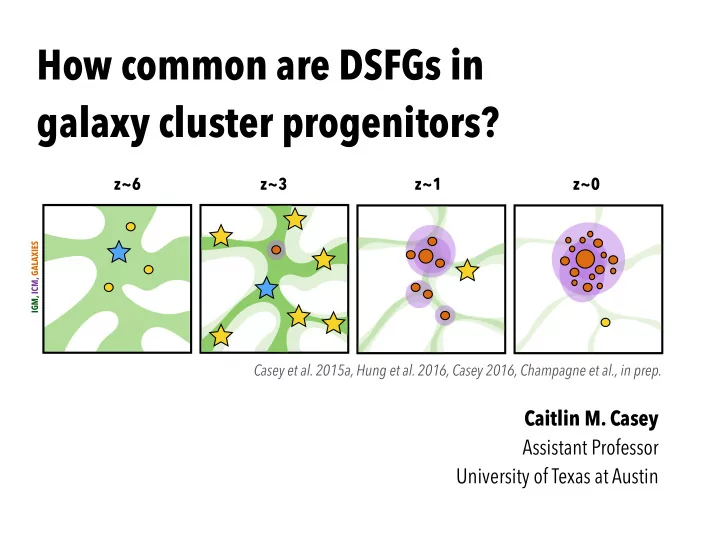
How common are DSFGs in galaxy cluster progenitors? z~6 z~3 z~1 z~0 IGM, ICM, GALAXIES Casey et al. 2015a, Hung et al. 2016, Casey 2016, Champagne et al., in prep. Caitlin M. Casey Assistant Professor University of Texas at Austin


slide-1
SLIDE 1

IGM, ICM, GALAXIES

z~6 z~3 z~1 z~0

How common are DSFGs in galaxy cluster progenitors?

Caitlin M. Casey Assistant Professor University of Texas at Austin

Casey et al. 2015a, Hung et al. 2016, Casey 2016, Champagne et al., in prep.
slide-2
SLIDE 2

Sinclaire Manning

e-MERLIN radio morphology of galaxies in SuperCLASS

Patrick Drew

Kinematics & Optical/NIR spectroscopy of DSFGs

Jaclyn Champagne

Molecular gas content of galaxies in overdense environments

Chao-Ling Hung Jorge Zavala Justin Spilker

slide-3
SLIDE 3
  • 1. Can DSFGs be useful tools in studying the assembly

history of protoclusters (galaxy cluster progenitors)?

  • 2. Do DSFGs (at z>2) preferentially live in overdensities?

IGM, ICM, GALAXIES

z~6 z~3 z~1 z~0

virialized cluster stage protocluster stage

slide-4
SLIDE 4
  • 1. Review / known DSFG-rich overdensities at z>2: convince

you that they are real.


(Omitting discussion of overdensities that are not spectroscopically- confirmed, Planck candidates, flux excesses, etc.)


  • 2. In Context / Expectation from simulations and physical
  • implications. (Simultaneous triggering of DSFGs vs. random triggering?)

  • 3. Outlook / What should we aim to measure from future

large submm+OIR datasets?

slide-5
SLIDE 5

SSA22 at z=3.09

SSA22 Protocluster at z=3.09, 5-8 DSFGs associated with LABs

Steidel et al. (1998), Hayashino et al. (2004), Matsuda et al. (2005), Yamada et al. (2012)

* 283 LAE Candidates spanning ~1/2 degree


(Hayashino et al. 2004, Matsuda et al. 2005)

* ALMA follow-up reveal 9 DSFGs in core


(Umehata et al. 2015)

* 4 Lyman- blobs with submm emission


(Geach et al. 2005, Chapman et al. 2005)

α

slide-6
SLIDE 6

SSA22 at z=3.09

Matsuda et al. (2005)

30 x 40 x 40 Mpc comoving

slide-7
SLIDE 7

* Marginal significance (~2.5) in HDF spectroscopic samples of LBGs, much higher significance in DSFGs * Contains some well-studied systems:

HDF254/255 DSFG pair (mergers) HDF147 (massive radio galaxy) HDF130 (relic FRII galaxy)

Casey et al. (2009a,b), Fabian et al. (2009), Bothwell et al. (2010)

HDF z=1.99 Structure

Blain et al. (2004), Chapman et al. (2009) Chapman et al. (2009)

slide-8
SLIDE 8

HDF Overdensity at z=1.99, 6-9 DSFGs

Blain et al. (2004), Chapman et al. (2009)

HDF z=1.99 Structure

HDF254 HDF255 HDF147 HDF130

Chapman et al. (2009)

slide-9
SLIDE 9

HDF Overdensity at z=1.99, 6-9 DSFGs

Blain et al. (2004), Chapman et al. (2009)

HDF z=1.99 Structure

HDF254 HDF255 HDF147 HDF130

Chapman et al. (2009)

slide-10
SLIDE 10

HDF Overdensity at z=1.99, 6-9 DSFGs

Blain et al. (2004), Chapman et al. (2009)

Inverse compton ghost of radio galaxy (~FRII luminosity); Fabian et al. (2009)

HDF z=1.99 Structure

HDF254 HDF255 HDF147 HDF130

Chapman et al. (2009)

slide-11
SLIDE 11

Inverse compton ghost of radio galaxy (~FRII luminosity); Fabian et al. (2009)

HDF z=1.99 Structure

Radio galaxies in/ around protoclusters?

Cosmic Downsizing: Most rare, evolved galaxies should live in most massive overdensities at early times

“We estimate that roughly 75% of powerful (L2.7GHz > 1033 erg s−1 Hz−1 sr−1) high redshift radio galaxies reside in a protocluster.” —Venemans et al. 2007

Carilli et al. (2001), Stevens et al. (2003), Miley et al. (2004), Venemans et al. (2004, 2007), Tamura et al. (2009), Mostardi et al. (2013), Lee et al. (2014)

slide-12
SLIDE 12

CO(1-0) extending 150kpc in Spiderweb’s (Emonts et al. 2016) and around HAE229 (Dannerbauer et al. 2017)

Spiderweb z=2.16 Structure

* strong excess of Ly emitters around radio galaxy

α

Kurk et al. (2000, 2004a,b), Pentericci et al. (2000), Hatch et al. (2011b)

* statistical excess of submm emission around Spiderweb galaxy (the cD progenitor)

Stevens et al. (2003), Miley et al. (2006), Rigby et al. (2014), Valtchanov et al. (2013)

* 16 LABOCA sources detected in Dannerbauer et al. (2014), five DSFGs spectroscopically- confirmed at z=2.16

slide-13
SLIDE 13

COSMOS z=2.47 Structure

Casey et al. (2015a)

* Found via statistical overdensity

  • f DSFGs: 9 DSFGs

spectroscopically-confirmed with MOSFIRE (H ) and CO

α

* Confirmed through zCOSMOS N(z) distribution with ~3.5 significance

Casey et al. (2015a)

* As large as SSA22 structure, less complete (similar to HDF structure) * Related structures also reported:
 Chiang et al. (2015) at z=2.44, Diener et al. (2015) at z=2.45, T. Wang et al. (2016) at z=2.50

slide-14
SLIDE 14

COSMOS z=2.47 Structure

Casey et al. (2015a)

* Found via statistical overdensity

  • f DSFGs: 9 DSFGs

spectroscopically-confirmed with MOSFIRE (H ) and CO

α

* Confirmed through zCOSMOS N(z) distribution with ~3.5 significance

Casey et al. (2015a)

* As large as SSA22 structure, less complete (similar to HDF structure) * Related structures also reported:
 Chiang et al. (2015) at z=2.44, Diener et al. (2015) at z=2.45, T. Wang et al. (2016) at z=2.50

slide-15
SLIDE 15

COSMOS z=2.47 Structure

Casey et al. (2015a)

* Related structures also reported:
 Chiang et al. (2015) at z=2.44, Diener et al. (2015) at z=2.45, T. Wang et al. (2016) at z=2.50

slide-16
SLIDE 16

COSMOS z=2.47 Structure

Casey et al. (2015a)

* Related structures also reported:
 Chiang et al. (2015) at z=2.44, Diener et al. (2015) at z=2.45, T. Wang et al. (2016) at z=2.50

slide-17
SLIDE 17

COSMOS z=2.47 Structure

20”

VLA CO(1-0) map, 16 detections: Champagne et al. in prep

  • T. Wang et al. (2016)

structure appears to be a line-of-sight filament within the larger structure, not virialized cluster core.

*peculiar velocities (infall) would only mean the structure is more elongated*

slide-18
SLIDE 18

COSMOS z=2.47 Structure

K.-G. Lee et al. 2015, 2016

slide-19
SLIDE 19

COSMOS z=2.10 Structure

  • T. Yuan et al. (2014)

* Found in zFOURGE team intermediate-band imaging, MOSFIRE follow up via Swinburne, 100 sources in Hα

* Also present in zCOSMOS

catalog, and on larger scales, contains:

  • 9 DSFGs
  • 5 X-ray AGN

Spitler et al. (2012), Yuan et al. (2014) Casey et al. (2012c), Hung et al. (2016) Hung, Casey et al. 2016

slide-20
SLIDE 20

COSMOS z=2.10 Structure

  • T. Yuan et al. (2014)

* Found in zFOURGE team intermediate-band imaging, MOSFIRE follow up via Swinburne, 100 sources in Hα

* Also present in zCOSMOS

catalog, and on larger scales, contains:

  • 9 DSFGs
  • 5 X-ray AGN

Spitler et al. (2012), Yuan et al. (2014) Casey et al. (2012c), Hung et al. (2016) Hung, Casey et al. 2016

slide-21
SLIDE 21

COSMOS z=2.10 Structure

  • T. Yuan et al. (2014)

* Found in zFOURGE team intermediate-band imaging, MOSFIRE follow up via Swinburne, 100 sources in Hα

* Also present in zCOSMOS

catalog, and on larger scales, contains:

  • 9 DSFGs
  • 5 X-ray AGN

Spitler et al. (2012), Yuan et al. (2014) Casey et al. (2012c), Hung et al. (2016) Hung, Casey et al. 2016

slide-22
SLIDE 22

COSMOS z=2.10 Structure

  • T. Yuan et al. (2014)

* Found in zFOURGE team intermediate-band imaging, MOSFIRE follow up via Swinburne, 100 sources in Hα

* Also present in zCOSMOS

catalog, and on larger scales, contains:

  • 9 DSFGs
  • 5 X-ray AGN

Spitler et al. (2012), Yuan et al. (2014) Casey et al. (2012c), Hung et al. (2016) Hung, Casey et al. 2016

slide-23
SLIDE 23

Higher-redshift Overdensities with DSFGs AzTEC3 z=5.3 …SPT2349 at z=4.3

Capak et al. (2011) N(gals) = 11 N(rare) = 2

HDF850.1

Walter et al. (2012) N(gals) = 13 N(rare) = 2

GN20 z=4.06

Hodge et al. (2013) N(gals) = 8 N(rare) = 3

+ others? less spectroscopically robust (50-100s of members vs. ~10)

slide-24
SLIDE 24

Are there more?
 Selection is messy and heterogeneous.

SSA22 z=3.09, HDF z=1.99, Spiderweb z=2.16, COSMOS z=2.47 and z=2.10.

40 x 40 x 40 Mpc comoving

slide-25
SLIDE 25

Are there more?
 Selection is messy and heterogeneous.

SSA22 z=3.09, HDF z=1.99, Spiderweb z=2.16, COSMOS z=2.47 and z=2.10.

What should we expect?

40 x 40 x 40 Mpc comoving

slide-26
SLIDE 26

Chiang et al. (2013); see also Oñorbe et al. (2014) Muldrew et al. (2015)

D[h−1 cMpc]

Expectation from Simulations: Protocluster Size

Protoclusters are physically HUGE, and the most massive progenitors are the largest. Volume collapses by a factor of ~100 between z=3 and z=0.5.

(Quantities measured related to protoclusters should consider this volume transformation)

STOP LOOKING ON ~ARCMIN SCALES.

slide-27
SLIDE 27

Chiang et al. (2013); see also Oñorbe et al. (2014) Muldrew et al. (2015)

D[h−1 cMpc]

Expectation from Simulations: Protocluster Size

Protoclusters are physically HUGE, and the most massive progenitors are the largest. Volume collapses by a factor of ~100 between z=3 and z=0.5.

(Quantities measured related to protoclusters should consider this volume transformation)

STOP LOOKING ON ~ARCMIN SCALES.

slide-28
SLIDE 28

Expectation from Simulations: Will it collapse?

Chiang et al. (2013)

Mo & White 1996: Press-Schechter spherical collapse: probability of collapse needs to exceed critical value Non-virialized structures are in non- linear regime, direct SAM output needed to predict collapse

(Chiang et al. 2013, Granato et al. 2015, Lacey et al. 2015)

slide-29
SLIDE 29

Expectation from Simulations: Will it collapse?

Chiang et al. (2013)

SSA22 COS z=2.47 COS z=2.10 HDF z=1.99 SW z=2.16

Mo & White 1996: Press-Schechter spherical collapse: probability of collapse needs to exceed critical value Non-virialized structures are in non- linear regime, direct SAM output needed to predict collapse

(Chiang et al. 2013, Granato et al. 2015, Lacey et al. 2015)

slide-30
SLIDE 30

epoch of interest

Expectation from Simulations: Protocluster SFRD

Chiang et al. (2017)

slide-31
SLIDE 31

epoch of interest

Expectation from Simulations: Protocluster SFRD

Chiang et al. (2017)

slide-32
SLIDE 32

Galaxy overdensities trace the underlying dark matter overdensity. How well they trace it is bias.

δgal = (Nobs − Nexp) Nexp

1 + bδmass = C(1 + δgal) b ≈ δgal/δmass

How does the bias in SMGs compare to the bias in “normal” galaxies (LBGs)?

slide-33
SLIDE 33

How does the bias in SMGs compare to the bias in “normal” galaxies (LBGs)?

slide-34
SLIDE 34

How does the bias in SMGs compare to the bias in “normal” galaxies (LBGs)?

slide-35
SLIDE 35

How does the bias in SMGs compare to the bias in “normal” galaxies (LBGs)?

slide-36
SLIDE 36

How does the bias in SMGs compare to the bias in “normal” galaxies (LBGs)?

slide-37
SLIDE 37

How does the bias in SMGs compare to the bias in “normal” galaxies (LBGs)?

slide-38
SLIDE 38

How does the bias in SMGs compare to the bias in “normal” galaxies (LBGs)?

slide-39
SLIDE 39

Expectation from Simulations: SMG bias… i.e. where are the SMGs?

Miller et al. (2015) : Bolshoi simulation (SAM/ large volume), eight 2deg2 light cones, SFR-halo mass relation to scale to S850.

(Klypin, Trujillo-Gomez & Primack 2011; Behroozi et al. 2013; Hayward et al. 2013)

SMGs appear to have high bias, but poisson noise means they don’t usually trace

  • verdensities, with a few exceptions.
slide-40
SLIDE 40

Expectation from Simulations: SMG bias… i.e. where are the SMGs?

  • nly ~10% of all

1015 Msun massive protoclusters should have A LOT of SMGs

Casey 2016

Blain et al. (2004)

slide-41
SLIDE 41

Expectation from Simulations: SMG bias… i.e. where are the SMGs?

  • nly ~10% of all

1015 Msun massive protoclusters should have A LOT of SMGs

Casey 2016

Blain et al. (2004)

slide-42
SLIDE 42

DSFG-rich (N>5) protoclusters should not exist.


(at least in our small/incomplete surveys).

What does their existence teach us?

slide-43
SLIDE 43

z=1 (or z=0) cluster with ~50 ellipticals over >1011 Msun

cosmic time

How likely is it to see N DSFGs (simultaneously) in a given protocluster?

Casey 2016

Importance of Timescales.

slide-44
SLIDE 44

z=1 (or z=0) cluster with ~50 ellipticals over >1011 Msun

1<z<7: When were they DSFGs?

cosmic time

How likely is it to see N DSFGs (simultaneously) in a given protocluster?

Casey 2016

Importance of Timescales.

slide-45
SLIDE 45

z=1 (or z=0) cluster with ~50 ellipticals over >1011 Msun

1<z<7: When were they DSFGs?

cosmic time

z~1 z~7

How likely is it to see N DSFGs (simultaneously) in a given protocluster?

Casey 2016

Importance of Timescales.

slide-46
SLIDE 46

z=1 (or z=0) cluster with ~50 ellipticals over >1011 Msun

1<z<7: When were they DSFGs?

cosmic time

z~1 z~7

How likely is it to see N DSFGs (simultaneously) in a given protocluster?

Casey 2016

Importance of Timescales.

slide-47
SLIDE 47

z=1 (or z=0) cluster with ~50 ellipticals over >1011 Msun

1<z<7: When were they DSFGs?

cosmic time

z~1 z~7

Casey 2016

How likely is it to see N DSFGs (simultaneously) in a given protocluster?

Importance of Timescales.

slide-48
SLIDE 48

p(5|τ100) = 4%

Casey (2016)

Importance of Timescales.

slide-49
SLIDE 49

Importance of Timescales.

DSFGs: short-lived, ~100Myr.

Derived directly from gas depletion times; Greve et al. 2005, Bothwell et al. 2010, Swinbank et al. 2014

luminous AGN, QSO lifetimes? <100Myr.

time SFR

DSFGs: long-lived, ~1Gyr.

Daddi et al. 2009, Carilli et al. 2009, Hodge et

  • al. 2012, Narayanan et al. 2015

high SFR sustainable for up to 1Gyr? building galaxies

1012 M

Correlated Triggering: protoclusters light up with DSFGs/QSOs DSFGs should be ubiquitous in protoclusters

slide-50
SLIDE 50

Importance of Timescales.

DSFGs: short-lived, ~100Myr.

Derived directly from gas depletion times; Greve et al. 2005, Bothwell et al. 2010, Swinbank et al. 2014

luminous AGN, QSO lifetimes? <100Myr.

time SFR

DSFGs: long-lived, ~1Gyr.

Daddi et al. 2009, Carilli et al. 2009, Hodge et

  • al. 2012, Narayanan et al. 2015

high SFR sustainable for up to 1Gyr? building galaxies

1012 M

Correlated Triggering: protoclusters light up with DSFGs/QSOs DSFGs should be ubiquitous in protoclusters

slide-51
SLIDE 51

timescale limits this Gas Depletion timescale gives a useful constraint on starburst lifetime.

Casey 2016 cumulative distribution of depletion time for 7 DSFGs in protoclusters Average depletion time/lifetime for DSFGs is ~100Myr (Bothwell et al. 2013, Swinbank et al. 2014)

slide-52
SLIDE 52

timescale limits this Gas Depletion timescale gives a useful constraint on starburst lifetime.

Casey 2016 cumulative distribution of depletion time for 7 DSFGs in protoclusters Average depletion time/lifetime for DSFGs is ~100Myr (Bothwell et al. 2013, Swinbank et al. 2014) VLA + ALMA follow-up of protoclusters: CO(1-0), CO(3-2), dust continuum Champagne et al. in prep

slide-53
SLIDE 53

timescale limits this Gas Depletion timescale gives a useful constraint on starburst lifetime.

Casey 2016 cumulative distribution of depletion time for 7 DSFGs in protoclusters Average depletion time/lifetime for DSFGs is ~100Myr (Bothwell et al. 2013, Swinbank et al. 2014)

slide-54
SLIDE 54

timescale limits this

100’s of Msun/yr in accretion (in field)!

Scoville et al. (2017)

“Depletion timescale means nothing if there’s

  • ngoing gas accretion.” - Scoville / Hayward

Gas Depletion timescale gives a useful constraint on starburst lifetime.

Casey 2016 cumulative distribution of depletion time for 7 DSFGs in protoclusters Average depletion time/lifetime for DSFGs is ~100Myr (Bothwell et al. 2013, Swinbank et al. 2014)

slide-55
SLIDE 55

They shouldn’t exist (unless simulations are having trouble reproducing SMGs…)

12.0 12.5

Even if depletion times aren’t valid starburst “lifetimes” the stellar mass function can be used as an upper limit to DSFG growth.

Predicted forward growth of COSMOS z=2.47 structure to z=1.8

slide-56
SLIDE 56

They shouldn’t exist (unless simulations are having trouble reproducing SMGs…)

12.0 12.5

Even if depletion times aren’t valid starburst “lifetimes” the stellar mass function can be used as an upper limit to DSFG growth.

Predicted forward growth of COSMOS z=2.47 structure to z=1.8

Martini (2004), Merloni et al. (2004) QSO lifetimes must be short!

slide-57
SLIDE 57

* Protoclusters are rare but the

Universe is big

* To learn about their growth and

impact on galaxies you need statistics: what fraction of protoclusters are DSFG-rich? * wide-field surveys: mm matched with spec-z campaigns like HETDEX

What can we hope to constrain?

slide-58
SLIDE 58

Summary Provocative question: is some large fraction of z>4 star-formation

  • bscured and living in DSFGs in overdensities?

Wilkinson et al. (2017)

DSFG-rich protoclusters EXIST and are HUGE. We can start to use them to learn about physics of cluster assembly (Casey 2016). **though not every protocluster will be DSFG-rich**

slide-59
SLIDE 59

Miller et al. (2015)

slide-60
SLIDE 60

Casey 2016

slide-61
SLIDE 61

Casey 2016