
SLIDE 1
How AI is Transforming Manufacturing
Webinar
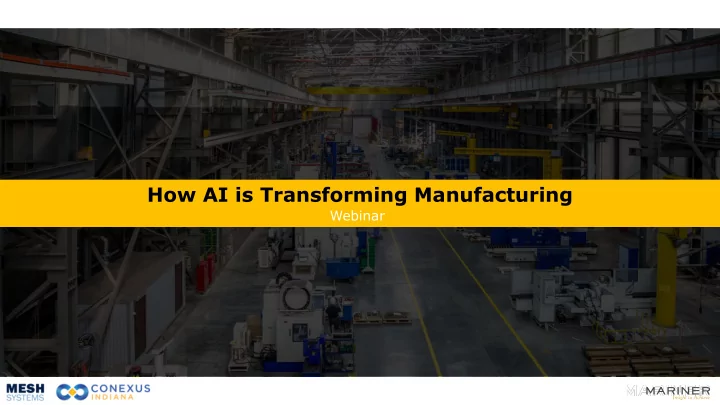
How AI is Transforming Manufacturing Webinar Agenda TIME TOPIC - - PowerPoint PPT Presentation
How AI is Transforming Manufacturing Webinar Agenda TIME TOPIC KEY ITEMS PRESENTER Rob Capozziello 3 Introduction & Housekeeping About Zoom, Q&A, Agenda EVP Services, Mariner Mitch Landess 5 Conexus Intro Conexus
How AI is Transforming Manufacturing
Webinar
TIME TOPIC KEY ITEMS PRESENTER 3 Introduction & Housekeeping
Rob Capozziello
EVP Services, Mariner
5 Conexus Intro
Mitch Landess
VP Innovation and Digital Transformation Conexus
10 Transforming Quality Performance with Applied AI
David Breaugh
Manufacturing Business Lead, Microsoft
20 Data Driven Decision Making for the Factory Floor
Robbie Jones
Enterprise Sales Manager
40 Deep Dive into Deep Learning for Visual Inspection
Learning
Stephen Welch
VP Data Science Mariner
15 Q&A
Moderator: Rob Capozziello
Agenda
Microsoft
Microsoft
Top challenges with current CI programs
▪ Making changes (and results) sustainable ▪ Deploying what works with speed and scale ▪ Finding and unlocking new funding sources Law of diminishing returns Next gen efficient frontier
Scale innovation across value chains
▪ Connectivity ▪ Flexible Automation ▪ Intelligence
INTELLIGENT OPERATIONS PLATFORM
DIST MFG ENG SERVICE
CUSTOMER
ASSEMBLY
Amplify with algorithmic decision making and automated execution Move from reactive to predictive with big data, machine learning, IoT Leverage the cloud to connect, automate, visualize end-to-end business view
Microsoft
Machine Learning Object Recognition BOT Services Speech Recognition Knowledge Mining Machine Translation Machine Teaching
Data Driven Decision Making for the Factory Floor
Robbie Jones, Mariner
AI/MACHINE LEARNING DATA SCIENCE IOT AND IOT EDGE DATA VISUALIZATION INFORMATION LIFE CYCLE MANAGEMENT & GOVERNANCE Right-Sized, Agile AI/ML, IoT, Analytics, Data Science Teams Analytics Teams-as-a-Service IP Solutions MODERN DATA WAREHOUSE/ESTATE CLOUD DATA PLATFORM Project-based Services BI/DW Analytics Reporting
From Adam Smith’s “The Wealth of Nations” through the Toyota Production System, manufacturers have historically sought ways to eliminate waste from industrial process systems. From Statistical Process Control to Six Sigma to Lean, these methods have delivered measurable improvements leading to reducing waste. For mature companies, the value from low hanging fruit has been captured. To gain more value, manufacturers must leverage new techniques and technologies.
Manufacturers have made significant investments in continuous improvement methods SPC, 6 Sigma, Lean have delivered significant improvements Much of the value has been realized. New approaches are required to get more.
Alerting/Monitoring
When detecting emergent conditions sooner rather than later will save time/money
OEE Analytics
Benchmark your progress. Measuring plant productivity is the first step towards improving it
Predictive Maintenance
Reduce uplanned downtime by predicting the probability of failures that impact operations
patterns
production quality metrics
maintenance process.
the information back into their management systems for full visibility into compliance with SOP (Remember – Your Virtualized Production Manager)
(temperature, speed, pressure, etc.) and automatically match them to lots and SKUs and real-time Statistical Process Control (SPC) Out-Of-Control (OOC) alerts
routing to alert department supervisors to the upstream process responsible for visible defects and provide a situation report for each incident
and compare to the planned outage schedule
should have a PM (planned maintenance) work order generated for the next planned outage, or if it can wait until the next outage
equipment than other products, in effect altering the MCBF
within thousands of hours of scheduled work
they are easy to spot
impaired OEE score
Quality, Production, Maintenance activities?
your data?
functioning?
Our Guaranteed Approach to Your Personal Virtual Production Manager Define Success
The Mariner team works with you to define your success criteria
Install & Train SCF
Connect Spyglass Connected Factory to your production lines and teach it to recognize recurring issues.
Be a Change Agent
Instead of fighting fires, you can mentor your teams to ensure you remain competitive. You are the change agent.
Please send detailed questions to robbie.jones@mariner-usa.com For more information please visit https://mariner-usa.com/
Deploying Deep Learning For Quality Inspection
Stephen Welch, Mariner
Our data comes from a tricky fabric manufacturing problem
Traditional machine vision systems use a two step process to make decisions
IMAGE CAPTURE Human Machine Interface Diversion Gates Pick-and-Place Robots
…
SOFTWARE COMPUTER VISION ALGORITHM Feature Extraction Decisioning
MAX_CONTRAST > THRESHOLD1 AND DEFECT_SIZE > THRESHOLD2?
COMPUTE
(Integrated or Discrete)
TRADITIONAL MACHINE VISION
FEATURE EXTRACTION
MAX_CONTRAST > THRESHOLD1 AND DEFECT_SIZE > THRESHOLD2?
IMAGE CAPTURE PREDICTIONS/RESULTS IMAGE CAPTURE
DEEP LEARNING MODEL
These algorithms are typically designed
and “baked in” to production software. DECISIONING May consist of many tunable parameters, often difficult to find
PREDICTIONS/RESULTS MODEL TRAINED ON YOUR DATA Deep learning model trained using labeled examples from your experts, and updated as conditions change.
Alexnet Krizhevsky, Alex, Ilya Sutskever, and Geoffrey E. Hinton. "Imagenet classification with deep convolutional neural networks." Advances in neural information processing systems. 2012. ResNet He, Kaiming, et al. "Deep residual learning for image recognition." Proceedings of the IEEE conference on computer vision and pattern recognition. 2016.
ResNet Accuracy
Classification accuracy
False Rejects Reduction Improvement Over Manual Inspection
James Carroll, Machine vision’s hottest technologies: How much are they used, where, how, and by whom? Our survey of 320 machine vision professionals. Vision System Design, Dec 6 2019.
So if Deep Learning is so great, why is it not used more in machine vision?
Deep Learning Myths
1. How to operationalize/deploy? 2. Model maintenance – how to measure drift, and how often to retrain? 3. Change management – shifting data to the center of your quality processes.
Deep Learning Challenges
1. Deep Learning models need to be trained on very large datasets 2. Deep Learning models take a long time to train 3. You need a Data Scientist or Machine Learning expert on staff to use Deep Learning
Paul Bergmann, Michael Fauser, David Sattlegger, Carsten Steger. MVTec AD - A Comprehensive Real-World Dataset for Unsupervised Anomaly Detection; in: IEEE Conference on Computer Vision and Pattern Recognition (CVPR), June 2019
Myth #1: Deep Learning models need to be trained on very large datasets.
Classification Detection Segmentation
Let’s walk through training a deep learning classification model on leather examples from the mvtech dataset.
Myth #1: Deep Learning models need to be trained on very large datasets.
Learning Classification model on the leather dataset
we have
model Myth #1: Deep Learning models need to be trained on very large datasets.
Myth #1: Deep Learning models need to be trained on very large datasets.
Model trained “from scratch” Model pre-trained on ImageNet dataset (transfer learning)
Test set accuracy = 57/73 = 78% Training time = saturates after 30 minutes Test set accuracy = 73/73 = 100% Training time = ~10 minutes
Test set accuracy = 77/78 = 98.7% Training time = ~15 minutes
Test set accuracy = 71/96 = 73.9% Training time = saturates after ~30 minutes
More difficult problems do require more labeled data, we typically recommend starting with ~50 examples of each category.
Deep Learning Myths
1. How to operationalize/deploy? 2. Model maintenance – how to measure drift, and how often to retrain? 3. Change management – shifting data to the center of your quality processes.
Deep Learning Challenges
1. Deep Learning models need to be trained on very large datasets 2. Deep Learning models take a long time to train 3. You need a Data Scientist or Machine Learning expert on staff to use Deep Learning
Myth #2: Deep Learning models take a long time to train.
Deep Learning Myths
1. How to operationalize/deploy? 2. Model maintenance – how to measure drift, and how often to retrain? 3. Change management – shifting data to the center of your quality processes.
Deep Learning Challenges
1. Deep Learning models need to be trained on very large datasets 2. Deep Learning models take a long time to train 3. You need a Data Scientist or Machine Learning expert on staff to use Deep Learning
Myth #3: You need a Data Scientist or Machine Learning expert on staff to use Deep Learning
really leads to successfully outcomes is subject matter expertise.
customer’s subject matter experts – this part is more important than the deep learning!
Deep Learning Myths
1. How to operationalize/deploy? 2. Model maintenance – how to measure drift, and how often to retrain? 3. Change management – shifting data to the center of your quality processes.
Deep Learning Challenges
1. Deep Learning models need to be trained on very large datasets 2. Deep Learning models take a long time to train 3. You need a Data Scientist or Machine Learning expert on staff to use Deep Learning
Challenges to Deep Learning in Machine Vision
1This is true in traditional machine vision as well, and is often mitigated by carefully controlling the physical environment. Since deep learning models are completely learned fromdata, they can be more sensitive to changes in underlying data than traditional Machine Vision approaches.
2Monitoring DL model health remains an area of active research, but a number approaches are effective in practice today, such as monitoring model confidence. 3Quality Assurance/Quality ControlDeployment Model Maintenance Change Management
CHALLENGES
existing investments in machine vision hardware – rip & replace is often not a viable option
vision data storage, transfers, and signaling standards.
need to to be added to models.
change over time, Deep Learning (DL) algorithm performance will degrade/drift1
performance has degraded (most quality processed have no “ground truth” quality measures)
successfully Deep Learning deployment is quality labeled training data - DL systems are only as good as the data they’re trained on
labeled data must be updated to capture quality experts knowledge. SOLUTIONS
INDUSTRIAL VISION SYSTEM SVI MACHINE
Edge Container
FACTORY FLOOR CLOUD
ML Model + Deployment Code Human Machine Interface Local Data Storage Optional Storage Optional Scoring
FACTORY EQUIPMENT
Diversion Gates Pick-and-Place Robots Cloud Storage Azure SQL + Blob Cloud Storage Azure SQL + Blob Images + meta data (LAN) Control Signals Monitoring + Alerting Model Training PyTorch Quality Analytics Power BI
Modbus/ Profibus/ Devicenet/ Ethernet/IP
Reporting + Data (MQTT) Local GPU Compute Model Updates
Challenge #1: Deployment
Challenges to Deep Learning in Machine Vision
1This is true in traditional machine vision as well, and is often mitigated by carefully controlling the physical environment. Since deep learning models are completely learned fromdata, they can be more sensitive to changes in underlying data than traditional Machine Vision approaches.
2Monitoring DL model health remains an area of active research, but a number approaches are effective in practice today, such as monitoring model confidence. 3Quality Assurance/Quality ControlDeployment Model Maintenance Change Management
CHALLENGES
existing investments in machine vision hardware – rip & replace is often not a viable option
vision data storage, transfers, and signaling standards.
need to to be added to models.
change over time, Deep Learning (DL) algorithm performance will degrade/drift1
performance has degraded (most quality processed have no “ground truth” quality measures)
successfully Deep Learning deployment is quality labeled training data - DL systems are only as good as the data they’re trained on
labeled data must be updated to capture quality experts knowledge. SOLUTIONS
GPU machines
feasible via existing communication protocols (e.g. TCP/IP)
Challenge #2: Model Maintenance & Monitoring
Challenges to Deep Learning in Machine Vision
1This is true in traditional machine vision as well, and is often mitigated by carefully controlling the physical environment. Since deep learning models are completely learned fromdata, they can be more sensitive to changes in underlying data than traditional Machine Vision approaches.
2Monitoring DL model health remains an area of active research, but a number approaches are effective in practice today, such as monitoring model confidence. 3Quality Assurance/Quality ControlDeployment Model Maintenance Change Management
CHALLENGES
existing investments in machine vision hardware – rip & replace is often not a viable option
vision data storage, transfers, and signaling standards.
need to to be added to models.
change over time, Deep Learning (DL) algorithm performance will degrade/drift1
performance has degraded (most quality processed have no “ground truth” quality measures)
successfully Deep Learning deployment is quality labeled training data - DL systems are only as good as the data they’re trained on
labeled data must be updated to capture quality experts knowledge. SOLUTIONS
GPU machines
feasible via existing communication protocols (e.g. TCP/IP)
model performance2, across multiple lines/plants as needed
labeling, retraining, deployment
Challenges to Deep Learning in Machine Vision
1This is true in traditional machine vision as well, and is often mitigated by carefully controlling the physical environment. Since deep learning models are completely learned fromdata, they can be more sensitive to changes in underlying data than traditional Machine Vision approaches.
2Monitoring DL model health remains an area of active research, but a number approaches are effective in practice today, such as monitoring model confidence. 3Quality Assurance/Quality ControlDeployment Model Maintenance Change Management
CHALLENGES
existing investments in machine vision hardware – rip & replace is often not a viable option
vision data storage, transfers, and signaling standards.
need to to be added to models.
change over time, Deep Learning (DL) algorithm performance will degrade/drift1
performance has degraded (most quality processed have no “ground truth” quality measures)
successfully Deep Learning deployment is quality labeled training data - DL systems are only as good as the data they’re trained on
labeled data must be updated to capture quality experts knowledge. SOLUTIONS
GPU machines
feasible via existing communication protocols (e.g. TCP/IP)
model performance2, across multiple lines/plants as needed
labeling, retraining, deployment
visual inspection is as part of a broad industry-wide shift to more data-driven approaches
Continuous Improvement QA/QC3 tool - happily, performance improves with the amount of labeled data.
Deep Learning Myths
1. How to operationalize/deploy? 2. Model maintenance – how to measure drift, and how often to retrain? 3. Change management – shifting data to the center of your quality processes.
Deep Learning Challenges
1. Deep Learning models need to be trained on very large datasets 2. Deep Learning models take a long time to train 3. You need a Data Scientist or Machine Learning expert on staff to use Deep Learning
Our Guaranteed Approach to Visual Inspection
Define Success
The Spyglass team works with you to define your unique vision accuracy requirements.
Supply Images
Provide sets of images of your products that represent acceptable quality as well as images of each class of defect.
Prove it Works
Using supplied images, the Spyglass team builds an AI model demonstrating the success criteria
Please send detailed questions to stephen.welch@mariner-usa.com For more information please visit https://mariner-usa.com/