Housekeeping/Navigation Participant Raise Hand & Q&A Panel - - PowerPoint PPT Presentation

housekeeping navigation
SMART_READER_LITE
LIVE PREVIEW

Housekeeping/Navigation Participant Raise Hand & Q&A Panel - - PowerPoint PPT Presentation

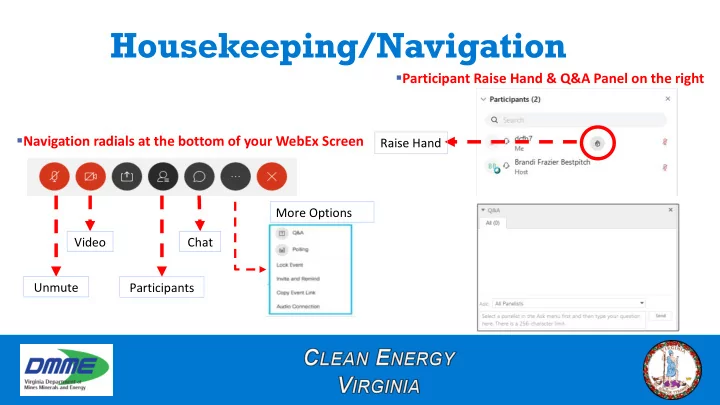
Housekeeping/Navigation Participant Raise Hand & Q&A Panel on the right Navigation radials at the bottom of your WebEx Screen Raise Hand More Options Video Chat Unmute Participants Clean Energy Virginia Webinar Series Angela


slide-1
SLIDE 1

Housekeeping/Navigation

  • Navigation radials at the bottom of your WebEx Screen

Participants More Options Chat Unmute Video Raise Hand

  • Participant Raise Hand & Q&A Panel on the right
slide-2
SLIDE 2

Clean Energy Virginia Webinar Series

Angela Navarro Deputy Secretary of Commerce and Trade Office of Governor Northam

slide-3
SLIDE 3

Webinar Series

Webinars will discuss the Commonwealth’s clean energy policies and next steps, with a focus on the following subjects:

  • Webinar 1: July 22, 2020 – Energy Efficiency
  • Webinar 2: July 29, 2020 – Distributed Generation Solar
  • Webinar 3: August 5, 2020 – Energy Storage
  • Webinar 4: August 12, 2020 – Utility Scale Solar and Onshore Wind
  • Webinar 5: August 19, 2020 – Offshore Wind

Register Today: https://www.dmme.virginia.gov/de/delandingpage.shtml

slide-4
SLIDE 4

Presentation Outline

I. Virginia Clean Economy Act (VCEA) overall goals and regulatory changes II. Energy efficiency components of VCEA (presenter: Chelsea Harnish, VA Energy Efficiency Council)

  • IV. Virginia’s use of Regional Greenhouse Gas Initiative (RGGI) funds to expand

low-income energy efficiency programs for affordable housing (presenter: Erik Johnston, VA Dept. of Housing & Community Development) V. Q&A (moderator: Dan Farrell, DMME)

slide-5
SLIDE 5

Welcome and Introduction

Clean Energy Virginia Policy Objectives:

  • Transition Virginia’s electric grid to 100% carbon-free resources by 2050;
  • Significant build-out of clean energy assets that will drive new investment

across the Commonwealth;

  • Provide the landscape for clean energy businesses to expand or locate in

the Commonwealth; and

  • Ensure energy equity and environmental justice while providing benefits to

historically economically disadvantaged communities.

slide-6
SLIDE 6

State Energy Goals: Executive Order 43

30% by 2030

Produce 30 percent of Virginia’s electricity from renewable energy sources by 2030

Energy Equity

Achieve energy goals in a just manner that advance social, energy, and environmental equity

6

100% by 2050

Produce 100 percent of Virginia’s electricity from carbon-free sources by 2050

slide-7
SLIDE 7

Virginia Clean Economy Act

  • Establishes a mandatory renewable portfolio standard

(RPS):

  • Dominion Energy: 40% by 2030; 100% by 2045
  • Appalachian Power: 30% by 2030; 100% by 2050
  • Establishes a mandatory energy efficiency resource

standard (EERS):

  • Dominion Energy: 5% by 2025
  • Appalachian Power: 2% by 2025
  • Deems 16,100 MW of solar and onshore wind, 5,200 MW of
  • ffshore wind, and 2,700 MW of energy storage in the public

interest.

slide-8
SLIDE 8

VCEA – Major Regulatory Changes

  • Requires State Corporation Commission (SCC) to consider the social

cost of carbon in any application to construct new generating facility.

  • The SCC must ensure development of new energy resources or facilities

does not have disproportionate adverse impact on historically economically disadvantaged communities (HEDCs).

  • Establishes a Percentage of Income Payment Program (PIPP) for low

income households to provide an alternative payment structure.

slide-9
SLIDE 9

Worker Health & Safety During COVID-19 Pandemic

  • Virginia Department of Labor and Industry’s Safety and Health

Codes Board adopted the first statewide emergency workplace safety standards in the U.S. in response to COVID-19.

  • These standards mandate appropriate personal protective

equipment, sanitation, social distancing, infectious disease preparedness and response plans, record keeping, training, and hazard communications in workplaces across the Commonwealth.

  • Opportunities to innovate new processes and technologies to protect

health and safety (e.g. virtual audits and virtual permits)

slide-10
SLIDE 10

Clean Energy Virginia

Energy Efficiency Webinar Partner Organizations

slide-11
SLIDE 11

Audience Poll Question

What type of organization do you represent? (Please respond using poll side panel)

slide-12
SLIDE 12

VCEA - Energy Efficiency Components

Chelsea Harnish, Executive Director Virginia Energy Efficiency Council (VAEEC)

slide-13
SLIDE 13

Energy Efficiency Resource Standard (EERS)

What is an EERS? “An energy efficiency resource standard (EERS) is a quantitative, long-term energy savings target for utilities. Under direction from this policy, utilities must procure a percentage of their future energy needs using energy efficiency measures, typically equal to a specific percentage of their load or projected load growth.”

Source: American Council for an Energy Efficient Economy (www.ACEEE.org)

slide-14
SLIDE 14

Energy Efficiency is Key to Carbon-Free

Source: ACEEE graph using data from International Energy Agency (IEA). www.aceee.org/sites/default/files/publications/researchreports/u1604.pdf

slide-15
SLIDE 15

VCEA Structure for EERS

Year Appalachian Power Co. (“Phase I electric utility”) Dominion Energy (“Phase II electric utility”) 2022 0.5% 1.25% 2023 1.0% 2.50% 2024 1.5% 3.75% 2025 2.0% 5.00%

*Savings are total annual savings achieved by utility programs, calculated against 2019 average annual retail sales baseline

Starting in 2026, State Corporation Commission (SCC) to generate new annual savings targets for each successive three-year period

slide-16
SLIDE 16

Average incremental annual savings target

Electric EERS by State

slide-17
SLIDE 17

VCEA Provides New Business Opportunities

  • EERS savings requirements will compel utilities to better target and

diversify energy efficiency program portfolios

  • Regulatory changes streamline SCC program approval process
  • Get engaged with utility energy efficiency working groups. Email

facilitator Ted Kniker if interested: ted.kniker@ipa-llc.org

  • 50% of revenues generated by Virginia’s participation in RGGI to

Department of Housing and Community Development (DHCD) low- income housing energy efficiency programs

slide-18
SLIDE 18

Specific New Program Opportunities

  • 1. Expanded programs for households and businesses (includes 500 kW

to 1 MW customers)

  • 2. Large industrial customers (>1 MW) must demonstrate effective

internal EE programs before opt-out; new partnerships/savings

  • pportunities
  • 3. Pilot programs considered in the public interest if:
  • Program is of limited scope, cost and duration
  • Intended to determine whether a new program would be cost

effective.

  • Could be used to test innovations (e.g. industrial customers)
slide-19
SLIDE 19

Addressing Energy System Impacts on HEDCs

In Virginia, low-income households face higher-than-national-average energy burdens*. The VCEA will help reduce these burdens by:

  • 1. Increasing funding for utility low-income energy efficiency programs

from 5% to 15%

  • 2. Requiring DMME to evaluate additional burdens imposed on HEDCs

by components of the VCEA that move Virginia to 100% carbon-free

* For more information on energy burden, please visit: https://vplc.org/affordable-clean-energy-project

slide-20
SLIDE 20

Workforce Development

2 or 4 Year degree Preferred or Required: No Certifications Preferred or Required: Yes

  • Association of Energy Engineers (AEE), Certified Energy Manager (CEM)
  • Building Performance Institute (BPI), Energy Auditor
  • American Society of Heating, Refrigeration, and Air-Conditioning Engineers (ASHRAE),

Building Energy Assessment Professional (BEAP)

Virginia Workforce Resources:

  • Virginia Energy Workforce Consortium (VEWC) - Building tomorrow’s workforce needs

in the energy sector

  • Weatherization Training Centers - Train energy professionals to create healthier, safer,

more energy-efficient living and working environments

slide-21
SLIDE 21

Audience Poll Question

Would you like to receive more information about incentives for clean energy businesses in Virginia? (Please respond using poll side panel)

slide-22
SLIDE 22

RGGI Participation & Affordable Housing Investment in Virginia

Erik Johnston, Director

Virginia Department of Housing & Community Development (DHCD)

slide-23
SLIDE 23

What is RGGI?

  • The Regional Greenhouse Gas Initiative (RGGI) is the first mandatory market-

based program in the United States to cap and reduce greenhouse gas emissions

  • Virginia’s CO2 Budget Trading Program regulation became effective on July 1
  • Virginia is in the process of joining RGGI; on January 1, 2021, Virginia will become

a full participant in RGGI

  • Power producers must purchase emissions allowances through the RGGI auctions

and Virginia will begin to receive proceeds from the RGGI auction in the first quarter of 2021 (www.rggi.org)

slide-24
SLIDE 24

Low-income Energy Efficiency Programs

  • 1. 50 percent of RGGI proceeds will be directed to DHCD for affordable

housing programs (per SB 1027/HB 981)

  • 2. Administration’s Goals for RGGI Investments
  • Deep energy retrofits (exceeding code) that complement existing state

affordable housing construction and rehabilitation to ensure lowest income populations benefit from long-term cost savings

  • Incorporate innovative approaches
  • Prioritize long-term sustainability/durability and occupant health (e.g.

ventilation) as well as energy efficiency

slide-25
SLIDE 25

COVID-19: Community Impact & Housing Market Challenges

  • Housing market has multiple challenges with COVID-19 and

economic disruption

  • Focus is now on avoiding evictions and stabilizing housing

market - Governor Northam announced Rent and Mortgage Relief Program (RMRP) on June 26

  • For RMRP eligibility, visit dhcd.virginia.gov/eligibility or call

211 VIRGINIA by dialing 2-1-1 from your phone

slide-26
SLIDE 26

RGGI Implementation Process

  • DHCD will begin stakeholder process in Fall 2020

for public input on how RGGI investments will be used for energy efficiency investments in affordable housing

  • For more information, or to get involved in DHCD’s

stakeholder workgroup: http://dhcd.virginia.gov/rggi

slide-27
SLIDE 27

Clean Energy Virginia

Thanks again to our content and promotional partners!

slide-28
SLIDE 28

Thank you for attending!

Please use the Q&A box to submit your questions