Homo naledi How did id it it happen and what can we le learn? - - PowerPoint PPT Presentation

homo naledi
SMART_READER_LITE
LIVE PREVIEW

Homo naledi How did id it it happen and what can we le learn? - - PowerPoint PPT Presentation

Homo naledi How did id it it happen and what can we le learn? SIG IGNIFICANCE Cradle of Humankind area is 53 ha of privately owned land in the west of Gauteng. ALL of the land is privately owned. Sterkfontein is owned by Wits


slide-1
SLIDE 1

Homo naledi

How did id it it happen and what can we le learn?

slide-2
SLIDE 2

SIG IGNIFICANCE

  • Cradle of Humankind area is 53 ha of privately owned land in the west
  • f Gauteng.
  • ALL of the land is privately owned. Sterkfontein is owned by Wits
  • Declared a World Heritage Site in 1999
  • By far the vast majority of the world’s Hominin fossil finds have been

found in this site (before H. naledi, over 800 fossils)

slide-3
SLIDE 3

Vision

slide-4
SLIDE 4

VISION

  • Area was one of the poorest areas in Gauteng
  • Started with some 47 tourism operations
  • Now has over 400
  • Significant tourism growth in the tourism and leisure sectors since

listing.

  • Inception planning involved visits to Lascaux in France and Dynamic

Earth in the UK

  • Sterkfontein as a natural resource can only manage 800 per day
  • Design was to be multi-purpose, multi-functional and not in

competition with surrounding tourism ventures.

slide-5
SLIDE 5

Vision

slide-6
SLIDE 6

VISION

  • Sterkfontein was to be a modest building, with a strictly scientific

exhibition

  • Maropeng, 10 kms away (and off the World Heritage Site), would be

an iconic building with an underground experience aimed at as broad a range of tourist as possible. Exhibition was intended to be as interactive as possible aimed at a broad audience.

  • Maropeng would take in all of Human development, from our earliest

beginnings - to our expolitative present – to our uncertain future.

slide-7
SLIDE 7

VISION

slide-8
SLIDE 8

VISION

  • Government provided R360m for the upgrade of the area.
  • This included 36 kms of roads and bulk infrastructure
  • Connectivity with Lanseria airport, Magaliesburg and the North West

Province.

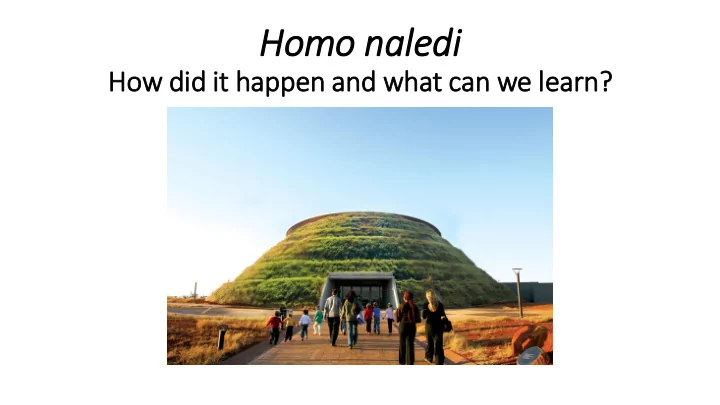
  • An iconic Tumulus building at Maropeng
  • Underground experience
  • Boatride
  • Contemplative space for viewing original fossils
  • Virtual Laboratory
  • Centrepiece for the World Heritage Site as a whole.
  • 24 bed boutique Hotel.
  • 120 bed multi-use “learners” accommodation
  • Intended that it would take 20 years to attain self-sufficiency.
slide-9
SLIDE 9

HOMO NALEDI

slide-10
SLIDE 10

HOMO NALEDI

  • Previously unknown species, clearly bipedal and connected in some

way to the human genetic path

  • Required extremely small scientists to do the excavation
  • Over 1 800 bones found in 1 square metre of excavation.
  • Extremely unusual, fragile bones.
  • All of one species, with specimens from babies to old age
  • Only other species was a relatively recent owl and its dinner.
  • Upper body ape-like
  • Lower body modern human
  • Brain the size of an orange
slide-11
SLIDE 11

HOMO NALEDI

slide-12
SLIDE 12

HOMO NALEDI

  • Professor Lee Berger discovered not only H. sediba in 2010, but now also H.

naledi.

  • As he put it in 2010 “This is so off the charts, it makes winning the lottery

look easy”. (I would want to add – twice!)

  • H. naledi had all the elements of an intriguing mystery. So many bones; all
  • f the same species; in a cave with highly restricted entry.
  • National Geographic quickly took hold of the story and it became

international news.

  • H. naledi became, over a period of three weeks, as famous a brand as that
  • ther immediately recognisable South African name, “Nelson Mandela”.
slide-13
SLIDE 13

HOMO NALEDI

  • With H. naledi there were a number of interlinked stories that

captivated the public imagination:

  • The story of the find itself;
  • The story of the “Underground astronauts”;
  • The story of the possible burial ground.
  • Visitor numbers sky-rocketed. From the usual 300 visitors a day, we

were getting 3 500 people per day.

  • Visitors across race, gender, age, religion, Province and country.
slide-14
SLIDE 14

HOMO NALEDI

20000 40000 60000 80000 100000 120000 140000 160000 Total 2013 Total 2014 Total 2015 5000 10000 15000 20000 25000 30000 Sept 2013 Oct 2013 Sept 2014 Oct 2015 Sept 2015 Oct 2015 Maropeng Sterkfontein

slide-15
SLIDE 15

HOMO NALEDI

  • Plans are afoot to have a permanent exhibition of H. naledi at

Maropeng

  • Presently installing temporary exhibition space for specific themed exhibitions
  • Also long-term exhibitions for the latest finds
slide-16
SLIDE 16

THE LONG AND THE SHORT OF THE STORY

The STORY is what sells The STORY is what compels The STORY is what gets re-told