SLIDE 1
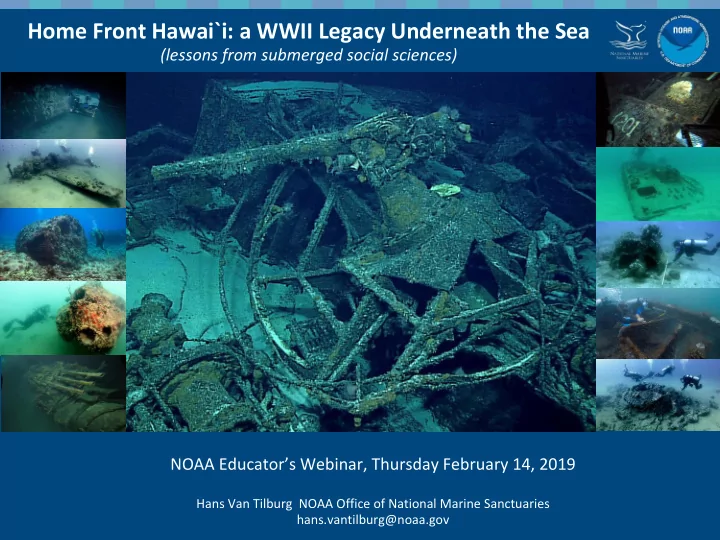
Home Front Hawai`i: a WWII Legacy Underneath the Sea
(lessons from submerged social sciences)
Hans Van Tilburg NOAA Office of National Marine Sanctuaries hans.vantilburg@noaa.gov
NOAA Educator’s Webinar, Thursday February 14, 2019
SLIDE 2
Topics to be Covered: 1) The maritime heritage field = submerged social science 2) The Hawaiian Islands during the war years = history 3) The WWII resource base in Hawai`i = maritime archaeology 4) Wrecks and the environment = biological interactions 5) Access to the oceans = evolving marine technology 6) Maritime Cultural Landscapes = understanding our impacts
SLIDE 3
Submerged Social Sciences
What is Maritime Archaeology? “The interpretation of the seafaring past through the study of things manufactured or modified by humans…usually underwater” but not this… This…
Multidisciplinary: Anthropology History Geography Engineering Chemistry etc
This…
Field initiated by Dr. George Bass and others in the 1960s
SLIDE 4 Training in the maritime archaeology field
Types of coursework:
- archaeology
- anthropology
- history
- museum studies
- material culture
- GIS and mapping
- engineering
- acoustics
- etc
- Applied skills needed:
- diving
- computer
- grant writing
- rigging
- drafting (drawing)
- photography
- archival research
Main American universities:
- Texas A&M
- East Carolina University
College graduate (Masters) degree standard for the field
SLIDE 5
- National Historic Preservation Act
section 106 section 110
- National Marine Sanctuaries Act
includes historic, archaeological, cultural resources
State properties under DLNR
- Sunken Military Craft Act
military vessels remain federal property
Maritime Heritage: the Preservation of our archaeological resources in the sea
SLIDE 6 History: Islands during War Years
US Army Museum
- Martial Law
- Japanese internment
- Loss of habeas corpus
- School closures
- Censorship
- Coastal fortifications
- Gas masks
- Curfew
- Blackout
- Rationing
- Victory gardens
- Loss of fishing fleet
Waikiki, Territory of Hawai`i, 1943
SLIDE 7 History: Islands during War Years
Japanese-American loyalty on parade, Waikiki 1942
US Army Museum
SLIDE 8 History: Islands during War Years
4th Marine Division departing Kahului, Maui
National Archives
SLIDE 9 History: Islands during War Years
WWII Ground training areas, Territory of Hawai`i
US Army Museum
SLIDE 10 Archaeology: Early Naval Aviation in Hawai`i
Ford Island VP-1 squadron insignia Keystone PK-I naval flying boat, long-range patrol bomber 1930s (USN photo)
(NOAA ONMS) (NOAA ONMS) USN
SLIDE 11 Archaeological Resource: 1,475+ Sunken Naval Aircraft
TBF Avenger
(Ross and Milisen 2015)
SB2C-1C Helldiver F6F Hellcat (HURL)
SLIDE 12 Evolution of amphibian vessels and tactics, 1932-1945
(USN image)
LCA
landing craft assault, small vessel LCI landing craft Infantry, fitted with bow doors LCP landing craft personnel, for transporting personal LCS landing craft support, small armed landing craft LCT landing craft tank, up to four tanks and bow doors LSI landing ship infantry, ship carrying LCI, or capable of being grounded LSM landing ship medium LST landing ship tank, RoRo vessel converted for carrying tanks DUKW amphibious truck six-wheel drive
And specific variations of all these:
SLIDE 13
Archaeological Resource: Amphibious Vessel losses in Hawai`i
LVT-4 Maui LVT(A)-4 Maui Operation Forager training exercises April-May 1944, Maui (NARA)
SLIDE 14
Combat losses in Hawai`i
USS Utah USS Arizona Japanese Kohyoteki (minisub) HURL PBY-5 site plan (Kaneohe Bay) (NPS) (NPS) Islands only attacked a couple times
SLIDE 15
Main Hawaiian Islands 2,127 entries in the database
SLIDE 16
Educational Collaboration: MAST courses (UH) NAS sport diver training
SLIDE 17
Biological Interaction: Wrecks in the Marine Environment
SLIDE 18
Biological Interaction: Wrecks in the Marine Environment
SLIDE 19
Biology: Wrecks in the Marine Environment
SLIDE 20 Technology: Multibeam and Backscatter Data for Target Analysis
Backscatter imagery comparison Multibeam survey
(NOAA OER)
Hull-mounted multibeam sonar The multibeam target = Japanese sibmarine I-401 Kongsberg EM302 30khz multibeam Range 7000m
SLIDE 21
Technology: from Breath-hold to Bubbles and Beyond
Diving bell 17th century Heavy gear 19th century SCUBA 1950s
Lloyd bridges as Mike Nelson!
Open-circuit scientific diving Closed-circuit rebreather technology
SLIDE 22 Hawai`i Undersea Research Lab PISCES 3-person research submersibles
(HURL C Wollerman)
SLIDE 23
ROV Surveys (Okeanos Explorer)
Ship control cab Remotely Operated Vehicles Deep Discoverer and Seirios Range 6000m
Shoreside Comm Center
SLIDE 24
Deploying Seirios and D2 ROV system
SLIDE 25
1) Oahu S-19 survey Sept 2015 2) Wake Island Amakasu Maru No.1 survey March 2016 3) Tinian B-29 Superfortress survey July 2016 4) Oahu Japanese mini-submarine survey Dec 2016 5) Oahu Royal Taipan (ex-USS Swan) survey Dec 2016 6) Oahu Sentaka I-203 search Sept 2017 7) Oahu USS Baltimore survey Sept 2017 NOAA CAPSTONE archaeology missions 2014-2017
SLIDE 26
"The maritime cultural landscape signifies human utilization (economy) of maritime space by boat, settlement, fishing, hunting, shipping, and its attendant subcultures, such as pilotage, lighthouse and seamark maintenance…"
Cultural Landscapes: Patterns in Ocean History
Navigation landscape along coasts and harbors Commercial fishing landscape Cultural landscape of traditional voyaging
SLIDE 27
Using a landscape analysis to understand WWII on the home front
SLIDE 28 …one of the most organized, premeditated, regimented, and patterned forms of human behavior…the action of military units on a battlefield are based on the tactics of the prevailing military wisdom of the day; they are not random. (Potter et al 2000)
Amphibious landing plan “Porcelain” Island -- Kwajalein
National Archives
SLIDE 29 T.A. 2nd Div T.A. 4th Div
LST area LST area
helldiver sailboat schooner helldiver helldiver hellcat mooring St Anthonys LVT LVTs schooner LVT
GREEN 1 GREEN 2 BLUE 1 BLUE 2 MAKENA AIRFIELD (CONSTRUCTIVE)
Amphibious rehearsal exercises Maui Island, Operation Forager, May 1944
SLIDE 30
Examples of modern military training landscapes in Hawai`i
SLIDE 31
Potentially polluting wrecks worldwide
SLIDE 32
Review: 1) The maritime heritage field = submerged social science 2) The Hawaiian Islands during the war years = history 3) The WWII resource base in Hawai`i = maritime archaeology 4) Wrecks and the environment = biological interactions 5) Access to the oceans = evolving marine technology 6) Maritime Cultural Landscapes = understanding our impacts
SLIDE 33
Wreck of the Dunnottar Castle 1886
“Curiosity is the First Prerequisite”
Thank you for participating
History and heritage have a special place in Our Oceans…