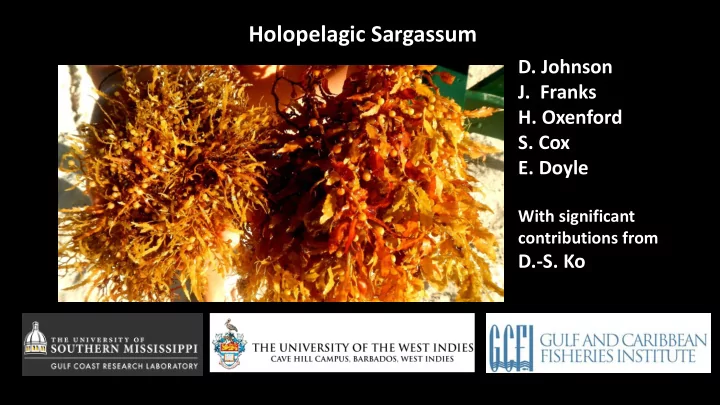
SLIDE 1 Holopelagic Sargassum
- D. Johnson
- J. Franks
- H. Oxenford
- E. Doyle
With data from
- S. Cox
- C. Hu
- M. Wang
- D. Johnson
- J. Franks
- H. Oxenford
- S. Cox
- E. Doyle
With significant contributions from
D.-S. Ko
SLIDE 2
Brown macroalgae (seaweed) Pelagic: from classical Greek means open sea. Holopelagic: All of life is at sea. Clings (?) together in large mats and long lines. Can be ~1-2 m thick. Reproduces vegetatively – breaks and new growth. Provides a unique open sea ecosystem.
What is it?
SLIDE 3 Pelagic Sargassum Fact Sheet
What is it? Mitigating impacts on Fishers. Removing from beaches.
SLIDE 4
Where did it come from? NERR
SLIDE 5
Working Hypothesis Working Hypothesis
During winter the NERR should ‘flush’ to the west/northwest. Exchanges between the east and west consolidation areas give several years gap in sargassum ‘leakage’ to the Caribbean.
SLIDE 6 PredictiWhere did it come from?
- Most likely from the North Atlantic in
sufficient quantity (critical mass?) to ‘bloom’ in the NERR before winter current reversals and flushing occurs.
- Once in the NERR it takes different routes
from different bloom/consolidation regions to different parts of the Caribbean in different seasons.
SLIDE 7 NAO: winds TNA: temperature AMM: equatorial dynamics
Why Now?
- Important Atlantic climate peaks
(pos and neg) were coincidental and large in 2010-2011.
- However, no ‘smoking gun.’
- Non-linear bio-physical
interaction due to large decadal scale climate oscillations may have played a role.
- African dust? Iron, manganese
and changing ocean PH.
SLIDE 8 What are the negative Impacts?
- Tourism and Health
- Shore ecology
- Turtle nesting
- Damage from removal
- Coral Reefs
- Sea grasses
- Turtle and porpoise drowning
- Fisheries
SLIDE 9
SLIDE 10 Diane Wilson
Sierra Leone, Andrew Huckbody
SLIDE 11 Hazel Oxenford
South Coast, Barbados, - July 2017
Radio Grenadines
Mustique – July 2014
Brigitte Gavio
Before Sargassum After Sargassum
Biological Impact of Sargassum on the coast.
SLIDE 12 Catch of Flyingfish 1994-2017 Barbados
Red line indicates first report
Barbados. Horizontal dashed lines are mean catch before and after June 2011. Flyingfish use Sargassum to attach egg masses. Flyingfish being replaced by Almaco Jacks in the fisheries. Dolphinfish are juveniles.
56.25 % decrease
June 2011 Flyingfish
2018
SLIDE 13 Take away messages
- It is very doubtful that the Sargasso Sea simply expanded its
- territory. The NERR appears to be a separate consolidation and
bloom area that was seeded by the Sargasso Sea.
- The new area extends across the Atlantic from Brazil to West Africa.
Sargassum on the coastline is not just a ‘Caribbean’ problem.
- It is not clear, but the NERR bloom possibly began with a
combination of coincidental climate conditions and biological responses.
- Coastal ecosystems are seriously harmed by massive invasions of
pelagic Sargassum.
- Offshore fisheries (fish and fishers) can be harmed or enhanced, but
certainly changed.
SLIDE 14
Management response (from Emma Doyle)
The response to the sargassum influx has often been a knee-jerk reaction - uncoordinated and not always environmentally sustainable. Local agencies need to agree on where and when it’s justified to take action to clean beaches or collect sargassum and how to dispose of it. Although various new approaches are evolving to manage sargassum in-water, they are costly, challenged by real marine and coastal conditions, and have at best mixed results. Good communications between agencies and the private sector, with the press, and with locals and visitors is essential.