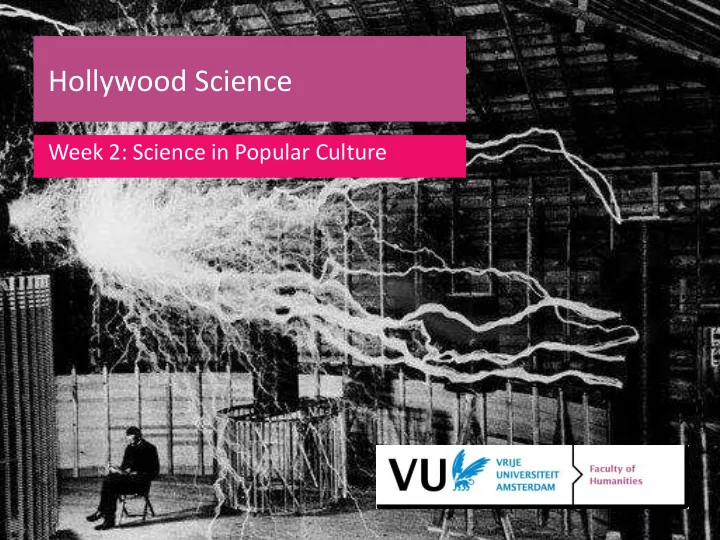
Hollywood Science Hollywood Science Week 2: Science in Popular - - PowerPoint PPT Presentation

hollywood science hollywood science
SMART_READER_LITE
LIVE PREVIEW

Hollywood Science Hollywood Science Week 2: Science in Popular - - PowerPoint PPT Presentation

Hollywood Science Hollywood Science Week 2: Science in Popular Culture A quick recap A quick recap Lecture 1 Science & Arts Two separate fields? Power of media Power of fiction Mutual influence Scientific


slide-1
SLIDE 1

Hollywood Science Hollywood Science

Week 2: Science in Popular Culture

slide-2
SLIDE 2

Faculty of Humanities

A quick recap A quick recap

Lecture 1

  • Science & Arts
  • Two separate fields?
  • Power of media
  • Power of fiction
  • Mutual influence
  • Scientific discovery (‘Canali on mars’) inspiration for fiction
  • Can it also be the other way around?

2 Hollywood Science – Week 2 – Leon van Wissen

slide-3
SLIDE 3

Faculty of Humanities

A quick recap A quick recap

The War of the Worlds (1953)

  • Science?
  • Second World War
  • Religion?
  • ‘The littlest things’
  • Stereotypes?
  • Dr. Clayton Forrester
  • Sylvia van Buren

3 Hollywood Science – Week 2 – Leon van Wissen

slide-4
SLIDE 4

Faculty of Humanities

Example: Ben Feringa (RUG), chemist Example: Ben Feringa (RUG), chemist

4 Hollywood Science – Week 2 – Leon van Wissen

slide-5
SLIDE 5

Faculty of Humanities

Ben Feringa, research program Ben Feringa, research program

“The research program of the Feringa group is focussed on synthetic and physical organic chemistry. Inspired by Nature's principles of molecular assembly, recognition, transport, motion and catalysis, the goal is to exploit the full potential of synthetic chemistry to create new structures and functions. A major part of the research is directed towards dynamic molecular systems. The focus is on molecular nanoscience, novel responsive materials and photo-pharma exploring biohybrid systems, self-assembly, molecular switches and motors.”

Taken from: www.benferinga.com

5 Hollywood Science – Week 2 – Leon van Wissen

slide-6
SLIDE 6

Faculty of Humanities

Ben Feringa, molecular motors Ben Feringa, molecular motors

“Molecular motors: how to control motion by exploring synthetic molecular motors. Light-driven rotary motors and catalytic motors are studied. The focus is on autonomous motion, the quest to make motors to perform work and the integration of molecular motors in nano-mechanical systems.”

  • Drug delivery?
  • Chemical

reactions?

  • Motor as

methaphor

6 Hollywood Science – Week 2 – Leon van Wissen

Taken from: https://cen.acs.org/articles/92/i40/Molecular-Mixers.html

slide-7
SLIDE 7

Faculty of Humanities

Ben Feringa, reference to Fantastic Voyage Ben Feringa, reference to Fantastic Voyage

In his Nobel Prize lecture, Feringa refered to Fantastic Voyage, a film about a submarine crew that shrinks to microscopic size and venture into the body of an injured scientist to repair the damage to his brain. Lecture on YouTube Start at 00:32:53 minutes (until 00:35:00) Science Fiction influences Science

  • “The best way to predict the future is to invent it” – Alan Kay

7 Hollywood Science – Week 2 – Leon van Wissen

slide-8
SLIDE 8

Faculty of Humanities

Nature’s reference to Fantastic Voyage Nature’s reference to Fantastic Voyage

“Meanwhile, inspired by the microscopic medical submarine of the cult 1966 film Fantastic Voyage, chemists have created an array of micrometre-sized particles and tubes that can zip through liquids like rockets.” “Wang suggests that loading drugs or imaging compounds onto the rockets could deliver them into stomach tissue rapidly and

  • effectively. “In the next five years we will move to practical in vivo

applications,” he says. “It really is the fantastic voyage.” Taken from: Peplow (2015)

8 Hollywood Science – Week 2 – Leon van Wissen

slide-9
SLIDE 9

Faculty of Humanities

Fantastic Voyage (1966), dir. Richard Fleischer Fantastic Voyage (1966), dir. Richard Fleischer

Summary

  • Cold War
  • Stolen technology
  • Shrunken nuclear powered submarine

Made into a book:

  • Fantastic Voyage (1966)

by Isaac Asimov

Science influences Science Fiction

(Dubeck et al. 2004, p. 261-265)

9 Hollywood Science – Week 2 – Leon van Wissen

slide-10
SLIDE 10

Faculty of Humanities

Trailer: Fantastic Voyage (1966) Trailer: Fantastic Voyage (1966)

https://www.youtube.com/watch?v=VcMwNSiQ8Jk

10 Hollywood Science – Week 2 – Leon van Wissen

slide-11
SLIDE 11

Faculty of Humanities

Fantastic Voyage (1966), dir. Richard Fleischer Fantastic Voyage (1966), dir. Richard Fleischer

Themes

  • A ‘Fantastic Voyage’
  • Odyssey?
  • Verne’s Twenty Thousand

Leagues under the Sea (1970)

  • Shrinkage
  • Biotourism
  • Sexism?

11 Hollywood Science – Week 2 – Leon van Wissen

slide-12
SLIDE 12

Faculty of Humanities

Sci-Fi influencing Technology Sci-Fi influencing Technology

Other examples: Science Fiction becoming ‘Science Fact’

  • “[…] the inventor of the first liquid-fuelled rocket, American

Robert H. Goddard, was inspired by H.G. Wells’ science fiction novel War of the Worlds (1898).”

  • “Similarly, the tablet computer actually first appeared in

Stanley Kubrick’s 2001: A Space Odyssey (1968) […]”

  • “[…] and the communicator– which we’ve

come to refer today as the mobile phone – was first used by Captain Kirk in Star Trek (1966).”

12 Hollywood Science – Week 2 – Leon van Wissen

Emmanuel Tsekleves, “Science fiction as fact: how desires drive discoveries.” The Guardian, 13 August 2015, https://www.theguardian.com/media-network/2015/aug/13/science-fiction-reality-predicts-future-technology

slide-13
SLIDE 13

Faculty of Humanities

Sci-Fi influencing Technology Sci-Fi influencing Technology

“Therefore science fiction, or what the design world refers to as design fiction, isn’t fiction but a technique for thinking ahead, predicting future technologies, potentially influencing policy, but most importantly creating debate by asking what if? In this way, science fiction can be used as a tool to help design future societies and technologies, giving the public a say on it too.”

13 Hollywood Science – Week 2 – Leon van Wissen

Emmanuel Tsekleves, “Science fiction as fact: how desires drive discoveries.” The Guardian, 13 August 2015, https://www.theguardian.com/media-network/2015/aug/13/science-fiction-reality-predicts-future-technology

slide-14
SLIDE 14

Faculty of Humanities

Sci-Fi influencing Technology Sci-Fi influencing Technology

Further reading:

  • Lorraine Longhi, "Science fiction: Shaping the future".

Knowledge Enterprise Development ASU, https://research.asu.edu/stories/read/science-fiction-shaping- future

  • Cory Doctorow, “I've Created a Monster!”. Slate, May 2017,

www.slate.com/articles/technology/future_tense/2017/05/sci _fi_doesn_t_predict_the_future_it_influences_it.html

14 Hollywood Science – Week 2 – Leon van Wissen

slide-15
SLIDE 15

Faculty of Humanities

Analysis: Intertextuality Analysis: Intertextuality

Definition:

  • “Intertextuality denotes the way in which texts (any text, not

just literature) gain meaning through their referencing or evocation of other texts.” (Novak, 2013) Examples:

  • Tolkien (Lord of The Rings) borrowing themes from Mediaeval

English Literature

  • A chemist referring to a movie
  • Parody or pastiche

15 Hollywood Science – Week 2 – Leon van Wissen

slide-16
SLIDE 16

Faculty of Humanities

Analysis: Intertextuality Analysis: Intertextuality

To:

  • Create relations between texts

Ask yourself:

  • Why is this intertextuality established?
  • Why did Nature and Feringa refer to Fantastic Voyage?
  • How is it used, meaning?
  • How was this movie reference used?
  • Effect?
  • What was the effect of the reference?

16 Hollywood Science – Week 2 – Leon van Wissen

slide-17
SLIDE 17

Faculty of Humanities

Analysis: Identification Analysis: Identification

Definition:

  • Identification is “[t]he (frequently unconscious) adaptation of one's ideas

and behaviour to accord or conform with those of a person or group seen as a model” (OED Third edition)

  • Result: feeling of close emotional and/or intellectual association.

To:

  • Depends on the object
  • Make something more appealing
  • Establish common ground

Ask yourself:

  • How is this identification established?
  • Why is it used?
  • Effect?

17 Hollywood Science – Week 2 – Leon van Wissen

slide-18
SLIDE 18

Faculty of Humanities

Analysis: Intertextuality and identification Analysis: Intertextuality and identification

In the case of Fantastic Voyage (1961):

  • Analogy/correspondence science and a film work
  • Shared conceptual horizon
  • To illustrate how his technique works
  • Making it easier to understand?
  • Related to the History of Technology
  • From fiction to reality
  • Honour the spirit of the film’s scientists
  • Evokes the image of the scientist as an entrepreneur, an

adventurer, and a hero

  • Narrative  Science as an adventure

18 Hollywood Science – Week 2 – Leon van Wissen

slide-19
SLIDE 19

Faculty of Humanities

This course: Representation of science in films This course: Representation of science in films

Hypothesis:

  • Science in film had and still has an huge impact on the general

(public) appraisal of the meaning and function of science in our society. Looking at:

  • Dissemination (of Knowledge)
  • Popular culture
  • Science in society.

Movies play a large role in defining the image of science in society. At the same time, movies are shaped by society. It is a two way stream.

19 Hollywood Science – Week 2 – Leon van Wissen

slide-20
SLIDE 20

Faculty of Humanities

Wrap-up: Two fields still exist Wrap-up: Two fields still exist

20 Hollywood Science – Week 2 – Leon van Wissen

Science Fiction (Arts … ) Strict methodological rules, experimenting and explaining No strict rules, ‘free’ , interpreting and understanding Conceptualization of facts, empirical data & manipulating nature Conceptualization and manipulation of everything: feeling, vision, attitude, thinking, dreaming, being, sound… ‘Democratic’, transparant, lucid, certain, coherent, logic Opaque, enigmatic, uncertain, incoherent, a-logic… Creative, adventurous , beautiful, fullfilling Creative, adventurous, beautiful, fullfilling

slide-21
SLIDE 21

Faculty of Humanities

Sidney Perkowitz: Hollywood Science Sidney Perkowitz: Hollywood Science

Genre problem Science Fiction

“Science fiction has proved notoriously difficult to define. It has variously been explained as a combination of romance, science, and prophecy (Hugo Gernsback), ‘realistic speculation about future events’ (Robert Heinlein), and a genre based on an imagined alternative to the reader’s environment (Darko Suvin). It has been called a form of fantastic fiction and an historical literature.” (Seed, p. 1) “It is helpful to think of an SF narrative as an embodied thought experiment whereby aspects of our familiar reality are transformed or suspended.” (Seed, p. 2) “[…] it consists of stories that extrapolate known science to ask ‘what if?’” (Perkowitz, p. 6)

21 Hollywood Science – Week 2 – Leon van Wissen

slide-22
SLIDE 22

Faculty of Humanities

Sidney Perkowitz: Hollywood Science Sidney Perkowitz: Hollywood Science

Definition:

  • “Fiction in which the setting and story feature hypothetical

scientific or technological advances, the existence of alien life, space or time travel, etc., esp. such fiction set in the future, or an imagined alternative universe.” (OED, Third edition)

  • Hard Science Fiction
  • Technological, analytical, strict
  • Exact/Hard sciences
  • Soft Science Fiction
  • Magical, intuitive, loose
  • Soft sciences

22 Hollywood Science – Week 2 – Leon van Wissen

(Roberts 2016)

slide-23
SLIDE 23

Faculty of Humanities

Sidney Perkowitz: Hollywood Science vs. Real Science Sidney Perkowitz: Hollywood Science vs. Real Science

Chapter 10

  • Bad science? Misinformation? Does this matter?
  • Film vs. Documentary
  • Still obyding nature’s laws?
  • Science <-> (Science) Fiction
  • Entertainment != accurate

“At one level, these films educate informally by presenting ideas like emerging viruses and black holes. But when the filmmaker’s first commitment is to tell an entertaining story, there’s little guarantee that the science is accurate. That may not affect the inspirational value of these films, but mistakes or deliberate distortion can do more harm than good to science literacy and public understanding of science.” (p. 217-218)

23 Hollywood Science – Week 2 – Leon van Wissen

slide-24
SLIDE 24

Faculty of Humanities

Sidney Perkowitz: Hollywood Science vs. Real Science Sidney Perkowitz: Hollywood Science vs. Real Science

Chapter 10

  • Science faction (p. 219)

“[…] illustrating that audiences do want a degree of verisimilitude: people can suspend only so much disbelief (p. 219)

  • Referentiality
  • Mimesis
  • Fictionalise
  • To:
  • Boost ‘reader’s emersion in the narrative/story
  • Entertainment!
  • Trade-off!

24 Hollywood Science – Week 2 – Leon van Wissen

slide-25
SLIDE 25

Faculty of Humanities

Sidney Perkowitz: Hollywood Science Sidney Perkowitz: Hollywood Science

“It’s true that we groan and complain when a science fiction film shows incorrect science or caricatures of scientists” (p. ix)

25 Hollywood Science – Week 2 – Leon van Wissen

slide-26
SLIDE 26

Faculty of Humanities

Sidney Perkowitz: Hollywood Science Sidney Perkowitz: Hollywood Science

26 Hollywood Science – Week 2 – Leon van Wissen

slide-27
SLIDE 27

The mad scientist The mad scientist

27 Hollywood Science – Week 2 – Leon van Wissen

Perkowitz and Superman analysis

slide-28
SLIDE 28

Faculty of Humanities

Sidney Perkowitz: Scientists as Heroes, Nerds and Villains Sidney Perkowitz: Scientists as Heroes, Nerds and Villains

Chapter 8 Stereotypes

  • Scientist as authority (p. 168)
  • Scientist as social outcast (p. 171)
  • Male/female scientists

“[…] because even when a female scientist appears, she may play a secondary part” (p. 186)

28 Hollywood Science – Week 2 – Leon van Wissen

Dana Scully, The X-Files

slide-29
SLIDE 29

Faculty of Humanities

Sidney Perkowitz: Scientists as Heroes, Nerds and Villains Sidney Perkowitz: Scientists as Heroes, Nerds and Villains

Chapter 8 Stereotypes Three (stereo)types (cf. James Cameron, p. 172):

  • 1. Nerd
  • 2. Villain  Mad Scientist
  • 3. Hero

29 Hollywood Science – Week 2 – Leon van Wissen

Evil Genius game, 2004

slide-30
SLIDE 30

Faculty of Humanities

Sidney Perkowitz: Scientists as Heroes, Nerds and Villains Sidney Perkowitz: Scientists as Heroes, Nerds and Villains

Mad scientist “[…] the madness is being driven by the thirst for knowledge […]” (p. 177)

  • Villains develop along with new sciences (p. 180)
  • Rise of genetic engineering (example: Mengele)
  • Stereotypes
  • How are scientists represented?
  • Female / male?
  • Attitude?

30 Hollywood Science – Week 2 – Leon van Wissen

Alchemist/Scientist Rotwang from Metropolis (1927)

slide-31
SLIDE 31

Faculty of Humanities

Superman – The Mad Scientist (1941) Superman – The Mad Scientist (1941)

https://www.youtube.com/watch?v=_frD6bGp63U September 26, 1941 Episode: 1 (of 17) First Appearance: Superman, Clark Kent, Lois Lane

Produced by Fleischer Studios and released by Paramount Pictures

31 Hollywood Science – Week 2 – Leon van Wissen

slide-32
SLIDE 32

Faculty of Humanities

Superman – The Mad Scientist (1941) Superman – The Mad Scientist (1941)

  • Mythology
  • Superman coming from Krypton on Earth
  • Scientist disturbing the Societal Order
  • Letter forecasting total destruction by a beam
  • Detective/crime
  • Investigation Attempt 1: Female journalist
  • Attack 1: on the Suspension Bridge
  • Investigation Attempt 2: Superman / male journalist
  • Attack 2: on the building of the Newspaper Company
  • Succes of Superman, Capture of the Scientist
  • In the end:
  • All's well that ends well: Restoration of the Societal Order

32 Hollywood Science – Week 2 – Leon van Wissen

slide-33
SLIDE 33

Faculty of Humanities

Superman – The Mad Scientist (1941) Superman – The Mad Scientist (1941)

“Electro-thanasia ray” New (composite) word with ‘blurry’ reference!

  • electro
  • Latin: electrum (amber) or Greek elektron (energy)
  • thanasia
  • Greek: thanatos (death, associations with ‘death’ and ‘violence’)
  • Freud’s Death Drive (Todestrieb/Thanatos)?

33 Hollywood Science – Week 2 – Leon van Wissen

slide-34
SLIDE 34

Faculty of Humanities

Narrative: structured by Opposition Narrative: structured by Opposition

34 Hollywood Science – Week 2 – Leon van Wissen

Male Characters: Superman Mad Scientist: without a name! Non Human/Human, Strong, Brave, Responsible, Member of a Team (Daily Planet) Human?, Briljant Technician, Organiser, Individual Lucid, Responsible, Safekeeper, Rational Weird, Irresponsible, Striving for World Domination, Disruption the Order, ‘Uncanny’ Good (in ethical and/or juridical and/or societal terms) Bad (although clever)

slide-35
SLIDE 35

Faculty of Humanities

Narrative: Opposition Narrative: Opposition

35 Hollywood Science – Week 2 – Leon van Wissen

Location or Space: Superman Mad Scientist Modern City (Working Life) Metropolis Isolated Rock, (Gothic?) Castle with ‘industrial aspects’ – factory, Machines (no furniture)

slide-36
SLIDE 36

Faculty of Humanities

Actantial model (Greimas) Actantial model (Greimas)

36 Hollywood Science – Week 2 – Leon van Wissen

slide-37
SLIDE 37

Faculty of Humanities

Actantial model (Greimas) Actantial model (Greimas)

  • Subject: Superman
  • Object: Restoration of order
  • Sender: Letter/danger from mad scientist
  • Receiver: Society
  • Helper: Louis Lane
  • Opponent: Mad Scientist

37 Hollywood Science – Week 2 – Leon van Wissen

slide-38
SLIDE 38

Faculty of Humanities

Superman – The Mad Scientist (1941) - Source? Superman – The Mad Scientist (1941) - Source?

  • Nikola Tesla (1856-1943)
  • Tesla Tower
  • Tesla sitting in his Colorado

Springs laboratory with his magnifying transmitter generating millions of volts.

  • War of the currents
  • AC/DC
  • Thomas Edison

38 Hollywood Science – Week 2 – Leon van Wissen

Further reading:

  • https://www.nytimes.com/1979/02/06/archives/

war-of-the-currents-had-profound-impact-the- war-of-the-currents-had.html

  • https://www.energy.gov/edison-vs-tesla
slide-39
SLIDE 39

Faculty of Humanities

Superman – The Mad Scientist (1941) - Nikola Tesla Superman – The Mad Scientist (1941) - Nikola Tesla

“Instead of being hailed as a genius and brilliant inventor, Tesla was increasingly thought of as a “mad scientist” in the minds of the general public and in popular culture.” (Hamilton, p. 14) “Newspaper reporters, looking for a laugh, would attend to listen to the crazy old man’s

  • utlandish predictions of wireless telephones,

communication with other life forms in the cosmos, beam weapons that could shoot down airplanes and missiles, and many more science fiction concepts that are now becoming reality.” (Uth in Hamilton, p. 14)

39 Hollywood Science – Week 2 – Leon van Wissen

slide-40
SLIDE 40

Faculty of Humanities

Tesla Tesla

40 Hollywood Science – Week 2 – Leon van Wissen

slide-41
SLIDE 41

Faculty of Humanities

Tesla Tesla

41 Hollywood Science – Week 2 – Leon van Wissen

slide-42
SLIDE 42

Faculty of Humanities

References References

  • Doctorow, Cory, “I've Created a Monster!”. Slate, May 2017,

www.slate.com/articles/technology/future_tense/2017/05/sci_fi_doesn_t_predict_the_future_it_inf luences_it.html

  • Dubeck, Leroy W., Judith E. Boss, and Suzanne E. Moshier. "Films Without LIterary [sic.]

Commentary." Fantastic Voyages: Learning Science Through Science Fiction Films (2004): 291-339.

  • Hamilton, Tyler J. Mad Like Tesla: Underdog inventors and their relentless pursuit of clean energy.

ECW Press, 2011.

  • Longhi, Lorraine, "Science fiction: Shaping the future". Knowledge Enterprise Development ASU,

https://research.asu.edu/stories/read/science-fiction-shaping-future

  • Novak, Sophie. “Intertextuality As A Literary Device.” The Write Practice, 30 Sept. 2013,

thewritepractice.com/intertextuality-as-a-literary-device/.

  • Peplow, Mark. "The tiniest Lego: a tale of nanoscale motors, rotors, switches and pumps." Nature

News 525.7567 (2015): 18.

  • Roberts, Adam. The history of science fiction. Palgrave Macmillan, 2016.
  • Seed, David. Science Fiction: a very short introduction. Vol. 271. Oxford University Press, 2011.
  • Tsekleves, Emmanuel, “Science fiction as fact: how desires drive discoveries.” The Guardian, 13

August 2015, https://www.theguardian.com/media-network/2015/aug/13/science-fiction-reality- predicts-future-technology

42 Hollywood Science – Week 2 – Leon van Wissen