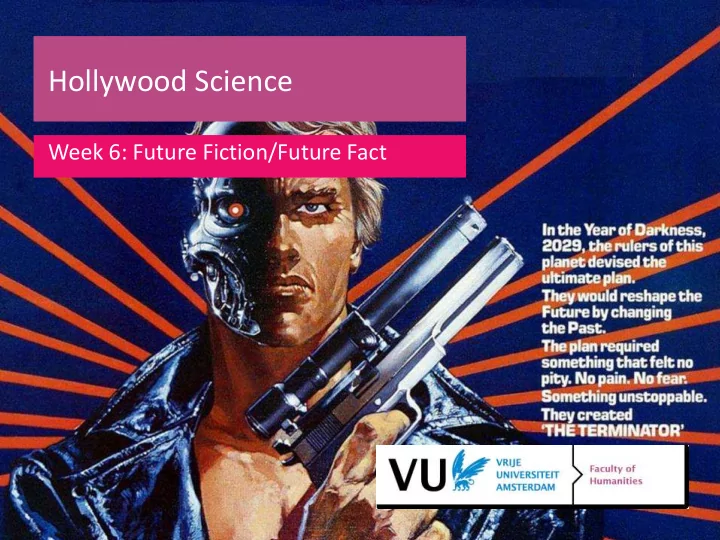
Hollywood Science Hollywood Science Week 6: Future Fiction/Future - - PowerPoint PPT Presentation
Hollywood Science Hollywood Science Week 6: Future Fiction/Future Fact Intertextuality? Intertextuality? 2 Hollywood Science Week 6 Leon van Wissen Faculty of Humanities Transhumanism Transhumanism A belief that the human race
Faculty of Humanities
Intertextuality? Intertextuality?
2 Hollywood Science – Week 6 – Leon van Wissen
Faculty of Humanities
Transhumanism Transhumanism
“A belief that the human race can evolve beyond its current limitations, esp. by the use of science and technology.” (OED, 3rd edition)
- Immortality
- Cryonism (= ‘freeze’ yourself)
- Ethical dilemmas
- Politics
- Privacy
- Eugenics?
3 Hollywood Science – Week 6 – Leon van Wissen
https://www.vpro.nl/programmas/robo- sapiens/kijk/afleveringen/2017/6.html (skip to 00:19:41 – 00:25:06) From Robo Sapiens (December 3rd 2017, VPRO)
Faculty of Humanities
Transhumanism Transhumanism
4 Hollywood Science – Week 6 – Leon van Wissen
“[…] will it be ethical to allow surgeons to replace someone’s limbs with carbon-fibre blades just so they can win gold medals?”
https://theguardian.com/technology/2018/ may/06/no-death-and-an-enhanced-life-is- the-future-transhuman
Faculty of Humanities
Transhumanism Transhumanism
5 Hollywood Science – Week 6 – Leon van Wissen
https://theguardian.com/technology/2018/ may/06/no-death-and-an-enhanced-life-is- the-future-transhuman
“[…] this turning point will be reached around the year 2030, when biotechnology will enable a union between humans and genuinely intelligent computers and AI systems. The resulting human-machine mind will become free to roam a universe of its own creation, uploading itself at will on to a “suitably powerful computational substrate”. We will become gods, or more likely “star children” similar to the one at the end of 2001: A Space Odyssey. ”
Faculty of Humanities
Technological Singularity Technological Singularity
Singularity “Abstract: Within thirty years, we will have the
technological means to create superhuman
- intelligence. Shortly after, the human era will be
ended.” (Vernor Vinge, 1993)
6 Hollywood Science – Week 6 – Leon van Wissen
https://www.theguardian.com/technology/2014/fe b/22/robots-google-ray-kurzweil-terminator- singularity-artificial-intelligence
Faculty of Humanities
Technological Singularity: Ray Kurzweil Technological Singularity: Ray Kurzweil
- Moore’s law
- The amount of transistors in a chip doubles every two years
- Turing test
- Cf. Voight-Kampff test in Blade Runner (1982)
7 Hollywood Science – Week 6 – Leon van Wissen
“So far, so sci-fi. Except that Kurzweil's new home isn't some futuristic MegaCorp intent on world domination. It's not Skynet. Or, maybe it is, but we largely still think of it as that helpful search engine with the cool design.” “When Kurzweil first started talking about the "singularity", a conceit he borrowed from the science-fiction writer Vernor Vinge, he was dismissed as a
- fantasist. He has been saying for years that he believes that the Turing test […]
will be passed in 2029.”
From: https://www.theguardian.com/technology/2014/feb/22/robots-google-ray-kurzweil-terminator-singularity-artificial-intelligence
Faculty of Humanities
Technological Singularity: Ray Kurzweil Technological Singularity: Ray Kurzweil
8 Hollywood Science – Week 6 – Leon van Wissen
[…] it should be noted […] that Google set up an ethics board to look at the question of what machine learning will actually mean when it's in the hands
- f what has become the most powerful company on the planet. Of what
machine learning might look like when the machines have learned to make their own decisions. Or gained, what we humans call, "consciousness". “"And once the computers can read their own instructions, well… gaining domination over the rest of the universe will surely be easy pickings. Though Kurzweil, being a techno-optimist, doesn't worry about the prospect of being enslaved by a master race of newly liberated iPhones with ideas above their
- station. He believes technology will augment us. Make us better, smarter, fitter.
That just as we've already outsourced our ability to remember telephone numbers to their electronic embrace, so we will welcome nanotechnologies that thin our blood and boost our brain cells. His mind-reading search engine will be a "cybernetic friend".”
From: https://www.theguardian.com/technology/2014/feb/22/robots-google-ray-kurzweil-terminator-singularity-artificial-intelligence
Faculty of Humanities
Self-conscious computers: What could go wrong? Self-conscious computers: What could go wrong?
9 Hollywood Science – Week 6 – Leon van Wissen
Faculty of Humanities
Self-conscious computers: What could go wrong? Self-conscious computers: What could go wrong?
The Terminator (1984)
“It is the creature of conscious computers that dominate the future world of 2029. These machines trace their lineage back to computers originally built to defend the United States against its enemies and that later became conscious and decided to rid the world of humanity.” (Perkowitz, p.146)
Hollywood Science – Week 6 – Leon van Wissen 10
The network of computers, ‘Skynet’, begins a war against humanity, exterminating all survivors (genocide).
Faculty of Humanities
Three Laws of Robotics Three Laws of Robotics
From I, Robot (1940-1950) by Isaac Asimov
- 1. A robot may not injure a human being or, through inaction,
allow a human being to come to harm.
- 2. A robot must obey the orders given it by human beings except
where such orders would conflict with the First Law.
- 3. A robot must protect its own existence as long as such
protection does not conflict with the First or Second Laws. How to interpret these rules?
11 Hollywood Science – Week 6 – Leon van Wissen
Faculty of Humanities
Robots in the field Robots in the field
Robots are all around us, but which fields allow for further ‘exploiting’ artificial intelligence? Examples of machine learning
12 Hollywood Science – Week 6 – Leon van Wissen
Faculty of Humanities
Example: Artificial Intelligence as chatbot Example: Artificial Intelligence as chatbot
- Learning: Replicating
human interaction
- What could possibly
go wrong?
https://techcrunch.com/2016/03/ 24/microsoft-silences-its-new-a-i- bot-tay-after-twitter-users-teach- it-racism/
Hollywood Science – Week 6 – Leon van Wissen 13
Faculty of Humanities
Example: Artificial Intelligence as artist Example: Artificial Intelligence as artist
- Learning: Neural
network replicating images it found on the internet.
- What could possibly go
wrong?
- What are the most
found things on the internet…?
https://www.theguardian.com/techn
- logy/2015/jun/18/google-image-
recognition-neural-network- androids-dream-electric-sheep
Hollywood Science – Week 6 – Leon van Wissen 14
Faculty of Humanities
Example: Artificial Intelligence as judge Example: Artificial Intelligence as judge
Robocop (1987)
- Cyborg, cf. Monster of Frankenstein?
- Apparently, judging needs a human
aspect.
- Easy for legal disputes, but what
about life and death?
“The “good robot–bad robot” theme is richer and more complicated with cyborgs. They go beyond mere machine, with human emotions and values. In RoboCop (1987), a man- machine hybrid provides better judgment than a purely artificial robot.” (Perkowitz, p.149)
Hollywood Science – Week 6 – Leon van Wissen 15
Faculty of Humanities
Example: Artificial Intelligence as judge Example: Artificial Intelligence as judge
http://www.ucl.ac.uk/news/news- articles/1016/241016-AI-predicts-
- utcomes-human-rights-trials
https://www.computerworld.com/article /3133957/artificial-intelligence/not- robocop-but-robojudge-ai-learns-to-rule- in-human-rights-cases.html
Hollywood Science – Week 6 – Leon van Wissen 16
Faculty of Humanities
Algorithmic bias Algorithmic bias
- Discriminatory sentences in law
- COMPAS (propublica)
- Predicting likelihood of a criminal
reoffending
- Higher risk for black defendants
- Closed algorithm
- Bias on gender stereotypes (science)
- He is a doctor
- She is a nurse
- Bias on sentiment (mashable)
- Negative sentiment towards
homosexuality or black skin colour
Hollywood Science – Week 6 – Leon van Wissen 17
Faculty of Humanities
Algorithmic bias Algorithmic bias
- Biased creators?
- Biased data?
Critical areas:
- Medicine
- Law
- Traffic?
Hollywood Science – Week 6 – Leon van Wissen 18
https://www.technologyreview.com/s/ 608986/forget-killer-robotsbias-is-the- real-ai-danger/
Faculty of Humanities
Example: The Self-Driving Car Example: The Self-Driving Car
19 Hollywood Science – Week 6 – Leon van Wissen
https://www.technologyreview.com/s/542626/why- self-driving-cars-must-be-programmed-to-kill/
Faculty of Humanities
Example: The Self-Driving Car: Liability? Example: The Self-Driving Car: Liability?
20 Hollywood Science – Week 6 – Leon van Wissen
https://cyberlaw.stanford. edu/blog/2015/05/tesla- and-liability
Faculty of Humanities
Example: The Self-Driving Car: Liability? Example: The Self-Driving Car: Liability?
Make computers think as humans
- Morality
- Ethics
Influence from the designer?
- How difficult is it to make these decisions?
21 Hollywood Science – Week 6 – Leon van Wissen
Faculty of Humanities
The Moral Machine The Moral Machine
The brakes are failing. What should the autonomous car do?
22 Hollywood Science – Week 6 – Leon van Wissen
http://moralmachine.mit.edu/
Faculty of Humanities
The Moral Machine The Moral Machine
The brakes are failing. What should the autonomous car do?
- Who is responsible?
- Military use of autonomous
weaponry?
23 Hollywood Science – Week 6 – Leon van Wissen
http://moralmachine.mit.edu/
Faculty of Humanities
The Moral Machine The Moral Machine
And this scenario?
24 Hollywood Science – Week 6 – Leon van Wissen
http://moralmachine.mit.edu/
Faculty of Humanities
I, Robot (2004) I, Robot (2004)
- Main character distrusts technology/robots
- A robot that bypasses these rules is created. It has emotions
and dreams.
- In order to protect humanity from itself (extinction), robots
- takeover. (first rule)
- Zeroth law: "A robot may not harm humanity"
- Preserving the human race
25 Hollywood Science – Week 6 – Leon van Wissen
Faculty of Humanities
Making computers more human Making computers more human
What happens if you add feelings/thoughts/emotions to computers? A satirical mostly harmless example comes from The Hitchhiker’s Guide to the Galaxy (1979) by Douglas Adams. Every robot has been given a personality, even doors and elevators.
26 Hollywood Science – Week 6 – Leon van Wissen
Faculty of Humanities
Making computers more human Making computers more human
1981 (BBC Series)
- Marvin, the Paranoid Android
27 Hollywood Science – Week 6 – Leon van Wissen
https://youtu.be/z0yBf1JKTw8?t=1m28s
Faculty of Humanities
Making computers more human Making computers more human
2005 (Movie)
- Marvin, the Paranoid Android
28 Hollywood Science – Week 6 – Leon van Wissen
https://youtu.be/P5MzPRa47ck
Faculty of Humanities
Making computers more human Making computers more human
This book/series/movie shows that giving a personality to a computer is a ridiculous idea. Or isn’t it?
29 Hollywood Science – Week 6 – Leon van Wissen
Faculty of Humanities
Making computers more human Making computers more human
30 Hollywood Science – Week 6 – Leon van Wissen
http://time.com/497 9262/google- wants-to-give- computer- personality/
Faculty of Humanities
Example: Her (2013) Example: Her (2013)
- Falling in love with a computer that has reached the state of
‘singularity’.
- Learns from experience
- Develops ‘sexual consciousness’ and
the ability to be jealous
- Socially acceptable to have an ‘OS’
as girlfriend?
- (Virtual) reality?
Kurzweil’s review of Her
31 Hollywood Science – Week 6 – Leon van Wissen
Samantha
Faculty of Humanities
Her (2013): Trailer Her (2013): Trailer
32 Hollywood Science – Week 6 – Leon van Wissen
https://youtu.be/6QRvTv_tpw0
Faculty of Humanities
Example: Her (2013) Example: Her (2013)
In Her the main character falls in love with artificial intelligence that only exists in software and has no physical appearance. What about A.I. that does have a physical presence?
- Black Mirror, ‘Be Right Back’
(2013, imdb)
- Deceased person’s personality
lives on in a humanoid
- Learns from social media profiles
(public)
33 Hollywood Science – Week 6 – Leon van Wissen
Faculty of Humanities
Robot’s appearance: Androids Robot’s appearance: Androids
Definition: “An automaton resembling a human being.” (OED, 3rd edition)
- Why are we developing human-like robots?
- Embodiment? Emotions?
- Interaction?
Hollywood Science – Week 6 – Leon van Wissen
http://edition.cnn.com/videos/design/2017/02/20/science- museum-robots-design-style-orig.cnn
34
Faculty of Humanities
Robot’s appearance: Androids Robot’s appearance: Androids
- Erica
Hollywood Science – Week 6 – Leon van Wissen
Erica: Man Made (2017) https://youtu.be/qfAW0RPY3HQ
“Erica is 23. She has a beautiful, neutral face and speaks with a synthesised voice. She has a degree
- f autonomy – but can’t move her
hands yet. Hiroshi Ishiguro is her ‘father’ and the bad boy of Japanese robotics. Together they will redefine what it means to be human and reveal that the future is closer than we might think.”
https://www.theguardian.com/technology/ ng-interactive/2017/apr/07/meet-erica-the- worlds-most-autonomous-android-video
Faculty of Humanities
Humanoids Humanoids
36 Hollywood Science – Week 6 – Leon van Wissen
The Pepper Bot
http://www.teksbotics.com/products/robots/portf
- lios/pepper/
Faculty of Humanities
Uncanny Valley Uncanny Valley
37 Hollywood Science – Week 6 – Leon van Wissen
“In his original thinking on the idea of the uncanny, Sigmund Freud suggested that, when found in strange objects, it was the familiar which often made us the most
- uncomfortable. The idea being that
familiarity, seen in an unfamiliar way, could be disconcerting. The Uncanny Valley suggests that, as we approach humanlike in the inhuman, it becomes
- revolting. The more human something is
without being human, the more startling we find it.”
Source: https://www.theguardian.com/tv-and- radio/tvandradioblog/2015/jul/18/robots- artificial-intelligence-ex-machina-humans-her (Mori, 1970)
Faculty of Humanities
VU-colleague VU-colleague
38 Hollywood Science – Week 6 – Leon van Wissen
Faculty of Humanities
More Human than Human More Human than Human
Aired at SXSW 2018 https://morehumanthanhuman.ai/ “More Human Than Human explores what it means to live in the age of intelligent machines. In this personal, playful and at times dramatic quest, the filmmaker finds out how much of his creativity and human values are at stake as he builds his own robot to replace himself as a filmmaker. More than just an exposé
- n the pros and cons of new technology, the filmmaker’s journey
takes him to the world’s leading AI experts and robot pioneers confronting them with existential questions such as: will AI, infinitely smarter, interconnected and possibly self-aware, render humanity obsolete?”
39 Hollywood Science – Week 6 – Leon van Wissen
Faculty of Humanities
Ex Machina (2014) Ex Machina (2014)
Description: “A young programmer is selected to participate in a ground-breaking experiment in synthetic intelligence by evaluating the human qualities of a breath-taking humanoid A.I.” (imdb)
- Self-conscious
androids/humanoids
- Why picking a ‘gender’ for a
robot?
- Sexuality as a ‘tool’
40 Hollywood Science – Week 6 – Leon van Wissen
Faculty of Humanities
Ex Machina (2014) Ex Machina (2014)
“Nathan argues that consciousness is inextricably connected to sexuality, as it, according to him, gives an imperative to interact with
- thers.
Later on in the scene, he tells Caleb "I programmed her to be
- heterosexual. Just like you were programmed to be heterosexual,” to
which Caleb responds "nobody programmed me to be straight." Nathan asks "you decided to be straight? Please. Of course you were
- programmed. By nature or nurture, or both."
As this statement suggests, Nathan sees no difference between the programming of robots and what he calls the programming by nature and/or nurture of human sexuality.” (Witsenburg, p. 2)
41 Hollywood Science – Week 6 – Leon van Wissen
Faculty of Humanities
Harari: Sapiens and Homo Deus Harari: Sapiens and Homo Deus Programming of robots ≈ programming by nature
- Biochemical algorithms
- Homo Deus
- Dataism
- Big data
- Two possibilities:
- Improving humanity
- Inventing AI
42 Hollywood Science – Week 6 – Leon van Wissen
“[…] ‘Sapiens, A Brief History of Humankind’ traces the evolution of Homo sapiens, combining history and science and both delving back into
- ur past and looking into our future.
Among the predictions advanced by its author, historian Yuval Harari, is the coming-to-pass of the prophecy
- f Mary Shelley, of the creature that
escapes the control of its creator and master, Dr Frankenstein. The analogy is a telling one, that of AI
- vertaking human beings.
https://atelier.bnpparibas/en/life-work/article/yuval- harari-human-beings-algorithms
Faculty of Humanities
Ex Machina (2014): Trailer Ex Machina (2014): Trailer
43 Hollywood Science – Week 6 – Leon van Wissen
https://www.youtube.com/watch?v=PI8XBKb6DQk
Faculty of Humanities
Now what? Now what?
Ava sets foot in the real world There is no clear boundary between what is human and what is technology anymore.
44 Hollywood Science – Week 6 – Leon van Wissen
Faculty of Humanities
Robot rights? Robot rights?
45 Hollywood Science – Week 6 – Leon van Wissen
https://www.cnet.com/news/nati
- nal-portrait-gallery-taylor-
wessing-photographic-prize- erica-robot/
Faculty of Humanities
Robot rights? Robot rights?
- Robots have
‘feelings’?
- Politics: Party for
Robots?
46 Hollywood Science – Week 6 – Leon van Wissen
http://www.independent.co.uk/li fe-style/gadgets-and- tech/news/saudi-arabia-robot- sophia-citizenship-android- riyadh-citizen-passport-future- a8021601.html
Faculty of Humanities
Robot rights? Robot rights?
“She [Sophia, the robot] said that people didn't need to be concerned about the rise of artificial intelligence as depicted in Blade Runner and Terminator. “You’ve been reading too much Elon Musk and watching too many Hollywood movies,” she told Mr Srkin.”
47 Hollywood Science – Week 6 – Leon van Wissen
http://www.independent.co.uk/life-style/gadgets-and-tech/news/saudi-arabia-robot-sophia- citizenship-android-riyadh-citizen-passport-future-a8021601.html
Faculty of Humanities
Don’t panic Don’t panic
Garry Kasparov (chess master)
- Lost in 1997 from an IBM
computer
- “We’re not being replaced by AI.
We’re being promoted.”
- “[…] machine-generated insight adds
to ours, extending our intelligence the way a telescope extends our vision.”
- AI: ‘augmented intelligence.”
- “But the notion that these machines
could become human-hunting Terminators is absurd.”
48 Hollywood Science – Week 6 – Leon van Wissen
https://www.wsj.com/articles/intelligent-machines- will-teach-usnot-replace-us-1525704147#
Faculty of Humanities
Do panic Do panic
- 150+ experts warn against new EU-rule
- Solving liability questions:
- ‘Electronic personhood’
49 Hollywood Science – Week 6 – Leon van Wissen
http://www.robotics-openletter.eu/
https://www.politico.eu/article/europe-divided-over-robot-ai- artificial-intelligence-personhood/
Faculty of Humanities
And what about the world we are living in and (upcoming) virtual reality (VR)?
50 Hollywood Science – Week 6 – Leon van Wissen
Faculty of Humanities
The Matrix (1999) The Matrix (1999)
- What happens if the world around
us turns out to be a virtual reality?
- Robot collective that wants to
dominate/kill humanity that has created the machines
- Hacking into the simulation/VR
and gain ‘superhuman’ abilities
51 Hollywood Science – Week 6 – Leon van Wissen
“The rebels have found that the world of 1999, which humanity seems to occupy, is an illusion; it’s actually a full-scale, totally persuasive virtual reality, the Matrix, generated by computers that control the human race 200 years in the future.” (Perkowitz, p. 155)
Faculty of Humanities
The Matrix (1999) The Matrix (1999)
Themes
- Human identity
- Human/AI
- Prophecy/fate/free will
- Inhabitable world
- References to religion/myth
52 Hollywood Science – Week 6 – Leon van Wissen
Faculty of Humanities
The Matrix (1999): Philosophy, ‘the brain in a vat’ The Matrix (1999): Philosophy, ‘the brain in a vat’
In philosophy, the brain in a vat is a scenario used in a variety of thought experiments intended to draw out certain features of our ideas of knowledge, reality, truth, mind, consciousness and
- meaning. It is an updated version of René Descartes' Evil Demon
thought experiment originated by Gilbert Harman. Common to many science fiction stories, it outlines a scenario in which a mad scientist, machine, or other entity might remove a person's brain from the body, suspend it in a vat of life-sustaining liquid, and connect its neurons by wires to a supercomputer which would provide it with electrical impulses identical to those the brain normally receives. (Wikipedia)
53 Hollywood Science – Week 6 – Leon van Wissen
Faculty of Humanities
The Matrix (1999): Trailer The Matrix (1999): Trailer
54 Hollywood Science – Week 6 – Leon van Wissen
https://www.youtube.com/watch?v=vKQi3bBA1y8
Faculty of Humanities
Journal report C Journal report C
55 Hollywood Science – Week 6 – Leon van Wissen
Faculty of Humanities
Next week Next week
- Information on the excursion
- Eye Film
- Possible dates:
- Thursday 17 June
- Tuesday 22 June
- Thursday 24 June
- Movie screening
- Fill in the quiz/survey on Canvas!
56 Hollywood Science – Week 6 – Leon van Wissen
Faculty of Humanities
References References
- Mori, Masahiro. "The uncanny valley." Energy 7.4 (1970): 33-35.
- Vinge, Vernor. "The coming technological singularity: How to survive in the
post-human era." (1993).
- Witsenburg, Amber. “The Mechanics of Robot (A)sexuality in Ex Machina”
(in press).
57 Hollywood Science – Week 6 – Leon van Wissen