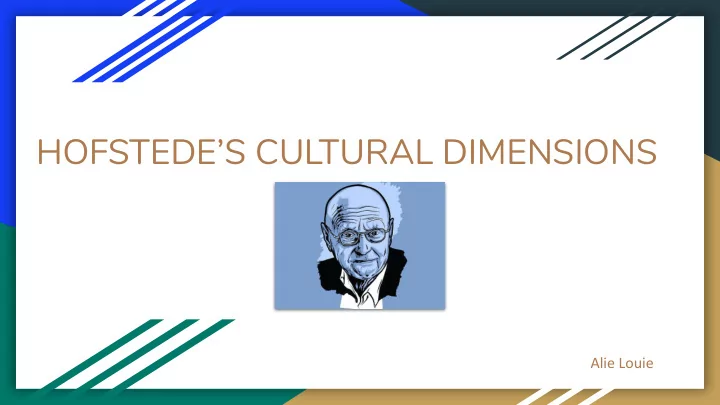
SLIDE 1 HOFSTEDE’S CULTURAL DIMENSIONS
Alie Louie
SLIDE 2
Overview:
1) About the theorist 2) Overview of the theory 3) Key Concepts 4) Communication case 5) Case Analysis 6) Conclusion
SLIDE 3
About the Theorist:
➢ Geert Hofstede ➢ Dutch social psychologist ➢ PhD in organizational behavior ➢ Worked for IBM ➢ Most known for his research on cross-cultural groups ➢ Most popular book: Cultures and Organizations
SLIDE 4 Overview of Theory:
Purpose- to understand variations within and across cultures
- Hofstede gathered data from 100,000 IBM employees
○ Determine the values on which cultures vary
○ Individualism v. Collectivism Uncertainty Avoidance ○ Power Distance Masculinity v. Femininity ○ Long-Term v. Short Term Indulgence v. Restraint
SLIDE 5
Key Concepts:
SLIDE 6
Individualism or Collectivism?????
➔ Individual first ➔ Independence ➔ Emphasis on negative face ➔ Reward personal achievements ➔ Value uniqueness ➔ Group needs & goals come first ➔ Obligation to the group ➔ Self isn’t distinct from others ➔ Focus on cooperation rather than competition
SLIDE 7
Uncertainty Avoidance
➔ How comfortable a culture is with uncertainty ➔ Extent to which people are made nervous by unstructured situations
SLIDE 8 http:// www.ni klasblan ke.com/ hofsted e---nati
ture.ht ml
SLIDE 9 Power Distance
➔ The extent to which people with little power consider inequity normal High Power Distance Low Power Distance
- power differences are natural
- value less power differences
- great centralization of power
- no “superiority” in workplace
- status and rank matter
SLIDE 10 ➔ Relationship between biological sex and what is considered sex-appropriate behavior
https://extraessay.top/?sub_id=3fq0fngus4dd7desk3c
SLIDE 11 Long Term v. Short Term Orientation
➔ Inspired by Confucian thinking ➔ Focused towards the future or present Long Term Short Term
- savings
- want immediate gratification
- perseverance
- prefer quick results
- strong work ethic
- not as willing to sacrifice
SLIDE 12
Indulgence v. Restraint
➔ Most recent addition in 2010 ➔ Societies that act freely and live to just live life ➔ Societies that suppress gratification needs and have strict social norms
SLIDE 13 Communication Case: A Handmaid’s Tale
Offred is a Handmaid in the Republic
- f Gilead, a totalitarian state that has
replaced the United States. Low reproduction rates has called for the need of these Handmaids. They are assigned to bear children for elite couples that have trouble conceiving.
SLIDE 14
Case Analysis:
➔ Aunt Lydia is in control of the women ➔ Collectivist society ➔ High power distance index ➔ High context communication used ◆ Focus on cooperation
SLIDE 15
Conclusion:
➔ Cultures vary in many ways! ➔ Cultural awareness ➔ Values have a great impact on behavior & communication
SLIDE 16 References
- A. (2016, March 12). Understanding Cultures & People with Hofstede Dimensions. Retrieved
from https://www.cleverism.com/understanding-cultures-people-hofstede-dimensions/ Dainton, M., & Zelley, E. D. (2011). Applying Communication Theory for Professional Life: A Practical Introduction. Los Angeles: SAGE. Geert Hofstede. (n.d.). The 6 Dimensions Model of National Culture by Geert Hofstede. Retrieved from https://geerthofstede.com/culture-geert-hofstede-gert-jan-hofstede/6d-model-of-national-culture/ Hofstede, G. (2011). Dimensionalizing Cultures: The Hofstede Model in Context. Online Readings in Psychology and Culture, 2(1). https://doi.org/10.9707/2307-0919.1014 Hofstede Insights. (2019). National Culture. Retrieved from https://www.hofstede-insights.com/models/national-culture/