
SLIDE 1
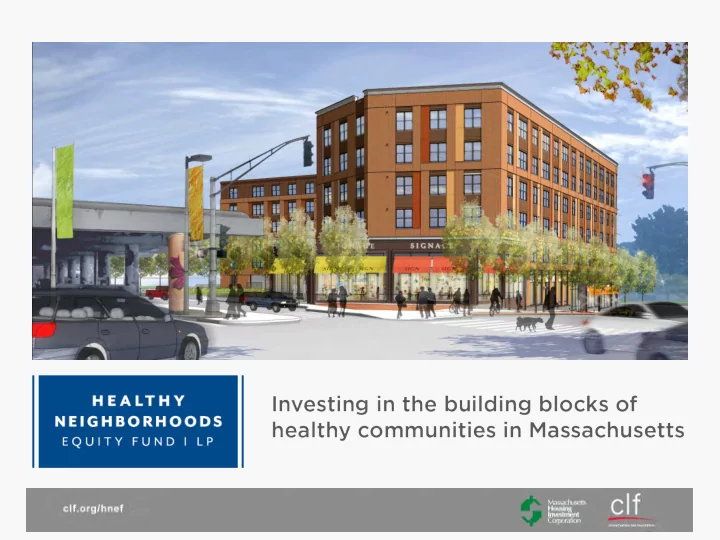
HNEF Mission The Fund will invest in high-impact real estate - - PowerPoint PPT Presentation
HNEF Mission The Fund will invest in high-impact real estate projects that have potential to: Transform neighborhoods Strengthen community and environmental health Promote regional equity Provide attractive risk-adjusted returns for
2
3
Access to jobs and economic mobility Safer, more walkable neighborhoods Improved health and well-being Increased real estate values Improved tax base Lower healthcare costs Reduced GHG emissions Reduced VMT Increased transit ridership + Economic
+ Environmental + Community Returns =
Healthy Communities
Quality housing for all income levels
4
5
life expectancy—vary sharply by neighborhood.
expectancy varied by as much as 33 years between census tracts in Boston.
lowest life expectancy (in Roxbury, 58.9 years) is shorter than the life expectancy of Cambodia, Gambia, and Iraq.
Life Expectancy by Census Tract, Boston, 2003-2007
Source: Social Capital and Health Outcomes Technical Report, Center on Human Needs, Virginia Commonwealth University, September 2012.
6
8
Health Determinant Health Outcomes
Walkability/Active Transport Physical activity, mental health, chronic disease Safety from Crime Injury, physical activity, mental health, real and perceived safety Economic Opportunity Economic stability Food Access Nutrition, chronic disease Safety from Traffic Injury, air quality, real and perceived safety Affordable Housing Economic stability Green Housing Exposure to environmental contaminants, chronic disease Green Space Physical activity, mental health, air quality Social Cohesion Mental health Displacement/Gentrification Mental health, economic stability Air Quality Air quality Environmental Contamination Exposure to environmental contaminants
Breadth of Impact
Source: Healthy Neighborhoods Equity Fund Health Impact Assessment: Metropolitan Area Planning Council, 2013
9
10
11
12
13
The information contained herein is confidential and should not be reproduced or disclosed. This document does not constitute an offer to sell or a solicitation of an offer to buy any interests in the Healthy Neighborhoods Equity Fund I Limited Partnership (the “Fund”). Any such offering will occur only in accordance with the terms and conditions set forth in the confidential private placement memorandum
not contain any investment advice, should not be relied upon by you and is subject to change or supplement without notice to you. The information contained herein is confidential and is not to be disclosed, reproduced or redistributed, in whole or in part, to any other person. This document is qualified in its entirety by reference to the PPM and the Fund’s organizational documents, each of which should be carefully reviewed by prospective investors. To the extent that the information set forth herein is inconsistent with any of such documents, such documents will control. The information provided herein is based upon matters as they existed as of the date of preparation and not as of any future date, and will not be updated or otherwise revised to reflect information that subsequently becomes available or circumstances or changes occurring after the date of
be deemed a representation that there has been no change in the information provided herein. Certain information contained in this presentation constitutes “forward-looking statements,” which can be identified by the use of forward-looking terminology such as “may,” “will,” “should,” “expect,” “anticipate,” “target,” “project,” “estimate,” “intend,” “continue” or “believe,” or the negatives thereof
events or results or the actual performance of the Fund may differ materially from those reflected or contemplated in such forward-looking statements. All duties to update this information are hereby
the external conditions and circumstances under which the Fund or any other person or entity will
contained herein.
CONTACT
Joe Flatley, MHIC 617.850.1028 flatley@mhic.com Bill Coleman, CLF 617.850.1775 bcoleman@clf.org