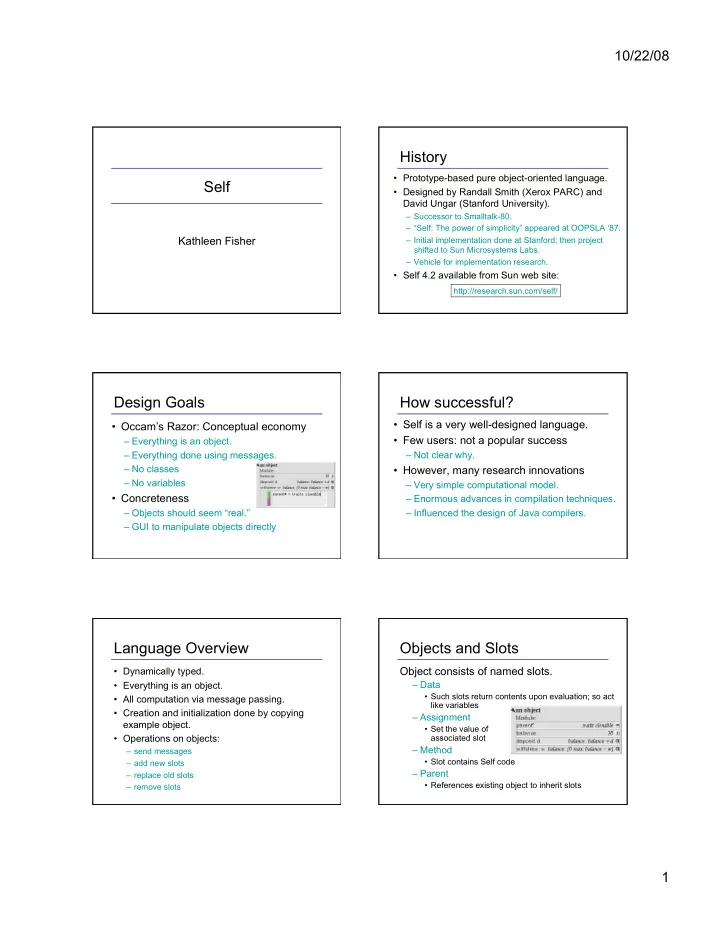
History Prototype-based pure object-oriented language. Self - - PDF document

history
SMART_READER_LITE
LIVE PREVIEW

History Prototype-based pure object-oriented language. Self - - PDF document

10/22/08 History Prototype-based pure object-oriented language. Self Designed by Randall Smith (Xerox PARC) and David Ungar (Stanford University). Successor to Smalltalk-80. Self: The power of simplicity appeared at OOPSLA


slide-1
SLIDE 1

10/22/08 1

Self

Kathleen Fisher

History

  • Prototype-based pure object-oriented language.
  • Designed by Randall Smith (Xerox PARC) and

David Ungar (Stanford University).

– Successor to Smalltalk-80. – “Self: The power of simplicity” appeared at OOPSLA ‘87. – Initial implementation done at Stanford; then project shifted to Sun Microsystems Labs. – Vehicle for implementation research.

  • Self 4.2 available from Sun web site:

http://research.sun.com/self/

  • Occam’s Razor: Conceptual economy

– Everything is an object. – Everything done using messages. – No classes – No variables

  • Concreteness

– Objects should seem “real.” – GUI to manipulate objects directly

Design Goals How successful?

  • Self is a very well-designed language.
  • Few users: not a popular success

– Not clear why.

  • However, many research innovations

– Very simple computational model. – Enormous advances in compilation techniques. – Influenced the design of Java compilers.

Language Overview

  • Dynamically typed.
  • Everything is an object.
  • All computation via message passing.
  • Creation and initialization done by copying

example object.

  • Operations on objects:

– send messages – add new slots – replace old slots – remove slots

Objects and Slots

Object consists of named slots.

– Data

  • Such slots return contents upon evaluation; so act

like variables

– Assignment

  • Set the value of

associated slot

– Method

  • Slot contains Self code

– Parent

  • References existing object to inherit slots
slide-2
SLIDE 2

10/22/08 2

Messages and Methods

  • When message is sent,
  • bject searched for slot with

name.

  • If none found, all parents are

searched.

– Runtime error if more than one parent has a slot with the same name.

  • If slot is found, its contents

evaluated and returned.

– Runtime error if no slot found.

parent* x 3 x: ← parent* print … clone …

Messages and Methods

parent* x 3 x: ← parent* print … clone …

  • bj x

3

  • bj print

print point

  • bject
  • bj x: 4
  • bj

after setting x to 4.

Mixing State and Behavior

parent* … +

add points

x 4 y 17 x: ← parent* y: ← x

random number generator

y

  • parent*

y: ←

Object Creation

  • To create an object,

we copy an old one.

  • We can add new

methods, override existing ones, or even remove methods.

  • These operations also apply to parent slots.

Changing Parent Pointers

parent*: ← name Charles name: ← jump … eatFly … parent* dance … eatCake … p jump. p eatFly. p parent: prince. p dance. p prince frog

Changing Parent Pointers

parent*: ← name Charles name: ← jump … eatFly … parent* dance … eatCake … p jump. p eatFly. p parent: prince. p dance p prince frog

slide-3
SLIDE 3

10/22/08 3

Disadvantages of classes?

  • Classes require programmers to understand a

more complex model.

– To make a new kind of object, we have to create a new class first. – To change an object, we have to change the class. – Infinite meta-class regression.

  • But: Does Self require programmer to reinvent

structure?

– Common to structure Self programs with traits:

  • bjects that simply collect behavior for sharing.
  • C++

– Restricts expressiveness to ensure efficient implementation.

  • Self

– Provides unbreakable high-level model of underlying machine. – Compiler does fancy optimizations to obtain acceptable performance.

Contrast with C++ Implementation Challenges I

  • Many, many slow function calls:

– Function calls generally somewhat expensive. – Dynamic dispatch makes message invocation even slower than typical procedure calls. – OO programs tend to have lots of small methods. – Everything is a message: even variable access! “The resulting call density of pure object-

  • riented programs is staggering, and brings

naïve implementations to their knees” [Chambers & Ungar, PLDI 89]

  • No static type system

– Each reference could point to any object, making it hard to find methods statically.

  • No class structure to enforce sharing

– Each object having a copy of its methods leads to space overheads.

Implementation Challenges II

Optimized Smalltalk-80 roughly 10 times slower than optimized C.

  • Avoid per object space requirements.
  • Compile, don’t interpret.
  • Avoid method lookup.
  • Inline methods wherever possible.

– Saves method call overhead. – Enables further optimizations.

Optimization Strategies Clone Families

Avoid per object data Mutable Fixed prototype Mutable Fixed Mutable Fixed Mutable Fixed Mutable Fixed clone family Mutable Map Mutable Map Map Map Mutable Mutable Fixed Info Model Implementation map

slide-4
SLIDE 4

10/22/08 4

Dynamic Compilation

Avoid interpreting

LOAD R0 MOV R1 2 ADD R1 R2 … 01001010 01001100 01001011 01000110

Source Byte Code Machine Code Method is entered First method execution

  • Method is converted to byte codes when entered.
  • Compiled to machine code when first executed.
  • Code stored in cache
  • if cache fills, previously compiled method flushed.
  • Requires entire source (byte) code to be available.

Avoid method lookup

Lookup Cache

  • Cache of recently used methods, indexed

by (receiver type, message name) pairs.

  • When a message is sent, compiler first

consults cache

– if found: invokes associated code. – if absent: performs general lookup and potentially updates cache.

  • Berkeley Smalltalk would have been 37%

slower without this optimization.

Static Type Prediction

  • Compiler predicts types that are unknown

but likely:

– Arithmetic operations (+, -, <, etc.) have small integers as their receivers 95% of time in Smalltalk-80. – ifTrue had Boolean receiver 100% of the time.

  • Compiler inlines code (and test to confirm

guess):

if type = smallInt jump to method_smallInt call general_lookup

Avoid method lookup Avoid method lookup

Inline Caches

  • First message send from a call site:

– general lookup routine invoked – call site back-patched

  • is previous method still correct?

– yes: invoke code directly – no: proceed with general lookup & backpatch

  • Successful about 95% of the time
  • All compiled implementations of Smalltalk

and Self use inline caches.

Avoid method lookup

Polymorphic Inline Caches

  • Typical call site has <10 distinct receiver types.

– So often can cache all receivers.

  • At each call site, for each new receiver, extend

patch code:

  • After some threshold, revert to simple inline

cache (megamorphic site).

  • Order clauses by frequency.
  • Inline short methods into PIC code.

if type = rectangle jump to method_rect if type = circle jump to method_circle call general_lookup

Inline methods

Customized Compilation

  • Compile several copies of each method,
  • ne for each receiver type.
  • Within each copy:

– Compiler knows the type of self – Calls through self can be statically selected and inlined.

  • Enables downstream optimizations.
  • Increases code size.
slide-5
SLIDE 5

10/22/08 5

Inline methods

Type Analysis

  • Constructed by compiler by flow analysis.
  • Type: set of possible maps for object.

– Singleton: know map statically – Union/Merge: know expression has one of a fixed collection of maps. – Unknown: know nothing about expression.

  • If singleton, we can inline method.
  • If type is small, we can insert type test and

crate branch for each possible receiver (type casing). Inline methods

Message Splitting

  • Type information above a

merge point is often better.

  • Move message send “before”

merge point:

– duplicates code – improves type information – allows more inlining Inline methods

PICS as Type Source

  • Polymorphic inline caches build a call-site

specific type database as the program runs.

  • Compiler can use this runtime information

rather than the result of a static flow analysis to build type cases.

  • Must wait until PIC has collected information.

– When to recompile? – What should be recompiled?

  • Initial fast compile yielding slow code; then

dynamically recompile hotspots.

Performance Improvements

  • Initial version of Self was 4-5 times slower

than optimized C.

  • Adding type analysis and message

splitting got within a factor of 2 of

  • ptimized C.
  • Replacing type analysis with PICS

improved performance by further 37%.

Current Self compiler is within a factor of 2 of optimized C.

Impact on Java

Self with PICs Animorphics Java Java Hotspot Sun cancels Self Java becomes popular Sun buys A.J. Animorphics Smalltalk

  • “Power of simplicity”

– Everything is an object: no classes, no variables. – Provides high-level model that can’t be violated (even during debugging).

  • Fancy optimizations recover reasonable

performance.

  • Many techniques now used in Java compilers.
  • Papers describing various optimization

techniques available from Self web site.

Summary

http://research.sun.com/self/