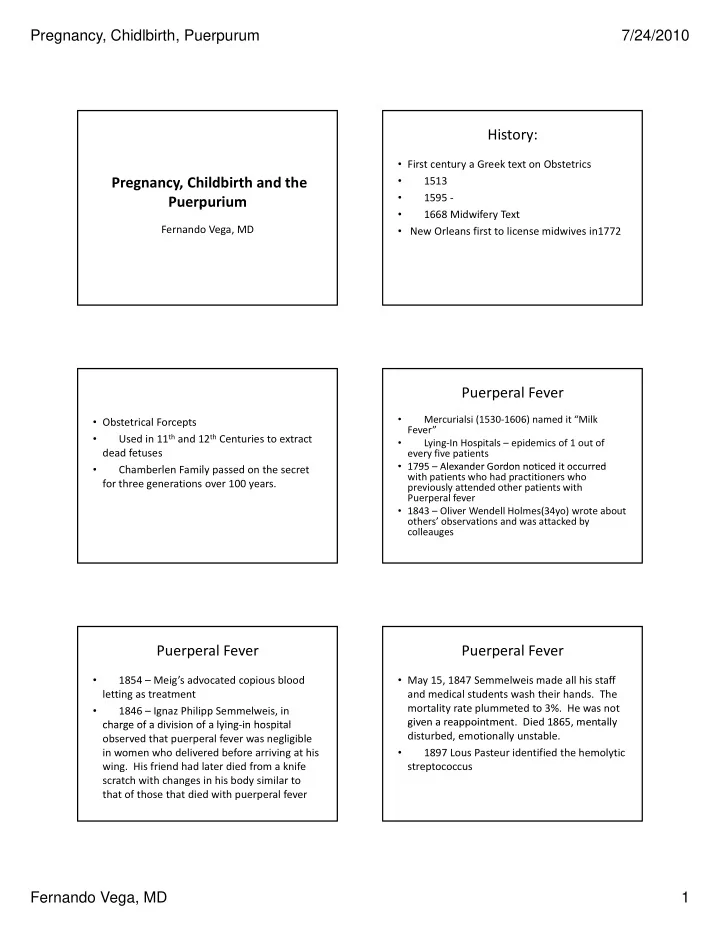
History: First century a Greek text on Obstetrics Pregnancy, - - PDF document

history
SMART_READER_LITE
LIVE PREVIEW

History: First century a Greek text on Obstetrics Pregnancy, - - PDF document

Pregnancy, Chidlbirth, Puerpurum 7/24/2010 History: First century a Greek text on Obstetrics Pregnancy, Childbirth and the 1513 1595 Puerpurium p 1668 Midwifery Text Fernando Vega, MD New Orleans first to license


slide-1
SLIDE 1

Pregnancy, Chidlbirth, Puerpurum 7/24/2010 Fernando Vega, MD 1

Pregnancy, Childbirth and the Puerpurium p

Fernando Vega, MD

History:

  • First century a Greek text on Obstetrics
  • 1513
  • 1595 ‐
  • 1668 Midwifery Text
  • New Orleans first to license midwives in1772
  • Obstetrical Forcepts
  • Used in 11th and 12th Centuries to extract

dead fetuses h b l il d h

  • Chamberlen Family passed on the secret

for three generations over 100 years.

Puerperal Fever

  • Mercurialsi (1530‐1606) named it “Milk

Fever”

  • Lying‐In Hospitals – epidemics of 1 out of

every five patients

  • 1795

Alexander Gordon noticed it occurred

  • 1795 – Alexander Gordon noticed it occurred

with patients who had practitioners who previously attended other patients with Puerperal fever

  • 1843 – Oliver Wendell Holmes(34yo) wrote about
  • thers’ observations and was attacked by

colleauges

Puerperal Fever

  • 1854 – Meig’s advocated copious blood

letting as treatment

  • 1846 – Ignaz Philipp Semmelweis, in

charge of a division of a lying in hospital charge of a division of a lying‐in hospital

  • bserved that puerperal fever was negligible

in women who delivered before arriving at his

  • wing. His friend had later died from a knife

scratch with changes in his body similar to that of those that died with puerperal fever

Puerperal Fever

  • May 15, 1847 Semmelweis made all his staff

and medical students wash their hands. The mortality rate plummeted to 3%. He was not given a reappointment Died 1865 mentally given a reappointment. Died 1865, mentally disturbed, emotionally unstable.

  • 1897 Lous Pasteur identified the hemolytic

streptococcus

slide-2
SLIDE 2

Pregnancy, Chidlbirth, Puerpurum 7/24/2010 Fernando Vega, MD 2

Gynecologic Endocrinology

  • ‐See Handout.
  • ‐ FSH (Follicle Stimulating Hormone) from

the pituitary to induce the ovaries to make follicles and estrogen follicles and estrogen

  • ‐ One of the follicles ruptures on day 14

and produces an egg (ovulation) to go into the fallopian tubes awaiting fertilization.

Gynecologic Endocrinology

  • ‐ What is left behind becomes a corpus

luteum which has a 14 day life span and produces progesterone for 14 days

  • The progesterone develops and supports
  • ‐ The progesterone develops and supports

the endometrium so the fertilized egg can implant.

Gynecologic Endocrinology

  • What happens in pregnancy
  • What happens with taking oral contraceptives

Pregnancy

  • Naegles rule for predincting EDC: Add three

months and subtract 7 days from LMP

Pregnancy

  • Subjective Symptoms:
  • Cessation of Menses
  • Morning Sickness
  • Breast Changes
  • Enlargement of abdomen
  • Quickening – 18 weeks

Pregnancy

  • Objective symptoms
  • Goodell’s sign – beginning of second

month ’ i f i f h l

  • Hegar’s sign – softening of the lower

segment

slide-3
SLIDE 3

Pregnancy, Chidlbirth, Puerpurum 7/24/2010 Fernando Vega, MD 3

Pregnancy

  • Breast signs
  • Auscutation – 18th week
  • Uterine size at pubis, umbilicus, xyphoid

Pregnancy

  • Abnormal pregnancy
  • Spontaneous abortion
  • Ectopic pregnancy
  • Hemolytic disease of the Newborn
  • Bleeding in pregnancy
  • Placenta previa
  • Abruption placenta
  • Rupture of the uterus
  • Preeclampsia‐eclampsia

Pregnancy

  • Preeclampsia‐eclampsia

Pregnancy

  • Normal labor
  • Pelvimetry
  • Stages of Labor
  • Fetal monitoring

Complications of Labor

  • Premature labor
  • Dystocia
  • Cord accidents, knots, coils, shortening
  • Usually 60 cm (30‐120cm)
  • Twins
  • Cesarean secton

The Puerpurium

  • Flowing delivery of placenta to resumption of
  • vulatory menstrual cycles (6‐8weeks)
  • bl

di

  • Post partum bleeding
  • Uterine atony, Lacerations
  • Fever, infections
  • Endometritis, mastitis, UTI’s
slide-4
SLIDE 4

Pregnancy, Chidlbirth, Puerpurum 7/24/2010 Fernando Vega, MD 4

Evaluation of Fetal Status

  • Evaluation of the Fetal Status
  • Amniocentesis
  • Urinary estriol
  • Ultransonography
  • Nonstress test.

The Infant

  • Physiology of the Fetus
  • Lung maturity
  • Circulation
  • Assessment of maturity
  • Tone
  • Skin
  • Ear folds
  • Genitalia
  • Plantar Creases