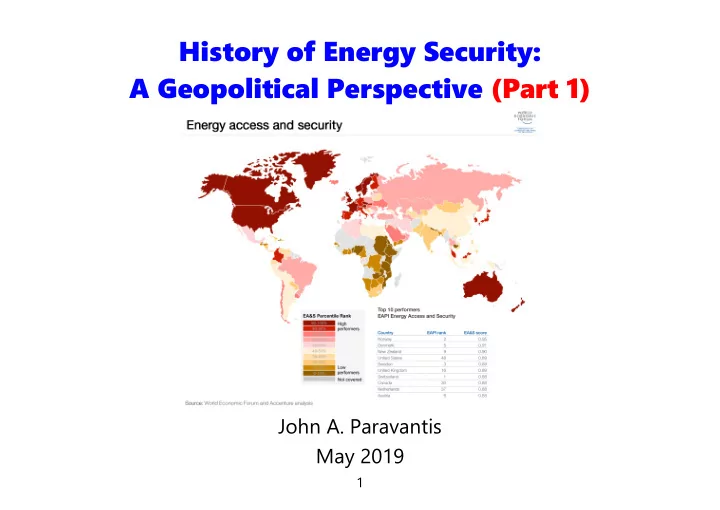
History of Energy Security: A Geopolitical Perspective (Part 1) - - PowerPoint PPT Presentation

history of energy security a geopolitical perspective
SMART_READER_LITE
LIVE PREVIEW

History of Energy Security: A Geopolitical Perspective (Part 1) - - PowerPoint PPT Presentation

History of Energy Security: A Geopolitical Perspective (Part 1) John A. Paravantis May 2019 1 1. Preamble History is just one damn thing after another H. A. L. Fisher Energy is an economic, ill-distributed and expensive good, subject to


slide-1
SLIDE 1

1

History of Energy Security: A Geopolitical Perspective (Part 1)

John A. Paravantis May 2019

slide-2
SLIDE 2

2

  • 1. Preamble

“History is just one damn thing after another”

  • H. A. L. Fisher

Energy is an economic, ill-distributed and expensive good, subject to price fluctuations, with repercussions in many domains of life. To complicate things further, the global energy landscape is in a state of disarray:

  • consumers have turned producers
  • producers have turned consumers
  • the volatility of oil prices has shot upwards

 in part due to geopolitical events that are difficult to predict in a multipolar world.

slide-3
SLIDE 3

3

Energy has always been intricately connected to governments and

  • ftentimes the arena of political contention because of
  • size
  • technological scale
  • monetary investment.

In particular, energy is related to global politics, e.g. although the Cold War between the US and Soviet Union lapsed when the latter ceased to exist in 1991, standoffs that generate similar concerns are in place globally:

  • Russia endeavoring to be an energy hegemon
slide-4
SLIDE 4

4

  • Iran acting as a rogue nation with its nuclear ambitions that can

change the balance of power in the Middle East  What if it shuts down the nearby Strait of Hormuz, a choke point

  • f great geostrategic value?
slide-5
SLIDE 5

5

  • China that is asserting its newly found place of power in the world

and the South China Sea, another global hotspot.

slide-6
SLIDE 6

6

Geopolitics has a big impact on oil companies and energy markets, and energy and geopolitics are entwined. Energy security has become an increasingly popular concept for

  • policy makers
  • entrepreneurs
  • academics.

Energy security can be viewed as a public good for societies, and its insufficient provision may be associated with

  • disruptions of the supply of oil, gas and electricity
  • severe consequences for societies, economies and individuals.
slide-7
SLIDE 7

7

Consequently, energy security is a political issue. In fact, an International Relations (IR) approach could think of energy security as

  • the ability of a country to access the energy resources that is needs

to maintain the current level of its national power without compromising its  foreign policy  economic objectives  social objectives  environmental objectives. The Securitization Theory translates to a militaristic interpretation of energy security.

slide-8
SLIDE 8

8

But things have changed nowadays:

  • Peak oil concerns are not as relevant as they were before the shale

revolution.

slide-9
SLIDE 9

9

“We used to think about Peak Oil like this – the reserves are finite, we know where they are and how long they will last, and we will start running out soon. But with recent technological innovations, we keep finding new oil deposits that are now recoverable and a peak may not happen for a century or more” (Association for the Study of Peak Oil & Gas, ASPO).

  • There is more confidence about the physical availability of oil.
slide-10
SLIDE 10

10

The current global attention to energy security is mostly explained by the new emerging giants of the world economy and their rising energy demand. Energy security concerns now stem more from the challenges of meeting the energy demand of developing nations with rapidly rising income such as China and India. The Rest of the World (RoW) consumes more oil than the OECD countries that were traditionally associated with most of the global energy demand.

slide-11
SLIDE 11

11

slide-12
SLIDE 12

12

Energy security means different things to different countries based on

  • geographical location
  • natural resource endowment
  • status of international relations
  • political system
  • economic disposition
  • ideological views and perceptions.

Approaches to energy security may also differ between countries, depending on

  • structure of energy system
  • historical experiences, e.g.
slide-13
SLIDE 13

13

This is observed in the various strategies chosen by the different member states within the European Union (EU), e.g.

  • the degree of reliance on Russian gas and the diverse historical

experiences from the Cold War have led to different approaches to energy security. A four-level approach to international politics:

  • 1. international (system)
  • 2. regional (sub-system)
  • 3. national (unit)
  • 4. internal (sub-unit).

Energy security needs to be investigated at these four levels:

  • 1. globally, to ensure adequacy of resources
  • 2. regionally, to ensure that networking and trade can take place
  • 3. at a country level, to ensure national security of supply;
  • 4. at a consumer level, to ensure that consumer demand is satisfied.
slide-14
SLIDE 14

14

1.1. Objectives

In this presentation, I work out the history of energy security adopting a geopolitical perspective.

  • To my knowledge, no published research addresses the history of

energy security Interesting questions:

  • What has energy security meant over time? How have nations tried

to achieve it in different time periods and areas of the world?

  • Does energy security mean being completely independent of the

energy other countries can provide? Or does it mean maintaining friendly relationships with other countries that are energy providers?  In particular, does the goal of oil (or energy) independence make sense in world that is a complex system of oil companies, countries and trading blocs such as North America?

slide-15
SLIDE 15

15

  • How has the concept of energy security been updated with the

revolution in source rock resources (e.g. shale gas and oil)? A very ambitious goal would be to offer:

  • alternative narratives of energy security history
  • a vision for the future.
slide-16
SLIDE 16

16

1.2. Motivation

Is it worth writing of the history of energy security? How would the students address this concern?

slide-17
SLIDE 17

17

As of April 29, 2019, https://www.sciencedirect.com/ contained

  • zero papers that contained the phrase “history of energy security” in

their title, abstract, keywords or full text

  • 24 papers that contained “history” and “energy security” in their title,

abstract or keywords; of these  one was entitled “The three perspectives on energy security: intellectual history, disciplinary roots and the potential for integration”, authored by Cherp & Jewell and was published in the Current Opinion in Environmental Sustainability journal in 2011)  the others were related to energy, but not directly related to energy security

  • 481 papers that contained “energy security” in their title, abstract or

keywords, and “history” in their main text

slide-18
SLIDE 18

18

As a confirmation, a full bibliometric analysis of 2845 energy security paper by Zhou et al (2017) contained no information on papers dealing with the history of energy security.

slide-19
SLIDE 19

19

  • 2. History of energy security

Historical milestones of energy security: Year Event Significance July 28, 1914 to November 11, 1918 First World War Oil appreciated as a significant logistical resource (transport) September 1, 1939 to September 2, 1945 Second World War Oil appreciated as a significant logistical resource (transport) 1947 Beginning of the Cold War Major changes in geopolitical alignment

slide-20
SLIDE 20

20

Year Event Significance 1947 Stanolind Oil (exploration subsidiary of Amoco) conducted the first experimental fracturing in southwestern Kansas, using gelled gasoline and sand from the Arkansas River Multistage hydraulic fracturing combined with horizontal drilling (60 years later) fueled the major changes in energy security

  • bserved presently
slide-21
SLIDE 21

21

Year Event Significance October 6 to 26, 1973 Yom Kippur Arab-Israeli war The 1973 (1st) Oil Crisis started when the Organization of Arab Exporting States proclaimed an embargo at nations perceived as supporting Israel during the Yom Kippur war October 1973 to March 1974 1st Oil Crisis Long lines of passenger cars at gas stations (unseen and unheard thus far in the US)

slide-22
SLIDE 22

22

Year Event Significance April 10, 1975 US Congress instituted US

  • il export ban by passing

the Energy Policy and Conservation Act (EPCA), as a response to the 1st Oil Crisis 1979 Three Mile Island nuclear accident 1978 to 1979 2nd Oil Crisis 1986 Chernobyl (USSR) nuclear accident

slide-23
SLIDE 23

23

Year Event Significance August 2, 1990 to February 28, 1991 1st Gulf War Saddam Hussein’s unsuccessful bid to conquer Kuwait and dominate the Persian Gulf, a region of immense geopolitical importance due to its abundance of energy resources

slide-24
SLIDE 24

24

Year Event Significance December 25, 1991 Mikhail Gorbachev’s 12- minute speech on national television announcing that the Soviet Union would cease to exist In his speech, Gorbachev made an indirect reference to the importance of energy for the success and security

  • f a state: “We have a lot of

everything – land, oil and gas and other natural resources…” March 20, 2003 to December 18, 2011 2nd Gulf War

  • G. W. Bush avenges his

father’s lack of perseverence

slide-25
SLIDE 25

25

Year Event Significance August 2005 Hurricane Katrina caused catastrophic damage in Florida and Louisiana The catastrophic potential of black-swan type of natural disasters for energy grids was made clear 1st Ukrainian Crisis 2nd Ukrainian Crisis December 18, 2010 Arab Spring upheaval Changed the strategic balance in the Middle East and North Africa (MENA), with indirect implications for energy

slide-26
SLIDE 26

26

Year Event Significance March 11, 2011 Fukushima Daiichi Nuclear Accident The importance of securing energy installations from “unthinkable” natural threats (even unusual ones line tsunamis as opposed to earthquakes, and further to traditional threats like terrorist attacks) became

  • bvious in a country (Japan)

devoid of indigenous energy resources.

slide-27
SLIDE 27

27

Year Event Significance April 17 to 19, 2011 Major cyber attack on Sony compromised personal details from 77 million accounts and prevented users of PlayStation 3 and PlayStation Portable consoles from accessing the service It was made clear that cyber vulnerability constitutes an important concern for energy security EU Energy Union (to be done)

slide-28
SLIDE 28

28

Year Event Significance August 15, 2012 Cyber attack on 35,000 computers of Aramco, the Saudi Arabian oil company As the ability of Aramco to supply 10% of the global demand for oil, this biggest computer hack in history alerted the world to the terrifying possibility of a cyber Pearl Harbor

slide-29
SLIDE 29

29

Year Event Significance January 16- 19, 2013 In Amenas gas plant hostage crisis in the Sahara desert in Algeria As terrorists linked to Al- Qaeda attacked the Tigantourine gas facility near In Amenas, Algeria, executing at least 39 expat hostages (10 of them Japanese), the world came into the alarming realization that terrorism constitutes a serious global threat to energy infrastructure and the power grid)

slide-30
SLIDE 30

30

Year Event Significance September 10, 2015 US House Energy & Power Subcommittee approved bill to lift the 1975 oil export ban (instituted by EPCA) It is reasonable to expect that the lift of the ban has encouraged new investments and created new jobs in all areas of the economy, enhancing various components of energy security in one fell swoop

slide-31
SLIDE 31

31

slide-32
SLIDE 32

32

slide-33
SLIDE 33

33

slide-34
SLIDE 34

34

slide-35
SLIDE 35

35

slide-36
SLIDE 36

36

slide-37
SLIDE 37

37

Let’s talk some more about the events on the table. Energy security has played an important role in the 20th century.

  • The dominance of oil was assured by its liquid form, which made it

the only viable fuel for transportation and the emerging automobile market. World Wars 1 and 2:

  • Winston Churchill believed that oil supply security was essential to

fuel his army during the First World War

  • Fueling the army was an important concern for Germany and Japan

as they invaded the Soviet Union (USSR) and Indonesia during the Second World War. During these wars, energy security was often implicitly used as a synonym for national security.

slide-38
SLIDE 38

38

In the 1950s & 1960s most of the world improved, recovering from the two World Wars:

  • According to 2013 United Nations (UN) energy statistics, the world

energy demand increased from 1676 million tons of oil equivalent (Mtoe) in 1950 to 4197 Mtoe in 1969.

  • Globally, economic growth, improved living standards, motorization,

and electrification pushed energy demand in all sectors, and the international energy trade increased from 331 Mtoe in 1950 to 1513 Mtoe in 1969. Yet, there was inequality:

  • In 1969, 72% of the electricity was consumed in OECD countries that

had only 20% of the world total population.

  • In many developing countries the majority of the population did not

have access to modern energy.

slide-39
SLIDE 39

39

In 1960, oil exporting countries formed the Organization of Petroleum Exporting Countries (OPEC)

  • to address the distribution of wealth derived from oil exports.

OPEC’s first Conference took place in Baghdad.

slide-40
SLIDE 40

40

The 1970s found the world in a state of

  • rampant inflation
  • persistently high unemployment
  • growing government expenditures
  • declining productivity
  • shrinking revenues
  • smaller profits margins
  • accepted management strategies of the 1950s and 1960s failed to

restore growth. Security of energy supply was not a priority in many developing countries

  • companies supplied cheap oil and, thus, stability.

The 1970s went down in history as a decade of

  • energy scarcity
  • gasoline lines.
slide-41
SLIDE 41

41

slide-42
SLIDE 42

42

slide-43
SLIDE 43

43

It was during the 1970s when

  • the first oil crises uncovered the vulnerability of developed

economies to oil price shocks

  • concerns about energy security first arose in Europe, Japan and the

US

  • energy security arose as a problem in the research literature.

Energy security became a matter of national security for many developed countries in the aftermath of the oil shocks of 1973. In the First Oil Crisis of 1973, oil embargoes by the Organization of Arab Petroleum Countries (OAPEC) shook the oil importing countries to the core.

  • It was forces put in motion then that shot up international oil prices

above $30 per barrel ($100 per barrel in 2015 values) in the Second Oil Crisis (1979).

slide-44
SLIDE 44

44

In a milestone move for energy security, the International Energy Agency (IEA) was created in 1974 by the countries of the Organization for Economic Cooperation and Development (OECD)

  • to promote energy security among its member countries
  • through collective response to physical disruptions of energy

supplies  e.g. by holding stocks equivalent to at least 90 days of net oil imports. According to 2013 IEA data

  • in 1979 oil shared as much as 86% of the world energy trade
  • the Middle East supplied 58% of the internationally traded oil
  • so international energy security still largely meant oil security.
slide-45
SLIDE 45

45

By the end of the 1970s

  • oil’s significance for the entire economy had become obvious
  • energy security was a high priority issue on the policy agenda.

What about modern concepts like renewable energy?

  • From the 1970s, when renewables burst into the scene, until the 21st

century, renewable energy went through the “valley of death”  period of technological immaturity and economic stagnation that lasted from discovery until rebirth (around the beginning of the 21st century) and on to scaling up, commercialization and diffusion

  • Now electric utilities buy into wind energy without hesitation.
slide-46
SLIDE 46

46

Then came the 1980s, with Reagan and Thatcher’s

  • less government involvement
  • pro market policies
  • greater competition.

Energy markets took the path towards restructuring and liberalization, which were strongly advocated by the grid companies of

  • electricity
  • telecommunications
  • gas.

Monopolies were broken up and new pricing schemes were introduced, promoted by

  • OECD
  • World Bank
  • International Monetary Fund (IMF)
  • international trading agreements.
slide-47
SLIDE 47

47

slide-48
SLIDE 48

48

slide-49
SLIDE 49

49

The concern for energy security was somewhat reduced in the 1980s

  • supply expansion
  • lower demand for oil

 global oil imports decreased by 25% during the first half of the decade  oil was in part replaced by natural gas and nuclear energy, especially for power generation. According to 2013 IEA data

  • world energy demand increased by 20% per year during the 1980s
  • share of oil shrank

 from 42 in 1980 to 37% in 1989 for primary energy supply  from 20 in 1980 to 12% in 1989 for power generation.

slide-50
SLIDE 50

50

The early 1990s were marked by

  • the First Gulf War (2 August 1990 – 28 February 1991)
  • the collapse of the Soviet Union.
slide-51
SLIDE 51

51

slide-52
SLIDE 52

52

slide-53
SLIDE 53

53

slide-54
SLIDE 54

54

Energy security gained momentum as the world went in to the 1990s

  • global demand for energy was growing
  • global resources became scarce
  • the concern for energy security began to gain prominence in global

discourse. According to 2013 UN energy statistics

  • 63% of electricity was still consumed within OECD
  • but power demand in non-OECD countries grew much faster than

that of the OECD countries

slide-55
SLIDE 55

55

How about global warming?

  • global warming issues became gradually institutionalized throughout

the decade

  • the Kyoto Protocol was signed in 1997.

Implementation required participating members to

  • create policies and measures to reduce and offset domestic

emissions

  • increase absorption of greenhouse gases.
slide-56
SLIDE 56

56

With the turn of the 21st century:

  • The oil situation could be characterized as a seller’s market

 OPEC, Russia and other exporters had the power

  • The US has kept promoting free markets domestically and

internationally  but the dynamics seemed to be dragging the world into more of a managed market for oil.

  • With OPEC investments not keeping up with increasing global

demand, the price of oil went up after 2003. The energy security issue re-emerged in the 2000s driven by

  • rising demand in Asia
  • disruptions of gas supplies in Europe
  • pressure to decarbonize energy systems.
slide-57
SLIDE 57

57

In 2005

  • The Russian federation cut down the supply of gas to Ukraine
  • As a result, the supply of gas towards western European was also

shortened. The Russian-Ukrainian crises of 2006 and 2009 showed that the main supplier of the EU was

  • unreliable
  • capable of using energy resources as a geopolitical weapon.
slide-58
SLIDE 58

58

A more recent revival of interest in energy security was stirred by

  • high oil prices (in the period up to 2008)
  • geopolitical supply tensions.

At the same time

  • Terrorist attacks led to the wars in Afghanistan and Iraq
  • Further tensions and instability were caused by

 the Arab Spring  the Islamic State created. Finally, in 2011 the Fukushima nuclear accident

  • scared the world
  • revealed how the Japanese work
  • revived important questions about the safety of nuclear energy.
slide-59
SLIDE 59

59

slide-60
SLIDE 60

60

In the 2010s, came Russia’s time to be recognized as an energy hegemon and a US national security threat:

  • Russia’s wealth from oil exports
  • Europe’s dependence on Russian gas.

At the same time

  • European dependence on Russian gas has motivated Europe to be in

silent support of the impunity that Russia enjoys

  • Russia has been buying into the European downstream through

state-managed Gazprom.

slide-61
SLIDE 61

61

Nuclear proliferation is not good for any great power

  • more ramifications were felt further away

 US’s efforts to combat nuclear proliferation in Iran are directly subverted by Russia  through Russia, Europe and Iran, the US could be losing oil dominion in Central Asia (underscoring the complexity of the globalized world. One could argue that

  • a new Cold War between US and Russia has already started
  • it is felt at various locations and levels of activity.

On the other hand, if one takes global warming into account

  • it is US and China energy securities that are most vulnerable

 these two countries make up almost half of total world CO2 emissions.

slide-62
SLIDE 62

62

To recap:

  • Originally, energy security suggested stable energy flow.
  • Its meaning expanded over time

 the fair price element was added in the 1970s and 1980s.

  • Energy security has become closely entangled with other energy

policy problems, e.g.  providing equitable access to modern energy  mitigating climate change.

  • The present era is defined by energy abundance coupled with new

concerns  equity  terrorism  global climate change

slide-63
SLIDE 63

63

  • 3. Nature of energy security

The nature of energy security is

  • polysemic
  • multi-dimensional
  • dynamic (depending on location and time frame).

The term has risen highly on the policy agenda of governments because

  • f a
  • complex system of global markets
  • vast cross-border infrastructure network
  • relatively small group of primary energy suppliers.

Let’s look at how different energy sources participate in energy security.

slide-64
SLIDE 64

64

Oil

  • had become the dominant fuel by 1930 mainly due to its importance

in transport

  • replaced coal as the industry’s primary energy source in the 1950s.

Oil and coal are very different economically

  • locating coal seams is relatively easy (i.e. cheap), but bringing coal to

the surface is very costly

  • locating oil is very difficult (with one fourth to 95% of exploratory

holes failing to yield oil), once located oil rises to the surface under its own steam.

slide-65
SLIDE 65

65

With natural gas

  • in 2016 accounted for about a quarter of global energy consumption

 a dominance catalyzed by the development of a global market for Liquefied Natural Gas (LNG)

  • the advent of supertankers and the development of pipeline

networks lowered the price of oil and natural gas The geopolitical problem with natural gas is that

  • its resources are concentrated in a handful of countries

 the former Soviet Union and the Middle East hold about three quarters of known world reserves (2017 BP data).

slide-66
SLIDE 66

66

Public acceptance of nuclear energy was hit by the accidents in

  • Three Mile Island (USA, 1979)
  • Chernobyl (USSR, 1986) accidents.

The growth of nuclear energy was slowed down by

  • high capital costs
  • lengthy construction times
  • problems with decommissioning older nuclear plants and disposing

their radioactive waste

  • reactor safety
  • concerns about the potential use to produce nuclear weapons.
slide-67
SLIDE 67

67

As of 2017:

  • the cost of coal was comparatively low
  • oil and natural gas prices had escalated and remained high
  • nuclear energy is not in vogue anymore.

The Rest of the World (RoW) versus OECD:

  • Developing nations are characterized by escalating energy demands.

 consumers have become producers  producers have become consumers

  • China as well as India (“Chindia”) have emerged as

 major geopolitical players  key energy consumers (India mostly)  major energy producers (China mostly).

slide-68
SLIDE 68

68

Energy security risks:

  • political instability in supplier countries
  • rapidly increasing oil prices
  • increasing frequency of disruptions to gas supplied from Russia to

Europe

  • terrorist attacks
  • extreme weather events (e.g. the Hurricane Katrina that hit the Gulf

coast of the US in 2005)  followed by electricity blackouts.

slide-69
SLIDE 69

69

The 4A definition of energy security is eminent in the literature:

  • Availability (if not, what are we talking about?)
  • Affordability (has to be cheap)
  • Accessibility (to all, including the fuel poor)
  • Acceptability (from an environmental standpoint).

The first two As (availability and affordability) constitute the classic approach to energy security (20th Century) The latter two (accessibility and acceptability) reflect contemporary concerns relating to fuel poverty and global climate change.

slide-70
SLIDE 70

70

In a 2013 speech in Yale University (https://youtu.be/M_Y8Jy2JBf8), Yergin has argued that there are three new dimensions to energy security:

  • 1. physical security in respect to threats like terrorism
  • 2. integrated energy shocks

 caused by natural disasters such as hurricanes and superstorms  electric power, fuel, emergency services etc. are all down at the same time  entire regions are immobilized

  • 3. cyber threats

 can affect large scale production and create global havoc.

slide-71
SLIDE 71

71

It may be argued that

  • different types of energy sources are characterized by differing

importance of their 4A profile dimensions, e.g.  with oil, physical and economic availability has been its preeminent aspect  with shale oil/gas, environmental acceptability has been its most important concern.

slide-72
SLIDE 72

72

With shale gas and oil drilling

  • environmental issues may be more of a public policy issue rather

than an actual activity issue  as long as producers manage shale drilling responsibly, something that is to their advantage to do since water aquifer contamination could bring the entire shale revolution to a halt. To be more secure, US shale oil and gas companies diversify their business, e.g.

  • also working on Canadian oil sands

 if price or other realities make operation in one country difficult, they will have recourse to the other country.

slide-73
SLIDE 73

73

slide-74
SLIDE 74

74

slide-75
SLIDE 75

75

Onshore shale gas vs deep water drilling

  • response times are much shorter with shale
  • permitting, setting up and drilling can be done much faster with

shale

  • with shale one ends up drilling many more wells.
slide-76
SLIDE 76

76

How can we measure oil affordability?

  • West Texas Intermediate (WTI, a grade of crude oil) is used as a

benchmark for the domestic price of oil in the US.

  • The average annual OPEC crude oil price may be used in US dollars

per barrel.  The Brent crude oil price (a blend of oil from a dozen oil field located in the North Sea, more expensive than WTI by then dollars or so in the last few years) may be a better indication of a global average price  it is very close to the average OPEC crude oil price.

slide-77
SLIDE 77

77

slide-78
SLIDE 78

78

Want to guess the price of oil? How about the volatility is oil prices after 2007?

  • unprecedented ups and downs

 in keeping with the geopolitical unpredictability in world affairs

  • predicted by the amazing David L. Goldwyn

 US Department of State’s Special Envoy and Coordinator for International Energy Affairs (2009 to 2011)

  • in a McKinsey Executive Rountable Series in International Economics

 June 21, 2007 (“Energy Security: What It Means and How to Achieve It”, https://youtu.be/kUIqF81wZJE, accessed April 28, 2019)

  • showcases the importance of combining qualitative approaches with

traditional quantitative forecasting methods.

slide-79
SLIDE 79

79

slide-80
SLIDE 80

80

For oil availability, the total annual OPEC production may be used. In particular, hydraulically fractured wells in the US

  • increased from approximately 23,000 in 2000 to approximately

300,000 in 2015  account for two thirds of total US natural gas production and half

  • f oil production.

Nest we turn to natural gas prices.

slide-81
SLIDE 81

81

slide-82
SLIDE 82

82

slide-83
SLIDE 83

83

slide-84
SLIDE 84

84

Renewable energy may be categorized as follows:

  • relevant for electricity

 wind (mostly)  solar (secondarily)

  • for other uses

 biofuels. Oftentimes, one component of the energy security may antagonize another, e.g.

  • with economic growth, China faces significant urban air pollution

(smog) problems that  undermine the health of the urban population  create a wave of protests by the growing middle class

  • the social component of energy security is affected negatively in

more than one ways.

slide-85
SLIDE 85

85

In Part 2 (next week) we will talk about the

  • geopolitics
  • future
  • f energy security.

In the elective class, we will concentrate on

  • the environmental dimension/component of energy security
  • social acceptance and energy security concerns regarding renewable

energy

  • climate change and urbanization, e.g. heat wave mortality.