Hindsight to Foresight Where have we come from, where are we - - PowerPoint PPT Presentation

hindsight to foresight
SMART_READER_LITE
LIVE PREVIEW

Hindsight to Foresight Where have we come from, where are we - - PowerPoint PPT Presentation

Hindsight to Foresight Where have we come from, where are we heading? | 14/06/2015 Andy Macfarlane, Dan Coup | 14/06/2015 Andy Macfarlane, Dan Coup | 14/06/2015 Andy Macfarlane, Dan Coup Old Technology | 14/06/2015 Andy Macfarlane, Dan


slide-1
SLIDE 1

| 14/06/2015 Andy Macfarlane, Dan Coup

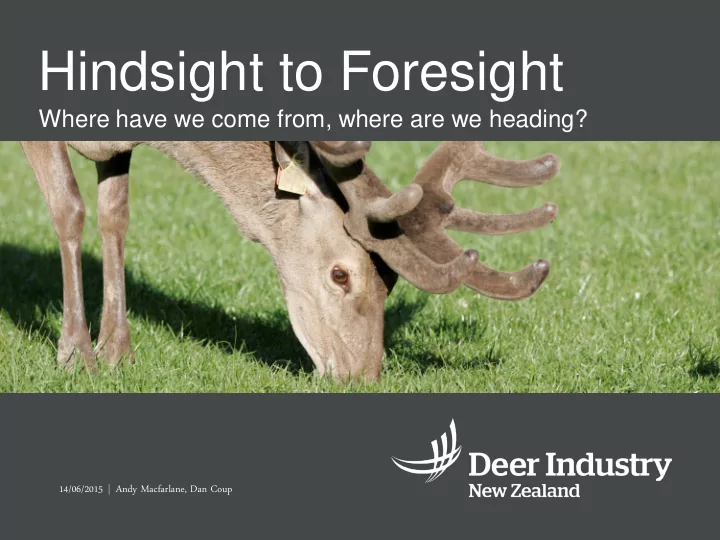
Hindsight to Foresight

Where have we come from, where are we heading?
slide-2
SLIDE 2

| 14/06/2015 Andy Macfarlane, Dan Coup

slide-3
SLIDE 3

| 14/06/2015 Andy Macfarlane, Dan Coup

slide-4
SLIDE 4

| 14/06/2015 Andy Macfarlane, Dan Coup

Old Technology

slide-5
SLIDE 5

| 14/06/2015 Andy Macfarlane, Dan Coup

New technology, new opportunity

slide-6
SLIDE 6

Entrepreneurs + risk =

slide-7
SLIDE 7

| 14/06/2015 Andy Macfarlane, Dan Coup

INNOVATION

slide-8
SLIDE 8

|

Message from Minister

14/06/2015 Andy Macfarlane, Dan Coup

slide-9
SLIDE 9

|

PGP provides not only financial support and expertise

  • 1. Independent panel has endorsed our strategy
  • 2. Agreement that Passion2Profit will create value for

deer industry and New Zealand

Endorsement

14/06/2015 Andy Macfarlane, Dan Coup

slide-10
SLIDE 10

|

A major strategy review showed that:

  • 1. We were vulnerable to market concentration risk in

both venison and velvet

  • 2. Industry collaboration could improve
  • 3. On-farm performance gains were low, other than

in velvet weights

2010

14/06/2015 Andy Macfarlane, Dan Coup

slide-11
SLIDE 11

|

Worked towards an industry profit goal that was ambitious but achievable.

2011 - 2012

14/06/2015 Andy Macfarlane, Dan Coup

slide-12
SLIDE 12

|

Our goal needed to be:

  • 1. Market led
  • 2. Underpinned by alignment between market

requirement and on-farm production capability

  • 3. Enabled by other value chain partners in such

areas as research, logistics, quality control and processing.

Profitability Goal

14/06/2015 Andy Macfarlane, Dan Coup

slide-13
SLIDE 13

|

Set ourselves some 10-year targets in 2012:

  • 1. On-farm gains:
  • Fawning - Survival to sale

84%

  • Carcass weight

61kg

  • Kill date
  • 16 days
  • Kg output per hind

51kg

  • EBIT/kg venison

+$1.48

  • 2. Market gains:

+$0.52 +$2.00

Profitability Goal

14/06/2015 Andy Macfarlane, Dan Coup

Or similar combination

slide-14
SLIDE 14

|

Fawning

14/06/2015 Presented by Max Müller

slide-15
SLIDE 15

|

Slaughter date

14/06/2015 Presented by Max Müller

Chart – Average slaughter date

slide-16
SLIDE 16

|

Product Weights

14/06/2015 Presented by Max Müller

slide-17
SLIDE 17

|

Gains identified in 2012 would come from:

  • 1. Diversified markets
  • 2. Increasing % of chilled exports
  • 3. Differentiation of farmed vs game in key market

segments

  • 4. Improved co-product value chain

Market gains

14/06/2015 Andy Macfarlane, Dan Coup

slide-18
SLIDE 18

|

An integration strategy:

  • pulling the value chain together

Passion2Profit

14/06/2015 Andy Macfarlane, Dan Coup

slide-19
SLIDE 19

|

Overview…

  • 1. Agreed by DINZ, NZDFA and Venison Marketers
  • 2. $16m investment over 7 years
  • ~ $4m farmers, $4m marketers, $8m Crown
  • 3. 50:50 - Marketing and Production

Passion2Profit - refresher

14/06/2015 Andy Macfarlane, Dan Coup

slide-20
SLIDE 20

|

Passion2Profit - refresher

14/06/2015 Andy Macfarlane, Dan Coup

slide-21
SLIDE 21

|

Passion2Profit - refresher

14/06/2015 Andy Macfarlane, Dan Coup

slide-22
SLIDE 22

|

“Go-Early” trials and pilots have been crucial to enabling momentum both on- farm and in market now we have official approval

Piloting is crucial

14/06/2015 Andy Macfarlane, Dan Coup

slide-23
SLIDE 23

|

P2P – On-farm

Where have we come from, what’s happening, what’s next…

14/06/2015 Andy Macfarlane, Dan Coup

slide-24
SLIDE 24

|

An integrated farm systems approach, recognises:

  • 1. Chosen production system
  • 2. Terrain, soils, climate
  • 3. Animal type
  • 4. Staff skills and management preference

Accounts for:

  • 1. Feed production options available
  • 2. Growth rates achievable

New ways of thinking

14/06/2015 Andy Macfarlane, Dan coup

slide-25
SLIDE 25

|

System 1 Farm:

  • 1. High degree of long term pasture
  • 2. Hay and silage used in winter
  • 3. Typically breeding only
  • 4. Low cost structure

Example:

14/06/2015 Andy Macfarlane, Dan Coup

slide-26
SLIDE 26

|

System 3 Farm:

  • 1. Perennial ryegrass base
  • 2. Supplemented with winter feed crops
  • 3. Some specialist crops, e.g. lucerne or red clover
  • 4. Typically breeding and finishing
  • 5. Animals typically finished in summer

(After the current chilled season)

  • 6. Medium cost structure

Example:

14/06/2015 Andy Macfarlane, Dan Coup

slide-27
SLIDE 27

|

System 5 Farm:

  • 1. High degree of short-term feed (short-rotation

ryegrass, chicory, red clover, plantain, lucerne, winter feed crops)

  • 2. Prepared to use concentrate supplements as

well as conserved feed

  • 3. Orientated to finishing
  • 4. Targets high % deer for chilled season
  • 5. High cost structure, high output/Ha

Example:

14/06/2015 Andy Macfarlane, Dan Coup

slide-28
SLIDE 28

| 14/06/2015 Andy Macfarlane, Dan Coup

slide-29
SLIDE 29

|

  • 1. Better description of farm system intensity
  • 2. Case study examples of how the desired level of

intensity can be achieved

  • 3. Verified feed budgets (modelled, and checked by

farmers using the system)

  • 4. Verified financial budgets
  • 5. Benchmarked to environmental metrics (resource

use efficiency)

  • 6. Framework for research and demonstration

Outputs

14/06/2015 Andy Macfarlane, Dan coup

slide-30
SLIDE 30

|

  • 1. Better visibility for farmers on “what system is

best for me”

  • 2. Assist in costing on-farm growth in numbers and

production (for farmers and financiers)

  • 3. Enables better reporting to other stakeholders

(govt environmental, etc)

  • 4. Better visibility of gains from P2P
  • 5. Better targeting of research to where
  • pportunities can be aligned to market

Outcomes

14/06/2015 Andy Macfarlane, Dan coup

slide-31
SLIDE 31

|

P2P – Marketing

Delivering greater market returns for venison

14/06/2015 Andy Macfarlane, Dan Coup

slide-32
SLIDE 32

|

Price relative to game…

14/06/2015 Andy Macfarlane, Dan Coup

slide-33
SLIDE 33

|

slide-34
SLIDE 34

|

Price relative to beef, lamb

14/06/2015 Andy Macfarlane, Dan Coup

slide-35
SLIDE 35

|

Lost value

14/06/2015 Andy Macfarlane, Dan Coup

slide-36
SLIDE 36

|

Lost value

14/06/2015 Andy Macfarlane, Dan Coup

slide-37
SLIDE 37

|

Objective

14/06/2015 Andy Macfarlane, Dan Coup

Develop sales outside traditional European game season

  • 1. Sell more chilled…
  • Deliver venison to consumers in the form they

value most highly

  • 2. Co-benefits
  • Reduce supply pressure on frozen venison
  • Reduce storage, financing costs
  • Reduce market concentration risk
slide-38
SLIDE 38

|

How?

14/06/2015 Andy Macfarlane, Dan Coup

Collaboration and support will enable effective market development investment

  • 1. Market development is difficult for any single

venison company

  • Risk of free-riders
  • Scale of investment required
  • 2. Collaboration, with PGP support, will create

necessary scale of action

  • Industry approach (Cervena™) has

advantages

slide-39
SLIDE 39

|

Where?

14/06/2015 Andy Macfarlane, Dan Coup

Europe and China

  • 1. China is too big an opportunity to ignore
  • Has transformed dairy, lamb industries
  • Traditional affinity for deer (but not venison)
  • 2. Europe is where we have existing partners
  • Customers who understand and care for our

venison

  • A niche opportunity
slide-40
SLIDE 40

|

China

14/06/2015 Andy Macfarlane, Dan Coup

China is very big and very complex and we need to figure out where to start

  • 1. What city/province?
  • 2. What cuisine style/sector?
  • Traditional Chinese
  • Western style
  • 3. Begin with desktop market research of options
  • 4. Move quickly to small-scale pilots
slide-41
SLIDE 41

|

Europe

14/06/2015 Andy Macfarlane, Dan Coup

Need to create a new, distinct positioning for spring-summer grilling meat

  • 1. Hirsch, Hertenvlees, Hjorte – are all eaten only in

autumn – so this must be something different

  • New name
  • New cuisine style
  • New consumers
  • 2. We need to understand what selling points will be

most favourable for these new consumers

slide-42
SLIDE 42

|

A very exciting first step in our collaborative strategy

Netherlands Cervena Pilot

14/06/2015 Andy Macfarlane, Dan Coup

slide-43
SLIDE 43

|

Netherlands Cervena Pilot

14/06/2015 Andy Macfarlane, Dan Coup

Trialling the appetite for a new concept

  • 1. Five marketing companies have agreed to

experimental pilot launch of Cervena

  • Testing market acceptance
  • Testing marketing messages
  • Assessing volume potential
  • 2. Trial commenced in April
  • Two Dutch partners, two suppliers
  • 3. Will be rolled-out to more partners if successful
slide-44
SLIDE 44

|

DINZ 5-year Strategy

Evolution not revolution

14/06/2015 Andy Macfarlane, Dan Coup

slide-45
SLIDE 45

|

Evolution not revolution

14/06/2015 Andy Macfarlane, Dan Coup

Board in final stages of revising the Nov 2010 strategy in light of:

  • 1. Global market trends
  • 2. NZ farming challenges and opportunities
slide-46
SLIDE 46

|

Single integrated strategy

14/06/2015 Andy Macfarlane, Dan Coup

A strategy encompassing all deer farming processing and marketing

  • 1. Venison
  • 2. Velvet
  • 3. Co-products
slide-47
SLIDE 47

|

Strategic Objectives

14/06/2015 Andy Macfarlane, Dan Coup

  • 1. Premium positioning
  • For all of our products to be “best in class”
  • 2. Market development and diversification
  • Drive new demand and mitigate risk
  • 3. Sustainable on-farm efficiency growth
  • Driving long-term alignment with market
  • 4. Cohesive and respected industry
  • Ensure strong communication and networks
slide-48
SLIDE 48

|

Hindsight to Foresight

14/06/2015 Andy Macfarlane, Dan Coup