High Voltage Aqueous Na/K-ion Batteries Masaru Tanaka of Kyushu - - PowerPoint PPT Presentation

high voltage aqueous na k ion batteries
SMART_READER_LITE
LIVE PREVIEW

High Voltage Aqueous Na/K-ion Batteries Masaru Tanaka of Kyushu - - PowerPoint PPT Presentation

ICEnSM 2019, Session 1, 9:30 am-10:00 am, Nov. 30th at Shenzhen Material synthesis and cell performance were measured by Dr. Kosuke Nakamoto, Mr. Ryo Sakamoto, and Prof. Masato Ito of Kyushu University. TG/DSC measurement was supported by


slide-1
SLIDE 1
  • 1. Candidates of Post Li-ion battery
  • 2. Concentrated aqueous electrolytes
  • 3. Aqueous half cell performances
  • 4. High voltage aqueous Na-ion battery
  • 5. High voltage aqueous K-ion battery
  • 6. Summary

Kyushu University

Shigeto Okada

OUTLINE

ICEnSM 2019, Session 1, 9:30 am-10:00 am, Nov. 30th at Shenzhen

High Voltage Aqueous Na/K-ion Batteries

  • Acknowledgement
  • Dr. D. Murakami, Prof. M. Tanaka, Prof. Y. Shiota
  • Dr. Kosuke Nakamoto, Mr. Ryo Sakamoto, Prof. Masato Ito

Material synthesis and cell performance were measured by Dr. Kosuke Nakamoto, Mr. Ryo Sakamoto, and Prof. Masato Ito of Kyushu University. TG/DSC measurement was supported by Prof. Daiki Mrakami and Prof. Masaru Tanaka of Kyushu University. HOMO/LUMO calculation was supported by Prof. Yoshihito Shiota of Kyushu University.

  • v

/

  • S. Okada, S. Sawa, M. Egashira, J.

Yamaki, M. Tabuchi, H. Kageyama, T. Konishi, A. Yoshino, “Cathode Properties

  • f

LiMPO4 for Lithium Secondary Batteries”, J. Power Sources, 97-98 (2001) 430-432. [Citation: 310]

  • A. K. Padhi, K. S. Nanjundaswamy, C.

Masquelier, S. Okada, J. B. Goodenough, “Effect of structure on the Fe3+/Fe2+ redox couple in iron phosphates”, J. Electrochem. Soc., 144 (1997) 1609-1613. [Citation: 1027]

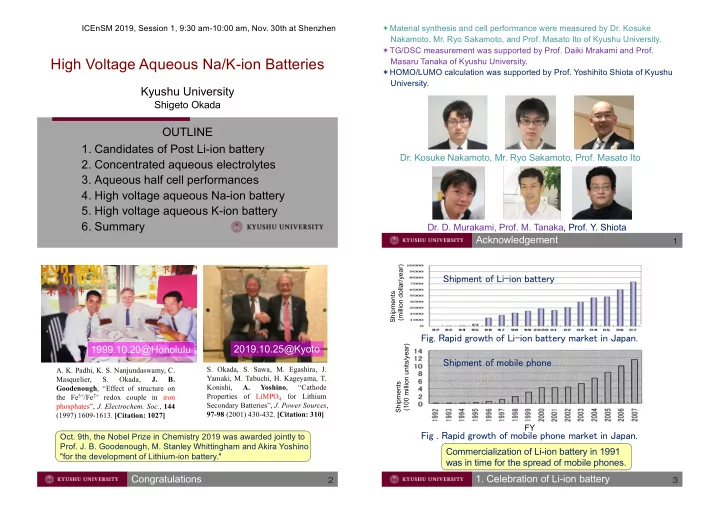
1999.10.20@Honolulu 2019.10.25@Kyoto

  • Oct. 9th, the Nobel Prize in Chemistry 2019 was awarded jointly to
  • Prof. J. B. Goodenough, M. Stanley Whittingham and Akira Yoshino

"for the development of Lithium-ion battery."

Congratulations

  • Commercialization of Li-ion battery in 1991

was in time for the spread of mobile phones.

  • 1. Celebration of Li-ion battery

Shipments (million dollar/year) Shipments (100 million units/year)

FY

slide-2
SLIDE 2
  • 1. Candidates of Post Li-ion battery
  • After S. Komaba
  • 1. Candidates of Post Li-ion battery
  • After S. Komaba
  • 1. Candidates of Post Li-ion battery
  • Ionic radius

Stokes radius Li+ 0.68 Å 3.8 Å Na+ 0.95 Å 3.6 Å K+ 1.33 Å 3.3 Å

  • T / ℃

Log σ / Scm-1

M6[Rh4Zn4O (L-cysteinate)12]·nH2O

  • N. Yoshinari et al.,Chem. Sci., 10 (2019) 587.
  • Li-ion battery (high energy density)

Ni-MH battery

(high power density)

  • Duration [hr]

Current [A]

day hour

! ! ! ! !

10 mAh 100 Ah VCR notePC Cellular 1 Ah Prius Electric Bike MP3 Music player Cordless Cleaner EV UPS AIBO

Large capacity High power

Lord leveling 100 mAh 10 Ah 1 kAh

Load Leveling

NaS battery

(Good cost

performance) Commercial Ni-MH battery Li-ion battery NaS battery Manufacturer Since 1990 by Sanyo Since 1991 by Sony Since 2003 by NGK Electrolyte Aqueous electrolyte Organic electrolyte Solid electrolyte Sales points High power High energy density Good cost performance

  • 1. Candidates of Post Li-ion battery
slide-3
SLIDE 3
  • Report by the Agency of Natural

Resources and Energy, Japan

  • 1. Candidates of Post Li-ion battery
  • Apr. 2016

$22.00

  • Oct. 2015

$7.13

Report by the Agency of Natural Resources and Energy, Japan

  • 1. Candidates of Post Li-ion battery
  • ←iMiEV

←Tesla Model S Tesla → Model 3

Tesla Giga Factory construction

Heat generation∝r 3

Heat radiation∝r 2

Thermal balance∝r 3 - ar 2

Cell size, Thermal balance Battery accident risk

Risk∝(Capacity)2

Secondary battery Li-ion battery Post Li-ion battery Application Cellular phone Note PC Hybrid EV Pure EV Grid storage Storage Energy 3 Wh 100 Wh 20 kWh 100 kWh 100 MWh

  • Cell size,

Basic equation for the safety of battery Thermal balance Heat radiation (surface area, r2) > Heat generation (volume, r3) Risk estimation Battery accident risk = Accident probability Accident damage (battery capacity)2

  • 1. Candidates of Post Li-ion battery
  • Thermal

runaway

  • Clarke Number [%]
  • Atomic Number

3Li 11Na 25Mn 26Fe 27Co 28Ni 22Ti

3d metal

Scale Solar cell Secondary battery Small Conversion efficiency () Gravimetric energy densityWh/kg Volumetric energy densityWh/L Large Cost efficiencyW/$ Cost performancekWh/$

  • Li-ion battery is not suitable for large-scale battery.

Anode Li → Na

  • Cathode

Co→Mn→Fe Game Changing

  • 1. Candidates of Post Li-ion battery
slide-4
SLIDE 4
  • Commercial

Ni-MH battery Li-ion battery NaS battery Manufacturer Since 1990 by Sanyo Since 1991 by Sony Since 2003 by NGK Sales points High power High energy density Low cost per performance Drawbacks Low cell voltage Expensive 300 ℃ operation Flammable Less conductive Post LIB Solid-state Na-ion battery

  • 1. Candidates of Post Li-ion battery
  • Table Basic frameworks for solid electrodes and electrolytes.

Framework Electrode Electrolyte NASICON Li3V2(PO4)3 Li1.5Al0.5Ge1.5(PO4)3 Na3V2(PO4)3 Na3Zr2(SiO4)2PO4 LISICON − Li3.25Ge0.25P0.25S4 Perovskite FeF3 Li0.35La0.55TiO3 Amorphous a-V2O5 a-LiS2-SiS2-P2S5 Layer LiCoO2

  • Spinel

LiMn2O4

  • Olivine

LiFePO4

  • NASICON is unique common framework for electrolytes/electrodes.
  • 1. Candidates of Post Li-ion battery
  • Table Basic frameworks for solid electrodes and electrolytes.

Framework Electrode Electrolyte NASICON Li3V2(PO4)3 Li1.5Al0.5Ge1.5(PO4)3 Na3V2(PO4)3 Na3Zr2(SiO4)2PO4 LISICON − Li3.25Ge0.25P0.25S4 Perovskite FeF3 Li0.35La0.55TiO3 Amorphous a-V2O5 a-LiS2-SiS2-P2S5 Layer LiCoO2

  • Spinel

LiMn2O4

  • Olivine

LiFePO4

  • Fig. 2 NASICON electrode/electrolyte composite structure.
  • 1. Candidates of Post Li-ion battery
  • PO4

tetrahedra VO6

  • ctahedra

Na

  • ZrO6
  • ctahedra

SiO4/PO4 tetrahedra

  • Fig. Charge/discharge profiles Fig. Charge/discharge profiles
  • f rhombohedral Na3V2(PO4)3 vs.
  • f Na3V2(PO4)3/Na3Zr2(SiO4)2PO4

Na anode with nonaqueous liquid /Na3V2(PO4)3 symmetric Na-ion electrolyte. battery. NASICON-type Na3V2(PO4)3 can be used as cathode and anode.

Charge Discharge

V4+/V3+ V3+/V2+

i Na3V2(PO4)3//1 M NaClO4/PC//Na3V2(PO4)3

symmetric cell ; ; (b) ; ; (b) ; ; ; ; (b)

Capacity / mAh g-1(cathode weight)

  • 1. Candidates of Post Li-ion battery
slide-5
SLIDE 5

σ(Na2.6V1.6Zr0.4(PO4)3) 0.01 mS/cm at 25℃

  • A. Inoishi, et al., Advanced Materials

Interfaces, 4 (2017) 1600942.

σ(Na3Zr2(SiO4)PO4) 1 mS/cm at 25℃

  • K. Hayashi, et al., J. Electrochem. Soc.,

160 (2013) A1467.

Commercial Ni-MH battery Li-ion battery NaS battery Electrolyte Aqueous electrolyte Organic electrolyte Solid electrolyte Sales points High power High energy density Low cost per performance Post LIB Solid-state Na-ion battery

  • 1. Candidates of Post Li-ion battery
  • Commercial

Ni-MH battery Li-ion battery NaS battery Manufacturer Since 1990 by Sanyo Since 1991 by Sony Since 2003 by NGK Sales points High power High energy density Low cost per performance Drawbacks Low cell voltage Expensive 300 ℃ operation Flammable Less conductive Post LIB Aqueous Li-ion Battery Solid-state Na-ion battery Aqueous Na-ion Battery

  • 1. Candidates of Post Li-ion battery
  • Commercial

Ni-MH battery Li-ion battery NaS battery Sales points High power High energy density Low cost per performance Drawbacks Low cell voltage Expensive 300 ℃ operation Flammable Less conductive Post LIB Aqueous Li-ion Battery Solid-state Na-ion battery Aqueous Na-ion Battery

  • ~

~

  • 1. Candidates of Post Li-ion battery
  • Solvent

Donor Number [kcal/mol] Acceptor Number [kcal/mol]

Acetonitrile (AN) 14.1 18.9 Propylene carbonate (PC) 15.1 18.3 Diethyl carbonate (DEC) 16.0

  • Ethylene carbonate (EC)

16.4

  • g-Butyrolactone (g-BL)

18 17.3 Water 33(Lq.) 54.8

  • Large DN means being easy to be oxidized

in cathode side.

LUMO HOMO

Anode

LUMO

Organic electrolyte with small AN and DN Aqueous electrolyte with large AN and DN

Cathode

Electrochemical window

HOMO 4 V 1.2 V

  • 2. Concentrated aqueous electrolytes
  • Large AN means being easy to be reduced

in anode side.

slide-6
SLIDE 6

LUMO HOMO

Anode

LUMO HOMO

Organic electrolyte with small AN and DN

LUMO

Aqueous electrolyte with large AN (55 kcal/mol) and DN (33 kcal/mol)

Cathode

HOMOFree H2O -13.5 eV HOMONa+(H2O)6-17.8 eV HOMONa+(H2O)5-17.8 eV HOMONa+(H2O)4-18.1 eV HOMONa+(H2O)3-18.5 eV HOMONa+(H2O)2-19.1 eV HOMONa+(H2O)1-19.6 eV

  • Hydrated water molecule

Free water molecule

  • Fig. HOMO energy of

hydrated water with Na+ estimated by DFT calculation(MP2/6-31G**). Na+

4 V 1.2 V

  • 2. Concentrated aqueous electrolytes
  • [1] W. Li, et al., Science, 264 (1994) 1115.

[2] J. Köhler, et al., Electrochim. Acta, 46 (2000) 59. [3] J.Y. Luo, et al., Adv. Funct. Mater., 17 (2007) 3877. [4] J. Luo, et al., Nat. Chem., 2 (2010) 76 [5] H. Qin, et al., J. Power Sources, 249 (2014) 367. [6] L. Suo, et al., Science, 350 (2015) 938. [7] L. Suo, et al., Angew. Chemie., 85287 (2016) 7136. [8] Y. Yamada, et al., Nat. Energy, 1 (2016) 16129.

  • High voltage aqueous Li cells were realized in concentrated aqueous electrolyte.
  • 2. Concentrated aqueous electrolytes
  • [1] W. Li, et al., Science, 264 (1994) 1115.

[2] J. Köhler, et al., Electrochim. Acta, 46 (2000) 59. [3] J.Y. Luo, et al., Adv. Funct. Mater., 17 (2007) 3877. [4] J. Luo, et al., Nat. Chem., 2 (2010) 76 [5] H. Qin, et al., J. Power Sources, 249 (2014) 367. [6] L. Suo, et al., Science, 350 (2015) 938. [7] L. Suo, et al., Angew. Chemie., 85287 (2016) 7136. [8] Y. Yamada, et al., Nat. Energy, 1 (2016) 16129.

  • 3 V aqueous Li-ion battery was reported in concentrated aqueous electrolyte.
  • 2. Concentrated aqueous electrolytes
  • Price of salt($/g)

Li2SO4 0.1 $/g Wako Pure Chemical Industries, Ltd. LiPF6 1.5 $/g Wako Pure Chemical Industries, Ltd. LiOT (LiSO3CF3) 2.4 $/g Tokyo Chemical Industry Co., Ltd. LiTFSI (LiN(SO2CF3)2) 2.5 $/g Tokyo Chemical Industry Co., Ltd. LiBETI (LiN(SO2C2F5)2) 34 $/g Tokyo Chemical Industry Co., Ltd.

  • 2. Concentrated aqueous electrolytes
slide-7
SLIDE 7

Price of salt($/g) Li2SO4 0.1 $/g Wako Pure Chemical Industries, Ltd. LiPF6 1.5 $/g Wako Pure Chemical Industries, Ltd. LiOT (LiSO3CF3) 2.4 $/g Tokyo Chemical Industry Co., Ltd. LiTFSI (LiN(SO2CF3)2) 2.5 $/g Tokyo Chemical Industry Co., Ltd. LiBETI (LiN(SO2C2F5)2) 34 $/g Tokyo Chemical Industry Co., Ltd.

  • OTf
  • 2. Concentrated aqueous electrolytes
  • Cation

Cation radius (Å) Hydration radius (Å) Hydration energy (kJ/mol) Hydration number Li+ 0.68 3.8

  • 520

5 Na+ 0.95 3.6

  • 406

4 K+ 1.33 3.3

  • 322

3 Cs+ 1.69 3.3

  • 276

1

  • Small cation can hydrates many water molecules.

So, larger cation needs higher concentration to eliminate the free water molecules in the aqueous electrolyte.

  • 2. Concentrated aqueous electrolytes
  • H2O → 4H+ + 4e- + O2↑

In 1 mol/kg aqueous electrolyte Na+ : H2O = 1 : 56 (mol. ratio) In 14 mol/kg aqueous electrolyte Na+ : H2O = 1 : 4 (mol. ratio)

To eliminate all water molecules in aqueous electrolyte, more than 14 mol/kg (8 mol/L) Na salt concentration is needed at least.

[Na(H2O)4]+

  • 2. Concentrated aqueous electrolytes
  • Cation

Cation radius (Å) Hydrated radius (Å) Hydration number Critical concentration Li+ 0.68 3.8 5 11 mol/kg (6 mol/L) Na+ 0.95 3.6 4 14 mol/kg (8 mol/L)

Saturated concentration [mol/kg] Disadvantages Anion Cation Li+ Na+ SO42- 3 2 Low solubility Cl- 18 6 Chlorine gas evolution by anodic oxidation N(SO2CF3)2- (TFSI) 21 9 Expensive SO2CF3- (OTf) 22 9 Expensive NO3- 13 10 Corrosion of Ti based NASICON by Nitrate ClO4- 6 17 Explosive in dry powder OH- 5 32 Decomposition of Prussian Blue by hydroxide

  • To eliminate the free water molecules in the aqueous electrolyte,

we used 17 mol/kg NaClO4 aqueous electrolyte.

  • 2. Concentrated aqueous electrolytes
slide-8
SLIDE 8

1 ~ 17 mol/kg NaClO4 aq.

Free water molecule (weak interraction against Na+) Intermediate water molecule (weak interaction against Na+) Bound water molecule (strong interaction against Na+)

20) M. Tanaka, et al., Poly. J., 45 (2013) 701.

  • Fig. Local structure model of Na+ hydrated water molecure20).
  • 2. Concentrated aqueous electrolytes
  • 1

ΔT m Kfm MRTf2 ΔHf

ΔTFreezing point descent mMass molarity of the solute MMolecular weight of the solvent TfFreezing point of the solvent ΔHf: Solidification heat of the solvent Kf: Freezing point depression constant of the solvent (water is 1.85)

  • Fig. Concentration dependence of NaClO4 aqueous solution DSC curve.

1

Non freezing bound water Freezing water Freezing point depression

Boiling point rise/ freezing point depression

  • 2. Concentrated aqueous electrolytes
  • Fig. Estimated amounts of free water, intermediate water,

and non-freezing water in each concentration of NaClO4. According to this calculation, there are no free water molecule in concentrated NaClO4 aqueous electrolyte more than 10 mol/kg.

W0 : Sample weight (mg) W1 : Water weight (mg) Mw :Fomula weight of solute (g/mol) C :Concentration of NaClO4 (mol/kg) Wf :Free water weight (mg) Wfb:Intermediate water weight (mg) Wnf :Non-freezing water weight (mg) DHf :Enthalpy change on freezing of Free water (mJ/mol) DHfb:Enthalpy change on freezing of Intermediate water (mJ/mol)

W1 = W0 1000/(1000+Mw+C ) Wf = W1 -Wfb+Wnf Wf = DHf W0 /334 Wfb= DHfbW0 /334

21) K. Sato, et al., Macromol. Biosci., 15 (2015) 1296.

  • 2. Concentrated aqueous electrolytes
  • 2. Concentrated aqueous electrolytes
slide-9
SLIDE 9
  • Fig. Ionic conductivities of aqueous electrolytes

with various NaClO4 concentrations.

200 150 100 50 20 15 10 5

Molality/mol kg-1 Conductivity/mS cm-1

Ionic conductivity of Non-aq. electrolyte

NaClO4 aqueous electrolyte 10 mS/cm 100 mS/cm

  • 2. Concentrated aqueous electrolytes
  • 3
  • 2
  • 1

1 2 5 4 3 2 1

E (V) vs. Na/Na+ E (V) vs. Li/Li+ E (V) vs. NHE E (V) vs. Ag/AgCl

E = 1.23 – 0.059pH O2↑ H2↑ E = – 0.059pH Theoretical stability window

  • f water

7 14 pH

NaTi2(PO4)3 Na2MnFe(CN)6 Na2Fe2(CN)6

FeII/III MnII/III

Practical stability window of 17 m NaClO4 aq. in this study Na2CoFe(CN)6

[FeII/III(CN)6] [FeII/III(CN)6] [FeII/III(CN)6] CoII/III MnIII/II [MnII/I(CN)6]

Na2Mn2(CN)6 Easy oxidation High cost Difficult to synthesize No reports high- crystalizing method Polyimide Extended practical stability window

  • f aqueous sodium-ion electrolyte

Cathode

4 3 2 1

  • 3
  • 2
  • 1

1

  • 3. Aqueous half cell performances
  • Fig. Charge/discharge profile of Na2Mn[Fe(CN)6]·zH2O against Na.

1 M NaClO4 in EC/DEC(1:1)

17) J. Song, et al., J. Am. Chem. Soc., 137 (2015) 2658.

  • 3. Aqueous half cell performances
  • Fig. Charge/discharge profile of Na2Mn[Fe(CN)6]·zH2O against Na.

1 M NaClO4 in EC/DEC(1:1) Electrochemical window

17) J. Song, et al., J. Am. Chem. Soc., 137 (2015) 2658.

  • 3. Aqueous half cell performances
slide-10
SLIDE 10

Stir (in H2O + EtOH) @ RT Na4[Fe(CN)6] aq. NaxMn[Fe(CN)6]yzH2O Filter & Wash (H2O + EtOH) NaCl aq. Light green precipitation MnCl2 aq. Vacuum dry @100 ℃ (over night)

  • Fig. Obtained greenish blue powder
  • f NaxMn[Fe(CN)6]yzH2O.
  • Fig. Synthesis route of NaxMn[Fe(CN)6]yzH2O.17)

17) J. Song, et al., J. Am. Chem. Soc., 137 (2015) 2658.

  • 3. Aqueous half cell performances
  • (100)

(110) (200) (210) (211) (220) (310) (300) Na2MnFe(CN)6 Pm-3m Cubic ICSD #75-4637

2q/degree Intensity/a. u.

200 nm

XRD Na Mn Fe H2O 1.24 1 0.81 1.28

Table Decided stoichiometry by ICP-AES & TGA.

As-prepared NMHCF

60 50 40 30 20 10

22) Y. Morimoto, et al., Energies, 8 (2015) 9486.

[20]

  • Fig. Identification of Na manganese hexacyanoferrate (NMHCF).22)

SEM Na1.24Mn[Fe(CN)6]0.81·1.28H2O (NMHCF: Na2Mn[FeCN)6])

  • 3. Aqueous half cell performances
  • WE

Ti mesh CE Ti mesh WE pellet (~ 2 mg) CE pellet (~ 3 mg)

Beaker-type cell with 3 electrodes

RE

Working electrode (WE) Electrolyte (EL) Reference electrode (RE) Counter electrode (CE)

Na2Mn[Fe(CN)6]ABPTFE 70255 (wt%) 1 17 mol/kg NaClO4 aq. Silver-silver chloride (Ag/AgCl) in sat. KCl aq. NaTi2(PO4)3ABPTFE 70255 (wt%)

Prussian blue analogues Na2Mn[Fe(CN)6] (NMHCF) NASICON NaTi2(PO4)3

Table Configuration of the aqueous Na-ion battery in this study. Coin-type cell with 2 electrodes for full cell test

  • 3. Aqueous half cell performances
  • 4

3 2 1 4 3 2 1 Voltage/V vs. Ag/AgCl Voltage/V vs. Na/Na+ Current/mA 0.5

  • 0.5

0.0 Current density/A g-1 0.5

  • 0.5

0.0

  • 2
  • 1

1 2

  • 2
  • 1

1 2

  • 2
  • 1

1 2

  • 2
  • 1

1 2 NMHCF NMHCF NaTi2(PO4)3

1 mol/kg NaClO4 aq. 17 mol/kg NaClO4 aq. 1 mol/kg NaClO4 aq. 17 mol/kg NaClO4 aq.

Theoretical electrochemical window 1.23 V pH = 7

O2↑ H2↑ H2↑ O2↑ O2↑ H2↑

  • Fig. CV profiles of 1 and 17 mol/kg NaClO4 aq. Electrolyte.

NaTi2(PO4)3 Practical electrochemical window 1.9 V Practical electrochemical window 2.7 V Theoretical electrochemical window 1.23 V pH = 6

  • 3. Aqueous half cell performances

←Oxygen Evolution Reaction ←Hydrogen Evolution Reaction 2H2O → 4H+ + 4e- + O2↑ 4H+ + 4e- → 2H2↑ 4H+ + 4e- → 2H2↑ 2H2O → 4H+ + 4e- + O2↑ ←Oxygen Evolution Reaction ←Hydrogen Evolution Reaction

slide-11
SLIDE 11

4 3 2 1 4 3 2 1 Voltage/V vs. Ag/AgCl Voltage/V vs. Na/Na+ Current/mA 0.5

  • 0.5

0.0 Current density/A g-1 0.5

  • 0.5

0.0

  • 2
  • 1

1 2

  • 2
  • 1

1 2

  • 2
  • 1

1 2

  • 2
  • 1

1 2 Na2Mn[Fe(CN)6] NaTi2(PO4)3

1 mol/kg NaClO4 aq. 17 mol/kg NaClO4 aq. 1 mol/kg NaClO4 aq. 17 mol/kg NaClO4 aq.

Theoretical electrochemical window 1.23 V pH = 7

O2↑ H2↑ H2↑ O2↑ O2↑ H2↑

  • Fig. CV profiles of 1 and 17 mol/kg NaClO4 aq. electrolyte

with/without Na2Mn[Fe(CN)6] cathode and NaTi2(PO4)3 anode.

NaTi2(PO4)3 Practical electrochemical window 1.9 V Practical electrochemical window 2.7 V Theoretical electrochemical window 1.23 V pH = 6 Na2Mn[Fe(CN)6]

  • 3. Aqueous half cell performances
  • Voltage/V vs. Ag/AgCl

NMHCF Specific capacity/mAh g-1-anode Specific capacity/mAh g-1-cathode NTP NTP NMHCF

1.3 V cut 1.2 V cut

1 mol/kg NaClO4 aq. 2.0 mA cm-2

  • 2
  • 1

1 2 400 300 200 100 1st 2nd 150 100 50

  • Fig. Charge/Discharge profiles of Na2Mn[Fe(CN)6] cathode and

NaTi2(PO4)3 anode in 1 and 17 mol/kg NaClO4 aq. electrolyte.

NaTi2(PO4)3

Na1.24Mn[Fe(CN)6]0.81·1.28H2O 2H2O + 2e- → H2↑ + 2OH-

  • 3. Aqueous half cell performances
  • Voltage/V vs. Ag/AgCl

Specific capacity/mAh g-1-anode NMHCF Voltage/V vs. Na/Na+ Specific capacity/mAh g-1-anode Specific capacity/mAh g-1-cathode Specific capacity/mAh g-1-cathode NTP NTP NMHCF 4 3 2 1

1.3 V cut 1.2 V cut

1 mol/kg NaClO4 aq. 2.0 mA cm-2 17 mol/kg NaClO4 aq. 2.0 mA cm-2

150 100 50 150 100 50 1st 2nd

  • 2
  • 1

1 2 400 300 200 100 1st 2nd 150 100 50

  • Fig. Charge/Discharge profiles of Na2Mn[Fe(CN)6] cathode and

NaTi2(PO4)3 anode in 1 and 17 mol/kg NaClO4 aq. electrolyte.

NaTi2(PO4)3

Na1.24Mn[Fe(CN)6]0.81·1.28H2O

NaTi2(PO4)3

Na1.24Mn[Fe(CN)6]0.81·1.28H2O 2H2O + 2e- → H2↑ + 2OH-

  • 0.9 V 1.3 V Ag/AgCl
  • 3. Aqueous half cell performances
  • 1.5

1.0 0.5 0.0 300 250 200 150 100 50

  • 50

Voltage/V vs. Ag/AgCl Capacity/mAh g-1 17 mol/kg NaClO4 aq.

1.5 1.0 0.5 0.0 400 300 200 100

Capacity/mAh g-1 Voltage/V vs. Ag/AgCl

Na2Mn[Fe(CN)6] in 1 mol/kg NaClO4 aq.

[Fe(CN)6]4- dissolution MnO precipitation H3O+ extraction Partially O2↑ MnO precipitation No dissolution or no precipitation

  • Fig. Deterioration of Na2Mn[Fe(CN)6] cathode in 1 and

17 mol/kg NaClO4 aqueous electrolytes on 1st cycle.

[Fe(CN)6]a- deposition [Fe(CN)6] deposition

Na2Mn[Fe(CN)6] in 17 mol/kg NaClO4 aq.

[Fe(CN)6]4- dissolution

  • 3. Aqueous half cell performances
slide-12
SLIDE 12

40 30 20 10 40 30 20 10

2q/degree

1.5 1.0 0.5 0.0 300 250 200 150 100 50

  • 50

Voltage/V vs. Ag/AgCl Capacity/mAh g-1 2q/degree

1.5 1.0 0.5 0.0 400 300 200 100

Capacity/mAh g-1 Voltage/V vs. Ag/AgCl 1 mol/kg NaClO4 aq. Na2Mn[Fe(CN)6] Intensity/a. u. Intensity/a. u. 0.2 V 0.7 V 1.3 V 1.2 V 0.9 V OCV 0.2 V 0.7 V 1.3 V 0.9 V OCV 0.2 V 0.7 V 1.3 V 1.2 V 0.9 V OCV 0.2 V 0.7 V 1.3 V 0.9 V OCV

Na2Mn[Fe(CN)6] Deposition

17 mol/kg NaClO4 aq. Na2Mn[Fe(CN)6]

  • Fig. XRD patterns of Na2Mn[Fe(CN)6] cathode with diluted and

concentrated aq. electrolyte in charge/discharge process.

  • 3. Aqueous half cell performances (XRD)
  • 3. Aqueous half cell performances (XPS)
  • Fig. Fe and Mn valence changes in Na2Mn[Fe(CN)6] cathode

in 17 mol/kg NaClO4 aqueous electrolytes on 1st cycle.

Fe2+/Fe3+ Mn2+/Mn3+ Fe2+/Fe3+

C/D profile of Na2Mn[Fe(CN)6] in 17 mol/kg NaClO4 aq. electrolyte

  • Fig. Concentration dependence of the cyclability and charge/discharge

profiles of Na2Mn[Fe(CN)6] cathode in NaClO4 aqueous electrolyte.

  • 4. High voltage aqueous Na-ion battery

Cycle# Discharge capacity/mAh g-1

  • at const. 2.0 mA cm-2

17 mol/kg 1 4 m

  • l

/ k g 7 m

  • l

/ k g 1 mol/kg 100 50 100 80 60 40 20

1 1 1 300 250 200 150 100 50 1

Voltage/V vs. Ag/AgCl Capacity/mAh g-1-cathode Theoretical capacity 120 mAh g-1 Voltage range 0.0 ~ 1.3 V 14 mol/kg 7 mol/kg 1 mol/kg

1th 10th 100th

17 mol/kg

  • Concentrated ↔ Diluted

100 50 100 80 60 40 20 Cycle number Discharge capacity / mAh g-1 Discharge capacity retention / % Cycle number 17 mol/kg 1 4 m

  • l

/ k g 10 mol/kg 7 m

  • l

/ k g 1 mol/kg 5.0 mA cm-2 2.0 mA cm-2 . 5 m A c m

  • 2
  • Fig. Concentration (left) and rate dependences (right)
  • n the cyclability of Na2Mn[Fe(CN)6] cathode.

2.0 mA cm-2 17 mol/kg NaClO4

  • aq. electrolyte

100 50 100 80 60 40 20

Cyclability of concentrated aqueous cell becomes better at higher current rate.

  • 4. High voltage aqueous Na-ion battery
  • High rate ↔ Low rate
slide-13
SLIDE 13

100 50 20 15 10 5 1.0 0.5 0.0 2.5 2.0 1.5 1.0 0.5 0.0 150 100 50 1.5 1.0 0.5 0.0 1st 2nd

x in Na2-xMn[Fe(CN)6] Capacity/mAh g-1–cathode Voltage/V vs. NaTi2(PO4)3 2.0 mA cm-2 0.5 ~ 2.0 V

100 80 60 40 20 50 40 30 20 10 Retention/% Cycle number

Current density/mA cm-2 Discharge capacity/mAh g-1 cathode Cathode: 20 mg cm-2, 200 µmt! Anode: 30 mg cm-2, 200 µmt! Current density/A g-1-cathode 0.5 ~ 2.0 V

  • Fig. Charge/discharge profile and the rate capability of Na2Mn[Fe(CN)6]

cathode//17 mol/kg NaClO4 aq. electrolyte//NaTi(PO4)3 anode.

1000 mA/g 8.3C

  • Av. discharge voltage:1.3 V

Concentrated aqueous cell can operate even at 20 mA/cm2.

  • 4. High voltage aqueous Na-ion battery
  • E [V] vs. Na/Na+

E [V] vs. Ag/AgCl

KCr2+[Cr3+/2+(CN)6] KFe2+[Cr3+/2+(CN)6] Na2Mn2+[Fe2+/3+(CN)6]

  • [V]
  • vs. Ag/AgCl

Ref. KFe3+[Fe2+/3+(CN)6] 0.969 23) KCr3+[Fe2+/3+(CN)6] 0.806 N/A Na2Mn2+[Fe2+/3+(CN)6] 0.612 24) KCr2+[Mn3+/2+(CN)6] 0.352 25) KMn2+[Mn3+/2+(CN)6] 0.052 25) Fe2+[Mn3+/2+(CN)6] 0.075 N/A KCr2+[Cr3+/2+(CN)6]

  • 0.761

N/A KMn2+[Cr3+/2+(CN)6]

  • 1.003

N/A KFe2+[Cr3+/2+(CN)6]

  • 1.059

N/A

Na2Mn2+/3+[Fe3+(CN)6] 23) L. Shen, et al., Chem. Eur. J. 20 (2014) 12559. 24) K. Nakamoto, et al., Electrochemistry, 85 (2017) 179. 25) M. Pasta, et al., Nat. Commun., 5 (2014) 3007. 26) F. Scholz, et al., Angew. Chemie, 34 (1995) 2685.

  • 3
  • 2
  • 1

1 4 3 2 1

NaTi4+/3+2(PO4)3 KMn2+[Cr3+/2+(CN)6]

Table Potential of Prussian Bule analogs26) Electrochemical windows of 17 mol/kg NaClO4 aq. solution

4 3 2 1

  • 3
  • 2
  • 1

1

  • Fig. Redox potentials of anode candidates within

electrochemical window of 17 mol/kg aq. electrolyte.

  • 5. High voltage aqueous K-ion battery
  • Fig. Choice of alternative anode for 2 V class aqueous Na-ion battery.
  • 5. High voltage aqueous K-ion battery
  • x in Na2Mn[Fe(CN)6]

Capacity/mAh g-1-cathode Voltage/V vs. NaTi2(PO4)3 2.0 mA cm-2 0.5 ~ 2.0 V

100 80 60 40 20 50 40 30 20 10 Retention/% Cycle number

  • Av. discharge voltage:1.3 V
  • Av. discharge voltage:1.7 V
  • Fig. Charge/discharge profile of Na2Mn[Fe(CN)6] cathode/NaTi(PO4)3 anode

and Na2Mn[Fe(CN)6] cathode/KMn[Cr(CN)6] anode with 17 mol/kg.

5.0 mA cm-2 0.5 ~ 2.6 V Voltage/V vs. KMn[Cr(CN)6]

Na2Mn[Fe(CN)6]//17 mol/kg aq.//KMn[Cr(CN)6]

2.5 2.0 1.5 1.0 0.5 0.0 150 100 50 1.5 1.0 0.5 0.0 1st 2nd

Na2Mn[Fe(CN)6]//17 mol/kg aq.//NaTi(PO4)3

  • 5. High voltage aqueous K-ion battery

1.7 V discharge voltage is successfully obtained in 17 mol/kg aqueous Na/K hybrid-ion battery.

slide-14
SLIDE 14
  • Fig. Charge/discharge profile of aqueous Na-ion and K-ion battery

with concentrated aqueous electrolyte at a rate of 5 mA/cm2.

K2MnII[FeII(CN)6]+ 2KMnII[CrIII(CN)6] ⇄ MnIII[FeIII(CN)6]+ 2K2MnII[CrII(CN)6] Na2MnII[FeII(CN)6]+ 2KMnII[CrIII(CN)6] ⇄ MnIII[FeIII(CN)6]+ 2NaKMnII[CrII(CN)6]

  • 5. High voltage aqueous K-ion battery
  • Sodium trifluoromethanesulfonate

Electrodes selection Electrolyte selection Effect of concentrated electrolyte Full-cell operation of aqueous Na-ion battery First report of 1.7 V operation in aqueous Na-ion battery First report of aqueous K-ion battery

  • 6. Summary
  • Minor metal free combination of Na2MnFe(CN)6 cathode & NaTi2(PO4)3 anode were

chose to check the expansion effect by the concentrated aqueous electrolyte. Inexpensive NaClO4 salt was chose to realize concentrated aqueous electrolyte. Concentrated 17 mol/kg aqueous electrolyte suppressed the water decomposition and dissolution of Na2Mn[Fe(CN)6] (= Na1.24Mn[Fe(CN)6]0.81·1.28H2O) cathode. Na2Mn[Fe(CN)6]//17 mol/kg NaClO4 aq.//NaTi2(PO4)3 full cell can be charged upto 2 V and it was able to deliver 117 mAh/g initial discharge capacity. 1.7 V average discharge voltage was successfully obtained in concentrated aq. Na-ion battery with Na2Mn[Fe(CN)6] cathode and KMn[Cr(CN)6] anode. 19 mol/kg KOTf concentrated aq. K-ion battery with K2Mn[Fe(CN)6] cathode and KMn[Cr(CN)6] anode.