High-order Surface Representation Oscar P. Bruno and Matthew M. - - PowerPoint PPT Presentation

high order surface representation
SMART_READER_LITE
LIVE PREVIEW

High-order Surface Representation Oscar P. Bruno and Matthew M. - - PowerPoint PPT Presentation

High-order Surface Representation Oscar P. Bruno and Matthew M. Pohlman, California Institute of Technology Background Standard Methods Piecewise interpolation methods are fast, but only C n for "small" n, n {0, 1} for

slide-1
SLIDE 1

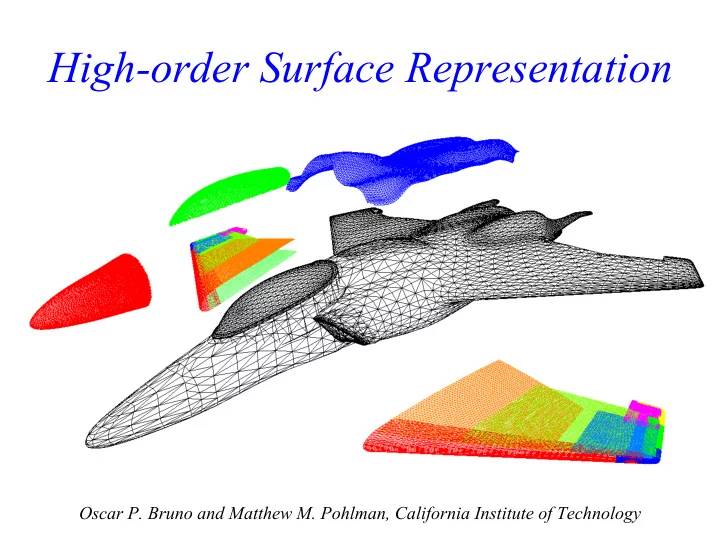
High-order Surface Representation

Oscar P. Bruno and Matthew M. Pohlman, California Institute of Technology

slide-2
SLIDE 2

Background

  • Standard Methods

– Piecewise interpolation methods are fast, but only Cn for "small" n, n ∈ {0, 1} for surfaces – Efficient trigonometric interpolation methods (using the FFT) are C∞ but require evenly spaced data

  • Current Approach

– Use Fourier Series for C∞ representation of surface patches – Take advantage of an Unevenly Spaced Fast Fourier Transform (USFFT) to obtain a Fourier coefficients from irregular data with accuracy ε in O(N log N + N log 1/ε) time [Dutt & Rokhlin, 1993] – Continue discrete data to smooth periodic functions in order to preserve spectral convergence of Fourier methods (Continuation Method)

slide-3
SLIDE 3

Unevenly Spaced Fast Fourier Transform

  • From unevenly spaced data f, sample the convolution f∗g, at

evenly spaced locations in O(MN) time

– the convolution filter g is known analytically – for error tolerance ε, the necessary sample rate of g for discrete convolution step is M=O(log 1/ε) → M≈32 when ε≈1e-16

  • Use standard FFT to move from spatial domain to frequency

domain, O(N log N) time

  • Divide by the Fourier coefficients of filter g to obtain Fourier

coefficients of f, O(N) time

Patches and Partitions of Unity

  • Use partitions of unity (POU) to divide surface into patches,

just like in surface scattering [Bruno, et. al.]

  • unknowns become smooth periodic functions on each patch
  • verlapping patches take care of regions where POU is small
slide-4
SLIDE 4

Interpolation using POU

partition of unity data∗POU FFT and division by POU (regions where POU ¿ 1 are discarded)

  • riginal 1D and 2D

unevenly spaced data

slide-5
SLIDE 5

Interpolation of Non-periodic Data

  • patches can’t overlap an edge or corner smoothly, so POU

can’t solve all issues for a complicated geometry!

  • need a spectrally accurate interpolation method for smooth

non-periodic data as well

  • IDEA:

– find smooth periodic function (over a larger period) that coincides with

  • riginal data
  • finding such a periodic function is easy using a least-squares fit of

truncated Fourier series

– need to also ensure that the result is smooth

  • Fourier coefficients of smooth periodic functions decay exponentially, so

make sure the coefficients of the “continuation” decay exponentially too!

  • this can be accomplished during the least-squares step by multiplying

Fourier coefficients by appropriate factors and setting “equal” to zero

slide-6
SLIDE 6

Theoretical Results

slide-7
SLIDE 7

Direct FFT: Gibbs phenomenon Double-period continuation:

  • scillations

Continuation and smoothing! Given data

Continuation Non-periodic Data

slide-8
SLIDE 8

Convergence of Continuation Method

Generalizes to any number of dimensions!

slide-9
SLIDE 9

Gegenbauer-polynomial approach

Comparison with other methods

  • Does not use information about discontinuity

location (+)

  • Requires much finer discretizations for given

error tolerance (-)

  • Only applies to square domains (-)
  • Requires use of data at (generally unavailable)

data points (-)

Gottlieb and Shu [1992]-… Error Function

slide-10
SLIDE 10

Comparison w/ other methods (contd.):

Singular Padè-Fourier approach

Function Fourier sum

“The proposed approach exhibits the significant advantage of being able to deal with arbitrary data sets (non-square domains, non-uniformly- spaced data, arbitrary dimensionality), and yet, it yields more accurate results than other available methods”

Padè-Fourier sum Singular Padè-Fourier sum

Driscoll and Fornberg [2001]

slide-11
SLIDE 11

Surface Parameterization

  • Parameterization of

each patch is done with the Intrinsic Parameterization initially developed in the CG community to minimize texture map deformation [Desbrun, Meyer and Alliez, 2002]

  • Human intervention is

currently needed to rescale singularities in the parameterization (which occur where the geometry has large curvature)

slide-12
SLIDE 12

Wing represented by eleven

  • verlapping patches, each patch

given explicitly by three coordinate functions (which are Fourier Series!)

Refined mesh shown here generated via surface interpolation

Surface Interpolation of Wing Patch

slide-13
SLIDE 13

Wing Edges

A change of variables in parameter space gives an unevenly sampled surface for accurate resolution of edge- scattering

slide-14
SLIDE 14

It is easy to compute surface normals and curvatures by differentiation of Fourier Series representation! Fine array of surface normals plotted on interpolated wing surface

Wing Normals

slide-15
SLIDE 15

A Few Other Patches

Canopy Nose Top

slide-16
SLIDE 16

Conclusions

  • interpolation using USFFT together with POU or Periodic Continuation is spectrally accurate

– USFFT is O(N log N) for fixed accuracy (ε≈1e-16) – Continuation is O(N3) due to SVD but necessary only for small patches of a geometry – evaluation of Fourier Series is O(N log N) in either case

  • can accurately evaluate the surface derivatives needed by scattering codes for what began as a

triangle mesh

Future Work

  • Self-tuning continuation methods for more general interpolation applications
  • Automatic parameterization of much more complicated surface patches to improve

computational efficiency in scattering codes

References

  • Dutt and Rokhlin, Fast Fourier Transforms for Nonequispaced Data, 1993
  • Duijndam and Schonewille, Nonuniform fast Fourier transform, 1999
  • Desbrun, Meyer and Alliez, Intrinsic Parameterizations of Surface Meshes, 2002
  • Bruno and Pohlman, Smooth Interpolation of Unevenly Spaced Data, in preparation