High Elevation Sand/Cultural Sites: The response of source-bordering - - PowerPoint PPT Presentation

high elevation sand cultural sites
SMART_READER_LITE
LIVE PREVIEW

High Elevation Sand/Cultural Sites: The response of source-bordering - - PowerPoint PPT Presentation

High Elevation Sand/Cultural Sites: The response of source-bordering aeolian dunefields to the 2012- 2016 High Flow Experiments of the Colorado River in Grand Canyon Glen Canyon Dam Adaptive Management Program Annual Reporting Meeting, March


slide-1
SLIDE 1

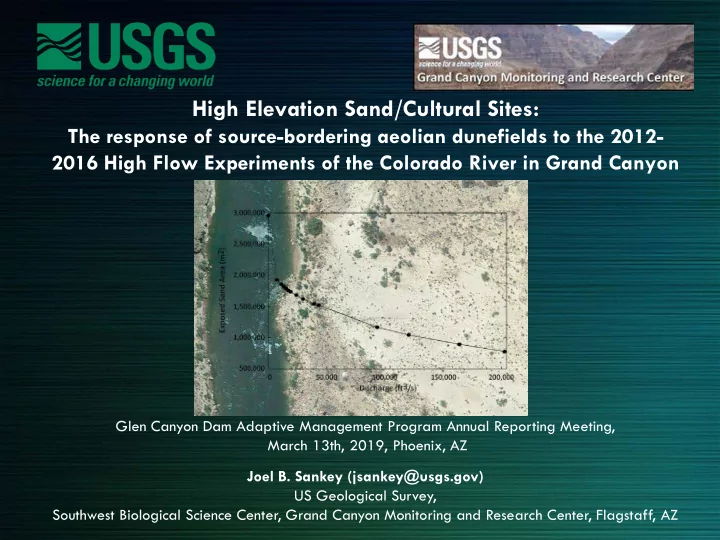
High Elevation Sand/Cultural Sites:

The response of source-bordering aeolian dunefields to the 2012- 2016 High Flow Experiments of the Colorado River in Grand Canyon

Joel B. Sankey (jsankey@usgs.gov) US Geological Survey, Southwest Biological Science Center, Grand Canyon Monitoring and Research Center, Flagstaff, AZ Glen Canyon Dam Adaptive Management Program Annual Reporting Meeting, March 13th, 2019, Phoenix, AZ

slide-2
SLIDE 2
  • Joel B. Sankey, US Geological Survey, SBSC, GCMRC, Flagstaff, AZ
  • Alan Kasprak, US Geological Survey, SBSC, GCMRC, Flagstaff, AZ
  • Joshua Caster, US Geological Survey, SBSC, GCMRC, Flagstaff, AZ
  • Helen Fairley, US Geological Survey, SBSC, GCMRC, Flagstaff, AZ
  • Amy East, US Geological Survey, CMSC, Santa Cruz, CA
  • Jen Dierker, National Park Service, Grand Canyon, AZ
  • Laura Durning, NAU, School of Informatics, Computing and Cyber Systems
  • Ashton Bedford, NAU, School of Informatics, Computing and Cyber Systems
  • Paul Grams, US Geological Survey, SBSC, GCMRC
  • Dan Buscombe, NAU, School of Earth Science and Environmental Sustainability
  • Temuulen T. Sankey, NAU, School of Informatics, Computing and Cyber Systems

The response of source-bordering aeolian dunefields to the 2012-2016 High Flow Experiments of the Colorado River in Grand Canyon

slide-3
SLIDE 3

Bare, unvegetated sand is important for recreation, habitat, and cultural resources along the Colorado River in Grand Canyon

slide-4
SLIDE 4

River Corridor Remote Sensing Assessment of Bare Unvegetated Sand

https://www.aopa.org/news-and-media/all- news/2015/march/10/pilot-getaways-mineral- canyon-utah

RM 45 RM 53 RM 62 RM 58

(RM 0) (RM 280) Sankey et al. 2018, Sand classifications along the Colorado River in Grand Canyon derived from 2002, 2009, and 2013 high-resolution multispectral airborne imagery: U.S. Geological Survey data release, https://doi.org/10.5066/P99TN424.

slide-5
SLIDE 5

The Distribution of Colorado River Sand in Grand Canyon

Kasprak et al., 2018, Quantifying and forecasting changes in the areal extent of river valley sediment in response to altered hydrology and land

  • cover. Progress in Physical Geography, https://doi.org/10.1177/0309133318795846

~ 1/3 is almost always underwater ~ 1/6 is periodically underwater Baseflow Discharge HFE Discharge ~ 1/2 is above the HFE high water line Bare, Unvegetated, Exposed Sand Area (m2)

slide-6
SLIDE 6

~ 1/3 is almost always underwater ~ 1/6 is periodically underwater Baseflow Discharge HFE Discharge

?

~ 1/2 is above the HFE high water line

The Distribution of Colorado River Sand in Grand Canyon

Bare, Unvegetated, Exposed Sand Area (m2)

Kasprak et al., 2018, Quantifying and forecasting changes in the areal extent of river valley sediment in response to altered hydrology and land

  • cover. Progress in Physical Geography, https://doi.org/10.1177/0309133318795846
slide-7
SLIDE 7
slide-8
SLIDE 8

Sankey et al. (2018a) The response of source-bordering aeolian dunefields to sediment-supply changes 1: Effects of wind variability and river-valley

  • morphodynamics. Aeolian Research, 32, pp.228-245.

Sankey et al. (2018b) The response of source-bordering aeolian dunefields to sediment-supply changes 2: Controlled floods of the Colorado River in Grand Canyon, Arizona, USA. Aeolian Research, 32, pp.154-169.

slide-9
SLIDE 9
  • Dunefields aren’t inundated by contemporary discharges from GCD, and

they are located above the stage of HFEs.

  • Are they affected by dam operations?
slide-10
SLIDE 10

Lees Ferry Dunefield – Relict River Sediment Supply Example

Remote sensing topographic change detection 2002-2013

Sankey et al. (2018a) The response of source-bordering aeolian dunefields to sediment-supply changes 1: Effects of wind variability and river-valley morphodynamics. Aeolian Research, 32, pp.228-245.

slide-11
SLIDE 11

Lees Ferry Dunefield – Relict River Sediment Supply Example

Remote sensing topographic change detection 2002-2013

Sankey et al. (2018a) The response of source-bordering aeolian dunefields to sediment-supply changes 1: Effects of wind variability and river-valley morphodynamics. Aeolian Research, 32, pp.228-245.

slide-12
SLIDE 12

Lees Ferry Dunefield – Relict River Sediment Supply Example

Remote sensing topographic change detection 2002-2013

Sankey et al. (2018a) The response of source-bordering aeolian dunefields to sediment-supply changes 1: Effects of wind variability and river-valley morphodynamics. Aeolian Research, 32, pp.228-245.

1923 (La Rue) 2017 (Fairley)

slide-13
SLIDE 13

Soap Creek Dunefield – Modern River Sediment Supply Example

Sankey et al. (2018a) The response of source-bordering aeolian dunefields to sediment-supply changes 1: Effects of wind variability and river-valley morphodynamics. Aeolian Research, 32, pp.228-245.

Remote sensing topographic change detection 2002-2013

slide-14
SLIDE 14

Did the 2012-16 HFEs resupply dunefields with sand by rebuilding upwind sandbars?

Sankey et al. (2018b) The response of source-bordering aeolian dunefields to sediment-supply changes 2: Controlled floods of the Colorado River in Grand Canyon, Arizona, USA. Aeolian Research, 32, pp.154-169.

slide-15
SLIDE 15

Dunefield response to HFEs

Sankey et al. (2018b) The response of source-bordering aeolian dunefields to sediment- supply changes 2: Controlled floods of the Colorado River in Grand Canyon, Arizona, USA. Aeolian Research, 32, pp.154-169.

slide-16
SLIDE 16

Dunefield response to HFEs

Sankey et al. (2018b) The response of source-bordering aeolian dunefields to sediment- supply changes 2: Controlled floods of the Colorado River in Grand Canyon, Arizona, USA. Aeolian Research, 32, pp.154-169.

slide-17
SLIDE 17

Dunefield response to HFEs

Sankey et al. (2018b) The response of source-bordering aeolian dunefields to sediment- supply changes 2: Controlled floods of the Colorado River in Grand Canyon, Arizona, USA. Aeolian Research, 32, pp.154-169.

slide-18
SLIDE 18

Dunefield response to HFEs

Change in dunefield sediment storage from aeolian processes (m3)

Post-2012 HFE Post-2013 HFE Post-2014 HFE Post-2016 HFE

Increase in sediment storage with consecutive annual HFEs

Sankey et al. (2018b) The response of source-bordering aeolian dunefields to sediment-supply changes 2: Controlled floods of the Colorado River in Grand Canyon, Arizona, USA. Aeolian Research, 32, pp.154-169.

slide-19
SLIDE 19

Dunefield archaeological site response to HFEs

Unpublished results, do not cite

Increase in sediment storage owing to resupply from 2012-2016 HFE sand

slide-20
SLIDE 20

Dunefield response to HFEs

Mean elevation change from aeolian processes at the upwind dunefield boundary (m)

Post-2012 HFE Post-2013 HFE Post-2014 HFE Post-2016 HFE

Aeolian resupply attributed to sediment from individual HFE

Resupply occurred for 50 % (8 of 16) of flood-dunefield instances Analogous to resupply of sandbars by HFEs; e.g., ~ ½ of monitored sandbars increased in size following the 2012, 2013, 2014 HFEs (Grams et al., 2015)

Sankey et al. (2018b) The response of source-bordering aeolian dunefields to sediment-supply changes 2: Controlled floods of the Colorado River in Grand Canyon, Arizona, USA. Aeolian Research, 32, pp.154-169.

slide-21
SLIDE 21
  • In Grand Canyon, approximately ½ of the area of bare, unvegetated sand

derived from the Colorado River is located in 117 large dunefields

  • HFEs do not directly inundate most of these dunefields, however, HFEs resupply

the dunefields with sand by rebuilding upwind sandbars

  • Aeolian dunefields were resupplied with windblown sand from HFE deposits in

half of the instances monitored after the 2012, 2013, 2014, and 2016 HFEs

  • Frequency of dunefield resupply by HFEs is analogous to resupply of

sandbars by HFEs

  • Dunefield sediment storage increases cumulatively when HFEs are conducted

consistently on an annual basis. Sediment storage decreased with 1-year hiatus from HFE in 2015.

  • Sediment storage increased at dunefield archaeological sites owing to

resupply from 2012-2016 HFE sand

Summary - The response of source-bordering aeolian dunefields to the 2012-2016 High Flow Experiments of the Colorado River in Grand Canyon

slide-22
SLIDE 22

Implications and Future Work

  • Bare sand area has decreased by 49% since 1965 owing to a combination of

vegetation expansion, increase in baseflow, and erosion (Kasprak et al., 2018).

  • Bare sand area is projected to decrease by an additional 12% by 2037 due to

future riparian vegetation expansion (Kasprak et al., 2018)

  • The past, present, and likely future expansion of riparian vegetation onto

sandbars reduces the supply of HFE sand for dunefields

slide-23
SLIDE 23

Implications and Future Work

  • Bare sand area has decreased by 49% since 1965 owing to a combination of

vegetation expansion, increase in baseflow, and erosion (Kasprak et al., 2018).

  • Bare sand area is projected to decrease by an additional 12% by 2037 due to

future riparian vegetation expansion (Kasprak et al., 2018)

  • The past, present, and likely future expansion of riparian vegetation onto

sandbars reduces the supply of HFE sand for dunefields

1923 (La Rue) 2018 (Fairley)

slide-24
SLIDE 24

Implications and Future Work

  • In April, 2019 the NPS will implement experimental vegetation removal

treatments in Grand Canyon to increase aeolian sediment supply to several dunefields that host archaeological sites

  • GCMRC will monitor the outcome of the treatments relative to future HFEs