High Dynamic Range Lighting March 24, 2004 Paul Debevec, USC - - PDF document

high dynamic range lighting march 24 2004 paul debevec
SMART_READER_LITE
LIVE PREVIEW

High Dynamic Range Lighting March 24, 2004 Paul Debevec, USC - - PDF document

High Dynamic Range Lighting March 24, 2004 Paul Debevec, USC Institute for Creative Technologies High Dynamic Range Lighting High Dynamic Range Lighting Paul Debevec Paul Debevec University of Southern California University of Southern


slide-1
SLIDE 1

“High Dynamic Range Lighting” Paul Debevec, USC Institute for Creative Technologies March 24, 2004 2004 Game Developer’s Conference 1

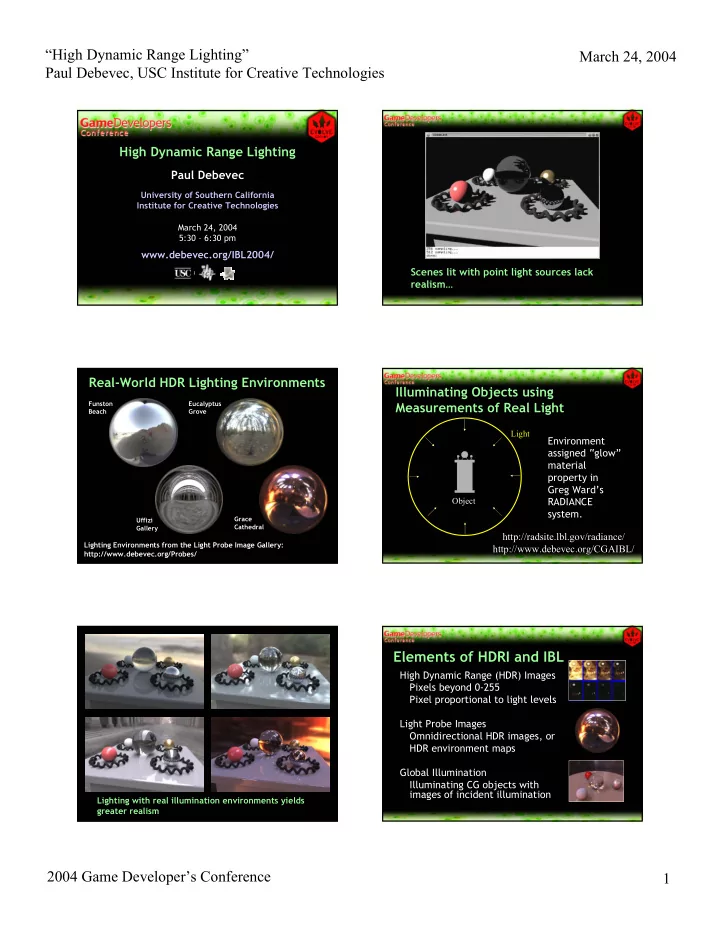
High Dynamic Range Lighting High Dynamic Range Lighting

Paul Debevec Paul Debevec

March 24, 2004 5:30 – 6:30 pm March 24, 2004 5:30 – 6:30 pm University of Southern California Institute for Creative Technologies University of Southern California Institute for Creative Technologies

www.debevec.org/IBL2004/ www.debevec.org/IBL2004/ Scenes lit with point light sources lack realism…

Real-World HDR Lighting Environments Real-World HDR Lighting Environments

Lighting Environments from the Light Probe Image Gallery: http://www.debevec.org/Probes/ Lighting Environments from the Light Probe Image Gallery: http://www.debevec.org/Probes/

Funston Beach Uffizi Gallery Eucalyptus Grove Grace Cathedral

Illuminating Objects using Measurements of Real Light Illuminating Objects using Measurements of Real Light

Object Object Light Light

http://radsite.lbl.gov/radiance/ http://www.debevec.org/CGAIBL/ http://radsite.lbl.gov/radiance/ http://www.debevec.org/CGAIBL/ Environment assigned “glow” material property in Greg Ward’s RADIANCE system. Environment assigned “glow” material property in Greg Ward’s RADIANCE system.

Lighting with real illumination environments yields greater realism

Elements of HDRI and IBL Elements of HDRI and IBL

High Dynamic Range (HDR) Images Pixels beyond 0-255 Pixel proportional to light levels Light Probe Images Omnidirectional HDR images, or HDR environment maps Global Illumination Illuminating CG objects with images of incident illumination High Dynamic Range (HDR) Images Pixels beyond 0-255 Pixel proportional to light levels Light Probe Images Omnidirectional HDR images, or HDR environment maps Global Illumination Illuminating CG objects with images of incident illumination

slide-2
SLIDE 2

“High Dynamic Range Lighting” Paul Debevec, USC Institute for Creative Technologies March 24, 2004 2004 Game Developer’s Conference 2

IBL Tutorial IBL Tutorial

In Jan/Feb Computer Graphics and Applications and the SIGGRAPH 2002 IBL Course Notes www.debevec.org In Jan/Feb Computer Graphics and Applications and the SIGGRAPH 2002 IBL Course Notes www.debevec.org

Dynamic Range in the Real World Dynamic Range in the Real World

Office interior Indirect light from window 1/60th sec shutter f/5.6 aperture 0 ND filters 0dB gain Sony VX2000 video camera

Dynamic Range in the Real World Dynamic Range in the Real World

Outside in the shade 1/1000th sec shutter f/5.6 aperture 0 ND filters 0dB gain 16 times the light as inside

Dynamic Range in the Real World Dynamic Range in the Real World

Outside in the sun 1/1000th sec shutter f/11 aperture 0 ND filters 0dB gain 64 times the light as inside

Dynamic Range in the Real World Dynamic Range in the Real World

Straight at the sun 1/10,000th sec shutter f/11 aperture 13 stops ND filters 0dB gain 5,000,000 times the light as inside

Dynamic Range in the Real World Dynamic Range in the Real World

Very dim room 1/4th sec shutter f/1.6 aperture 0 stops ND filters 18dB gain 1/1500th the light than inside

slide-3
SLIDE 3

“High Dynamic Range Lighting” Paul Debevec, USC Institute for Creative Technologies March 24, 2004 2004 Game Developer’s Conference 3

Dynamic Range in the Real World Dynamic Range in the Real World

400,000 2,000,000,000 25,000 1500 1

High-Dynamic Range Photography High-Dynamic Range Photography

300,000 : 1 300,000 : 1

Debevec and Malik, Recovering High Dynamic Range Radiance Maps from Photographs, SIGGRAPH 97

Visualization: Greg Ward

www.debevec.org/HDRShop

Chris Tchou and Paul Debevec. HDR Shop. SIGGRAPH 2001 Technical Sketch

Gamma 2.2 graph Gamma 2.2 graph

A m

  • u

n t

  • f

L i g h t 0 Pixel Value 255 See also Charles Poynton’s Gamma FAQ: http://www.inforamp.net/~poynton/GammaFAQ.html

Implications: 128 is less than ¼ as bright as 255 128 is more than 4 times as bright as 64 175 is twice as bright as 128 93 is half as bright as 128 “128 + 128 = 175” “128 / 2 = 93”

175 255 128 64

DirectX 9 HDR Data Formats DirectX 9 HDR Data Formats

32-bit floating point textures

  • D3DFMT_A32B32G32R32F / D3DFMT_R32F
  • IEEE compatible

16-bit floating point textures

  • D3DFMT_A16B16G16R16F
  • saves memory bandwidth
  • often sufficient dynamic range and

precision

32-bit floating point textures

  • D3DFMT_A32B32G32R32F / D3DFMT_R32F
  • IEEE compatible

16-bit floating point textures

  • D3DFMT_A16B16G16R16F
  • saves memory bandwidth
  • often sufficient dynamic range and

precision

HDR Image File Formats HDR Image File Formats

slide-4
SLIDE 4

“High Dynamic Range Lighting” Paul Debevec, USC Institute for Creative Technologies March 24, 2004 2004 Game Developer’s Conference 4

HDR Formats: RADIANCE Format (.pic, .hdr) HDR Formats: RADIANCE Format (.pic, .hdr)

(145, 215, 87, 149) = (145, 215, 87) * 2^(149-128) = (1190000, 1760000, 713000) (145, 215, 87, 149) = (145, 215, 87) * 2^(149-128) = (1190000, 1760000, 713000)

Red Green Blue Exponent Red Green Blue Exponent

32 bits / pixel 32 bits / pixel (145, 215, 87, 103) = (145, 215, 87) * 2^(103-128) = (0.00000432, 0.00000641, 0.00000259) (145, 215, 87, 103) = (145, 215, 87) * 2^(103-128) = (0.00000432, 0.00000641, 0.00000259)

Greg Ward’s “Real Pixels” format Greg Ward’s “Real Pixels” format

Ward, Greg. "Real Pixels," in Graphics Gems IV, edited by James Arvo, Academic Press, 1994

HDR Formats: Portable FloatMap (.pfm) HDR Formats: Portable FloatMap (.pfm)

12 bytes per pixel, 4 for each channel 12 bytes per pixel, 4 for each channel

sign exponent mantissa

PF 768 512 1 <binary image data>

Floating Point TIFF similar Floating Point TIFF similar Text header similar to Jeff Poskanzer’s .ppm image format:

HDR Formats: ILM’s OpenEXR (.exr) HDR Formats: ILM’s OpenEXR (.exr)

6 bytes per pixel, 2 for each channel, compressed 6 bytes per pixel, 2 for each channel, compressed

sign exponent mantissa

  • Several lossless compression options, 2:1 typical
  • Compatible with the “half” datatype in NVidia's Cg
  • Supported natively on GeForce FX and Quadro FX
  • Available at: http://www.openexr.net/

HDR Formats: Ward’s LogLuv TIFF

based on human color perception

HDR Formats: Ward’s LogLuv TIFF

based on human color perception

Larson, G.W., “Overcoming Gamut and Dynamic Range Limitations in Digital Images,” Proceedings of the Sixth Color Imaging Conference, November 1998. http://positron.cs.berkeley.edu/~gwlarson/pixformat/tiffluv.html

24 bits:10 for log luminance 14 for chromaticity index 32 bits:15 log luminance 8 u chrominance 8 v chrominance 1 sign

Light Probe Images: Capturing Real-World Illumination Light Probe Images: Capturing Real-World Illumination

Panoramic (Omnidirectional) Photography Panoramic (Omnidirectional) Photography

Other techniques:

  • Panoramic Stitching (Realviz Stitcher)
  • Fisheye Images
  • Scanning Panoramic Cameras

(Panoscan, Spheron)
slide-5
SLIDE 5

“High Dynamic Range Lighting” Paul Debevec, USC Institute for Creative Technologies March 24, 2004 2004 Game Developer’s Conference 5

HDR Image of a Mirrored Ball HDR Image of a Mirrored Ball

Assembled from ten digital images, ∆ t = 1/4 to 1/10000 sec Assembled from ten digital images, ∆ t = 1/4 to 1/10000 sec

(60,40,35) (60,40,35) (18,17,19) (18,17,19) (5700,8400,11800) (5700,8400,11800) (620,890,1300) (620,890,1300) (11700,7300,2600) (11700,7300,2600)

Comparison: HDRI versus single image lighting Comparison: HDRI versus single image lighting

Image-Based Lighting: Illuminating Synthetic Objects with Real Light Image-Based Lighting: Illuminating Synthetic Objects with Real Light

Rendering with Natural Light, SIGGRAPH 98

Acquiring the Light Probe Acquiring the Light Probe Assembling the Light Probe Assembling the Light Probe

RNL Environment mapped onto interior of large cube

slide-6
SLIDE 6

“High Dynamic Range Lighting” Paul Debevec, USC Institute for Creative Technologies March 24, 2004 2004 Game Developer’s Conference 6

RNL Example RNL Example

Renderer Output Renderer Output

RNL Example RNL Example

Defocus & Glare Added Defocus & Glare Added

RNL Example RNL Example

Soft Focus Added Soft Focus Added

RNL Example RNL Example

Light Falloff (Vignetting) Added Light Falloff (Vignetting) Added

www.debevec.org/RNL

Real-Time RNL

Jason Mitchell, John Isidoro, Alex Vlachos

Real-Time RNL

Jason Mitchell, John Isidoro, Alex Vlachos

Rendered in Real Time on ATI RADEON™ 9700 Rendered in Real Time on ATI RADEON™ 9700

slide-7
SLIDE 7

“High Dynamic Range Lighting” Paul Debevec, USC Institute for Creative Technologies March 24, 2004 2004 Game Developer’s Conference 7

HDR Rendering Process HDR Rendering Process

Scene Geometry lit with HDR Light Probes Bloom Filter Tone Map Displayable Image + HDR Scene

Building the Scene Building the Scene

  • Render reflected scene into HDR planar

reflection map for table top

  • HDR light probe for distant environment
  • HDR environment maps for local

reflections from balls on pedestals

  • Postprocess to get glows
  • Tone map to displayable image
  • Render reflected scene into HDR planar

reflection map for table top

  • HDR light probe for distant environment
  • HDR environment maps for local

reflections from balls on pedestals

  • Postprocess to get glows
  • Tone map to displayable image

Local Reflection Local Reflection

Distant HDR Light probe is always sampled with reflection vector in pixel shader Local environment map is sampled with a blend of the surface normal (N) and the reflection vector (R) Distant HDR Light probe is always sampled with reflection vector in pixel shader Local environment map is sampled with a blend of the surface normal (N) and the reflection vector (R)

Up Up

100% N 100% N 100% R 100% R Blend between R and N

Frame Postprocessing Frame Postprocessing

Horizontal 3-Gaussian Filters

Tone Map

Displayable Image

+

HDR Scene

¼ Size Frame

Vertical 3- Gaussian Filters

  • Filter 50x50 pixel region with

sum of three Gaussians Gaussians are σ=2, σ=6 and σ=14

  • Filter 50x50 pixel region with

sum of three Gaussians Gaussians are σ=2, σ=6 and σ=14

Real Time Tone Mapping Real Time Tone Mapping

Very Underexposed Underexposed Good exposure Overexposed

http://www.daionet.gr.jp/~masa/

Masaki Kawase DirectX 9 Demo Masaki Kawase DirectX 9 Demo

slide-8
SLIDE 8

“High Dynamic Range Lighting” Paul Debevec, USC Institute for Creative Technologies March 24, 2004 2004 Game Developer’s Conference 8

Capturing Light Probes in the Sun Capturing Light Probes in the Sun

Clipped Light Probe (sun too bright) Clipped Light Probe (sun too bright)

How bright is the sun? How bright is the sun?

Radius = 695,000 km Distance = 149,600,000 km => 0.5323 degrees in diameter seen from earth = 0.00465 radians radius 1/0.004652 = 46,334 times brighter than “white” Radius = 695,000 km Distance = 149,600,000 km => 0.5323 degrees in diameter seen from earth = 0.00465 radians radius 1/0.004652 = 46,334 times brighter than “white”

Can we recover the sun? Can we recover the sun?

+ α ≈ + α ≈

Shoot Diffuse Sphere Shoot Diffuse Sphere Solve for Sun Scaling Factor Solve for Sun Scaling Factor

+ α ≈ α ≈

α = (1.166, 0.973, 0.701)

Diffuse Ball

slide-9
SLIDE 9

“High Dynamic Range Lighting” Paul Debevec, USC Institute for Creative Technologies March 24, 2004 2004 Game Developer’s Conference 9

Verify composite probe matches diffuse ball Verify composite probe matches diffuse ball

  • Avg. Error (0.5%, 0.3%, 0.2%) RMS Error = (2.2%, 1.8%, 1.3%)

+ − = =

Real Diffuse Real Diffuse Rendered Diffuse Lit with Sun Lit with Probe

Background plate Synthetic objects added

Lighting Entire Environments with Outdoor Light Probes Lighting Entire Environments with Outdoor Light Probes

Rendered in Arnold by Marcos Fajardo. Rendered in Arnold by Marcos Fajardo.

slide-10
SLIDE 10

“High Dynamic Range Lighting” Paul Debevec, USC Institute for Creative Technologies March 24, 2004 2004 Game Developer’s Conference 10

24 Samples per Pixel – 6h, 22min

Rendered in Arnold by Marcos Fajardo. Rendered in Arnold by Marcos Fajardo. Rendered in Arnold by Marcos Fajardo. Rendered in Arnold by Marcos Fajardo.

24 Samples per Pixel – 6h, 22min Making High Dynamic Range Lighting Efficient Making High Dynamic Range Lighting Efficient

Rendering Light Probes as Light Sources Rendering Light Probes as Light Sources

1999 1999 “LightGen” by Jon Cohen et

  • al. at

www.debevec.org/HDRShop Supports Maya, RADIANCE, Mental Ray, Lightwave

slide-11
SLIDE 11

“High Dynamic Range Lighting” Paul Debevec, USC Institute for Creative Technologies March 24, 2004 2004 Game Developer’s Conference 11

Structured Importance Sampling

  • f Environment Maps

Structured Importance Sampling

  • f Environment Maps

Sameer Agarwal Serge Belongie Henrik Wann Jensen Ravi Ramamoorthi Sameer Agarwal Serge Belongie Henrik Wann Jensen Ravi Ramamoorthi

Importance Sampling 3000 samples Noisy and slow! Importance Sampling 3000 samples Noisy and slow!

Structured Importance Sampling

  • f Environment Maps

Structured Importance Sampling

  • f Environment Maps

Sameer Agarwal Serge Belongie Henrik Wann Jensen Ravi Ramamoorthi Sameer Agarwal Serge Belongie Henrik Wann Jensen Ravi Ramamoorthi

Structured Importance Sampling 300 samples Yay! Structured Importance Sampling 300 samples Yay!

Approximating Environments Approximating Environments

Step 1) Partition into regions of increasing brightness Step 1) Partition into regions of increasing brightness Step 2) Use Hochbaum-Schmoys Algorithm to place samples in the brightest region(s) Step 2) Use Hochbaum-Schmoys Algorithm to place samples in the brightest region(s) Step 3) Repeat for the next brightest region, but make sure you consider the samples you added above first Step 3) Repeat for the next brightest region, but make sure you consider the samples you added above first Step 4) Repeat until you’ve covered the whole environment. Step 4) Repeat until you’ve covered the whole environment.

Light Stage 1.0 Light Stage 1.0

Debevec, Hawkins, Tchou, Duiker, Sarokin, and Sagar. Acquiring the Reflectance Field

  • f a Human Face.

SIGGRAPH 2000.

The Light Stage: 60-second exposure The Light Stage: 60-second exposure

slide-12
SLIDE 12

“High Dynamic Range Lighting” Paul Debevec, USC Institute for Creative Technologies March 24, 2004 2004 Game Developer’s Conference 12

Light Stage – 4D Reflectance Field Light Stage – 4D Reflectance Field

Modulated Images Modulated Images Light Stage Results Light Stage Results

Environments from the Light Probe Image Gallery

www.debevec.org

Environments from the Light Probe Image Gallery

www.debevec.org

Lighting Reflectance Functions Lighting Reflectance Functions

normalized light map normalized light map reflectance function reflectance function lighting product lighting product rendered pixel rendered pixel

1 1

DCT Basis DCT Basis

Smith and Rowe. Compressed domain processing of JPEG-encoded images. 1996 Smith and Rowe. Compressed domain processing of JPEG-encoded images. 1996 Interactive Lighting Demo Chris Tchou, Dan Maas

SIGGRAPH 2000 Creative Applications Laboratory www.debevec.org/FaceDemo

Interactive Lighting Demo Chris Tchou, Dan Maas

SIGGRAPH 2000 Creative Applications Laboratory www.debevec.org/FaceDemo

Real-Time IBL with Spherical Harmonics Real-Time IBL with Spherical Harmonics

Frequency Space Environment Map Rendering Ravi Ramamoorthi, Pat Hanrahan, SIGGRAPH2002 Precomputed Radiance Transfer for Real-Time Rendering in Dynamic, Low-Frequency Lighting Environments Peter-Pike Sloan, Jan Kautz, John Snyder, SIGGRAPH2002 Frequency Space Environment Map Rendering Ravi Ramamoorthi, Pat Hanrahan, SIGGRAPH2002 Precomputed Radiance Transfer for Real-Time Rendering in Dynamic, Low-Frequency Lighting Environments Peter-Pike Sloan, Jan Kautz, John Snyder, SIGGRAPH2002

slide-13
SLIDE 13

“High Dynamic Range Lighting” Paul Debevec, USC Institute for Creative Technologies March 24, 2004 2004 Game Developer’s Conference 13

Real-time IBL Techniques for Complex BRDFs Real-time IBL Techniques for Complex BRDFs

Ramamoorthi and Hanrahan,

An Efficient Representation for Irradiance Environment Maps, Siggraph 2001.

Ramamoorthi and Hanrahan,

Frequency Space Environment Map Rendering, Siggraph 2002.

Ramamoorthi and Hanrahan,

An Efficient Representation for Irradiance Environment Maps, Siggraph 2001.

Ramamoorthi and Hanrahan,

Frequency Space Environment Map Rendering, Siggraph 2002.

Real-time IBL Techniques Real-time IBL Techniques P.-P. Sloan, J. Kautz, J.

Snyder, Precomputed Radiance Transfer for Real-Time Rendering in Dynamic, Low-Frequency Lighting Environments, SIGGRAPH 2002

P.-P. Sloan, J. Kautz, J.

Snyder, Precomputed Radiance Transfer for Real-Time Rendering in Dynamic, Low-Frequency Lighting Environments, SIGGRAPH 2002

Excellent Overview: Robin Green, Spherical Harmonic Lighting: The Gritty Details, GDC 2003.

All-Frequency Shadows Using Non-linear Wavelet Lighting Approximation All-Frequency Shadows Using Non-linear Wavelet Lighting Approximation

Ren Ng Stanford University Ravi Ramamoorthi Columbia University Pat Hanrahan Stanford University

  • Approx. lighting L (EM) in (non-linear)

wavelet basis

  • Light transport T as sparse matrix
  • B = TL (sparse matrix-vector mult.)
  • Better than spherical harmonics!
  • blurred lighting
  • soft shadows

SH (100) Wavelets (100)

Non-linear Lighting Approximation Non-linear Lighting Approximation

All frequencies! 2D Harr transform

  • orthonormal basis

Weighting (error minimization)

  • Unweighted
  • Transport weighted
  • Area weighted

Further investigation required!

  • Weighting scheme
  • Spherical wavelets

All frequencies! 2D Harr transform

  • orthonormal basis

Weighting (error minimization)

  • Unweighted
  • Transport weighted
  • Area weighted

Further investigation required!

  • Weighting scheme
  • Spherical wavelets

High energy lights (> 104) Low energy lights (< 102)

Image-Relighting Comparison Image-Relighting Comparison

IMAGE-BASED LIGHTING IN FIAT LUX

Paul Debevec, Tim Hawkins, Westley Sarokin, H. P. Duiker, Christine Cheng, Tal Garfinkel, Jenny Huang SIGGRAPH 99 Electronic Theater

slide-14
SLIDE 14

“High Dynamic Range Lighting” Paul Debevec, USC Institute for Creative Technologies March 24, 2004 2004 Game Developer’s Conference 14

Assembled Panorama Assembled Panorama

Light Probe Images Light Probe Images

Interior of St. Peter’s reconstructed from one viewpoint

Debevec, Taylor, and Malik. Modeling and Rendering Architecture from Photographs. SIGGRAPH 96

Interior of St. Peter’s reconstructed from one viewpoint

Debevec, Taylor, and Malik. Modeling and Rendering Architecture from Photographs. SIGGRAPH 96

Lighting Calculation Lighting Calculation

“Impostor” light sources “Impostor” light sources Renderings made with Radiance: http://radsite.lbl.gov/radiance/ Renderings made with Radiance: http://radsite.lbl.gov/radiance/

HDR Lighting Real-World Reflectance Properties HDR Lighting Real-World Reflectance Properties

Gardner, Tchou, Hawkins, and Debevec SIGGRAPH 2003

Recovered Ward Model Reflectance Parameters Recovered Ward Model Reflectance Parameters

d

ρ

t

ρ

s

ρ

α

N D

slide-15
SLIDE 15

“High Dynamic Range Lighting” Paul Debevec, USC Institute for Creative Technologies March 24, 2004 2004 Game Developer’s Conference 15

The Ward Model with Translucency (Single Light Source) The Ward Model with Translucency (Single Light Source)

( )

                   − ⋅ ⋅ + + +

2 2 2 2

4 tan exp cos cos cos cos α α δ θ θ ρ π θ ρ θ ρ π

r i s i t i d

I

Note: all cosines are clamped to be non-negative

In terms of vectors In terms of vectors

( ) ( )

                   − ⋅ ⋅ + − ⋅ + ⋅

2 2 2 2

4 tan exp α α δ ρ ρ ρ π N V N L N L N L I

s t d

ρ ρ ρ ρ ρ ρ ρ ρ ( ) ( )

N H N V L ⋅ = ⋅ + =

− − 1 1

cos cos δ Where: = half angle

Interpolated / Constant Values Interpolated / Constant Values

I = light intensity L = light direction vector V = view (camera) direction vector H = half angle vector I = light intensity L = light direction vector V = view (camera) direction vector H = half angle vector

( ) ( )

                   − ⋅ ⋅ + − ⋅ + ⋅

2 2 2 2

4 tan exp α α δ ρ ρ ρ π N V N L N L N L I

s t d

ρ ρ ρ ρ ρ ρ ρ ρ

HDR Texture Maps HDR Texture Maps

= Diffuse reflectance (RGB) = Translucent transmission (RGB) = Specular reflectance (RGB) = Specular roughness (A) = Surface normal (XYZ) = Diffuse reflectance (RGB) = Translucent transmission (RGB) = Specular reflectance (RGB) = Specular roughness (A) = Surface normal (XYZ)

d

ρ

t

ρ

s

ρ

α

N

( ) ( )

                   − ⋅ ⋅ + − ⋅ + ⋅

2 2 2 2

4 tan exp α α δ ρ ρ ρ π N V N L N L N L I

s t d

ρ ρ ρ ρ ρ ρ ρ ρ

Gaussian Specular Lobe Table Gaussian Specular Lobe Table ( ) ( )

                   − ⋅ ⋅ + − ⋅ + ⋅

2 2 2 2

4 tan exp α α δ ρ ρ ρ π N V N L N L N L I

s t d

ρ ρ ρ ρ ρ ρ ρ ρ Stored in a texture map indexed by

( )

N H ⋅ , α

LLS Real-Time Demo… LLS Real-Time Demo…

slide-16
SLIDE 16

“High Dynamic Range Lighting” Paul Debevec, USC Institute for Creative Technologies March 24, 2004 2004 Game Developer’s Conference 16

High Dynamic Range Display System High Dynamic Range Display System

High Dynamic Range Display System

Emerging Technologies

High Dynamic Range Display System

Emerging Technologies Helge Seetzen Lorne Whitehead

  • Dept. of Physics of Astronomy

University of British Columbia Helge Seetzen Lorne Whitehead

  • Dept. of Physics of Astronomy

University of British Columbia Wolfgang Stuerzlinger Andrejs Vorozcovs

  • Dept. of Computer Science

York University Wolfgang Stuerzlinger Andrejs Vorozcovs

  • Dept. of Computer Science

York University Greg Ward AnyHere Consulting Greg Ward AnyHere Consulting

Thanks! Thanks!

Jason Mitchell, Chris Brennan, Masaki Kawase Chris Tchou, Andrew Gardner, Tim Hawkins, H.P. Duiker, Westley Sarokin Sponsors: National Science Foundation, Interactive Pictures Corporation, Interval Research Corporation, the US Army, TOPPAN Printing Co. Inc., and the University of Southern California http://www.debevec.org/ Jason Mitchell, Chris Brennan, Masaki Kawase Chris Tchou, Andrew Gardner, Tim Hawkins, H.P. Duiker, Westley Sarokin Sponsors: National Science Foundation, Interactive Pictures Corporation, Interval Research Corporation, the US Army, TOPPAN Printing Co. Inc., and the University of Southern California http://www.debevec.org/