High Dimensional Data PCA So far we ve considered scalar data - - PDF document

high dimensional data pca
SMART_READER_LITE
LIVE PREVIEW

High Dimensional Data PCA So far we ve considered scalar data - - PDF document

High Dimensional Data PCA So far we ve considered scalar data values f i (or We have n data points from m dimensions: interpolated/approximated each component of store as columns of an mxn matrix A vector values individually) We


slide-1
SLIDE 1

1 cs542g-term1-2006

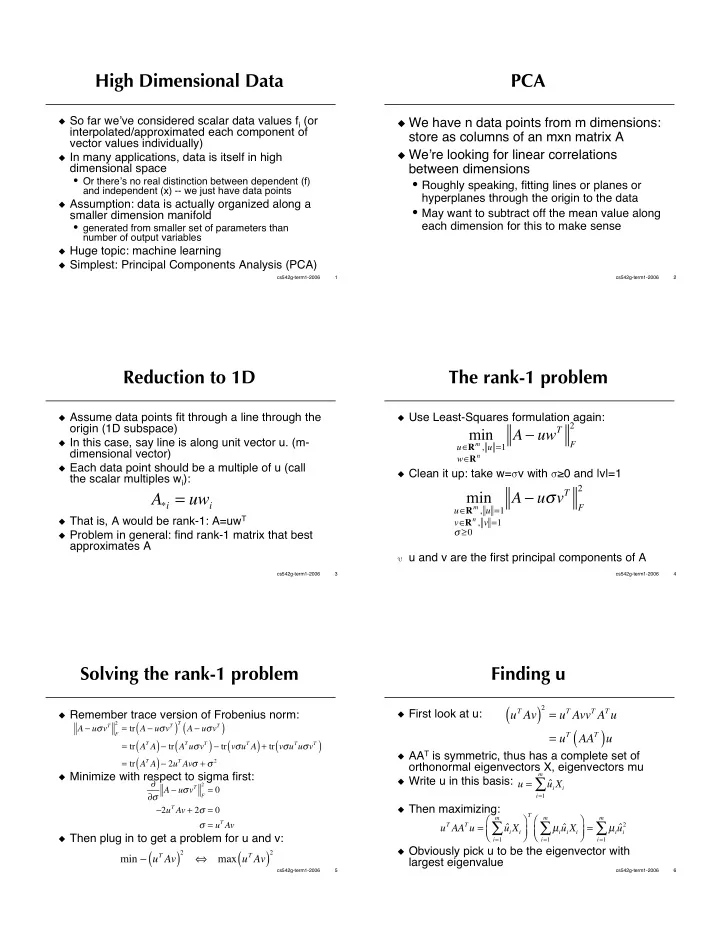
High Dimensional Data

So far weve considered scalar data values fi (or

interpolated/approximated each component of vector values individually)

In many applications, data is itself in high

dimensional space

  • Or theres no real distinction between dependent (f)

and independent (x) -- we just have data points

Assumption: data is actually organized along a

smaller dimension manifold

  • generated from smaller set of parameters than

number of output variables

Huge topic: machine learning Simplest: Principal Components Analysis (PCA)

2 cs542g-term1-2006

PCA

We have n data points from m dimensions:

store as columns of an mxn matrix A

Were looking for linear correlations

between dimensions

  • Roughly speaking, fitting lines or planes or

hyperplanes through the origin to the data

  • May want to subtract off the mean value along

each dimension for this to make sense

3 cs542g-term1-2006

Reduction to 1D

Assume data points fit through a line through the

  • rigin (1D subspace)

In this case, say line is along unit vector u. (m-

dimensional vector)

Each data point should be a multiple of u (call

the scalar multiples wi):

That is, A would be rank-1: A=uwT Problem in general: find rank-1 matrix that best

approximates A

A*i = uwi

4 cs542g-term1-2006

The rank-1 problem

Use Least-Squares formulation again: Clean it up: take w=v with 0 and |v|=1 u and v are the first principal components of A

min

uRm , u =1 wRn

A uwT

F 2

min

uRm , u =1 vRn , v =1

A uvT

F 2

5 cs542g-term1-2006

Solving the rank-1 problem

Remember trace version of Frobenius norm: Minimize with respect to sigma first: Then plug in to get a problem for u and v: A uvT

F 2 = tr A uvT

( )

T A uvT

( )

= tr AT A

( ) tr ATuvT ( ) tr vuT A ( ) + tr vuTuvT ( )

= tr AT A

( ) 2uT Av + 2

  • A uvT

F 2 = 0

2uT Av + 2 = 0 = uT Av

min uT Av

( )

2

  • max uT Av

( )

2

6 cs542g-term1-2006

Finding u

First look at u: AAT is symmetric, thus has a complete set of

  • rthonormal eigenvectors X, eigenvectors mu

Write u in this basis: Then maximizing: Obviously pick u to be the eigenvector with

largest eigenvalue

uT Av

( )

2 = uT AvvT ATu

= uT AAT

( )u

u = ˆ uiXi

i=1 m

  • uT AATu =

ˆ uiXi

i=1 m

  • T

µi ˆ uiXi

i=1 m

  • =

µi ˆ ui

2 i=1 m

slide-2
SLIDE 2

7 cs542g-term1-2006

Finding v

Write the thing were maximizing as: Same argument gives v the eigenvector

corresponding to max eigenvalue of ATA

Note we also have

uT Av

( )

2 = vT ATuuT Av

= vT AT A

( )v

2 = uT Av

( )

2 = max AAT

( ) = max AT A ( ) = A 2

2

8 cs542g-term1-2006

Generalizing

In general, if we expect problem to have

subspace dimension k, we want the closest rank-k matrix to A

  • That is, express the data points as linear

combinations of a set of k basis vectors (plus error)

  • We want the optimal set of basis vectors and

the optimal linear combinations:

min

U Rmk ,UTU = I W Rnk

A UW T

F 2

9 cs542g-term1-2006

Finding W

Take the same approach as before: Set gradient w.r.t. W equal to zero:

A UW T

F 2 = tr A UW T

( )

T A UW T

( )

= tr AT A 2trWU T A + trWU TUW T = A F

2 2trWU T A + W F 2

2ATU + 2W = 0 W = ATU

10 cs542g-term1-2006

Finding U

Plugging in W=ATU we get AAT is symmetric, hence has a complete

set of orthogonormal eigenvectors, say columns of X, and eigenvalues along the diagonal of M (sorted in decreasing order):

min A UW T

F 2

min 2tr ATUU T A + tr ATUU T A max trU T AATU

AAT = XMXT

11 cs542g-term1-2006

Finding U cont’d

Our problem is now: Note X and U are both orthogonal, so is XTU,

which we can call Z:

Simplest solution: set Z=(I 0)T which means that

U is the first k columns of X (first k eigenvectors of AAT)

maxtrU T XMXTU

max

ZT Z = I tr Z T MZ

max

ZT Z = I

µ jZ ji

2 j=1 m

  • i=1

k

  • 12

cs542g-term1-2006

Back to W

We can write W=VT for an orthogonal V, and

square kxk

Same argument as for U gives that V should be

the first k eigenvectors of ATA

What is ? From earlier rank-1 case we know Since U*1 and V*1 are unit vectors that achieve

the 2-norm of AT and A, we can derive that first row and column of is zero except for diagonal.

11 = = A 2 = AT

2

slide-3
SLIDE 3

13 cs542g-term1-2006

What is

Subtract rank-1 matrix U*111V*1

T from A

  • zeros matching eigenvalue of ATA or AAT

Then we can understand the next part of End up with a diagonal matrix,

containing the squareroots of the first k eigenvalues of AAT or ATA (theyre equal)

14 cs542g-term1-2006

The Singular Value Decomposition

Going all the way to k=m (or n) we get the

Singular Value Decomposition (SVD) of A

A=UVT The diagonal entries of are called the singular

values

The columns of U (eigenvectors of AAT) are the

left singular vectors

The columns of V (eigenvectors of ATA) are the

right singular vectors

Gives a formula for A as a sum of rank-1

matrices:

A = iuivi

T i

  • 15

cs542g-term1-2006

Cool things about the SVD

2-norm: Frobenius norm: Rank(A)= # nonzero singular values

  • Can make a sensible numerical estimate

Null(A) spanned by columns of U for zero

singular values

Range(A) spanned by columns of V for nonzero

singular values

For invertible A:

A 2 = 1 A F

2 = 1 2 ++ n 2

A1 = V1U T = viui

T

i

i=1 n

  • 16

cs542g-term1-2006

Least Squares with SVD

Define pseudo-inverse for a general A: Note if ATA is invertible, A+=(ATA)-1AT

  • I.e. solves the least squares problem]

If ATA is singular, pseudo-inverse defined:

A+b is the x that minimizes ||b-Ax||2 and of all those that do so, has smallest ||x||2

A+ = V+U T = viui

T

i

i=1 i >0 n

  • 17

cs542g-term1-2006

Solving Eigenproblems

Computing the SVD is another matter! We can get U and V by solving the symmetric

eigenproblem for AAT or ATA, but more specialized methods are more accurate

The unsymmetric eigenproblem is another

related computation, with complications:

  • May involve complex numbers even if A is real
  • If A is not normal (AATATA), it doesnt have a full

basis of eigenvectors

  • Eigenvectors may not be orthogonal… Schur decomp

Generalized problem: Ax=Bx LAPACK provides routines for all these Well examine symmetric problem in more detail

18 cs542g-term1-2006

The Symmetric Eigenproblem

Assume A is symmetric and real Find orthogonal matrix V and diagonal matrix D

s.t. AV=VD

  • Diagonal entries of D are the eigenvalues,

corresponding columns of V are the eigenvectors

Also put: A=VDVT or VTAV=D There are a few strategies

  • More if you only care about a few eigenpairs, not the

complete set…

Also: finding eigenvalues of an nxn matrix is

equivalent to solving a degree n polynomial

  • No “analytic” solution in general for n5
  • Thus general algorithms are iterative