High clinical utility the potential for fewer risky procedures and - - PowerPoint PPT Presentation

high clinical utility the potential for fewer risky
SMART_READER_LITE
LIVE PREVIEW

High clinical utility the potential for fewer risky procedures and - - PowerPoint PPT Presentation

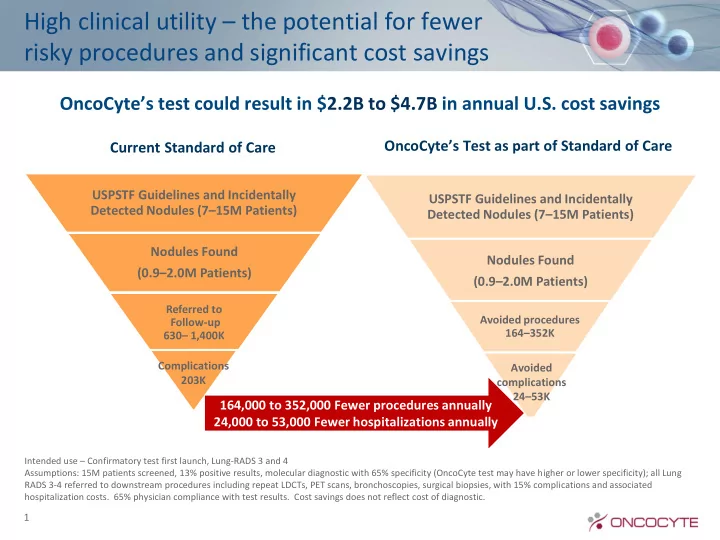
High clinical utility the potential for fewer risky procedures and significant cost savings OncoCytes test could result in $ 2.2B to $4.7B in annual U.S. cost savings OncoCytes Test as part of Standard of Care Current Standard of Care


slide-1
SLIDE 1

High clinical utility – the potential for fewer risky procedures and significant cost savings

USPSTF Guidelines and Incidentally Detected Nodules (7–15M Patients) Nodules Found (0.9–2.0M Patients)

Referred to Follow-up 630– 1,400K

Current Standard of Care

USPSTF Guidelines and Incidentally Detected Nodules (7–15M Patients) Nodules Found (0.9–2.0M Patients)

Avoided procedures 164–352K

OncoCyte’s Test as part of Standard of Care

OncoCyte’s test could result in $2.2B to $4.7B in annual U.S. cost savings

164,000 to 352,000 Fewer procedures annually 24,000 to 53,000 Fewer hospitalizations annually

1

Intended use – Confirmatory test first launch, Lung-RADS 3 and 4 Assumptions: 15M patients screened, 13% positive results, molecular diagnostic with 65% specificity (OncoCyte test may have higher or lower specificity); all Lung RADS 3-4 referred to downstream procedures including repeat LDCTs, PET scans, bronchoscopies, surgical biopsies, with 15% complications and associated hospitalization costs. 65% physician compliance with test results. Cost savings does not reflect cost of diagnostic.

Complications 203K Avoided complications 24–53K

slide-2
SLIDE 2

8.5 7.8 8.3 8.7 9.3 1 2 3 4 5 6 7 8 9 10 Total Oncologists Radiologists Interventional radiologists Pulmonologists

Interest in Using OncoCyte Product

Physicians in target specialties express highest level of interest

  • Interest in using the OncoCyte test is very high (mean rating of 8.5 out of 10)
  • Highest interest with pulmonologists and interventional radiologists
  • Reasons provided for high ratings:

 Useful for smaller nodules with high risk factors  Provides additional accuracy and benefit  Avoid biopsies  Non-invasive blood test  Provides clinical utility

2

Results of (30) in-depth, clinician interviews fielded in September/October 2015. Question asks: On a scale from 1-10 where 10 is very interested, how interested would you be in utilizing Test X?

slide-3
SLIDE 3

Reimbursement strategy has three key components

Coding

  • MAAA Ensured status allows value based pricing
  • Pursue CDLT status
  • Launch with unlisted code
  • Obtain unique CPT code when have CMS coverage

Coverage

  • MolDx has clear pathway to coverage
  • Develop and implement a strong evidence and publication plan
  • Clearly demonstrate analytical and clinical validation, clinical utility and cost

savings to health care system

  • Obtain CMS coverage 2-3 years after launch

Reimbursement

  • List price at launch
  • CMS Price set post-launch based on weighted average of commercial plans
  • Pursue private payor strategy that leverages PAMA pricing guidelines
  • Optimize rather than maximize in-network providers

3

slide-4
SLIDE 4

Lung is compelling proposition for payers

  • Payers gave diagnostic high ratings for unmet needs
  • Pricing and TPP discussion with payers very positive

Survey of (10) Commercial, Managed Medicaid and Managed Medicare payers representing 20M covered lives. Question asks: What is your perception of the overall unmet need for certain oncology screening diagnostics or procedures. On a scale of 1 to 10 where 1 is no unmet need and 10 is significant unmet need for an improved screening procedure/diagnostic.

4

“Getting tissue in lung biopsy is much more invasive for lung than other cancers” “Am concerned with USPSTF guidelines and the high false positives (one in five) and invasiveness of biopsies” “Not just about the expense, there is also increase morbidity and mortality with biopsies” “High need driven by lack of good screening procedures and a clinical concern to identify patients earlier”

slide-5
SLIDE 5

Key to coverage is strong clinical validation and clinical utility studies

MolDx Coverage Pathway

Coverage Probability

MolDx Level of Evidence Clinical Trial Design Principal Study Clinical Trial Design Secondary Study

Highest IA Randomized, Prospective (PCT) Randomized Prospective or Retrospective (PCT, PRT) IB PCT` Prospective Observational Studies (POS) or Retrospective Data Modeling (RDM) IIA PRT POS or RDM IIB

(minimum requirement)

POS POS or RDM 5

Conclusion: Successful trials should result in positive coverage decisions.

  • OncoCyte’s strategy is to achieve

the highest level (IA) of evidence

  • Previewed clinical protocol designs

with payers (November 2016) – 10 Payers – Public and commercial – 77M Covered lives

slide-6
SLIDE 6

Focused reimbursement strategy enables value-based pricing

6

Value-based pricing creates list price Optimize private-payer coverage PAMA Ensures maintenance of value-based pricing

  • OncoCyte test is MAAA
  • Full list price for the

first six months of Medicare coverage

  • Medicare price determined

every 12–36 months based

  • n weighted commercial

median

  • Contracting strategy

focused on maintaining value-based pricing

  • Patient assistance

program