
SLIDE 1
Rise UP
Michelle Parise
With Purpose Coaching
- Hi. I’m Michelle
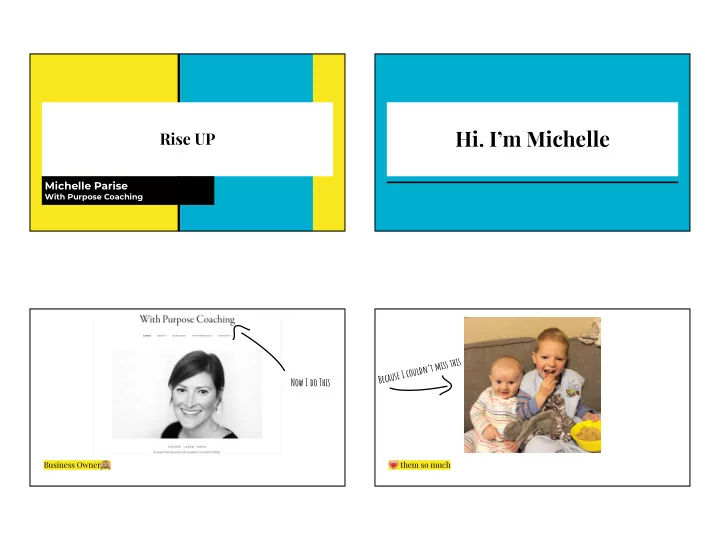
Business Owner🙊
Now I do This
💘 them so much
B e c a u s e I c
- u
l d n ’ t m i s s t h i s
Hi. Im Michelle Rise UP Michelle Parise With Purpose Coaching s - - PowerPoint PPT Presentation
Hi. Im Michelle Rise UP Michelle Parise With Purpose Coaching s h i t s i s m t n d u l o c I e u s a e c B Now I do This Business Owner them so much I worked here West Hollywood, CA No joke DREAM job
Michelle Parise
With Purpose Coaching
Business Owner🙊
Now I do This
💘 them so much
B e c a u s e I c
l d n ’ t m i s s t h i s
West Hollywood, CA
I worked here
No joke DREAM job Younger than me
#58, 1st EA, $100m, 1 offjce 1300, 14 EAs, $12B, 11 offjces globally
The beginning, sort of. My motto for life
We all have one!
Posture
Clean your desk The Entitled Newcomer The Volunteer who gets overwhelmed The Know It All
The Pessimist The Rockstar The Martyr The Queen Bee
No I in TEAM No I in TEAM
Yep, every day.
Assertive
Assertiveness is a positive and constructive way of relating to other people that respects their needs, wants and rights as well as one’s own needs, wants and rights.
Aggressive
People behave aggressively when they express themselves in a threatening, abusive or hostile manner. Aggressive behavior shows itself in insults, belittling, and sarcasm. Manipulation - using others for one’s own purposes without regard
when one individual assumes this right to make decisions for another. People who make demands of others and label others are showing signs of aggression.
Passive
People are passive when they fail to express their feelings, needs, or afgections to
exercise authority and therefore do not make their own decisions are being
and they won’t say yes, even when they do want to do something. Passive behavior can mean constantly letting others take advantage of you. People behave passively when they allow their ideas or opinions to be easily changed by others, which is difgerent from just being flexible.
Passive-Aggressive
Passive-aggressive behavior is marked by hidden hostility. When someone is asked to do something and he or she apparently agrees but then does not follow through, even though he or she could, that is passive-aggressive behavior. Passive-aggressive behavior can include stubbornness, pouting, insistence on proper procedure to the nth degree, or sabotage. All the passive-aggressive person’s opposition takes place behind the scenes and under cover, while on the surface he or she may seem agreeable and compliant.
Aggressive / Assertive / Passive
Seeks to punish a person who does wrong Seeks to help a person who does wrong Seeks to punish self for doing wrong or having angry feelings Has unreasonably high expectations for everyone Knows that even the finest people make mistakes Has unreasonably high expectations of self Cares about what happens to self Cares about the welfare of others Feels powerless to affect anyone’s welfare Doesn’t care about the other person’s POV Tires to be understanding Seethes inside b/c her POV isn’t recognized Holds grudges Knows the value of forgiving Holds anger inside Is stubborn, unmoveable, demanding Is flexible, willing to seek alternatives Resents others not agreeing with him or her Does not notice one’s own weakness Recognizes that one can always improve Feels paralyzed by her own weakness Is outwardly condemning and judgemental Recognizes that everyone has faults Is inwardly condemning and judgemental
Assertive Communication
A Role B Role C Observer
Situation
A) You want to borrow B’s car for couple of hours. Yours is in the repair shop and you need to go grocery shopping. Make an assertive request. B) A is your good friend and you don’t mind lending her your car, but you have somewhere you have to be in an hour and you need your car. Respond assertively. C) Observe
Situation
A) You are in a long line at the grocery store. B doesn’t see you and cuts in front
B) You saw the line but hoped there were two branches and pretended not to see A. C) Observe
Situation
A) Your co-worker B has a great idea that will make your boss look good. B) You give your co-worker A a great idea that they use with their boss, and they take credit for the idea. Respond assertively. C) Observe
Situation
A) As the boss, your EA’s idea wasn’t a good fit with your current goals and you turned it down. B) Your boss just shot down a suggestion you made. Respond assertively. C) Observe
Situation
A) You just got home an hour later than you said you would be. B) Your family member A just got home an hour later than she said she would be
happened in the last month. Respond assertively. C) Observe
Deciding to be assertive
1) Is this a problem, and how do I know that it is a problem? 2) Is this the time and place to respond assertively? 3) What are my chances of at least a small measure of success initially? 4) Am I willing to invest time and energy, and endure some risk, in order to make the change? 5) Will I stay relatively calm while I try some new behaviors, not letting fears or anxieties overwhelm me?
How to speak
Say something Be honest Use “I” messages Avoid labeling Be concise Don’t apologize for asserting yourself Avoid sarcasm Be persistent as necessary
Nonverbal Communication - Stay Assertive
Look the way you feel Use assertive gestures Speak clearly Face the person Maintain eye contact Be aware of your body orientation Pay attention to the quality of your voice Listen
Assertive statements
Let’s make some
Be positive Recognize good work Push growth Clear expectations Big picture - it’s a hospital
Hiring Create Shared Resources Group Meetings Culture Performance Assignments
Scope Scope Scope Own your 1:1 1) Group items by topic 2) Prioritize 3) Calendar review 4) 1x per month, quarterly calendar review 5) 1x per quarter, biannual & annual calendar review & time audit
1:1 MUST ASK FOR FEEDBACK IN EVERY 1:1 a) What else should I know? b) Is there anything I can do difgerently? c) Do you have any feedback for me? Making a request
1) Describe the situation 2) Express your feelings 3) Specify what you want 4) Consequences associated with your request 5) Get confirmation EX: I notice you’re always late for your 10am meeting. I think it’s causing disruption to the group. I’d like to add a 30min bufger block before the
10am group have their full hour long meeting. How does that sound to you? Phone # on emails! Always.
Work Faster
Stress Mindful Mindful
noun 1. 1. the quality or state of being conscious or aware of something. "their mindfulness of the wider cinematic tradition" 2. 2. a mental state achieved by focusing one's awareness on the present moment, while calmly acknowledging and accepting one's feelings, thoughts, and bodily sensations, used as a therapeutic technique.
Mindful
Mindful
Around the Room: Resource Sharing & Working Hacks
Empathy
“The ability to imagine oneself in another’s place and understand the other’s feelings, desires, ideas and actions”, in other words, to walk in their shoes.
Why?
Empathy is important because it is what facilitates our interactions and connections with others. It is the foundation for building community.
Empathy
Let’s play BINGO!
Yep, every day.
michelle@withpurposecoaching.com