Heroku Provider The Heroku provider is used to interact with the - - PDF document

heroku provider
SMART_READER_LITE
LIVE PREVIEW

Heroku Provider The Heroku provider is used to interact with the - - PDF document

Heroku Provider The Heroku provider is used to interact with the resources provided by Heroku Platform API and needs to be congured with credentials before it can be used. Background Heroku (https://www.heroku.com) is a fully-managed platform


slide-1
SLIDE 1

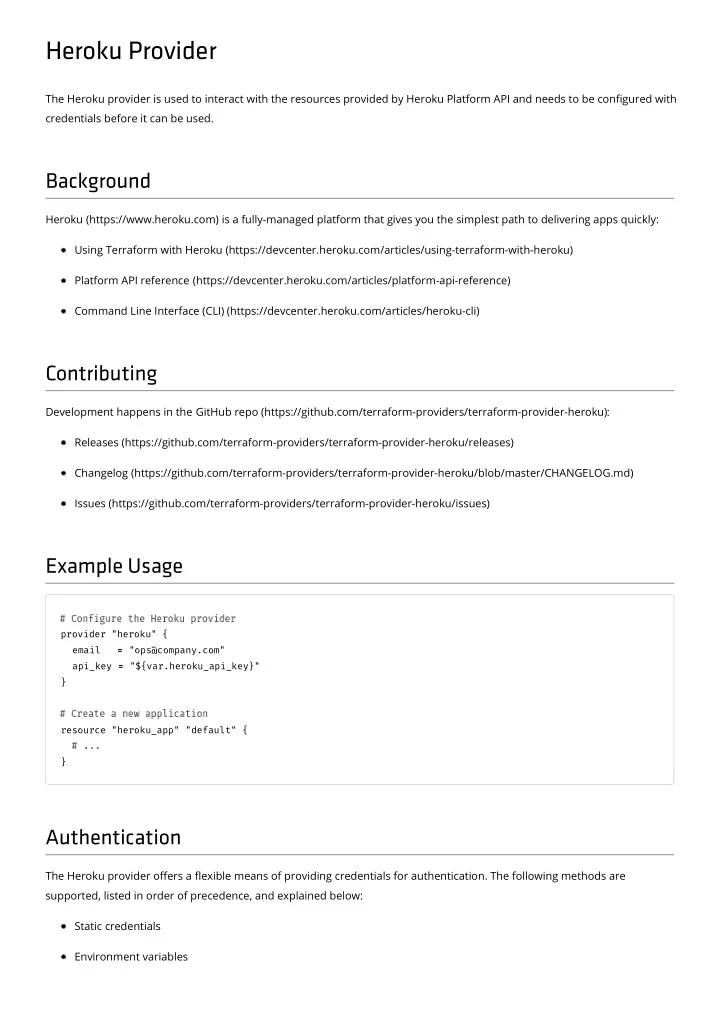
Heroku Provider

The Heroku provider is used to interact with the resources provided by Heroku Platform API and needs to be congured with credentials before it can be used.

Background

Heroku (https://www.heroku.com) is a fully-managed platform that gives you the simplest path to delivering apps quickly: Using Terraform with Heroku (https://devcenter.heroku.com/articles/using-terraform-with-heroku) Platform API reference (https://devcenter.heroku.com/articles/platform-api-reference) Command Line Interface (CLI) (https://devcenter.heroku.com/articles/heroku-cli)

Contributing

Development happens in the GitHub repo (https://github.com/terraform-providers/terraform-provider-heroku): Releases (https://github.com/terraform-providers/terraform-provider-heroku/releases) Changelog (https://github.com/terraform-providers/terraform-provider-heroku/blob/master/CHANGELOG.md) Issues (https://github.com/terraform-providers/terraform-provider-heroku/issues)

Example Usage

provider "heroku" { email = = "ops@company.com" api_key = = "${var.heroku_api_key}" } resource "heroku_app" "default" { }

Authentication

The Heroku provider oers a exible means of providing credentials for authentication. The following methods are supported, listed in order of precedence, and explained below: Static credentials Environment variables

slide-2
SLIDE 2

Netrc

Static credentials

Credentials can be provided statically by adding email and api_key arguments to the Heroku provider block:

provider "heroku" { email = = "ops@company.com" api_key = = "${var.heroku_api_key}" }

Environment variables

When the Heroku provider block does not contain an email or api_key argument, the missing credentials will be sourced from the environment via the HEROKU_EMAIL and HEROKU_API_KEY environment variables respectively:

provider "heroku" {} $ export HEROKU_EMAIL= ="ops@company.com" $ export HEROKU_API_KEY= ="heroku_api_key" $ terraform plan Refreshing Terraform state in in-memory prior to plan...

Netrc

Credentials can instead be sourced from the .netrc (https://ec.haxx.se/usingcurl-netrc.html) le in your home directory:

provider "heroku" {} $ cat ~/.netrc ... machine api.heroku.com login <your_heroku_email> password <your_heroku_api_key> ...

Argument Reference

The following arguments are supported:

api_key - (Required) Heroku API token. It must be provided, but it can also be sourced from other locations.

slide-3
SLIDE 3

email - (Required) Email to be notied by Heroku. It must be provided, but it can also be sourced from other locations

.

headers - (Optional) Additional Headers to be sent to Heroku. If not provided, it will be sourced from the HEROKU_HEADERS environment variable (if set). delays - (Optional) Delays help mitigate issues that can arise due to Heroku's eventually consistent data model. Only

a single delays block may be specied and it supports the following arguments:

post_app_create_delay - (Optional) The number of seconds to wait after an app is created. Default is to wait 5

seconds.

post_space_create_delay - (Optional) The number of seconds to wait after a private space is created. Default

is to wait 5 seconds.

post_domain_create_delay - (Optional) The number of seconds to wait after a domain is created. Default is to

wait 5 seconds.

slide-4
SLIDE 4

Data Source: heroku_addon

Use this data source to get information about a Heroku Addon.

Example Usage

data "heroku_addon" "from_another_app" { name = = "addon-from-another-app" }

  • utput "heroku_addon_data_basic" {

value = = [ "Addon from another app", "id: ${data.heroku_addon.from_another_app.id}", "name: ${data.heroku_addon.from_another_app.name}", "app: ${data.heroku_addon.from_another_app.app}", "plan: ${data.heroku_addon.from_another_app.plan}", "provider_id: ${data.heroku_addon.from_another_app.provider_id}", "config_vars: ${join(", ", data.heroku_addon.from_another_app.config_vars)}", ] }

Argument Reference

The following arguments are supported:

name - (Required) The add-on name

Attributes Reference

The following attributes are exported:

id - The ID of the add-on name - The add-on name plan - The plan name provider_id - The ID of the plan provider config_vars - The Conguration variables of the add-on

slide-5
SLIDE 5

Data Source: heroku_app

Use this data source to get information about a Heroku App.

Example Usage

data "heroku_app" "default" { name = = "my-cool-app" }

Argument Reference

The following arguments are supported:

name - (Required) The name of the application. In Heroku, this is also the unique ID, so it must be unique and have a

minimum of 3 characters.

Attributes Reference

The following attributes are exported:

name - (Required) The name of the application. In Heroku, this is also the unique . stack - (Optional) The application stack is what platform to run the application in. buildpacks - (Optional) A list of buildpacks that this app uses. space - (Optional) The private space in which the app runs. Not present if this is a common runtime app. region - (Required) The region in which the app is deployed. git_url - (Required) The Git URL for the application. This is used for deploying new versions of the app. web_url - (Required) The web (HTTP) URL that the application can be accessed at by default. heroku_hostname - (Required) A hostname for the Heroku application, suitable for pointing DNS records. config_vars - (Optional) A map of all of the conguration variables for the app. acm - (Required) True if Heroku ACM is enabled for this app, false otherwise.

  • rganization - (Optional) The Heroku Team that owns this app. The elds for this block are documented below.

The organization block supports:

name (string) - The name of the Heroku Team. locked (boolean)

slide-6
SLIDE 6

personal (boolean)

slide-7
SLIDE 7

Data Source: heroku_space

Use this data source to get information about a Heroku Private Space (https://www.heroku.com/private-spaces).

Example Usage

data "heroku_space" "default" { name = = "my-secret-space" }

Argument Reference

The following arguments are supported:

name - (Required) The name of the Heroku Private Space.

Attributes Reference

The following attributes are exported:

name - The name of the Heroku Private Space. In Heroku, this is also the unique . id - The unique ID of the Heroku Private Space. region - The region in which the Heroku Private Space is deployed. state - The state of the Heroku Private Space. Either allocating or allocated . shield - Whether or not the space has Shield (https://devcenter.heroku.com/articles/private-spaces#shield-private-

spaces) turned on. One of on or off .

  • rganization - The Heroku Team that owns this space. The elds for this block are documented below.

cidr - The RFC-1918 CIDR the Private Space will use. It must be a /16 in 10.0.0.0/8, 172.16.0.0/12 or 192.168.0.0/16 data_cidr - The RFC-1918 CIDR that the Private Space will use for the Heroku-managed peering connection that’s

automatically created when using Heroku Data add-ons. It must be between a /16 and a /20

  • utbound_ips - The space's stable outbound NAT IPs (https://devcenter.heroku.com/articles/platform-api-

reference#space-network-address-translation). The organization block supports:

name (string) - The name of the Heroku Team.

slide-8
SLIDE 8

Data Source: heroku_space_peering_info

Use this data source to get peering information about a Heroku Private Space (https://www.heroku.com/private-spaces).

Example Usage

data "heroku_space_peering_info" "default" { name = = "my-secret-space" } resource "aws_vpc_peering_connection" "foo" { peer_owner_id = = "${data.heroku_space_peering_info.default.aws_account_id}" peer_vpc_id = = "${data.heroku_space_peering_info.default.vpc_id}" vpc_id = = "${aws_vpc.foo.id}" }

Argument Reference

The following arguments are supported:

name - (Required) The name of the Heroku Private Space.

Attributes Reference

The following attributes are exported:

aws_account_id - The AWS account ID that the Heroku Private Space runs in. aws_region - The AWS region that the Heroku Private Space runs in. vpc_id - The VPC ID of the Heroku Private Space. vpc_cidr - The CIDR block of the VPC ID. dyno_cidr_blocks - The CIDR blocks that the Dynos run on. unavailable_cidr_blocks - A list of unavailable CIDR blocks.

slide-9
SLIDE 9

Data Source: heroku_team

Use this data source to get information about a Heroku Team or Heroku Enterprise team.

Example Usage

data "heroku_team" "my_heroku_team" { name = = "name_of_my_heroku_team" }

  • utput "heroku_team_data_basic" {

value = = [ "Heroku team", "id: ${data.heroku_team.my_heroku_team.id}", "default: ${data.heroku_team.my_heroku_team.default}", "membership_limit: ${data.heroku_team.my_heroku_team.membership_limit}", "provisioned_licenses: ${data.heroku_team.my_heroku_team.provisioned_licenses}", "type: ${data.heroku_team.my_heroku_team.type}", ] }

Argument Reference

The following arguments are supported:

name - (Required) The team name

Attributes Reference

The following attributes are exported:

id - The ID of the team default - Whether to use this team when none is specied credit_card_collections - Whether charges incurred by the team are paid by credit card membership_limit - Upper limit of members allowed in a team provisioned_licenses - Whether the team is provisioned licenses by Salesforce type - type of team Will likely be either "enterprise" or "team"

slide-10
SLIDE 10

heroku_account_feature

This resource is used to create and manage User Features (https://devcenter.heroku.com/articles/heroku-beta-features) on Heroku. NOTE: If this resource's HCL is removed from a .tf le, the behavior is to disable account feature and remove resource from state.

Available Features

For a list of available features, use the Heroku CLI (https://devcenter.heroku.com/articles/heroku-cli) to fetch them for the current user:

heroku labs

The output will contain User Features that may be managed with this resource.

Example Usage

resource "heroku_account_feature" "example_metrics" { name = = "metrics-request-volume" enabled = = true true }

Argument Reference

The following arguments are supported:

name - (Required) Name of the account feature enabled - (Required) Enable or disable the account feature

Attributes Reference

The following attributes are exported:

id - Comprised of acount email & feature name description - Description of account feature state - State of account feature

slide-11
SLIDE 11

Import

Existing account features can be imported using a combination of the account email (the email address tied to the Heroku API key) and the feature name. For example: $ terraform import heroku_account_feature.example_metrics name@example.com:metrics-request-

volume

slide-12
SLIDE 12

heroku_addon_attachment

Attaches a Heroku Addon Resource to an additional Heroku App.

Example Usage

resource "heroku_addon_attachment" "database" { app_id = = "${heroku_app.default.id}" addon_id = = "${heroku_addon.database.id}" }

Argument Reference

The following arguments are supported:

app_id - (Required) The ID of the Heroku App to attach to. addon_id - (Required) The ID of the existing Heroku Addon to attach. name - (Optional) A friendly name for the Heroku Addon Attachment.

Attributes Reference

The following attributes are exported:

id - The unique ID of the add-on attachment

Import

Addons can be imported using the unique Addon Attachment id , e.g.

$ terraform import heroku_addon_attachment.foobar 01234567-89ab-cdef-0123-456789abcdef

slide-13
SLIDE 13

heroku_addon

Provides a Heroku Add-On resource. These can be attach services to a Heroku app.

Example Usage

resource "heroku_app" "default" { name = = "test-app" } resource "heroku_addon" "database" { app = = "${heroku_app.default.name}" plan = = "heroku-postgresql:hobby-basic" } resource "heroku_addon" "webhook" { app = = "${heroku_app.default.name}" plan = = "deployhooks:http" config = = { url = = "http://google.com" } }

Argument Reference

The following arguments are supported:

app - (Required) The Heroku app to add to. plan - (Required) The addon to add. config - (Optional) Optional plan conguration. name - (Optional) Globally unique name of the add-on.

Attributes Reference

The following attributes are exported:

id - The ID of the add-on name - The add-on name plan - The plan name provider_id - The ID of the plan provider

slide-14
SLIDE 14

config_vars - The Conguration variables of the add-on

Import

Addons can be imported using the Addon id , e.g.

$ terraform import heroku_addon.foobar 12345678

slide-15
SLIDE 15

heroku_app_cong_association

Provides a Heroku App Cong Association resource, making it possible to set/update/remove heroku app cong vars independently from the heroku_app resource. An example usage scenario could be: User has separate git repositories for various micro-services. Multiple micro-services use Kafka. User has a separate repository for kafka terraform les with blue/green support. User builds out new clusters. Prior to this resource's introduction, user would need one terraform apply to update state and X number of

terraform apply for each micro-service to pick up the new kafka clusters. However with this resource, user can do

  • ne terraform apply and let Heroku handle the rolling restarts to pick up the new cong vars.

"Sensitive" is not secret

Heroku does not have a 'sensitivity' distinction for its cong variables. This distinction is only made during terraform plan and apply to avoid leaking sensitive data in the console output.

Beware of conicting vars

Be careful when having cong variables dened in both heroku_app and heroku_app_config_association resources. As the latter resource has a dependency on the former, any overlapping cong variables in heroku_app will be overwritten in

heroku_app_config_association during a terraform apply . Furthermore, this overlap will cause an innite dirty

terraform plan if cong variables have dierent values on both resources at the same time. It is recommended to use one or the other resource, not both, to manage your app(s) cong vars.

Example HCL

slide-16
SLIDE 16

resource "heroku_config" "common" { name = = "common-vars" vars = = { LOG_LEVEL = = "info" } sensitive_vars = = { PRIVATE_KEY = = "some_private_key" } } resource "heroku_app" "foobar" { name = = "my-cool-app" region = = "us" } resource "heroku_app" "foobar2" { name = = "my-cool-app2" region = = "us" } resource "heroku_app_config_association" "foobar" { app_id = = "${heroku_app.foobar.id}" vars = = "${heroku_config.common.vars}" sensitive_vars = = "${heroku_config.common.sensitive_vars}" } resource "heroku_app_config_association" "foobar2" { app_id = = "${heroku_app.foobar2.id}" vars = = "${heroku_config.common.vars}" sensitive_vars = = { DATABASE_URL = = "some_db_url_that_has_auth_info" } }

Argument Reference

app_id - (Required) A Heroku app's UUID . Can also be the name of the Heroku app but UUID is preferred as it is

idempotent.

vars - Map of cong vars that are output in plaintext. sensitive_vars - This is the same as vars . The main dierence between the two attributes is sensitive_vars

  • utputs are redacted on-screen and replaced by a placeholder, following a terraform plan or apply. It is recommended

to put private keys, passwords, etc in this argument.

Attributes Reference

The following attributes are exported:

slide-17
SLIDE 17

id - The ID of the app cong association.

Import

The heroku_app_config_association resource's primary attributes are managed only within Terraform state. It does not exist as a native Heroku resource. Therefore, it is not possible to import an existing heroku_app_config_association resource.

slide-18
SLIDE 18

heroku_app_feature

This resource is used to create and manage App Features (https://devcenter.heroku.com/articles/heroku-beta-features) on Heroku.

Available Features

For a list of available features, use the Heroku CLI (https://devcenter.heroku.com/articles/heroku-cli) to fetch them for one of your existing apps:

heroku labs --app foobar

The output will contain User Features and App Features. This resource manages App Features. If you need to manage User Features, use the heroku_account_feature resource (/docs/providers/heroku/r/account_feature.html).

Example Usage

resource "heroku_app_feature" "log_runtime_metrics" { app = = "test-app" name = = "log-runtime-metrics" }

Argument Reference

The following arguments are supported:

app - (Required) The Heroku app to link to. name - (Required) The name of the App Feature to manage. enabled - (Optional) Whether to enable or disable the App Feature. The default value is true.

Import

App features can be imported using the combination of the application name, a colon, and the feature's name. For example: $ terraform import heroku_app_feature.log-runtime-metrics foobar:log-runtime-metrics

slide-19
SLIDE 19

heroku_app

Provides a Heroku App resource. This can be used to create and manage applications on Heroku.

Example Usage

resource "heroku_app" "default" { name = = "my-cool-app" region = = "us" config_vars = = { FOOBAR = = "baz" } buildpacks = = [ "heroku/go" ] }

Example Usage for a Team

A Heroku "team" was originally called an "organization", and that is still the identier used in this resource.

resource "heroku_app" "default" { name = = "my-cool-app" region = = "us"

  • rganization {

name = = "my-cool-team" } }

Argument Reference

The following arguments are supported:

name - (Required) The name of the application. In Heroku, this is also the unique ID, so it must be unique and have a

minimum of 3 characters.

region - (Required) The region that the app should be deployed in. stack - (Optional) The application stack is what platform to run the application in. buildpacks - (Optional) Buildpack names or URLs for the application. Buildpacks congured externally won't be

altered if this is not present.

config_vars - (Optional) Conguration variables for the application. The cong variables in this map are not the

1

slide-20
SLIDE 20

nal set of conguration variables, but rather variables you want present. That is, other conguration variables set externally won't be removed by Terraform if they aren't present in this list.

sensitive_config_vars - (Optional) This argument is the same as config_vars . The main dierence between the

two is when sensitive_config_vars outputs are displayed on-screen following a terraform apply or terraform refresh, they are redacted, with displayed in place of their value. It is recommended to put private keys, passwords, etc in this argument.

space - (Optional) The name of a private space to create the app in. internal_routing - (Optional) If true, the application will be routable only internally in a private space. This option is

  • nly available for apps that also specify space .
  • rganization - (Optional) A block that can be specied once to dene Heroku Team settings for this app. The elds

for this block are documented below.

acm - (Optional) The ag representing Automated Certicate Management for the app.

The organization block supports:

name (string) - The name of the Heroku Team locked (boolean) personal (boolean)

Deleting vars

Deleting an entire config_vars or sensitive_config_vars map from a heroku_app conguration will not actually remove the vars on the remote resource. To remove an existing variable, leave these attribute maps in-place and delete only its entries from the map. Once these attributes are empty, the map itself may be deleted from the conguration. Otherwise if one deletes the map with existing entries, the cong vars will not be deleted from the remote resource. This is especially important if you are migrating all config_vars to sensitive_config_vars or migrating cong vars to

heroku_app_config_association resource.

Attributes Reference

The following attributes are exported:

id - The ID of the app. This is also the name of the application. name - The name of the application. In Heroku, this is also the unique ID. stack - The application stack is what platform to run the application in. space - The private space the app should run in. internal_routing - Whether internal routing is enabled the private space app. region - The region that the app should be deployed in. git_url - The Git URL for the application. This is used for deploying new versions of the app.

1

slide-21
SLIDE 21

web_url - The web (HTTP) URL that the application can be accessed at by default. heroku_hostname - A hostname for the Heroku application, suitable for pointing DNS records. all_config_vars - A map of all of the conguration variables that exist for the app, containing both those set by

Terraform and those set externally. (These are treated as "sensitive" so that their values are redacted in console

  • utput.)

uuid - The unique UUID of the Heroku app. NOTE: Use this for null_resource triggers.

Import

Apps can be imported using the App id , e.g.

$ terraform import heroku_app.foobar MyApp

slide-22
SLIDE 22

heroku_app_release

Provides a Heroku App Release (https://devcenter.heroku.com/articles/platform-api-reference#release) resource. An app release represents a combination of code, cong vars and add-ons for an app on Heroku. NOTE: This resource requires the slug be uploaded to Heroku using heroku_slug (/docs/providers/heroku/r/slug.html)

  • r with external tooling prior to running terraform.

Example Usage

resource "heroku_app" "foobar" { name = = "foobar" region = = "us" } resource "heroku_app_release" "foobar-release" { app = = "${heroku_app.foobar.name}" slug_id = = "01234567-89ab-cdef-0123-456789abcdef" }

Argument Reference

The following arguments are supported:

app - (Required) The name of the application slug_id - unique identier of slug description - description of changes in this release

Attributes Reference

The following attributes are exported:

id - The ID of the app release

Import

Existing app releases can be imported using the combination of the application name, a colon, and the formation's type. For example: $ terraform import heroku_app_release.foobar-release foobar

slide-23
SLIDE 23

heroku_app_webhook

Provides a Heroku App Webhook (https://devcenter.heroku.com/categories/app-webhooks).

Example Usage

resource "heroku_app" "foobar" { name = = "foobar" } resource "heroku_app_webhook" "foobar_release" { app_id = = "${heroku_app.foobar.id}" level = = "notify" url = = "https://example.com/heroku_webhook" include include = = ["api:release"] }

Argument Reference

The following arguments are supported:

app_id - (Required) The Heroku app to add to. level - (Required) The webhook level (either notify or sync ) url - (Required) Optional plan conguration. include - (Required) List of events to deliver to the webhook. secret - (Optional) Value used to sign webhook payloads. Once set, this value cannot be fetched from the Heroku API,

but it can be updated.

authorization - (Optional) Values used in Authorization header. Once set, this value cannot be fetched from the

Heroku API, but it can be updated.

Importing

Existing webhooks can be imported using the combination of the application name or id, a colon, and the webhook name or id, e.g.

$ terraform import heroku_app_webhook.foobar_release foobar:b85d9224-310b-409b-891e-c903f5a40568

slide-24
SLIDE 24

heroku_build

Provides a Heroku Build (https://devcenter.heroku.com/articles/platform-api-reference#build) resource, to deploy source code to a Heroku app. Either a URL or local path, pointing to a tarball (https://en.wikipedia.org/wiki/Tar_(computing)) of the source code, may be

  • deployed. If a local path is used, it may instead point to a directory of source code, which will be tarballed automatically and

then deployed. This resource waits until the build (https://devcenter.heroku.com/articles/build-and-release-using-the-api) & release (https://devcenter.heroku.com/articles/release-phase) completes. If the build fails, the error will contain a URL to view the build log. curl "https://the-long-log-url-in-the-error" . To start the app from a successful build, use a Formation resource (/docs/providers/heroku/r/formation.html) to specify the process, dyno size, and dyno quantity.

Source code layout

The code contained in the source directory or tarball must follow the layout required by the buildpack (https://devcenter.heroku.com/articles/buildpacks) or the Dockerfile for container builds (https://devcenter.heroku.com/articles/build-docker-images-heroku-yml).

Building with Buildpacks

This is the default build process. For apps that do not have a buildpack set, the ocial Heroku buildpacks (https://devcenter.heroku.com/articles/buildpacks#ocially-supported-buildpacks) will be searched until a match is detected and used to compile the app. A Procfile (https://devcenter.heroku.com/articles/procle) may be required to successfully launch the app. Some buildpacks provide a default web process, such as npm start for Node.js (https://devcenter.heroku.com/articles/nodejs- support#default-web-process-type). Other buildpacks may require a Procfile , like for a pure Ruby app (https://devcenter.heroku.com/articles/ruby-support#ruby-applications-process-types).

Building with Docker

To use container builds, set the parent heroku_app resource's stack = "container" A heroku.yml manifest (https://devcenter.heroku.com/articles/build-docker-images-heroku-yml#heroku-yml-overview) le is required to declare which Dockerfile to build for each process. Be careful not to create conicting conguration between heroku.yml and Terraform, such as addons or cong vars.

Source URLs

A source.url may point to any https:// URL that responds to a GET with a tarball source code. When running

slide-25
SLIDE 25

terraform apply , the source code will only be fetched once for a successful build. Change the URL to force a new

resource. Useful for building public, open-source source code, such as projects that publish releases on GitHub.

GitHub URLs

GitHub provides release (https://help.github.com/articles/creating-releases/) tarballs through URLs. Create a release and then use the tag as a source.url , such as:

https://github.com/username/example/archive/v1.0.0.tar.gz

Using a branch or master source.url is possible, but be aware that tracking down exactly what commit was deployed for a given terraform apply may be dicult. On the other hand, using stable release tags ensures repeatability of the Terraform conguration.

Example Usage with Source URL

resource "heroku_app" "foobar" { name = = "foobar" region = = "us" } resource "heroku_build" "foobar" { app = = "${heroku_app.foobar.id}" buildpacks = = ["https://github.com/mars/create-react-app-buildpack"] source = = { url = = "https://github.com/mars/cra-example-app/archive/v2.1.1.tar.gz" version = = "v2.1.1" } } resource "heroku_formation" "foobar" { app = = "${heroku_app.foobar.id}" type = = "web" quantity = = 1 size = = "Standard-1x" depends_on = = ["heroku_build.foobar"] }

Local source

A source.path may point to either: a tarball of source code a directory of source code

slide-26
SLIDE 26

use src/appname relative path to reference src/ sub-directories, monorepo-style use ../appname relative or /opt/src/appname absolute paths to external directories something else will need to manage the state of that external source code, before Heroku Build When running terraform apply , if the contents (SHA256) of the source path changed since the last apply , then a new build will start.

Example Usage with Local Source Directory

resource "heroku_app" "foobar" { name = = "foobar" region = = "us" } resource "heroku_build" "foobar" { app = = "${heroku_app.foobar.id}" source = = { path = = "../example-app" } } resource "heroku_formation" "foobar" { app = = "${heroku_app.foobar.id}" type = = "web" quantity = = 1 size = = "Standard-1x" depends_on = = ["heroku_build.foobar"] }

Argument Reference

The following arguments are supported:

app - (Required) The ID of the Heroku app buildpacks - List of buildpack GitHub URLs source - (Required) A block that species the source code to build & release: checksum - Hash of the source archive for verifying its integrity, auto-generated when source.path is set, SHA256:e3b0c44298fc1c149afbf4c8996fb92427ae41e4649b934ca495991b7852b855 path - (Required unless source.url is set) Local path to the source directory or tarball archive for the app url - (Required unless source.path is set) https location of the source archive for the app version - Use to track what version of your source originated this build. If you are creating builds from git-

versioned source code, for example, the commit hash, or release tag would be a good value to use for the version parameter.

slide-27
SLIDE 27

Attributes Reference

The following attributes are exported:

uuid - The ID of the build

  • utput_stream_url - URL that streams the log output from the build (https://devcenter.heroku.com/articles/build-

and-release-using-the-api#streaming-build-output)

release_id - The Heroku app release created with a build's slug slug_id - The Heroku slug created by a build stack - Name or ID of the Heroku stack (https://devcenter.heroku.com/articles/stack) status - The status of a build. Possible values are pending , successful and failed user - Heroku account that created a build email id

Import

Existing builds can be imported using the combination of the application name, a colon, and the build ID. For example: $ terraform import heroku_build.foobar bazbux:4f1db8ef-ed5c-4c42-a3d6-3c28262d5abc

foobar is the heroku_build resource's name bazbux is the Heroku app name (or ID) that the build belongs to : separates the app identier & the build identier 4f1db8ef… is the build ID

slide-28
SLIDE 28

heroku_cert

Provides a Heroku SSL certicate resource. It allows to set a given certicate for a Heroku app.

Example Usage

resource "heroku_app" "default" { name = = "test-app" } resource "heroku_addon" "ssl" { app = = "${heroku_app.default.name}" plan = = "ssl" } resource "heroku_cert" "ssl_certificate" { app = = "${heroku_app.default.name}" certificate_chain = = "${file("server.crt crt")}" private_key = = "${file("server.key key")}" depends_on = = ["heroku_addon.ssl"] }

Argument Reference

The following arguments are supported:

app - (Required) The Heroku app to add to. certificate_chain - (Required) The certicate chain to add private_key - (Required) The private key for a given certicate chain

Attributes Reference

The following attributes are exported:

id - The ID of the add-on cname - The CNAME for the SSL endpoint name - The name of the SSL certicate

Importing

slide-29
SLIDE 29

When importing a Heroku cert resource, the ID must be built using the app name colon the unique ID from the Heroku API. For an app named production-api with a certicate ID of b85d9224-310b-409b-891e-c903f5a40568 , you would import it as:

$ terraform import heroku_cert.production_api production-api:b85d9224-310b-409b-891e-c903f5a40568

slide-30
SLIDE 30

heroku_cong

Provides a Heroku Cong resource, making it possible to dene variables to be used throughout your Heroku terraform

  • congurations. Combined with heroku_app_config_association , these two resources enable users to decouple setting

cong var(s) from the heroku_app resource. NOTE: Unlike most Terraform resources, this resource DOES NOT by itself create, update or delete anything in Heroku. A heroku_app_config_association (/docs/providers/heroku/r/app_cong_association.html),

heroku_app.config_vars , or heroku_app.sensitive_config_vars is required to actually set these values on

Heroku apps.

Example HCL

resource "heroku_config" "endpoints" { vars = = { x = = "https://..." y = = "https://..." z = = "https://..." } sensitive_vars = = { PRIVATE_KEY = = "some_private_key" } }

Argument Reference

vars - Map of vars that are can be outputted in plaintext. sensitive_vars - This is the same as vars . The main dierence between the two attributes is sensitive_vars

  • utputs are redacted on-screen and replaced by a placeholder, following a terraform plan or apply . It is

recommended to put private keys, passwords, etc in this argument.

Attributes Reference

The following attributes are exported:

id - The ID of the cong.

Import

The heroku_config resource is a meta-resource, managed only within Terraform state. It does not exist as a native Heroku

  • resource. Therefore, it is not possible to import an existing heroku_config conguration.
slide-31
SLIDE 31

heroku_domain

Provides a Heroku Domain resource. This can be used to create and manage custom domains on Heroku.

Example Usage

resource "heroku_app" "default" { name = = "test-app" } resource "heroku_domain" "default" { app = = "${heroku_app.default.name}" hostname = = "terraform.example.com" }

Argument Reference

The following arguments are supported:

hostname - (Required) The hostname to serve requests from. app - (Required) The Heroku app to link to.

Attributes Reference

The following attributes are exported:

id - The ID of the of the domain record. hostname - The hostname trac will be served as. cname - The CNAME trac should route to.

Importing

When importing a Heroku domain resource, the ID must be built using the app name colon the unique ID from the Heroku

  • API. For an app named production-api with a domain ID of b85d9224-310b-409b-891e-c903f5a40568 , you would

import it as:

$ terraform import heroku_domain.production_api production-api:b85d9224-310b-409b-891e-c903f5a40568

slide-32
SLIDE 32

heroku_drain

Provides a Heroku Drain resource. This can be used to create and manage Log Drains on Heroku.

Example Usage

resource "heroku_drain" "default" { app = = "test-app" url = = "syslog://terraform.example.com:1234" }

Argument Reference

The following arguments are supported:

url - (Required) The URL for Heroku to drain your logs to. app - (Required) The Heroku app to link to.

Attributes Reference

The following attributes are exported:

token - The unique token for your created drain.

Importing

When importing a Heroku drain resource, the ID must be built using the app name colon the unique ID from the Heroku API. For an app named production-api with a drain ID of b85d9224-310b-409b-891e-c903f5a40568 , you would import it as:

$ terraform import heroku_drain.production_api production-api:b85d9224-310b-409b-891e-c903f5a40568

slide-33
SLIDE 33

heroku_formation

Provides a Heroku Formation (https://devcenter.heroku.com/articles/platform-api-reference#formation) resource. A formation represents the formation of processes that should be set for an application. NOTE: - The application must have a dyno in order to update its formation. - If the heroku formation resource is removed and deleted, this will be a no-op action in Heroku. The Heroku Platform does not have a DELETE endpoint for

formation . - This resource works well with the heroku_app_release resource, which allows you to deploy a

slug/release to an application before the formation can be updated.

Example Usage

resource "heroku_app" "foobar" { name = = "foobar" region = = "us" } resource "heroku_app_release" "foobar-release" { app = = "${heroku_app.foobar.name}" slug_id = = "01234567-89ab-cdef-0123-456789abcdef" } resource "heroku_formation" "foobar-web" { app = = "${heroku_app.foobar.name}" type = = "web" quantity = = 2 size = = "standard-2x" depends_on = = ["heroku_app_release.foobar-release"] }

Argument Reference

app - (Required) The name of the application type - (Required) type of process such as "web" quantity - (Required) number of processes to maintain size - (Required) dyno size (Example: “standard-1X”). Capitalization does not matter.

slide-34
SLIDE 34

Attributes Reference

The following attributes are exported:

id - The ID of the formation

Import

Existing formations can be imported using the combination of the application name, a colon, and the formation's type. For example:

$ terraform import heroku_formation.foobar-web foobar:web

slide-35
SLIDE 35

heroku_pipeline_coupling

Provides a Heroku Pipeline Coupling (https://devcenter.heroku.com/articles/pipelines) resource. A pipeline is a group of Heroku apps that share the same codebase. Once a pipeline is created using heroku_pipeline (/docs/providers/heroku/r/pipeline.html), and apps are added to dierent stages using heroku_pipeline_coupling , you can promote app slugs to the downstream stages.

Example Usage

resource "heroku_app" "staging" { name = = "test-app-staging" } resource "heroku_app" "production" { name = = "test-app-production" } resource "heroku_pipeline" "test-app" { name = = "test-app" } resource "heroku_pipeline_coupling" "staging" { app = = "${heroku_app.staging.name}" pipeline = = "${heroku_pipeline.test-app.id}" stage = = "staging" } resource "heroku_pipeline_coupling" "production" { app = = "${heroku_app.production.name}" pipeline = = "${heroku_pipeline.test-app.id}" stage = = "production" }

Argument Reference

The following arguments are supported:

app - (Required) The name of the app for this coupling. pipeline - (Required) The ID of the pipeline to add this app to. stage - (Required) The stage to couple this app to. Must be one of review , development , staging , or production .

Attributes Reference

slide-36
SLIDE 36

The following attributes are exported:

id - The UUID of this pipeline coupling. app - The name of the application. app_id - The ID of the application. pipeline - The UUID of the pipeline. stage - The stage for this coupling.

Import

Pipeline couplings can be imported using the Pipeline coupling id , e.g.

$ terraform import heroku_pipeline_coupling.foobar 12345678

slide-37
SLIDE 37

heroku_pipeline

Provides a Heroku Pipeline (https://devcenter.heroku.com/articles/pipelines) resource. A pipeline is a group of Heroku apps that share the same codebase. Once a pipeline is created, and apps are added to dierent stages using heroku_pipeline_coupling (/docs/providers/heroku/r/pipeline_coupling.html), you can promote app slugs to the next stage.

Example Usage

resource "heroku_app" "staging" { name = = "test-app-staging" } resource "heroku_app" "production" { name = = "test-app-production" } resource "heroku_pipeline" "test-app" { name = = "test-app" } resource "heroku_pipeline_coupling" "staging" { app = = "${heroku_app.staging.name}" pipeline = = "${heroku_pipeline.test-app.id}" stage = = "staging" } resource "heroku_pipeline_coupling" "production" { app = = "${heroku_app.production.name}" pipeline = = "${heroku_pipeline.test-app.id}" stage = = "production" }

Argument Reference

The following arguments are supported:

name - (Required) The name of the pipeline.

Attributes Reference

The following attributes are exported:

id - The UUID of the pipeline.

slide-38
SLIDE 38

name - The name of the pipeline.

Import

Pipelines can be imported using the Pipeline id , e.g.

$ terraform import heroku_pipeline.foobar 12345678

slide-39
SLIDE 39

heroku_slug

Provides a Heroku Slug (https://devcenter.heroku.com/articles/platform-api-reference#slug) resource. This resource supports uploading a pre-generated archive le of executable code, making it possible to launch apps directly from a Terraform cong. This resource does not itself generate the slug archive. A guide to creating slug archives (https://devcenter.heroku.com/articles/platform-api-deploying-slugs) is available in the Heroku Dev Center.

Minimal Example

Create a ready-to-release slug:

file_url or file_path must reference a le containing a slug archive of executable code and must follow the

prescribed layout from Create slug archive (https://devcenter.heroku.com/articles/platform-api-deploying- slugs#create-slug-archive) in the Heroku Dev Center (nested within an ./app directory) The archive may be created by an external build system, downloaded from another Heroku app, or otherwise provided

  • utside of the context of this Terraform resource

If the content (SHA256) of file_path changes, then a new resource will be forced on the next plan/apply; if the le does not exist, the dierence is ignored. The file_url is only fetched during resource creation. To trigger another fetch the file_url should be changed, then a new resource will be forced on the next plan/apply.

resource "heroku_slug" "foobar" { app = = "${heroku_app.foobar.id}" file_url = = "https://github.com/terraform-providers/terraform-provider-heroku/raw/master/heroku/test-fix tures/slug.tgz" process_types = = { web = = "ruby server.rb" } }

Example Usage

Complete cong to launch a Heroku app:

slide-40
SLIDE 40

resource "heroku_app" "foobar" { name = = "foobar" region = = "us" } resource "heroku_slug" "foobar" { app = = "${heroku_app.foobar.id}" buildpack_provided_description = = "Ruby" // The slug archive file must already exist file_path = = "slug.tgz" process_types = = { web = = "ruby server.rb" } } resource "heroku_app_release" "foobar" { app = = "${heroku_app.foobar.id}" slug_id = = "${heroku_slug.foobar.id}" } resource "heroku_formation" "foobar" { app = = "${heroku_app.foobar.id}" type = = "web" quantity = = 1 size = = "Standard-1x" depends_on = = ["heroku_app_release.foobar"] }

Argument Reference

The following arguments are supported:

app - (Required) The ID of the Heroku app buildpack_provided_description - Description of language or app framework, "Ruby/Rack" ; displayed as the

app's language in the Heroku Dashboard

checksum - Hash of the slug for verifying its integrity, auto-generated from contents of file_path or file_url , SHA256:e3b0c44298fc1c149afbf4c8996fb92427ae41e4649b934ca495991b7852b855 commit - Identication of the code with your version control system (eg: SHA of the git HEAD), "60883d9e8947a57e04dc9124f25df004866a2051" commit_description - Description of the provided commit file_path - (Required unless file_url is set) Local path to a slug archive, "slugs/current.tgz" file_url - (Required unless file_path is set) https URL to a slug archive, "https://example.com/slugs/app- v1.tgz" process_types - (Required) Map of processes to launch on Heroku Dynos

slide-41
SLIDE 41

(https://devcenter.heroku.com/articles/process-model)

stack - Name or ID of the Heroku stack (https://devcenter.heroku.com/articles/stack)

Attributes Reference

The following attributes are exported:

id - The ID of the slug app - The ID or unique name of the Heroku app blob - Slug archive (compressed tar of executable code) method - HTTP method to upload the archive url - Pre-signed, expiring URL to upload the archive buildpack_provided_description - Description of language or app framework, "Ruby/Rack" checksum - Hash of the slug for verifying its integrity, auto-generated from contents of file_path or file_url commit - Identication of the code with your version control system (eg: SHA of the git HEAD), "60883d9e8947a57e04dc9124f25df004866a2051" commit_description - Description of the provided commit process_types - Map of processes to launch on Heroku Dynos (https://devcenter.heroku.com/articles/process-

model)

size - Slug archive lesize in bytes stack - Heroku stack (https://devcenter.heroku.com/articles/stack) name stack_id - Heroku stack (https://devcenter.heroku.com/articles/stack) ID

Import

Existing slugs can be imported using the combination of the application name, a colon, and the slug ID. For example:

$ terraform import heroku_slug.foobar bazbux:4f1db8ef-ed5c-4c42-a3d6-3c28262d5abc

foobar is the heroku_slug resource's name bazbux is the Heroku app name (or ID) that the slug belongs to : separates the app identier & the slug identier 4f1db8ef… is the slug ID

slide-42
SLIDE 42

heroku_space_app_access

Provides a resource for managing permissions for the entire Private Space. Members with the admin role will always have full permissions in the Private Space, so using this resource on an admin will have no eect. The provided email must already be a member of the Heroku Team. Currently the only supported permission is create_apps .

Example Usage

// Create a new Heroku Private Space resource "heroku_space" "default" { name = = "test-space"

  • rganization =

= "my-company" region = = "virginia" } // Give an existing team member create_apps permissions to the Private Space resource "heroku_space_app_access" "member1" { space = = "${heroku_space.default.name}" email = = "member1@example.com" permissions = = ["create_apps"] } // Remove all permissions from an existing team member resource "heroku_space_app_access" "member2" { space = = "${heroku_space.default.name}" email = = "member2@example.com" permissions = = [] }

Argument Reference

The following arguments are supported:

space - (Required) The name of the Private Space. email - (Required) The email of the existing Heroku Team member. permissions - (Required) The permissions to grant the team member for the Private Space. Currently create_apps

is the only supported permission. If not provided the member will have no permissions to the space. Members with admin role will always have create_apps permissions, which cannot be removed.

Importing

Existing permissions can be imported using the combination of the Private Space name, a colon, and the member email. For example:

slide-43
SLIDE 43

$ terraform import heroku_space_app_access.member1 my-space:member1@foobar.com

slide-44
SLIDE 44

heroku_space

Provides a Heroku Private Space resource for running apps in isolated, highly available, secure app execution environments.

Example Usage

A Heroku "team" was originally called an "organization", and that is still the identier used in this resource.

// Create a new Heroku space resource "heroku_space" "default" { name = = "test-space"

  • rganization =

= "my-company" region = = "virginia" } // Create a new Heroku app in in test-

  • space

resource "heroku_app" "default" { name = = "test-app" space = = "${heroku_space.default.name}"

  • rganization =

= { name = = "my-company" } }

Argument Reference

The following arguments are supported:

name - (Required) The name of the Private Space.

  • rganization - (Required) The name of the Heroku Team which will own the Private Space.

cidr - (Optional) The RFC-1918 CIDR the Private Space will use. It must be a /16 in 10.0.0.0/8, 172.16.0.0/12 or

192.168.0.0/16

data_cidr - (Optional) The RFC-1918 CIDR that the Private Space will use for the Heroku-managed peering

connection that’s automatically created when using Heroku Data add-ons. It must be between a /16 and a /20

region - (Optional) provision in a specic Private Spaces region

(https://devcenter.heroku.com/articles/regions#viewing-available-regions).

shield - (Optional) provision as a Shield Private Space (https://devcenter.heroku.com/articles/private-spaces#shield-

private-spaces).

Attributes Reference

The following attributes are exported:

id - The ID of the space.

slide-45
SLIDE 45

name - The space's name.

  • rganization - The space's Heroku Team.

region - The space's region. cidr - The space's CIDR. data_cidr - The space's Data CIDR.

  • utbound_ips - The space's stable outbound NAT IPs (https://devcenter.heroku.com/articles/platform-api-

reference#space-network-address-translation).

Import

Spaces can be imported using the space id , e.g.

$ terraform import heroku_space.foobar MySpace

slide-46
SLIDE 46

heroku_space_inbound_ruleset

Provides a resource for managing inbound rulesets (https://devcenter.heroku.com/articles/platform-api- reference#inbound-ruleset) for Heroku Private Spaces.

Example Usage

resource "heroku_space" "default" { name = = "test-space"

  • rganization =

= "my-company" region = = "virginia" } resource "heroku_space_inbound_ruleset" "default" { space = = "${heroku_space.default.name}" rule { action = = "allow" source = = "0.0.0.0/0" } rule { action = = "deny" source = = "8.8.4.4/32" } }

Argument Reference

The following arguments are supported:

space - (Required) The name of the space. rule - (Required) At least one rule block. Rules are documented below.

A rule block supports the following arguments:

action - (Required) The action to apply this rule to. Must be one of allow or deny . source - (Required) A CIDR block source for the rule.

Attributes Reference

The following attributes are exported:

id - The ID of the inbound ruleset.

slide-47
SLIDE 47

heroku_space_peering_connection_accepter

Provides a resource for accepting VPC peering requests to Heroku Private Spaces.

Example Usage

data "heroku_space_peering_info" "peer_space" { name = = "my-fancy-space" } resource "aws_vpc_peering_connection" "request" { peer_owner_id = = "${data.heroku_space_peering_info.peer_space.aws_account_id}" peer_vpc_id = = "${data.heroku_space_peering_info.peer_space.vpc_id}" vpc_id = = "${aws_vpc.main.id}" } resource "heroku_space_peering_connection_accepter" "accept" { space = = "${heroku_space.peer_space.name}" vpc_peering_connection_id = = "${aws_vpc_peering_connection.request.id}" }

Argument Reference

The following arguments are supported:

space - (Required) The name of the space. vpc_peering_connection_id - (Required) The peering connection request ID.

Attributes Reference

The following attributes are exported:

status - The status of the peering connection request. type - The type of the peering connection.

slide-48
SLIDE 48

heroku_space_vpn_connection

Provides a resource for creating a VPN connection between a network and a Heroku Private Space. For more information, see Private Spaces VPN Connection (https://devcenter.heroku.com/articles/private-space-vpn-connection?preview=1) in the Heroku DevCenter.

Example Usage

// Create a new Heroku space resource "heroku_space" "default" { name = = "test-space"

  • rganization =

= "my-company" region = = "virginia" } // Connect the Heroku space to another network with a VPN resource "heroku_space_vpn_connection" "office" { name = = "office" space = = "${heroku_space.default.name}" public_ip = = "203.0.113.1" routable_cidrs = = ["192.168.1.0/24"] }

Argument Reference

The following arguments are supported:

name - (Required) The name of the VPN connection. space - (Required) The name of the Heroku Private Space where the VPN connection will be established. public_ip - (Required) The public IP address of the VPN endpoint on the network where the VPN connection will be

established.

routable_cidrs - (Required) A list of IPv4 CIDR blocks used by the network where the VPN connection will be

established.

Attributes Reference

The following attributes are exported:

space_cidr_block - The CIDR block for the Heroku Private Space. The network where the VPN will be established

should be congured to route trac destined for this CIDR block over the VPN link.

ike_version - The IKE version used to setup the IPsec tunnel. tunnels - Details about each VPN tunnel endpoint. ip - The public IP address of the tunnel.

slide-49
SLIDE 49

pre_shared_key - The pre-shared IPSec secret for the tunnel.

slide-50
SLIDE 50

heroku_team_collaborator

A Heroku Team Collaborator (https://devcenter.heroku.com/articles/platform-api-reference#team-app-collaborator) receives access to a specic Team-owned app. To create a Heroku Team, use the New Team (https://dashboard.heroku.com/teams/new) feature of Heroku Dashboard. For Heroku Enterprise accounts, new Teams may be created within the account by users with the right permissions. A Heroku "team" was originally called an "organization", and that is still the identier used elsewhere in this provider. For

heroku_app (/docs/providers/heroku/r/app.html) & heroku_space (/docs/providers/heroku/r/space.html) resources, set

the Heroku Team name as the "organization". NOTE: This resource only works for Team-owned apps

Example Usage

resource "heroku_team_collaborator" "foobar-collaborator" { app = = "${heroku_app.foobar.name}" email = = "collaborator@foobar.com" permissions = = ["view", "operate", "manage"] }

Argument Reference

app - (Required) The name of the team app that the team collaborator will be added to. email - (Required) Email address of the team collaborator permissions - (Required) List of permissions that will be granted to the team collaborator. The order in which

individual permissions are set here does not matter. Please visit this link (https://devcenter.heroku.com/articles/app- permissions) for more information on available permissions.

Attributes Reference

The following attributes are exported:

id - The ID of the team collaborator

Import

Team Collaborators can be imported using the combination of the team application name, a colon, and the collaborator's email address

slide-51
SLIDE 51

For example:

$ terraform import heroku_team_collaborator.foobar-collaborator foobar_app:collaborator@foobar.com

slide-52
SLIDE 52

heroku_team_member

A Heroku Team Member (https://devcenter.heroku.com/articles/platform-api-reference#team-member) receives access to everything owned by the Team. To create a Heroku Team, use the New Team (https://dashboard.heroku.com/teams/new) feature of Heroku Dashboard. For Heroku Enterprise accounts, new Teams may be created within the account by users with the right permissions. A Heroku "team" was originally called an "organization", and that is still the identier used elsewhere in this provider. For

heroku_app (/docs/providers/heroku/r/app.html) & heroku_space (/docs/providers/heroku/r/space.html) resources, set

the Heroku Team name as the "organization".

Example Usage

resource "heroku_team_member" "foobar-member" { team = = "my-team" email = = "some-user@example.com" role = = "member" }

Argument Reference

team - (Required) The name of the Heroku Team. email - (Required) Email address of the member role - (Required) The role to assign the member. See the API docs (https://devcenter.heroku.com/articles/platform-

api-reference#team-member) for available options.

Import

Team members can be imported using the combination of the team application name, a colon, and the member's email address.

$ terraform import heroku_team_member.foobar-member my-team-foobar:some-user@example.com