
080523 Bibliotheca Alexandrina Updated by Hadir Ashraf & Manar Badr
1
Henrik Ibsen (1828 – 1906)
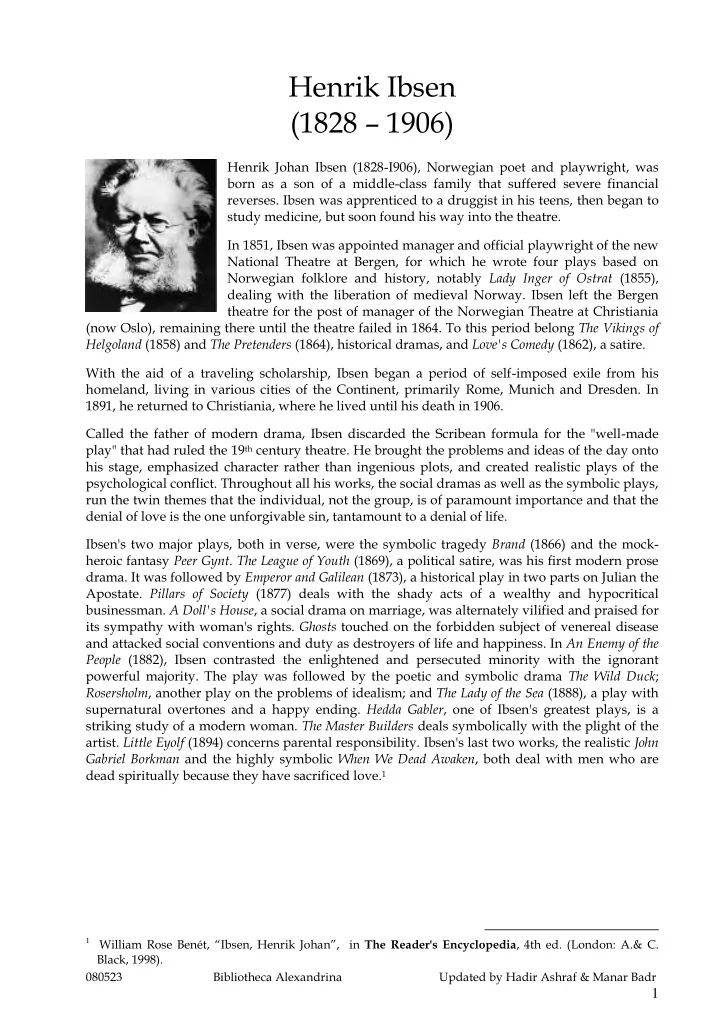
Henrik Johan Ibsen (1828-I906), Norwegian poet and playwright, was born as a son of a middle-class family that suffered severe financial
- reverses. Ibsen was apprenticed to a druggist in his teens, then began to
study medicine, but soon found his way into the theatre. In 1851, Ibsen was appointed manager and official playwright of the new National Theatre at Bergen, for which he wrote four plays based on Norwegian folklore and history, notably Lady Inger of Ostrat (1855), dealing with the liberation of medieval Norway. Ibsen left the Bergen theatre for the post of manager of the Norwegian Theatre at Christiania (now Oslo), remaining there until the theatre failed in 1864. To this period belong The Vikings of Helgoland (1858) and The Pretenders (1864), historical dramas, and Love's Comedy (1862), a satire. With the aid of a traveling scholarship, Ibsen began a period of self-imposed exile from his homeland, living in various cities of the Continent, primarily Rome, Munich and Dresden. In 1891, he returned to Christiania, where he lived until his death in 1906. Called the father of modern drama, Ibsen discarded the Scribean formula for the "well-made play" that had ruled the 19th century theatre. He brought the problems and ideas of the day onto his stage, emphasized character rather than ingenious plots, and created realistic plays of the psychological conflict. Throughout all his works, the social dramas as well as the symbolic plays, run the twin themes that the individual, not the group, is of paramount importance and that the denial of love is the one unforgivable sin, tantamount to a denial of life. Ibsen's two major plays, both in verse, were the symbolic tragedy Brand (1866) and the mock- heroic fantasy Peer Gynt. The League of Youth (1869), a political satire, was his first modern prose
- drama. It was followed by Emperor and Galilean (1873), a historical play in two parts on Julian the
- Apostate. Pillars of Society (1877) deals with the shady acts of a wealthy and hypocritical
- businessman. A Doll's House, a social drama on marriage, was alternately vilified and praised for
its sympathy with woman's rights. Ghosts touched on the forbidden subject of venereal disease and attacked social conventions and duty as destroyers of life and happiness. In An Enemy of the People (1882), Ibsen contrasted the enlightened and persecuted minority with the ignorant powerful majority. The play was followed by the poetic and symbolic drama The Wild Duck; Rosersholm, another play on the problems of idealism; and The Lady of the Sea (1888), a play with supernatural overtones and a happy ending. Hedda Gabler, one of Ibsen's greatest plays, is a striking study of a modern woman. The Master Builders deals symbolically with the plight of the
- artist. Little Eyolf (1894) concerns parental responsibility. Ibsen's last two works, the realistic John
Gabriel Borkman and the highly symbolic When We Dead Awaken, both deal with men who are dead spiritually because they have sacrificed love.1
1 William Rose Benét, “Ibsen, Henrik Johan”, in The Reader's Encyclopedia, 4th ed. (London: A.& C.
Black, 1998).