
SLIDE 1
HENDERSON-HOPKINS:
WHOLE FAMILY STABILITY AS AGENCY FOR URBAN REVIVAL
- Annette C. Anderson, Ph.D.
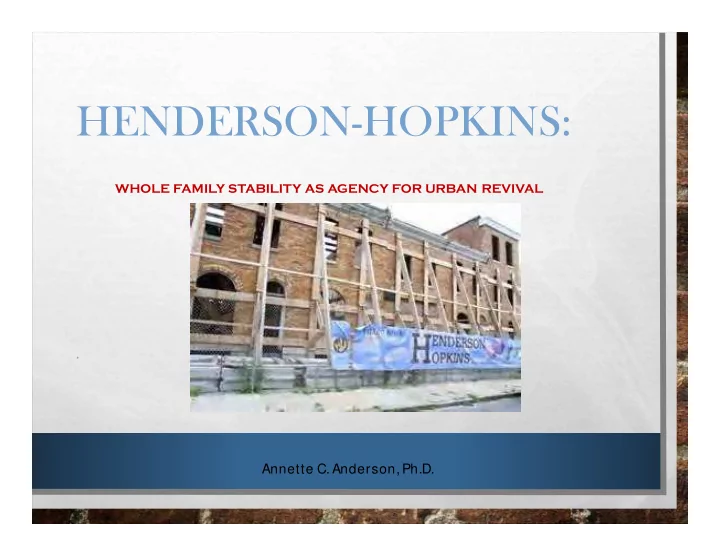
HENDERSON-HOPKINS: WHOLE FAMILY STABILITY AS AGENCY FOR URBAN - - PowerPoint PPT Presentation
HENDERSON-HOPKINS: WHOLE FAMILY STABILITY AS AGENCY FOR URBAN REVIVAL Annette C. Anderson, Ph.D. CITIES AND METROPOLITAN AREAS ARE THE ENGINES OF ECONOMIC PROSPERITY AND SOCIAL TRANSFORMATION IN THE UNITED STATES. BRUCE KATZ &
WHOLE FAMILY STABILITY AS AGENCY FOR URBAN REVIVAL
“CITIES AND METROPOLITAN AREAS ARE THE ENGINES OF ECONOMIC PROSPERITY AND SOCIAL TRANSFORMATION IN THE UNITED STATES.” BRUCE KATZ & JENNIFER BRADLEY, THE METROPOLITAN REVOLUTION (2013)
SI NC E T HE PUBLI C AT I O N O F T HE C O LEMAN REPO RT IN 1966, JO HNS HO PKINS UNIVERSIT Y HAS HI ST O RI C ALLY REC O G NI ZED T HAT A C O NT I NUED LAC K O F Q UALI T Y EDUC AT I O NAL O PPO RT UNIT Y IN URBAN C O MMUNIT IES LI KE BALT I MO RE RO UT I NELY SI G NALS
(PROVOST’S SYMPOSIUM ON THE SOCIAL DE TE RMINANTS OF HE AL TH, 5/ 2012)
2
3
4
The Elmer A. Henderson: A Johns Hopkins Partnership School (K- 8) and The Harry and Jeanette Weinberg Early Childhood Center comprise the first new Baltimore public school building in East Baltimore in nearly 30 years. This unique university-community partnership has the extraordinary opportunity to create a high-performing school that serves a diverse, mixed-income community of students, families and teachers. Students will receive personalized learning in a $42 million, 90,000- square-foot facility on a 7-acre campus, which will be shared with the $10 million, 28,000- square-foot Harry and Jeanette Weinberg Early Childhood Center.
5
POVE RTY STATISTICS FOR ZIPCODE S 21205 & 21213: AROUND THE HH CAMPUS
22% 22% 34% 34% 32% 32% 43% 43% 26% 26% 45% 45%
78% 66% 68% 57% 74% 55% All families with related children under 5 years Families with female householder, no husband present with related children under 5 years All people Related children under 5 years
Above Poverty Above Poverty Level Level Percentage of Families and People Percentage of Families and People whose Income in th whose Income in the Past 12 Months is Below Poverty Level e Past 12 Months is Below Poverty Level
6
HE NDE RSON-HOPKINS NE IGHBORHOOD DE MOGRAPHICS, HE NDE RSON-HOPKINS NE IGHBORHOOD DE MOGRAPHICS, ZIPCODE S ZIPCODE S 21205 & 21213 21205 & 21213
84% 84% 11% 11% 1% 1% 2% 2% 2% 2% Black or Af Black or African American rican American W White ite As Asia ian Some oth Some other ra r race ce Two or more races Two or more races Note that Hispanics or Latinos (of any race) are 4% of the total.
7
PE RCE NT UNE MPLOYE D IN CIVILIAN WORKFORCE , ZIPCODE S 21205 & 21213*
21% 21% 79% 79%
Unemployed E mployed
*Baltimore City unemployment rate is 7%
8
WHOLE F AMIL Y STABILITY: PRE DICTIVE MODE L FOR COMMUNITY LIFE COURSE SUCCE SS
DIFFICUL TY OF WHOLE SCALE E DUCATION RE FORM E FFORTS IN URBAN COMMUNITIE S SUGGE STS A NE W OPPORTUNITY -- THAT E DUCATION MIGHT BE TIE D TO THE BROADE R THE ME OF COMMUNITY E CONOMIC OPPORTUNITY THROUGH URBAN RE DE VE LOPME NT AND RE NE WE D HOUSING CHOICE S.
, F AMILIE S WITH GRE ATE R SOCIAL CAPITAL TO SUPPORT LIFE COURSE SUCCE SS AREINDUCE D TO PARTICIPATEIN HOUSING TRANSFORMATION INITIATIVE S THROUGH ATTRACTIVE SOCIALINCE NTIVE S WITH A HIGH-PE RFORMINGSCHOOLAS ANCHOR INSTITUTION, WHILEF AMILIE S WITH AN INHIBITE D CAPACITYTOE NGAGESTRONGSOCIALCAPITALSUPPORTS ARESIMUL TANE OUSL YSCAFFOLDE D TO RE ACH PARITYWITH WIDE RE XPE CTATIONS OFLIFECOURSESUCCE SS THROUGH SUBSIDIE S AND SUPPORTS.
T RE SUL T IS A SCALABLE , COLLABORATIVESOCIALRE NE WALMODE LFOR THESUCCE SSFULRE BUILDING OFME TROPOLITAN CE NTE RS AS THRIVINGURBAN E NTE RPRISE S.
9
HE NDE RSON-HOPKINS:
LIFE COURSE STABILITY MODEL RESISTS A SINGULAR FOCUS ON TRADITIONAL SCHOOL ACHIEVEMENT.
FUNCTION OF THE WIDER MEASURE ALONG A CONTINUUM OF THREE KEY DIMENSIONS ALREADY ADDRESSED IN THE CANON:
LIFE COURSE ORIENTATION SUCCESS
COMMUNITY ACCESS TO THE HENDERSON- HOPKINS FACILITY AS KEY TO ENSURING FAMILY STABILITY WITHIN THE EDUCATIONAL CONTEXT AS WELL AS ENGAGING LIFE COURSE ORIENTATION SUCCESS FOR THE WIDER COMMUNITY.
TOWARDS A FAMILY STRENGTHS PARADIGM IN THE CONTEXT OF HOUSING & COMMUNITY RENEWAL
10
HOW THE F ACILITY INFORMS WHOLE CHILD E DUCATION
11
Longitudinal Student Knowledge Response House Concept comprised of small, flexible learning communities Gradual student
learning using an increasingly personalized learning platform increases
engage lifelong education
12
WHOLE C WHOLE CHILD EDUC ILD EDUCATIO ION: N: DATA-INF
ORMED DECISIONS
E ffective 21
st Century
Instruction
across the E CC and K/ 8 campus as continuously measured by a series of Formative, E mbedded, and Summative Assessments
Grade Level Reading & Beyond
arly Childhood and Key Primary Grade Benchmarks to Predict & Scaffold Student Literacy Success at BOY Kindergarten and by E OY 3rd Grade
Personalized Learning
very student in the Henderson-Hopkins facility (E CC & K/ 8) will have a Student Growth Trajectory by Fall 2014
13
F.A.C.C.T C.C.T. F FAMIL MILY SUPPOR SUPPORT -
ENGAGEMENT & GEMENT & INTER INTERVENTION VENTION
Tier 1: E ngagement
Henderson-Hopkins campus. Diagnostic data is reviewed on every child to determine additional needed academic, social/ emotional, and family supports from a strengths-based paradigm
Tier 2: E nrichment
nrichment activities for all families from providers such as the Y of Central Maryland and the Weinberg Library offers families across the campus afterschool and extended day student programs, as well as evening & weekend activities
Tier 3: Support & Intervention
literacy, have access to extended family resources within the Henderson-Hopkins facility
14
COMMUNIT MMUNITY LIFE C Y LIFE COURSE ORIENT URSE ORIENTATION ION
Health & Well-Being
Using the CDC’s coordinated school health platform, families are engaged in an ongoing effort to promote strong health
household.
Community Activity
Henderson-Hopkins as a center of measurable community activity, including afterschool and weekend programming through partners such as the Y and Peabody Institute.
E ngagement
Afterschool and other out-of- school time engagement promotes the stability of the family in the context of the broader success of the community.
15
HE NDE RSON-HOPKINS SUCCE SS PRE DICTOR CHE CKLIST
Has the student benefitted from strong instruction for three consistent years or more at Henderson-Hopkins (E CC/ K-8)? Has the student met milestones for School Readiness and/ or Grade Level Reading? Does the student have an accurate Student Learner Profile and Growth Trajectory? Has the student mastered the E xecutive Function Inquiry Model? Has the student required remediative family support? (E xamples include Food Bank, Truancy Court, BGE energy assistance.) Does the student participate in out of school time enrichments? Has the school met guidelines for strong student health & well-being? Does the student participate in school-community engagement activities?
16