Using Municipal Land Banks for Urban Renewal: Structuring and - - PowerPoint PPT Presentation

using municipal land banks for urban renewal structuring
SMART_READER_LITE
LIVE PREVIEW

Using Municipal Land Banks for Urban Renewal: Structuring and - - PowerPoint PPT Presentation

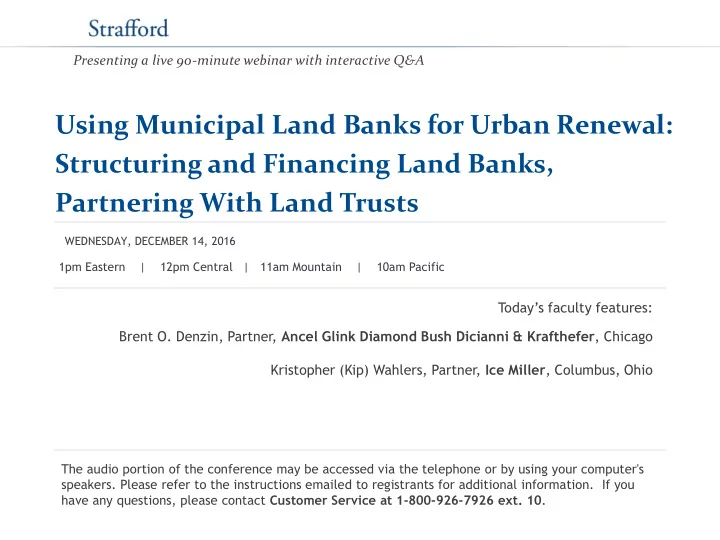
Presenting a live 90-minute webinar with interactive Q&A Using Municipal Land Banks for Urban Renewal: Structuring and Financing Land Banks, Partnering With Land Trusts WEDNESDAY, DECEMBER 14, 2016 1pm Eastern | 12pm Central | 11am


slide-1
SLIDE 1

The audio portion of the conference may be accessed via the telephone or by using your computer's

  • speakers. Please refer to the instructions emailed to registrants for additional information. If you

have any questions, please contact Customer Service at 1-800-926-7926 ext. 10.

Presenting a live 90-minute webinar with interactive Q&A

Using Municipal Land Banks for Urban Renewal: Structuring and Financing Land Banks, Partnering With Land Trusts

Today’s faculty features:

1pm Eastern | 12pm Central | 11am Mountain | 10am Pacific WEDNESDAY, DECEMBER 14, 2016

Brent O. Denzin, Partner, Ancel Glink Diamond Bush Dicianni & Krafthefer, Chicago Kristopher (Kip) Wahlers, Partner, Ice Miller, Columbus, Ohio

slide-2
SLIDE 2

Tips for Optimal Quality

Sound Quality If you are listening via your computer speakers, please note that the quality

  • f your sound will vary depending on the speed and quality of your internet

connection. If the sound quality is not satisfactory, you may listen via the phone: dial 1-866-871-8924 and enter your PIN when prompted. Otherwise, please send us a chat or e-mail sound@straffordpub.com immediately so we can address the problem. If you dialed in and have any difficulties during the call, press *0 for assistance. Viewing Quality To maximize your screen, press the F11 key on your keyboard. To exit full screen, press the F11 key again.

FOR LIVE EVENT ONLY

slide-3
SLIDE 3

Continuing Education Credits

In order for us to process your continuing education credit, you must confirm your participation in this webinar by completing and submitting the Attendance Affirmation/Evaluation after the webinar. A link to the Attendance Affirmation/Evaluation will be in the thank you email that you will receive immediately following the program. For additional information about continuing education, call us at 1-800-926-7926

  • ext. 35.

FOR LIVE EVENT ONLY

slide-4
SLIDE 4

Program Materials

If you have not printed the conference materials for this program, please complete the following steps:

  • Click on the ^ symbol next to “Conference Materials” in the middle of the left-

hand column on your screen.

  • Click on the tab labeled “Handouts” that appears, and there you will see a

PDF of the slides for today's program.

  • Double click on the PDF and a separate page will open.
  • Print the slides by clicking on the printer icon.

FOR LIVE EVENT ONLY

slide-5
SLIDE 5

icemiller.com icemiller.com

Kip Wahlers Ice Miller LLP 250 West Street, Suite 700 Columbus, Ohio 43215 (614) 462-1074 Kip.Wahlers@icemiller.com

From Vacancy to Vitality: Land Banks as Catalyst for Redevelopment

December 14, 2016

slide-6
SLIDE 6

icemiller.com

Land banks are public or community-owned entities created to acquire, manage, maintain and repurpose vacant, abandoned and foreclosed properties Created to replace systems where local governments sell their interest in tax-delinquent property to speculators,

  • ften for pennies on the dollar

What is a Land Bank?

6

slide-7
SLIDE 7

icemiller.com

Ohio Cities ravaged by foreclosure crisis At peak, over 100,000 vacant and abandoned homes statewide Recent Surveys by Western Reserve Land Conservancy show

Vacancy rates of:

8% of all properties with structures in Cleveland (2015) 4% of all properties with structures in Akron (2015) 4.7% of all properties with structures in Sandusky (2015) 6 % of all properties with structures in Lorain (2013) 20% of all properties with structures in East Cleveland (2013)

Adverse effects on neighborhood of vacant properties– crime, atmosphere, safety as well as lost revenues US Fire administration reports that over 12,000 vacant structure fires are reported each year 1993 Austin Texas study found that 34% of abandoned properties were used for illegal activities

Land Banks as tools for Revitalization

7

slide-8
SLIDE 8

icemiller.com

Benefits of Land Banks

Source: 2014 Kirwan Institute for Study Race & Ethnicity, Ohio State University

8

slide-9
SLIDE 9

icemiller.com

Promotion of economic development Strategic land assembly Blight clearance Expedited tax foreclosure Reduction of “flipping” of low value properties Stabilization of housing base Historic preservation Creation of funding sources for these activities

Direct government support Arbitrage of penalty and interest on delinquent real estate Utilization of delinquent tax penalties and interest

Benefits of Land Banks

9

slide-10
SLIDE 10

icemiller.com

Original county land bank law enacted in 2008; applied only to Cuyahoga County (Cleveland) Since that time law has been revised to provide for the establishment

  • f land banks in all Ohio counties

Patterned after land bank program in Genesee County, Michigan (Flint), established in 2004

In first 10 year of its existence, Genesee County Land Bank received 14,803 properties; nearly 75% of all tax foreclosures in the County. Sold 2,210 houses in total

1,759 on land contract to former renters and first time home buyers Average sale price of $10,135 Approximately $5 million received and invested in rehabilitating vacant houses.

Source: www.thelandbank.org/downloads/gclb_10th_anniversary_booklet.pdf

History of Ohio Land Banks

10

slide-11
SLIDE 11

icemiller.com

Law, enacted in 2008, provided for creation of a land bank as one of two types of “community improvement corporations” (a private non- profit corporation) created under ORC Chapter 1724

An economic development corporation (traditionally referred to as a CIC) or A county land utilization corporation

Entities organized under 1724 are not governments, but are created by and operate at the behest of, governments Land banks can file for an Internal Revenue Code (IRC) Section 501(c)(3) tax status, but IRC Section 115 is preferable. IRC Section 115 organizations are commonly referred to as “instrumentalities of government” and do not have to file federal tax returns as do “C-3” organizations Subject to Ohio open meetings and public records laws

Organizing Land Banks under Ohio Law

11

slide-12
SLIDE 12

icemiller.com

Board of county commissioners passes a resolution authorizing the formation

  • f a land bank.

County treasurer files articles of incorporation with the Ohio Secretary of State. After incorporation, county commissioners approve the corporation's

  • perating documents.

Board of Directors may be 5, 7 or 9 members

At least two County Commissioners County Treasurer Representative from the county’s largest municipal corporation Representative from township with population of at least 10,000, if at least two such townships exist in the county Remaining members selected by the Treasurer and board member County Commissioners One board member must have private sector or non profit experience in rehabilitation or real estate acquisitions

Mechanics of forming an Ohio Land Bank

12

slide-13
SLIDE 13

icemiller.com

Revenue stream from delinquent tax penalties and interest

This is a revenue stream that comes from the County

Ability to contract with state and local governments for data storage, office space, etc. Can use county staff, in addition to or instead of land bank staff. Ability to direct the initiation of tax foreclosure proceedings

Expedited foreclosure and sale process Lucas County Land Bank (Toledo) reports average of 165 days following expedited procedure to obtain title (as opposed to 2-3 years under standard judicial tax foreclosure)

Automatic cleaning of title upon transfer (including tax liens) Ability to contact with local governments for property maintenance No transfer fees Property exempt from taxation while held by the corporation

Special Powers of Ohio Land Redevelopment Corporations

13

slide-14
SLIDE 14

icemiller.com

RC 5722.22 protects land banks from state law liability for Underground storage tank laws (ORC Ch. 3783) Air pollution control laws (ORC Ch. 3704) Solid and hazardous waste and substances laws (ORC

  • Ch. 3734 and 3751)

Ohio EPA laws/regulations (ORC Ch. 3735) Voluntary action plans, emergency planning and cessation of regulated operations (ORC Ch. 3746, 3750 and 3752) Water pollution and water conservancy laws (ORC Ch. 6101 and 6111) Common law causes of action

Immunities of Ohio Land Redevelopment Corporations

14

slide-15
SLIDE 15

icemiller.com

General fund, grants from other subdivisions are authorized) Penalty and Interest on Delinquent Taxes ORC 323.121(B)(2)(a) allows County Treasurer to charge interest at a rate of 12% per annum - this can accrue monthly.

County software may need to be modified for monthly accrual and assessment – in Cuyahoga County this was costly and error-ridden process

Late payments of taxes may be advanced to applicable taxing districts (i.e. schools, cities) that are otherwise entitled to receive them (ORC 321.341), with penalties and interest from late or delinquent payments going to land bank. ORC 321.263.

In order to fund these advances, delinquent tax anticipation notes may be issued by County Treasurer (this can be issued to capital markets or can be an internal borrowing). See ORC 133.082

Funding Sources for Ohio Land Banks – Penalties and Interest/Tax Anticipation Notes

15

slide-16
SLIDE 16

icemiller.com

Delinquent Tax and Assessment Collection (DTAC) Fund – established pursuant by ORC 321.261 From all delinquent real estate taxes, penalty and interest collected, 5% of the amount is to be credited to County Prosecutor and Treasurer to fund delinquent tax collection efforts (e.g. tax foreclosure, collection notices) Prosecutor and Treasurer are authorized to spend surplus funds for land banking purposes ORC 321.261(B) authorized County Commissioners, upon request of Treasurer, to increase the DTAC to 10% of those amounts – the additional 5% is to be credited to the land reutilization corporation. This can be a one-time authorization that carries forward in future years. In Hamilton County (Cincinnati), 5% of DTAC generates approximately $2.9 million per year.

Funding Sources for Ohio Land Banks - DTAC

16

slide-17
SLIDE 17

icemiller.com

Land Banks have reliable source of funding

DTAC

As of end of 2015, Cuyahoga Land Bank had over $60 million on its balance sheet according to audited financial statements Ohio’s method of funding land banks appears to be unique

Repository for grants and information sharing Can receive funding for demolition (e.g. hardest hit funds) Coordination among subdivisions to revitalize properties Can act as center of gravity for market studies and coordination of grants Creation of data base Location within economic development infrastructure

Independent (e.g. Cuyahoga, Lucas) Within County (smaller land banks) Within another local agency (Port Authority of Greater Cincinnati)

Ohio Land Redevelopment Corporation as Catalyst

17

slide-18
SLIDE 18

icemiller.com

Already vacant

No demolition costs Less environmental assessment costs No building maintenance costs

Tax foreclosure – no liens Demolition costs included End User in place Properties that can be used for “side lots” or parks Properties that can be transferred to non-profits or CDC’s for land assembly into new development.

Ideal Properties for Land Banks

18

slide-19
SLIDE 19

Using Municipal Land Banks for Urban Renewal

Strafford Live Webinar December 14, 2016

Presented By: Brent O. Denzin Attorney Ancel, Glink, Diamond, Bush, DiCianni & Krafthefer P.C. www.ancelglink.com

19

slide-20
SLIDE 20

Overview

  • Why Land Banking?
  • Structure of Governmental Land Banks
  • Organic Statute
  • Intergovernmental Agreement
  • Local Ordinance
  • Legal Tools Used By Governmental Land Banks
  • Partnering with Land Trusts, Community

Development Partners

20

slide-21
SLIDE 21

Why Land Banking?

21

slide-22
SLIDE 22

Residential Stabilization

22

slide-23
SLIDE 23

Blight Removal & Deconstruction

23

slide-24
SLIDE 24

Economic Development

  • Job Creation
  • Transit Oriented Development (TOD)
  • Land Assembly
  • Restore Tax Base

24

slide-25
SLIDE 25

Environmental and Social Benefits

  • Place making
  • Infill development
  • Greening & Urban agriculture
  • Alternative energy (solar, etc)
  • Blight removal
  • Deconstruction
  • Strategic code enforcement
  • Brownfields
  • Storm water management

25

slide-26
SLIDE 26

Legal Tools for Land Banking

  • Tax Abatement and Exemption
  • Review Authority in Property Tax Code
  • Strategic Use of Abatement Authority (e.g.

Deed in Lieu)

  • Tax Sale
  • Nuisance and Abandonment Authority
  • Lien Foreclosure
  • Soft Second Mortgages and Deed Restrictions

26

slide-27
SLIDE 27

Benefits of Land Banks

  • Clear Title and Taxes
  • Unlock Market Value
  • Entice strategic development/jobs
  • Self Sustaining Operations
  • Aggregate Land for Development
  • Create Certainty in Development Process
  • Ensure Outcomes (e.g. Deed Restrictions)

27

slide-28
SLIDE 28

Structuring Governmental Land Banks

  • State-wide Legislation
  • Michigan
  • Ohio
  • Georgia
  • New York
  • Statue sets procedure for creating and
  • perating a land bank

28

slide-29
SLIDE 29

Intergovernmental Land Bank

  • Municipal, County and other Governmental

Members

  • Formed by Intergovernmental Agreement
  • Utilize Authority of Members
  • Connect Land Bank Authority to Statutory

Authority of Members

29

slide-30
SLIDE 30

Partnering with Community Groups

  • Clear Taxes for Non-Profit Partners
  • Assemble Land
  • Take Advantage of Tax Credits and Grants
  • Brownfield Redevelopment

30

slide-31
SLIDE 31

Contact us…

Brent O. Denzin, Partner

bdenzin@ancelglink.com Ancel Glink P.C. www.ancelglink.com (312) 782-7606

31

slide-32
SLIDE 32

icemiller.com

Tax increment financing

Incremental taxes derived from difference in old value

  • vs. new value to be directed to pay for new

improvements Depending on state law, funding can be used for public improvements or even private improvements Can be used to provide for the payment, in whole or in part, of debt service on bonds Often requires consent of local school districts. Tax exemption while in hands of land bank can facilitate tax increment financing

Financing Sources for Redevelopment - State

32

slide-33
SLIDE 33

icemiller.com

New Market Tax Credits

Federal Program – enacted by Congress in 2000

Administered by US Treasury Department’s Community Development Financial institutions Fund (“CDFI Fund”)

Lender makes loan to a special purpose fund Taxpayer makes equity investment in the investment fund Investment Fund makes a qualified equity investment in a community development entity (CDE)

CDE’s primary mission must be to serve or provide investment capital for low income communities or low-income persons Awards are allocated annually

Investor making a qualified equity investment into a CDE receives tax credits equal to 39% of the amount invested; credits are claimed over seven years. CDE must use “substantially all” of the proceeds of the investment to make “Qualified Low Income Investments in Qualified Active Low-Income Community Businesses.” Investments are generally geographically restricted. Can be used for mixed use development, but not for multi-family housing.

Financing Sources for Redevelopment - Federal

33

slide-34
SLIDE 34

icemiller.com

Housing credits for affordable housing (LIHTC)

9% credits or 4% credits

9% pool is limited by volume cap for each state – generally competitive within each state 4% unlimited; available if 50% or more of project’s allocation is funded with tax-exempt private activity bonds

Section 42 of the Internal Revenue Code 40/60 test or 20/50 test

Historic rehabilitation tax credits Banks seeing Community Reinvestment Act compliance (often through tax credit vehicles)

Financing Sources for Redevelopment - Federal

34

slide-35
SLIDE 35

icemiller.com

EB-5 Program

Funding for projects in areas with high unemployment/poverty Investment of $500,000 per job created Source of funds: foreign investors seeking citizenship Program reauthorized through April 28, 2017

Historic Tax Credits

A 20% federal income tax credit available for the rehabilitation of historic historic, income-producing buildings that are determined by the National Park Service to be certified historic structures State historic tax credits may also be available Consider utilizing for abandoned churches etc. (City of Syracuse NY is doing this).

Financing Sources for Redevelopment - Federal

35

slide-36
SLIDE 36

icemiller.com icemiller.com

Questions

Kip Wahlers Ice Miller LLP kip.wahlers@icemiller.com