Hemodialysis Initial reasonable 0 with associated MSE 0 Iterative - - PDF document

hemodialysis
SMART_READER_LITE
LIVE PREVIEW

Hemodialysis Initial reasonable 0 with associated MSE 0 Iterative - - PDF document

Lezione 8 University of Bergamo Engineering and Management for Health FOR CHRONIC DISEASES MEDICAL SUPPORT SYSTEMS LESSON 8 Hemodialysis: discussion of the solutions proposed by the students and presentation of meta-heuristics. Ettore


slide-1
SLIDE 1

Lezione 8 Hemodialysis: discussion of the solutions proposed by the students and presentation of meta-heuristics.

Ettore Lanzarone April 1, 2020

MEDICAL SUPPORT SYSTEMS FOR CHRONIC DISEASES

Engineering and Management for Health University of Bergamo

LESSON 8

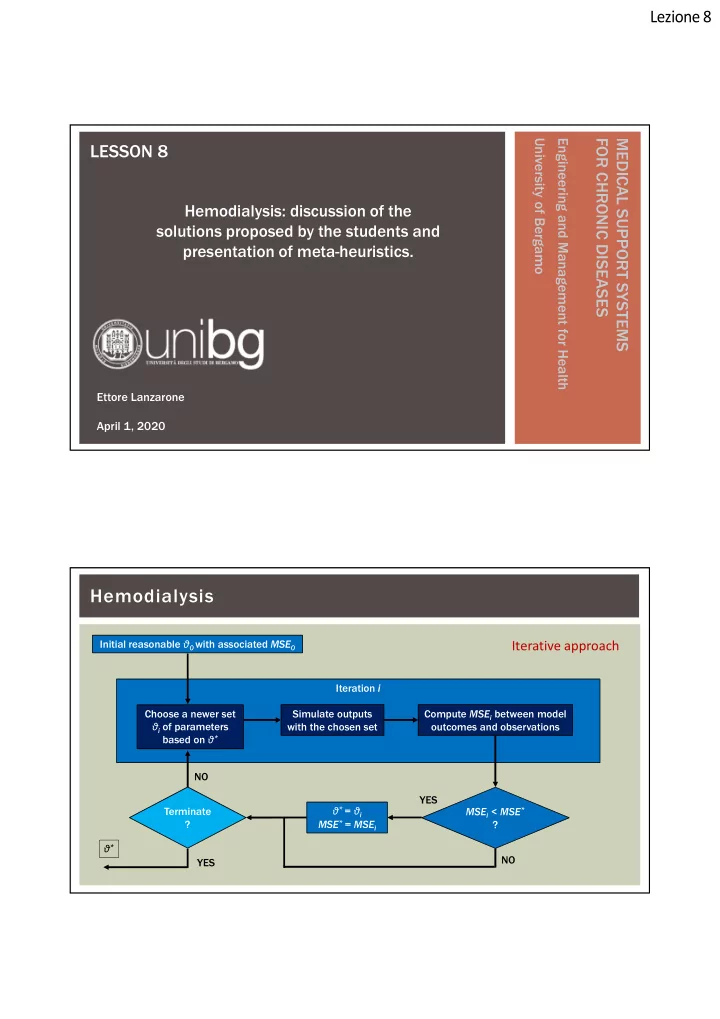
Iteration i

Hemodialysis

Iterative approach

Simulate outputs with the chosen set Compute MSEi between model

  • utcomes and observations

MSEi < MSE* ? θ* = θi MSE* = MSEi Choose a newer set θi of parameters based on θ* Terminate ? Initial reasonable θ0 with associated MSE0 NO NO YES YES θ*

slide-2
SLIDE 2

Lezione 8

Hemodialysis

This is the general layout. You detailed the blocks according to reasonable choices. More formally, based on the specific blocks, the general iterative approach can be tailored according to one of the literature approaches or a mix of them. For example:

  • Iterative Local Search
  • Tabu Search
  • Gradient method
  • Simulated annealing

Hemodialysis

  • Iterative Local Search

Randomly choose θi such that |θi- θ*|<δ

  • Tabu Search

Randomly choose θi such that |θi- θ*|<δ and that θi was not already tested in any previous iteration

  • Gradient method

If an analytical relationship is available (not our case), choose θi such that |θi- θ*|<δ in the direction of maximum decrease of MSE around MSE*

Choose a newer set θi of parameters based on θ*

slide-3
SLIDE 3

Lezione 8

Hemodialysis

  • Simulated annealing

Sometimes accept a worst solution to avoid being trapped in local optimal point. A worst solution is accepted with a probability πi that decreases along with the iterations (πi>πi+1) Thus, it is easy to worsen the solution in the first iterations while it becomes less probables after several iterations

MSEi < MSE* ?

Hemodialysis

Termination These heuristic approaches converge to the optimal solution after an infinite number of iterations. However it is computationally impossible to have infinite iterations. The algorithm has to be stopped at a certain point. Possible criteria are:

  • After a given number of iterations
  • When the solution does not improve any more after a certain number of iterations

Terminate ?

slide-4
SLIDE 4

Lezione 8

Hemodialysis

These algorithms are called heuristics of metaheuristics. For a detailed analysis see: Gendrau M. and Potvin J-V (editors) Handbook of Metaheuristics (3rd edition) 2019 Springer, ISBN 978-3-319-91085-7 Available at the Unibg Library  LINK

Hemodialysis

Simulated data vs real observations In both cases you minimize MSE during the iterations (or one of the other validation metrics).

What to evaluate? Is the final solution good?

slide-5
SLIDE 5

Lezione 8

Hemodialysis

SIMULATED DATA In case of simulated data you know the real values of the parameters used to generate the model. You can compute the error between the re-estimated value and the original value. If errors are low, you can trust the model and then apply to real clinical cases.

Hemodialysis

REAL DATA In case of real data, you do not know the real values of the parameters. You have to assume that a low MSE corresponds to fairly estimated values.  Pay attention to non-identifiability issues or equivalent solutions.

slide-6
SLIDE 6

Lezione 8

Hemodialysis

Refinement of your solutions

Hemodialysis

Integration of models in the machine

slide-7
SLIDE 7

Lezione 8

Hemodialysis

Acquire information from the current session

Hemodialysis

Real time estimation of the patient-specific characteristics

Use information of the current session Use stored information from the previous sessions

slide-8
SLIDE 8

Lezione 8

Hemodialysis

Prediction of the evolution of volumes and solute concentrations

Hemodialysis

Correction of the machine setting in case of need

slide-9
SLIDE 9

Lezione 8

Hemodialysis

Approval from the clinician