1 Why Monitor Endotoxin in HD ? Why Monitor Endotoxin in HD ? - - PDF document

1
SMART_READER_LITE
LIVE PREVIEW

1 Why Monitor Endotoxin in HD ? Why Monitor Endotoxin in HD ? - - PDF document

The function of kidney is to remove excess salts & waste products from the human body. Nonfunctional kidneys leads to problem in maintaining the level of sodium, potassium, and minerals


slide-1
SLIDE 1

1

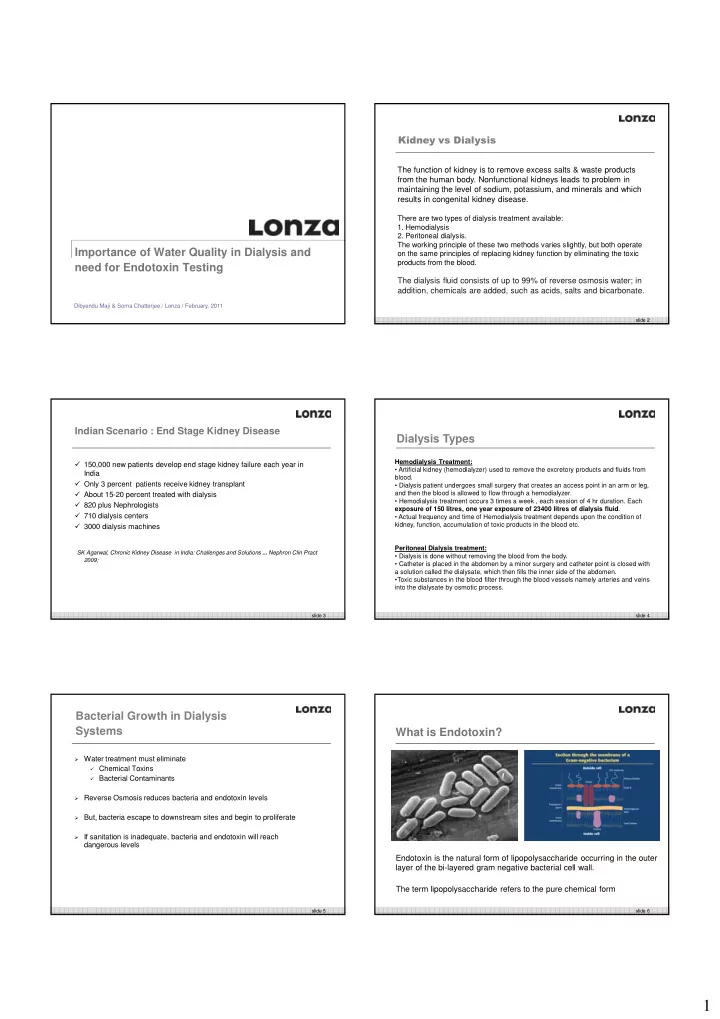
Importance of Water Quality in Dialysis and need for Endotoxin Testing

Dibyendu Maji & Soma Chatterjee / Lonza / February, 2011

slide 2

The function of kidney is to remove excess salts & waste products from the human body. Nonfunctional kidneys leads to problem in maintaining the level of sodium, potassium, and minerals and which results in congenital kidney disease.

There are two types of dialysis treatment available:

  • 1. Hemodialysis
  • 2. Peritoneal dialysis.

The working principle of these two methods varies slightly, but both operate

  • n the same principles of replacing kidney function by eliminating the toxic

products from the blood.

The dialysis fluid consists of up to 99% of reverse osmosis water; in addition, chemicals are added, such as acids, salts and bicarbonate.

  • slide 3

Indian Scenario : End Stage Kidney Disease

150,000 new patients develop end stage kidney failure each year in India Only 3 percent patients receive kidney transplant About 15-20 percent treated with dialysis 820 plus Nephrologists 710 dialysis centers 3000 dialysis machines

SK Agarwal, Chronic Kidney Disease in India: Challenges and Solutions ... Nephron Clin Pract 2009;

slide 4

Hemodialysis Treatment:

  • Artificial kidney (hemodialyzer) used to remove the excretory products and fluids from

blood.

  • Dialysis patient undergoes small surgery that creates an access point in an arm or leg,

and then the blood is allowed to flow through a hemodialyzer.

  • Hemodialysis treatment occurs 3 times a week , each session of 4 hr duration. Each

exposure of 150 litres, one year exposure of 23400 litres of dialysis fluid.

  • Actual frequency and time of Hemodialysis treatment depends upon the condition of

kidney, function, accumulation of toxic products in the blood etc. Peritoneal Dialysis treatment:

  • Dialysis is done without removing the blood from the body.
  • Catheter is placed in the abdomen by a minor surgery and catheter point is closed with

a solution called the dialysate, which then fills the inner side of the abdomen.

  • Toxic substances in the blood filter through the blood vessels namely arteries and veins

into the dialysate by osmotic process.

Dialysis Types

slide 5

Bacterial Growth in Dialysis Systems

Water treatment must eliminate Chemical Toxins Bacterial Contaminants Reverse Osmosis reduces bacteria and endotoxin levels But, bacteria escape to downstream sites and begin to proliferate If sanitation is inadequate, bacteria and endotoxin will reach

dangerous levels

slide 6

What is Endotoxin?

Endotoxin is the natural form of lipopolysaccharide occurring in the outer layer of the bi-layered gram negative bacterial cell wall. The term lipopolysaccharide refers to the pure chemical form

slide-2
SLIDE 2

2

slide 7

Why Monitor Endotoxin in HD ?

Patients receiving hemodialysis therapy are exposed to approx. 400 L of

water per week which is 20-25 fold greater than drinking water. This potentially exposes them to large amounts of endotoxin.

Endotoxin in the Dialysis Fluids may enter the blood compartment and

activate monocytes to produce pro-inflammatory cytokines.

Evidence also shows Transmembrane Stimulation of Mononuclear Cells Increase in cytokines, mainly IL-1, IL-6 and TNF-alpha, is thought to be

related to several distinct acute and chronic problems of HD patients.

Cytokines trigger a series of acute phase reactants and consequently,

these patients exhibit a state of chronic microinflammation.

Studies indicate a relationship between chronic microinflammation and

heart disease and mortality

slide 8

Why Monitor Endotoxin in HD ?

The use of popular HD modalities, e.g. use of bicarbonates dialysates

and high flux dialysers are predisposed to bacterial contamination of the dialysate fluid increasing the endotoxin burden of these fluids.

Additionally, washing with water for the reuse of hemodialysers and

centralized dialysate production also increases the risk of endotoxin

  • contamination. This practice is not being used anymore in the USA,

Europe, Japan, but might be used elsewhere.

In Hemodialysis systems, bacteria escape water treatment & reach

downstream sites and begin to proliferate. In case of inadequate sanitation, bacteria and endotoxin will reach dangerous levels

slide 9

Why test for Endotoxin?

Dialysis was once only administered to patients with acute renal failure

and was only administered over a very short period.

Now, chronic hemodialysis treatment can continue for years. Exposure to endotoxin can result in pyrogenic reactions: Fever, chills, fall in blood pressure, Activation of the complement system, Release of cytokines, Inflammation, Resistance to recombinant human erythropoietin. slide 10

Endotoxin in Dialysate

Endotoxin Chills, fever, BP Activation

  • f

Complement System Release of Cytokines Inflammation Resistance to rHuEPO

slide 11

Recombinant Human Erythropoietin (rHuEPO)

Anemia is common in patients with renal failure. rHuEPO is used to treat anemia in dialysis patients. Inflammation induced by exposure to endotoxin reduces the

effectiveness of rHuEPO resulting in higher doses.

Studies show that reduction in endotoxin increases the effectiveness of

rHuEPO.

Low endotoxin results in lower doses of rHuEPO. Reduction of rHuEPO dose is a significant reason for AAMI lowering the

allowable endotoxin in water and dialysate.

RD52: Microbiological Cultures and Endotoxin Levels

Matthew J. Arduino, Dr.P.H.

Chief, Environmental and Applied Microbiology Section Division of Healthcare Quality Promotion National Center for Infectious Diseases

Marduino@cdc.gov http://www.cdc.gov/ncidod/hip/default.htm

Slides Used With Permission

slide-3
SLIDE 3

3

Hypothesis: Transmembrane Stimulation of Mononuclear Cells

Blood Compartment Dialyzer Membran e Dialyzer Membrane Dialysate Compartment Gram negative bacteria and endotoxin Cytokines: TNF IL1ß Il6

Pyrogenic Reactions (early 1970s)

Outbreak 1 PR attack rate 13.5/1,000 treatments Attack rates were directly proportional to concentration of gram negative bacteria in the dialysate Outbreak -2 PR in 73% of patients Related to installation of DI unit

Favero MS, Petersen NJ,Boyer KM, Carson LA, Bond WW. Microbial contamination of renal dialysis systems and associated health risks. Trans Am Soc Artif Intern Organs 1974;20:175-183

Pyrogenic reactions

Endotoxin predominant cause of Acute Patient Reactions – Pyrogenic Reactions (PR): onset of objective chills (rigors) and/or fever (oral temp ≥ ≥ ≥ ≥ 37.8° C) in a patient who was afebrile and had no signs

  • r symptoms of infection before dialysis

treatment. In the United States, 21% of 2,808 hemodialysis centers report having ≥ ≥ ≥ ≥ 1 PR only 1.7% of these centers report PR in clusters From CDC investigations of outbreaks most PR clusters are associated with errors in dialyzer reprocessing

Pyrogenic Reactions

Usually occur within the first 1.5 to 2 hrs from the start of dialysis Involve the stimulation of macrophages to secrete a variety of cytokines: IL1ß, IL6, IL8, TNFα α α α In vitro whole blood studies at CDC have demonstrated peak TNFα α α α concentrations within 2 hrs of an endotoxin spike.

Factors Necessary for Control of Microbial Contamination

Standards Surveillance Systems Data Systems Control Mechanisms

Types of Hemodialysis Fluids Generally Cultured

slide-4
SLIDE 4

4

Recommended Frequency for Environmental Monitoring Hemodialysis Fluids

  • What do we do with the

results of monitoring?

  • slide 21

Global Statistics

Incidence of End Stage Renal Disease (ESRD) is increasing

  • globally. The number of dialysis patients is expected to continue

growing by about 4-6% annually.

2008, approximately 2,300,000 patients treated for ESRD Approximately 1,700,000 patients in 145 countries received

dialysis treatment in 2008.

1,580,000 received Hemodialysis 190,000 received Peritoneal Dialysis Dialysis patients worldwide increased by 7% in 2008 Of the 145 countries known to provide dialysis treatment, only 37

report statistics through a registry.

2008 statistics provided by Fresenius based on world population of 6.7 billion

slide 22

ESRD Prevalence, Patients per Million

Taiwan – 2,420 patients per million population Japan – 2,380 patients per million population U.S.A. – 1,780 patients per million population European Union – 960 patients per million population 2008 statistics provided by Fresenius Annual Report

slide 23

Dialysis Patients by Region

North America

445,000 patients +4-5%

  • U.S. (21% of global total) 370,000 patients +3-4%

Europe/Middle East/Africa

520,000 patients +5-6%

  • EU (17% of global total)

300,000 patients +3-4%

Asia-Pacific

620,000 patients +10-11%

  • Japan (16% of global total) 290,000 patients +3-4%

Latin America

185,000 patients +7-8%

Worldwide

1,770,000 patients +7%

2008 statistics provided by Fresenius Annual Report

Endotoxin: effect in Sepsis

slide-5
SLIDE 5

5

slide 25 slide 26

Sepsis

‘The systemic response to infectious organisms or their

products’.

Patients show evidence of cardiovascular abnormalities

and altered tissue perfusion.

This can result in multiple organ failure. Related terms – severe sepsis, septic shock Old term - ‘blood poisoning’

slide 27

Severe Sepsis: A Significant Healthcare Challenge

Major cause of morbidity and mortality worldwide Leading cause of death in non-coronary ICU (US) 11th leading cause of death overall (US) More than 750,000 cases of severe sepsis

in US annually

In the US, more than 500 patients die of severe sepsis

daily

slide 28

Factors in the High Incidence of sepsis

Aggressive use of catheters. Use of prosthetic devices. Administration of chemotherapy. Use of immunosuppressive drugs. Increased life expectancy of high-risk patients.

slide 29

Microbiological causes of sepsis & Indian scenario G -ve infections G +ve and fungal infections

Indian data, courtesy Dr Georgi Abraham, Sundaram Medical Foundation, Chennai

slide 30

Evidence linking LPS(endotoxin) with Sepsis

Endotoxin levels in Plasma can predict sepsis Reaction after administration of endotoxin to healthy

volunteers.

Clinical condition of sepsis may worsen despite antibiotic

therapy.

Experimental models of endotoxaemia.

slide-6
SLIDE 6

6

slide 31

LPS induces inflammatory mediators

α

  • slide 32

LPS - Pathogenesis of Sepsis (I)

Bacterium (LPS)

Cell-wall fragments

Macrophage

Lysis Inflammatory Mediators (Cytokines) Activation of Complement & Coagulation Platelet activation Neutrophil activation LPS LPS

slide 33

LPS - Pathogenesis of Sepsis (II) SEPSIS Capillary leak Tissue damage Fever Disseminated Intravascular Coagulation SEPTIC SHOCK Hypotension Adult respiratory distress syndrome Multiple Organ Failure DEATH Endothelial Damage

slide 34

Systemic Activation of Inflammation in Sepsis

Inflammation is Activated in Sepsis

14 12 10 8 6 4 2 60 120 180 240 300 360

Minutes After LPS Infusion

Endotoxin (ng/L) TNF (ng/L) IL-6 (U/mL)

slide 35

Endotoxin

slide 36

A Brief Endotoxin Testing Timeline

Since the pharmaceutical industry began manufacturing

injectables, pyrogen tests have been an absolute necessity.

Pyrogens are substances that can cause fever, shock and

even death if high levels are introduced into a person’s body.

The word pyrogen can be traced back to the Greek word

pyro, meaning burning or fire.

slide-7
SLIDE 7

7

slide 37

1800s

1860s: the word “pyrogen” was first used by a scientist

named Billbroth to describe substances that caused fever.

1884: Danish scientist, Hans Christian Gram, discovered a

method of differentiating bacteria into two groups, Gram- positive and Gram-negative, based on properties of their cell walls. This procedure is now known as the Gram stain.

1890s: A scientist by the name of Pfeiffer was studying

  • cholera. While growing cholera, he discovered a toxin that

was not secreted into growth medium and stayed anchored to the bacterial cell. Pfeiffer called this “endotoxin”.

Using Gram’s staining procedure, scientists discovered that

endotoxins were associated with Gram-negative bacteria.

slide 38

1900s

1912: E.C. Hort and W.J. Penfold developed the first

Rabbit Pyrogen Test and could classify bacteria as pyrogenic or non-pyrogenic.

With Gram’s staining procedure, Hort and Penfold

determined that pyrogens were associated with Gram- negative bacteria and fevers were not caused by the act of injection, but by the bacteria within the solution.

1920s: Florence Seibert (best known for developing a skin

test for tuberculosis) proved that pyrogens were heat- stable, filterable Gram-negative bacteria. She developed a method of distillation that made solutions safer from bacteria.

Seibert developed the Rabbit Pyrogen Test as we know it

today.

slide 39

1960s and 1970s

Drs Frederick Bang and Jack Levin developed the first LAL

test performed in a tube.

Bang and Levin developed their test based on information

from two other scientists, W.H. Howell and L. Loeb, from the 1800s.

Howell observed that when exposed to the elements, the

blood of a horseshoe crab would clot.

Loeb observed that clotting only occurred in plasma

containing the single blood cell or amebocyte of the horseshoe crab but not in plasma free of amebocytes.

1970s: The gel clot LAL test was commercially introduced. 1977: 04 Nov 1977, U.S. FDA described conditions for use

  • f LAL as an end-product test for endotoxin in parenteral

drugs, biological products and medical devices.

slide 40

What is Endotoxin?

Endotoxin is the natural form of lipopolysaccharide occurring in the outer layer of the bi-layered gram negative bacterial cell wall. The term lipopolysaccharide refers to the pure chemical form

slide 41

Section through the Gram negative outer membrane

slide 42

slide-8
SLIDE 8

8

slide 43

Biological Activity of LPS

LPS initiates inflammatory reponses from host systems These include release of :- Cytokines Lipids Free radicals Activation of Complement Coagulation LPS is a signal of infection with G-ve bacteria

slide 44

Release of LPS from bacteria

Natural shedding during bacterial growth. Complement-mediated lysis. Antibiotic-induced lysis (in vitro). Some organisms (N.meningitidis) shed large amounts of

LPS (LOS) during infection.

slide 45

LAL Reaction Cascade

Endotoxin Factor C Activated Factor C Factor B Activated Factor B Proclotting Enzyme Clotting Enzyme Coagulogen Coagulin LAL-RM 1-3 ß-D-Glucans

slide 46

Current Recognised LAL Methods

Gel Clot: Based on LAL clotting protein and formation of visible

clot in test tubes.

Kinetic Turbidimetric: Based on LAL clotting protein. Monitors

change in solution clarity as a clot forms. Most commonly performed in 96-well plates and read on an absorbance plate reader.

Endpoint Chromogenic: A synthetic substrate replaces the

clotting protein. A yellow color is generated as a response to cleaving of the substrate. Most commonly performed in 96-well plates and read on an absorbance plate reader.

Kinetic Chromogenic: Also uses a synthetic substrate and is

read in a plate on an absorbance plate reader. It is regarded as the most robust of the kinetic assays.

slide 47

Gel CLOT TEST

Gel Clot (Positive)

Can be read up to 2 minutes after

incubation period Read with momentary inversion of tube Do not invert more than once

slide 48

Limulus Amebocyte Lysate Gel Clot Test

Proenzyme Endotoxin Coagulogen Clotting Protein + (Fragment) Active Enzyme Clotting Protein Clot Formation

Electrostatic Bonding#

Active Enzyme

# Removal of peptide C leaves AB monomers which aggregate to form a gel-like AB polymeric substance

slide-9
SLIDE 9

9

slide 49

Kinetic Assay

slide 50

Limulus Amebocyte Lysate Kinetic Turbidimetric Test Proenzyme Endotoxin Coagulogen Clotting Protein + (Fragment) Active Enzyme Clotting Protein Turbidity Formation

Electrostatic Bonding

Active Enzyme

slide 51

Limulus Amebocyte Lysate Kinetic Chromogenic Test

Proenzyme Endotoxin Chromogenic Substrate Release of PNA + (Fragment) Active Enzyme PNA Concentration (Yellow Colour) Endotoxin Concentration

Directly Relates to

Active Enzyme

slide 52

AAMI - The Current Standards & other International standards

slide 53

History

AAMI is the Association for the Advancement of Medical

Instrumentation.

1982: First AAMI Standard for hemodyalisis was published. Maximum levels of bacteria in water and dialysate were

established.

Pyrogenic reactions were significantly increased if

bacteria in dialysate exceeded 2000 CFU/mL.

Diaysis machines at that time could amplify the bacteria

burden by a factor of 10.

Therefore, the limit was set at 200 CFU/mL. First standard did not include endotoxin. 2001: AAMI Standard was revised to include endotoxin.

slide 54

AAMI RD62 and RD52

  • AAMI procedures require that action be taken to reaffirm,

revise, or withdraw this standard no later than 5 years from the date of publication.

  • AAMI RD62 - Water Treatment Equipment for

Hemodialysis Applications a)section 3.11 talks on endotoxin effect b)section 4.1.1 on water quality & levels of endotoxin c)section 5.1.1on methods of water collection d)section 4.3.2.1 on limits of endotoxin in conventional dialysate

  • AAMI RD52 – Dialysate for Hemodialysis (section 4.3.2.2

Bacteriology of ultrapure dialysate)

slide-10
SLIDE 10

10

slide 55

EP Endotoxin Limits for Hemodialysis

Water for dilution of concentrated soln. - 0.25 IU/ml

  • Soln. for hemodialysis - 0.5 IU/ml
  • Soln. for hemofiltration & hemodiafiltration - 0.25 IU/ml
  • Soln. for peritoneal dialysis - 0.5 IU/ml

NOTE: These are non-mandatory limits

slide 56

Int’l Limits for Water for Dialysis Applications

Organization Bioburden (cfu/ml) Endotoxin EU/ml European Pharmacopeia < 100 < 0.25 EDTNA/ERCA* (proposed) < 100 < 0.25 Japan Society for Dialysis Therapy < 100 < 0.25 AAMI RD62 < 200 < 2

*European Dialysis and Transplant Nurses Association European Renal Care Association

slide 57

Additional Int’l Limits for Water for Dialysis Applications

French Health Ministry requires a limit of 0.05 IU/ml for

replacement electrolyte fluids used in hemofiltration

BP 2010 requires a limit of 0.5 IU/ml for hemodialysis

solutions and less than 0.25 IU/ml for Hemofiltration & Hemodiafiltration solutions.

slide 58

EDTNA/ERCA

The EDTNA/ERCA document endorses the EP microbial limits,

but goes further by addressing frequency of testing and sampling conditions.

It proposes that frequency be established based on historical

data and maintenance procedures for the water system.

Monthly test interval, unless history of elevated levels show a

need for weekly testing.

Recommends having in-house testing capability Immediate investigation of elevated results.

slide 59

New AAMI Standards

slide 60

Water Testing

AAMI RD 62 – Current Limit – 2.0 EU/mL AAMI RD 62 – Current Action Level – 1.0 EU/mL AAMI/ISO – New Proposed Limit – 0.25 EU/mL AAMI/ISO – New Action Level – 0.125 EU/mL Water samples may be tested undilute No interference with any LAL tests

slide-11
SLIDE 11

11

slide 61

AAMI RD 52 – Current Limit – 2.0 EU/mL AAMI RD 52 – Current Action Level – 1.0 EU/mL AAMI RD 52 – New Proposed Limit – 0.50 EU/mL AAMI RD 52 – New Action Level – 0.25 EU/mL Ultrapure Dialysate – 0.03 EU/mL Dialysate may require dilution to overcome inhibition Can be tested with LAL tests

Dialysate Testing

slide 62

Dialysis system & water sampling

slide 63

Hemodialysis schematic

slide 64 slide 65

Schematic: Hemodialysis System

Water Dialysate

Unit Unit Unit Unit

Mixer

Distribution System

slide 66

Monthly Monitoring Requirements

Product water from the water system and the distribution

loop.

This includes portable acute water units Conventional dialysate with sample collected from the

dialysate port of the dialyzer or from a sampling port in the inlet dialysate line that can be accessed using a syringe

Weekly Monitoring is required at start-up or if levels

exceed maximum levels until a pattern of consistent compliance with limits can be demonstrated.

slide-12
SLIDE 12

12

slide 67

Sample Collecting (Water)

Water samples should be collected directly from taps on the

water distribution system

Do not disinfect water collection tap If disinfection is necessary, only use alcohol and sterile

gauze

Do not use bleach or other disinfectant Allow alcohol to completely evaporate before collecting Water tap should be opened and allowed to run for a

minimum of 60-seconds before a sample is collected

A minimum of 50 mL or a volume specified by the testing

laboratory should be collected

slide 68

Sample Collecting (Dialysate)

Sample at least two machines per month Rotate so that all machines are tested at least once per 12 months Dialysate should be collected from dialysate port of dialyzer Newer machines have a dialysate sampling port that is accessed

with a syringe

If disinfection is necessary, only use alcohol and sterile gauze and

allow alcohol to evaporate

Do not use bleach or other disinfectant A 30 mL syringe is used to aspirate and dispense dialysate out of

and into the port before sample is collected

A new syringe should be used to collect the sample A minimum of 25 mL or a volume specified by the testing laboratory

should be collected in a sterile, endotoxin-free container

slide 69

  • lcohol should be

used and allowed to completely dry before the sample is

  • drawn. Bleach or other disinfectants should not be used.

Sample Collection Techniques (Water Used to Reprocess Dialyzers)

slide 70

The sample should be taken from the product water distribution piping at the following locations: Site 1: At the point where the water leaves the RO machine, before it enters the holding tank (Indirect System), or before it goes to the treatment room to provide water for dialysis machines (Direct System). Site 2: If an RO water holding tank is present, a sample should be taken at the point where the water leaves the tank. Site 3: At the end of the return line of the RO water distribution loop, whether it is returning to the RO or a water holding tank. If a bacteria filter is installed anywhere in the system, a sample is to be drawn from a sample port both pre and post filter. Site 4: At the point where water enters into the dialyzer reprocessing system, whether it is a manual or automated system. (Note: If a sample port is not present one should be installed.) Site 5: At a point where water enters equipment used to prepare bicarbonate and acid concentrate. (Note: If a sample port is not present one should be installed.) Site 6: At the point where the dialysis machine is hooked up to the product water loop. If a dialysis machine is consistently attached to that location, you may culture the machine instead of the water outlet. Site 7: If facility uses softened, dechlorinated water as a backup water plan, it is necessary to perform cultures and a Limulus Amebocyte Lysate (LAL) test on this water, because the RO is the primary source of bacterial protection for the patients.

Sample collection sites:

slide 71

Action Level Exceeded

If a sample exceeds the Action Level (currently 1 EU/mL),

an investigation should be conducted:

the sample should be collected again and retested, review compliance with disinfection and sampling

procedures,

evaluating microbiological data for the previous 3

months to look for trends,

Notify Medical Director.

Thank You