The IDT and The Patient: Working Together to Achieve 13mL/Kg/Hr - - PowerPoint PPT Presentation

the idt and the patient working together to achieve 13ml
SMART_READER_LITE
LIVE PREVIEW

The IDT and The Patient: Working Together to Achieve 13mL/Kg/Hr - - PowerPoint PPT Presentation

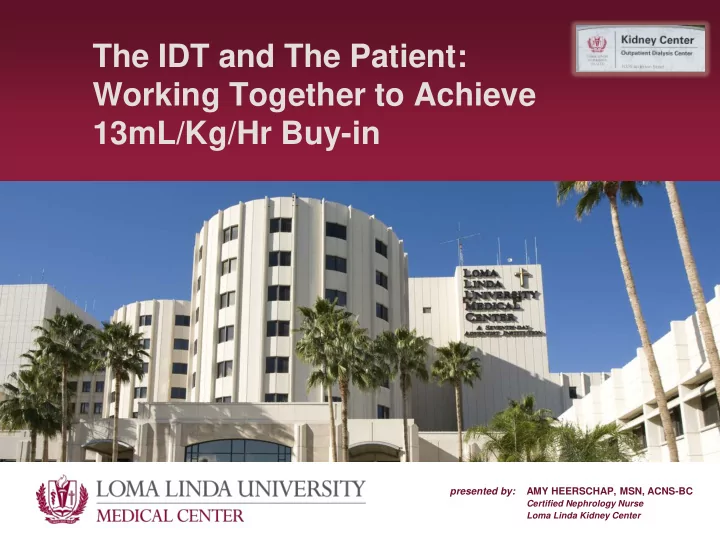
The IDT and The Patient: Working Together to Achieve 13mL/Kg/Hr Buy-in presented by: AMY HEERSCHAP, MSN, ACNS-BC Certified Nephrology Nurse Loma Linda Kidney Center BACKGROUND: All organ stunning has an impact on patient quality of life.

slide-1
SLIDE 1

The IDT and The Patient: Working Together to Achieve 13mL/Kg/Hr Buy-in

presented by: AMY HEERSCHAP, MSN, ACNS-BC

Certified Nephrology Nurse Loma Linda Kidney Center

slide-2
SLIDE 2

BACKGROUND:

 All organ stunning has an impact on patient quality of life.  Balancing and managing “between treatment” Interdialytic Weight Gain (IDWG) avoids complications.

slide-3
SLIDE 3

PURPOSE:

The Interdisciplinary Team (IDT) needed to work together to achieve a less than 13mL/Kg/Hr UF buy-in prior to CMS mandated implementation January 1, 2018.  The Medical Director set the goal at 12/mL/Kg/Hr for added patient safety.

slide-4
SLIDE 4

All patients on dialysis were educated toward the same goal by nursing staff.  The dietitians provided patient education material for fluid management.  Social Workers assisted support

  • f the change through conversations

shared with the patients at chair-side.

CONCEPTUAL FRAMEWORK:

slide-5
SLIDE 5

METHODOLOGY:

 The IDT developed appropriate diet and fluid restriction regimens to accommodate individual patient needs. All patients were educated on the regimen.  Each patient was coached by the dietitians and given a document specific to their target weight goal and IDWG with the 12/mL/Kg/Hr UF restrictions.  Assessment of patient adherence to the newly defined intradialytic weight gains were accomplished through structured IDWG assessments.  Loose initiation of the 12/mL/Kg/Hr UF restriction was implemented in September 2017 and fully enforced in January 2018.

slide-6
SLIDE 6

FINDINGS:

 Initial UF data in August 2017 identified 14% of patients consistently above the 5% estimated dry weight (EDW) goals set for them.  Patients were sent to the hospital for fluid

  • verload related admissions 36 times overall

in 2017; 15 of those admissions occurred in the first five months of that year.  In the five comparative months of 2018, only four admissions

  • ccurred.
slide-7
SLIDE 7

IMPLICATIONS FOR PRACTICE:

 After discussing implementation with one dietitian, a particular patient on dialysis stated: “I am really happy everyone is getting a strict goal because sometimes I went home feeling really bad, and now I adhere to a strict regimen and I feel better that I know what my limits are.”  Education and knowledge is the best facilitator

  • f success when implementing change.

 The Interdisciplinary Team must work to continually reinforce the standards set by CMS.

slide-8
SLIDE 8

CONCLUSIONS:

 When presented with mandated regulations, dialysis treatment centers must rise to implement patient fluid removal objectives within specific goals.  Our IDT has successfully transitioned our patients

  • n hemodialysis to a safe ultrafiltration

value without complications.

slide-9
SLIDE 9

CONCLUSIONS:

 When implementing change toward fluid adherence, patient accountability is key.  Given the option for success through knowledge, patients on dialysis will adhere to a strict fluid regimen and thus an improved quality of life.

slide-10
SLIDE 10

 This presentation is based on a manuscript submitted and accepted for publication in the Sept/Oct 2018, Nephrology Nursing Journal. Volume 45, Number 5.  Permission to present this data at this conference has been granted by the publisher.  Thank You to the Kidney Center Interdisciplinary Team, Physicians, Nursing Staff, Dietitians, Social Workers, and patients who worked toward this goal with great dedication and enthusiasm.