Helping People Make I.D. factors for successful weight maintenance - - PDF document

helping people make
SMART_READER_LITE
LIVE PREVIEW

Helping People Make I.D. factors for successful weight maintenance - - PDF document

3/5/2018 Type 2 Diabetes Prevention: Outline Lifestyle Change and Coverage Considerations Detail findings from Look AHEAD* and POUNDS LOST** studies I.D. factors for successful weight loss Helping People Make I.D. factors for


slide-1
SLIDE 1

3/5/2018 1 Type 2 Diabetes Prevention: Lifestyle Change and Coverage Considerations

Asheville, North Carolina Follow me on Twitter: @hopewarshaw

Helping People Make Lifestyle Changes that Stick

Outline

 Detail findings from Look AHEAD* and POUNDS LOST**

studies

 I.D. factors for successful weight loss  I.D. factors for successful weight maintenance post

weight loss

*Look AHEAD: Action for Health in Diabetes **POUNDS LOST: Preventing Overweight Using Novel Dietary Strategies

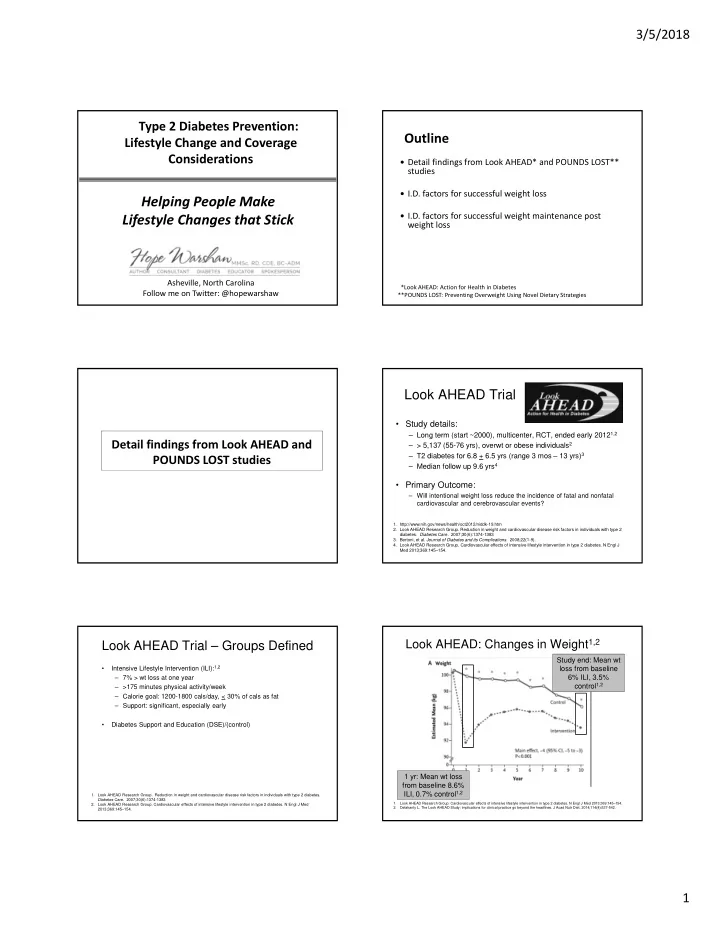
Detail findings from Look AHEAD and POUNDS LOST studies

Look AHEAD Trial

  • Study details:

– Long term (start ~2000), multicenter, RCT, ended early 20121,2 – > 5,137 (55-76 yrs), overwt or obese individuals2 – T2 diabetes for 6.8 + 6.5 yrs (range 3 mos – 13 yrs)3 – Median follow up 9.6 yrs4

  • Primary Outcome:

– Will intentional weight loss reduce the incidence of fatal and nonfatal cardiovascular and cerebrovascular events?

  • 1. http://www.nih.gov/news/health/oct2012/niddk-19.htm
  • 2. Look AHEAD Research Group. Reduction in weight and cardiovascular disease risk factors in individuals with type 2
  • diabetes. Diabetes Care. 2007;30(6):1374-1383
  • 3. Bertoni, et al. Journal of Diabetes and its Complications. 2008;22(1-9).
  • 4. Look AHEAD Research Group. Cardiovascular effects of intensive lifestyle intervention in type 2 diabetes. N Engl J

Med 2013;369:145–154.

Look AHEAD Trial – Groups Defined

  • Intensive Lifestyle Intervention (ILI):1,2

– 7% > wt loss at one year – >175 minutes physical activity/week – Calorie goal: 1200-1800 cals/day, < 30% of cals as fat – Support: significant, especially early

  • Diabetes Support and Education (DSE)/(control)

1. Look AHEAD Research Group. Reduction in weight and cardiovascular disease risk factors in individuals with type 2 diabetes. Diabetes Care. 2007;30(6):1374-1383 2. Look AHEAD Research Group. Cardiovascular effects of intensive lifestyle intervention in type 2 diabetes. N Engl J Med 2013;369:145–154.

Look AHEAD: Changes in Weight1,2

1 yr: Mean wt loss from baseline 8.6% ILI, 0.7% control1,2

1. Look AHEAD Research Group. Cardiovascular effects of intensive lifestyle intervention in type 2 diabetes. N Engl J Med 2013;369:145–154. 2. Delahanty L. The Look AHEAD Study: implications for clinical practice go beyond the headlines. J Acad Nutr Diet. 2014;114(4):537-542.

Study end: Mean wt loss from baseline 6% ILI, 3.5% control1,2

slide-2
SLIDE 2

3/5/2018 2

Look AHEAD – Positive Results, Despite Headlines1,2,3

  • Median follow up 9.6 yrs1
  • Mean wt loss from baseline 6% ILI, 3.5% control1
  • A1c lowering ILI group 0.2%1
  • Primary outcome: Failed to reduce CVD events in ILI vs. control
  • Other health benefits:
  • Reduced sleep apnea, depression, urinary incontinence and improved QOL3
  • Subjects with early T2D = most health benefits
  • Shortest duration
  • Not on insulin
  • Good baseline glycemic control

1. Look AHEAD Research Group. Cardiovascular effects of intensive lifestyle intervention in type 2 diabetes. N Engl J Med 2013;369:145–154. 2. Delahanty L. The Look AHEAD Study: implications for clinical practice go beyond the headlines. J Acad Nutr Diet. 2014;114(4):537-542. 3. Warshaw HS. The Look AHEAD Trial: Look beyond the headlines. Wt Mgmt Matters/WMDPG. 2014;12(4):2-3. Diab Care and Ed DPG

  • Newsflash. 2014;35(3):9-11.

Look AHEAD: Benefits of Weight Loss on CVD1

  • ILI who lost >10% of BW

– 20% lower risk of the primary outcome* – 21% lower risk of secondary outcome**

  • Change in fitness was not significantly associated with a change

in the primary outcome*

  • Key factor = amount of weight loss

*Primary outcome: composite of death from CV causes (non-fatal acute MI, non-fatal stroke,

  • r hospital admission for angina

**Secondary outcome: primary plus hx of CABG, carotid endartectomy, percutaneous coronary intervention, hospitalization for CHF, peripheral vascular disease, or total mortality (death)

  • 1. Gregg EW. Association of the magnitude of weight loss and changes in physical fitness with long-term

cardiovascular disease outcomes in overweight or obese people with type 2 diabetes: a post-hoc analysis of the Look AHEAD randomised clinical trial. Lancet Diabetes Endocrinol. 2016 Nov;4(11):913-921

Look AHEAD – Positive Results, Despite Headlines1,2

  • Financial analysis2:

– ILI produced mean relative per-person 10-year healthcare cost savings of $5,280; not evident in ppl w/ hx of CVD – Average annual savings ~$600/participant – ILI used fewer medications (7%) – ILI had fewer hospitalizations (11%)

  • Look AHEAD continues as observational trial until 1/20213

1. Look AHEAD Research Group. Cardiovascular effects of intensive lifestyle intervention in type 2 diabetes. N Engl J Med 2013;369:145–154. 2. Espeland MA, et al., Impact of an intensive lfestyle intervention on use and cost of medical services among overweight and obese adults with T2D: (Look AHEAD). Diabetes Care. 2014;37:2548–2556. 3. Look AHEAD: https://clinicaltrials.gov/ct2/show/NCT00017953

POUNDS LOST Study1

Study details:

  • NIH - 2 yr wt loss trial, 800+ subjects, 2 sites
  • Overwt adults, BMI: 25 - 40
  • 4 diets, varying % calories:

– CHO - Low 35% to high of 65%

  • 1. Sacks, F, et al. Comparison of Weight-Loss Diets with Different Compositions of Fat, Protein, and Carbohydrates.

New Eng J Med. 2009;360(9):859-873. *Preventing Overweight Using Novel Dietary Strategies

POUNDS LOST Study1

Results:

  • No one nutrient composition faired better than another (subjects

modified towards diet goal, but didn’t reach diet’s goal)

  • Weight loss:
  • 6 months: similar weight loss - 7% (6 kg/13 lbs)
  • 12 months: regained similar amounts of weight
  • 2 years weight loss remained similar: 4 kg/9 lbs
  • Subjects attending 2/3rd of sessions lost: 9 kg/20 lbs
  • Clinical improvements:
  • Reduced cardiovascular disease and type 2 diabetes risk factors including

lower LDL-cholesterol, BG and serum insulin levels; and slightly lower BP

  • 1. Sacks, F, et al. Comparison of Weight-Loss Diets with Different Compositions of Fat, Protein, and Carbohydrates.

New Eng J Med. 2009;360(9):859-873.

Natural History: Wt Gain, Loss, Regain1

  • 1. Eckel RH et al: Obesity and type 2 diabetes: What can be unified and what needs to be individualized?

Diabetes Care 34:1424-1430, 2011

Years Years Months Prevention Therapeutic Space Body Weight

Age-related Wt Gain

slide-3
SLIDE 3

3/5/2018 3

Weight Loss Matters Most – When?1

But Healthy Eating is continuously important and can always assist glucose, BP, lipid control!

American Diabetes Association (ADA). Standards of Medical Care – 2016.Diabetes Care. 2016;39:(supp 1). http://professional.diabetes.org/content/clinical‐practice‐ recommendations

  • 1. Evert A, Boucher J, et al. Nutrition therapy

recommendations for the management of adults with

  • diabetes. Diabetes Care: 2013;36(11):3821‐3842.

Words of Wisdom and Sanity from Experts: Arya Sharma, MD

 Obesity/overweight a chronic, progressive condition  Early, aggressive management is critical  It’s not a treat it, you’re done condition  Our goal should NOT be to help people get thinner,

but to help people get healthier. Take the attention

  • ff of weight.

 “I only care about the weight you can keep off.”

AADE 2013, http://www.presentdiabetes.com/ezines/#ezine413. Chair in Obesity Research and Management at the University of Alberta in Edmonton and Director of the Alberta Health Services Obesity Program. http://www.drsharma.ca/. Twitter: @drsharma.

http://www.drsharma.ca/

15 Dietary Approaches Associated with Weight Loss by Expert Panel1

Among 15, range of options:*

 Higher protein (25%), fat (30%), carbohydrate (45%)  Lacto‐ovo‐vegetarian‐style  Low‐fat (10% to 25% of total calories from fat) vegan‐style  Low‐carbohydrate (initially <20 g/day carbohydrate)  Mediterranean‐style diet with prescribed energy restriction

1. Jensen MD, et al. Guideline for the Management of Overweight and Obesity in Adults: A Report of the ACC, AHA, TOS Task Force on Practice

  • Guidelines. Circulation. https://circ.ahajournals.org/content/early/2013/11/11/01.cir.0000437739.71477.ee.full.pdf+html?sid=6af28578‐67b4‐

4bb1‐9a4d‐91ebab818a98 (published in 3 association journals)

*If reduction in dietary energy intake is achieved.

There Isn’t Just ONE,

But there IS common ground!

Best is healthy eating plan a person can follow forever!

Oldways 2015: https://oldwayspt.org/programs/oldways‐common‐ground/oldways‐common‐ground‐consensus

Words of Wisdom and Sanity from Experts: David Katz, MD

 (On DIETFITS 2/23) “A shift to wholesome foods in sensible

combinations is effective at lowering weight and improving health regardless of fat or carbohydrate levels, even among those with insulin resistance at the start...study suggests best way to lose weight and improve health…is not by fixating on macronutrients or calories, but by eating wholesome foods… emphasizing whole, minimally processed plant foods.”1

 (On LA Times Taube, Teicholz editorial low carb, high sat fat

2/2) “On what planet did the American public ever try these diets [Dietary Guidelines]? Clearly, not this one. A high quality, traditional Mediterranean diet, the DASH diet ‐ all others that ranked well on the [U.S. News] Best Diets are more alike than different…Emphasis on whole, minimally processed vegetables, fruits, whole grains, beans, lentils, nuts, and seeds‐ with or without lesser amounts of minimally processed dairy products, lean meats, eggs, fish, and seafood.2

  • 1. https://www.linkedin.com/pulse/horse‐sense‐weight‐loss‐david‐l‐katz‐md‐mph‐facpm‐facp‐faclm/
  • 2. https://www.linkedin.com/pulse/diet‐obesity‐myth‐mystery‐david‐l‐katz‐md‐mph‐facpm‐facp‐faclm/?trk=mp‐reader‐card

Identify factors for successful weight loss, maintenance from recent evidence

slide-4
SLIDE 4

3/5/2018 4

National Weight Control Registry (NWCR) - 10 years1

  • Initiated 1993, Wing and Hill
  • Goal: ID successful wt loss maintainers and describe their

strategies

  • Criteria: > 30lbs maintained > 1 yr; now > 10,000
  • 10 yr study: enrolled 1993 – 2000
  • Total: 2886 completed > 2 of 10 annual f/u surveys
  • 1. Graham Thomas J et al: Weight-loss maintenance for 10 yrs in NWCR. Am J Prev Med. 2014;46(1):17-23.
  • Magnitude of initial wt loss and duration
  • Increased physical activity
  • Low calorie and low fat intake
  • High restraint and low disinhibition around food
  • Self-weighing > several times/wk
  • 1. Graham Thomas J et al: Weight-loss maintenance for 10 yrs in NWCR. Am J Prev Med. 2014;46(1):17-23.

NWCR - 10 years Predictors of Success1

“Continued adherence to each behavior can improve long term outcomes.”

NWCR: Low Calorie Sweeteners and Weight Control1

  • Design: Random sample (N=434) of NWCR participants (mean wt loss: 34.2

+ 18.5 kg maintained for 7.8 + 5.2 yrs) responded to online survey about their consumption of low/no calorie sweetened beverages (LNCSB)

  • Results

– 53% regularly used LNCSB, while 10% regularly consumed SSB. – 78% who regularly used LNCSB reported they helped them control calorie intake – Top 5 reasons for using LNCSB were: taste (54%), satisfy thirst (40%), part of their routine (27%), reduce calories (22%), go with meals (21%) – Participants reported:

  • Changing their beverage choices was “very important” to successful

weight loss (42%) and weight maintenance (40%) efforts

  • Increasing water consumption was the most common strategy

reported with reducing SSB intake second

  • 1. Catenacci VA, Pan Z, et al: Low/No Calorie Sweetened Beverage Consumption in National Weight Control Registry.
  • Obesity. 2014;22(10): 2244-2251. http://onlinelibrary.wiley.com/doi/10.1002/oby.20834/abstract

Weight Loss: Successful Strategies

  • Ready, willing and able?1,2
  • Focus, don’t overwhelm1,2
  • Choose behaviors most ready to change1,2
  • Reduce total fat to < 30% fat (don’t focus on carb)2,3
  • Use of meal replacements/structure3
  • Include physical activity2-5
  • Early success (wt loss) predicts later success

(frequent contact early)5,6

  • 1. Bissett. Lessons from the DPP, On the Cutting Edge, Diabetes Care and Education. 2008;29(4).
  • 2. Delahanty L, Nathan D. J Am Diet Assoc.1 2008;108(Suppl1):S66-72.
  • 3. Wadden TA, et al. The Look AHEAD Research Group): One-year weight losses in the Look AHEAD study: Factors associated with success. Obesity.

2009;17(4):713-722. 4.Wadden, TA, Neiberg, RH, Wing, RR, et al., The Look AHEAD Research Group (2011), Four-Year Weight Losses in the Look AHEAD Study: Factors Associated With Long-Term Success. Obesity. 2011;19:1987–1998.

  • 5. Look AHEAD Research Group. Eight-year weight losses with an ILI: The Look AHEAD Study. Obesity 2014;22(1):5-13.
  • 6. Graham Thomas J et al: Weight-loss maintenance for 10 yrs in NWCR. Am J Prev Med. 2014;46(1):17-23.

Words of Wisdom and Sanity from Experts: B.J. Fogg, PhD

 Fogg equation:

BC (behavior change) = M (motivation) + A (ability to make the change) + T (the trigger).

 Tie new behavior to existing, easier to accomplish

 Build “success momentum” ‐ one tiny habit change after

another

 Can’t break bad habits. We can, overtime, “untangle” them  Behavior change mastery occurs due to continual practice.

Eventually “healthy reflexes” emerge

 “Help people change what they already want to change, not

what they know they should change but don’t really want to.”

https://www.bjfogg.com/

Weight Maintenance: Successful Strategies

  • Physiologic realities1

– Lower calorie needs to maintain lower weight: 300 – 400/day

  • Food/Calories:

– Low calorie, low fat intake2,3,4, eat breakfast2,5 – Simplify eating plan, minimize choices3

  • Physical Activity4:

– Regular significant physical activity (60-90 min/day)2,4 – Minimize sedentary behavior eg TV watching5

  • Maintain continuous support
  • Relapse prevention plan
  • Regular self weigh-ins4,5

1.Rosenbaum M: Weight Management DPG Symposium, 2013.

  • 2. Fletcher, On the Cutting Edge, Diabetes Care and Education. 2008;29(4).
  • 3. Wadden, TA, Neiberg, RH, Wing, RR, et al., The Look AHEAD Research Group (2011), Four-Year Weight Losses in the Look AHEAD Study:

Factors Associated With Long-Term Success. Obesity. 2011;19:1987–1998.

  • 4. Look AHEAD Research Group. Eight-year weight losses with an ILI: The Look AHEAD Study. Obesity 2014;22(1):5-13.
  • 5. Graham Thomas J et al: Weight-loss maintenance for 10 yrs in NWCR. Am J Prev Med. 2014;46(1):17-23.
slide-5
SLIDE 5

3/5/2018 5

M.W. (Michael Wadja): One Year Later

 NDPP within DSMES, Chester

County Hospital 4/17

 3/18: A1c = 5.7%  Wt: ~180 (maintenance)  Wife: lost 25 lbs  Motivation?

“Fear. I just don’t want to have diabetes diabetes.”