{ group, NMSS, NIH, and Race to Erase MS. She has UCSF Departments - - PowerPoint PPT Presentation

group nmss nih and race to erase ms she has ucsf
SMART_READER_LITE
LIVE PREVIEW

{ group, NMSS, NIH, and Race to Erase MS. She has UCSF Departments - - PowerPoint PPT Presentation

12/2/2016 Disclosures What the Ocular Fundus can tell Dr. Graves has no disclosures for the content of this presentation. us about Neurological Disease She has received grants from Genentech, Biogen, S3 Jennifer Graves, MD, PhD, MAS {


slide-1
SLIDE 1

12/2/2016 1

{

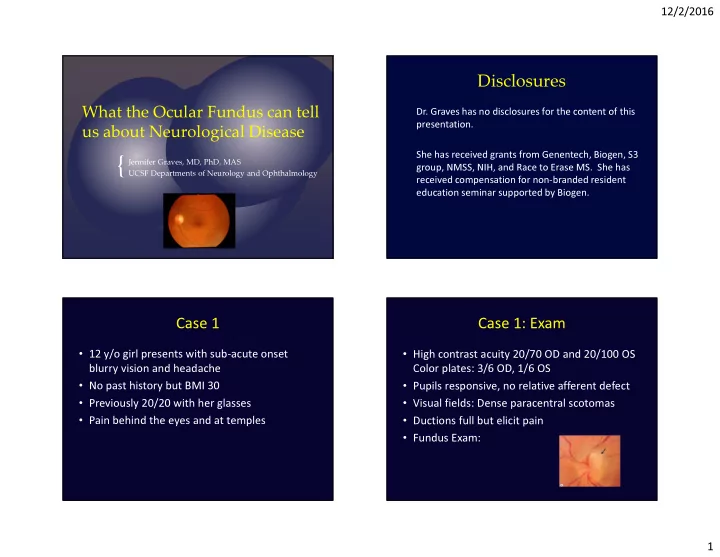
What the Ocular Fundus can tell us about Neurological Disease

Jennifer Graves, MD, PhD, MAS UCSF Departments of Neurology and Ophthalmology

Disclosures

  • Dr. Graves has no disclosures for the content of this

presentation. She has received grants from Genentech, Biogen, S3 group, NMSS, NIH, and Race to Erase MS. She has received compensation for non-branded resident education seminar supported by Biogen.

Case 1

  • 12 y/o girl presents with sub-acute onset

blurry vision and headache

  • No past history but BMI 30
  • Previously 20/20 with her glasses
  • Pain behind the eyes and at temples

Case 1: Exam

  • High contrast acuity 20/70 OD and 20/100 OS

Color plates: 3/6 OD, 1/6 OS

  • Pupils responsive, no relative afferent defect
  • Visual fields: Dense paracentral scotomas
  • Ductions full but elicit pain
  • Fundus Exam:
slide-2
SLIDE 2

12/2/2016 2

Pearl: Optic Nerve Head Edema

  • Best term for edematous optic disc
  • Papillitis
  • Ischemia
  • Papilledema = ONHE with elevated ICP

http://az616578.vo.msecnd.net/files/2016/05/20/6359936760922213671202756498_w hite-pearl-in-oyster.jpg

Case 1: Differential?

  • What are the most relevant features of case?
  • What next?

Case 1: Differential?

  • What are the most relevant features of case?

– Mild optic nerve head edema – Painful vision loss – Central acuity and color loss

  • What next?

Case 1: Evaluation for Suspected ON

  • MRI Brain and orbits
  • Serological evaluation

– As appropriate: Lyme, Bartonella, RPR, ESR, B12, TSH, SPEP, anti-aquaporin-4 antibodies

  • If available visual evoked potential
  • Consider lumbar puncture
slide-3
SLIDE 3

12/2/2016 3

Case 1: MRI

http://www.neurology.org/content/82/6/474/F1.large.jpg

Diagnosing Optic Neuritis

  • Visual evoked potentials

http://stanford25blog.stanford.edu/wp-content/uploads/2013/06/pupilReflex.jpg; http://www.acadjournal.com/2006/v17/part1/p3/

Case 1: Evaluation

Ending #1 Ending #2

VEP – P100 latencies 130, 145 VEP – P100 latencies 125, 135 CSF: 5 WBC, IgG index 1.2, CSF: 4 WBC, normal IgG index 0.5 5 unique oligoclonal bands No oligocloncal bands

Case 1: Evaluation

Ending #3

Aquaporin-4 Antibody positive CSF: 50 WBC, IgG index 0.6 1 unique oligoclonal band

slide-4
SLIDE 4

12/2/2016 4 Neuromyelitis Optica (NMO) vs. MS: Visual Outcomes Worse!!

Wingerchuk, 2006

  • Much more likely to go blind on first ON
  • More complement, destructive process
  • Global pallor, not temporal pattern in MS
  • Often need PLEX after steroids
  • Different long term therapies than MS!!

Case 1: Management

  • All non-infectious ON treatment begins with high dose

corticosteroids (methylprednisolone)

  • If unresponsive to steroids consider plasma exchange
  • Data less convincing for IVIg
  • Determine underlying etiology as treatments differ

– MS therapy if indicated – NMO treatment (mycophenylate, rituximab) – Isolated bilateral ON may just monitor, but if recurrent consider broad spectrum immunosuppressant (mycophenylate)

Optic Neuritis vs Neuroretinitis

Liu, Volpe, Galetta, Elsevier, 2010

  • Lyme disease
  • Cat scratch (Bartonella)
  • Syphillis
  • Measles, mumps, herpes
  • Macular star, other atypical findings
  • Fever, systemic illness
  • Treat with antimicrobial not just blast

with steroids!

Infectious ON

slide-5
SLIDE 5

12/2/2016 5

Sarcoid: Fundus Exam

Liu, Volpe, Galetta, 2010

Perineuritis with optic nerve swelling

Sarcoid

Liu, Volpe, Galetta, 2010; Frohman, L., et al. JNO 2003

Sarcoid: Fundus Exam

Liu, Volpe, Galetta, 2010

Optic Nerve Head Swelling Peripapillary Subretinal Granulomas

Case 2

  • 20 y/o college student had routine eye exam

and had abnormal optic disc appearance

  • No headaches, blurred vision, double vision,
  • r tinnitus
  • Weight gain at college over the last year
  • No steroid use or vitamin A products
  • Prior mild anemia as a teenager
slide-6
SLIDE 6

12/2/2016 6

Case 2: Exam

  • 20/15 OD and 20/15 OS
  • Normal color and low contrast vision
  • Fields full to confrontation
  • Normal ductions
  • Gaze orthophoric in all directions

Case 2: Fundus Exam and OCT Case 2: Differential?

  • Most relevant findings
  • Next steps

Case 2: Differential?

  • Most relevant findings

– Mild optic nerve head edema (superior/inferior) – Preserved central acuity and color vision

  • Next steps
slide-7
SLIDE 7

12/2/2016 7

Case 2: Evaluation

  • Next steps

– Visual Fields – MRI/MRV head – Orbital ultrasound – If no mass lesion, then lumbar puncture

  • Opening pressure
  • Usual – cell counts, protein, glucose, culture and

infectious as appropriate

Case 2: Visual Fields

Keltner, et al., https://www.nordicclinicaltrials.com/nordic/secureFiles/public/IIHTT_Baseline_HVF_Findings_Published_version.pdf

Case 3: MRI

Elsevier 2010, Liu, Volpe, Galetta, Neuro-ophthalmology

Case 2: Lumbar Puncture

  • Opening pressure: 37 mmHg
  • Otherwise bland tap
  • Diagnosis confirmed as?
slide-8
SLIDE 8

12/2/2016 8

Idiopathic intracranial hypertension

  • Pseudotumor cerebri
  • Elevated intracranial

pressures

  • Dilated optic nerve sheaths
  • Optic disc elevation and

edema

  • Headache, peripheral vision

loss, diplopia from pseudo- 6th palsy, tinnitus

Elsevier 2010, Liu, Volpe, Galetta, Neuro-ophthalmology

OCT in Idiopathic Intracranial Hypertension

Invest Ophthalmol Vis Sci. 2012 Jun 29;53(7):4069-75

Idiopathic intracranial hypertension (IIH)

  • Adults, children affected
  • Risk factors

– Recent weight gain – Steroids – Vitamin A products – Doxycycline/antibiotics – Anemia

  • More females than males

after puberty

Elsevier 2010, Liu, Volpe, Galetta, Neuro-ophthalmology

Idiopathic intracranial hypertension (IIH): Treatment

  • Medical

– First line Acetazolamide, – Recent IIH trial – if tolerated can try up to 4gr – Avoid in first trimester pregnancy if possible – Second line: furosemide, topiramate

  • Lifestyle

– Weight loss, low salt diet

  • Surgical

– CSF Diversion procedure – Optic nerve sheath fenestration

  • Monitor Visual Fields

Elsevier 2010, Liu, Volpe, Galetta, Neuro-ophthalmology

slide-9
SLIDE 9

12/2/2016 9

OCT in Idiopathic Intracranial Hypertension

Invest Ophthalmol Vis Sci. 2012 Jun 29;53(7):4069-75

Thank you!

Jennifer.graves@ucsf.edu