Heavy Lift Launch Vehicles HONR289V Final Presentation Stephen - - PowerPoint PPT Presentation

heavy lift launch vehicles
SMART_READER_LITE
LIVE PREVIEW

Heavy Lift Launch Vehicles HONR289V Final Presentation Stephen - - PowerPoint PPT Presentation

Heavy Lift Launch Vehicles HONR289V Final Presentation Stephen McNierney What is Heavy Lift? Anything rated to carry 20+ tons into Low Earth Orbit (LEO) Used for manned missions, large ISS resupply missions, and orbital


slide-1
SLIDE 1

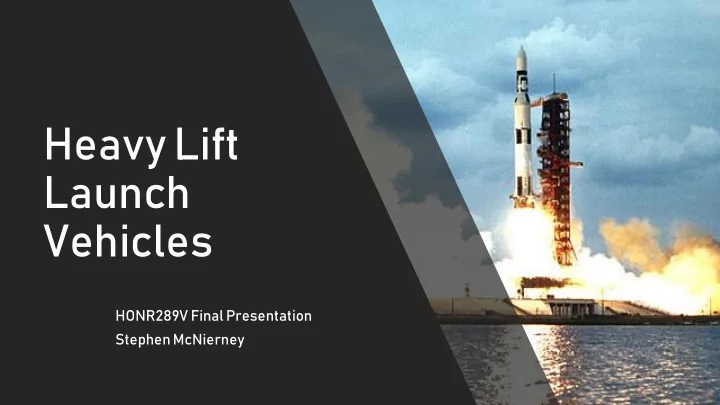
Heavy Lift Launch Vehicles

HONR289V Final Presentation Stephen McNierney
slide-2
SLIDE 2

What is “Heavy Lift”?

  • Anything rated to carry 20+ tons into Low Earth Orbit

(LEO)

  • Used for manned missions, large ISS resupply missions,

and orbital insertions

  • History:
  • First developed by Werner von Braun at NASA

Marshall

  • One aspect of the Cold War’s Space Race
slide-3
SLIDE 3

Saturn V

  • Used from 1967-1973 for Apollo

lunar missions

  • 155 tons to LEO
  • Five F-1 and six J-2 engines
  • Nearly 8 million lbf of thrust
slide-4
SLIDE 4

Delta IV and Space Shuttle

  • Used for travel to ISS, launch of

satellites/defense payloads

  • Only about 30 tons to LEO
  • Space Shuttle was developed

without much initial purpose

  • Delta IV is second most powerful

vehicle today

slide-5
SLIDE 5

Falcon Heavy

  • First commercial heavy lift

vehicle – SpaceX

  • 70 tons to LEO
  • 27 Merlin engines; 5 ½ million lbf
  • f thrust
  • Uses recoverable Falcon 9

boosters

slide-6
SLIDE 6

New Glenn

  • Under development by Blue

Origin

  • First flight expected in 2021
  • 45 tons to LEO
  • Seven BE-4 engines; 4 million

lbf of thrust

  • Industry-leading 7 meter fairing
slide-7
SLIDE 7

Starship

  • Meant to replace SpaceX Falcon

9 and Falcon Heavy

  • First flight expected in 2021
  • 150 tons to LEO
  • Two stages – “Super Heavy”

booster and “Starship” capsule

  • Can serve LEO, Moon, and Mars

missions

slide-8
SLIDE 8

Space Launch System

  • NASA’s heavy lift vehicle project
  • Exploration Mission 1 – June 2020
  • Multiple configurations: 130 tons

to LEO and 45 tons to deep space

  • Solid rocket booster and RS-25

engines; up to 11.9 million lbf thrust

  • Facing cost and schedule issues