
SLIDE 1
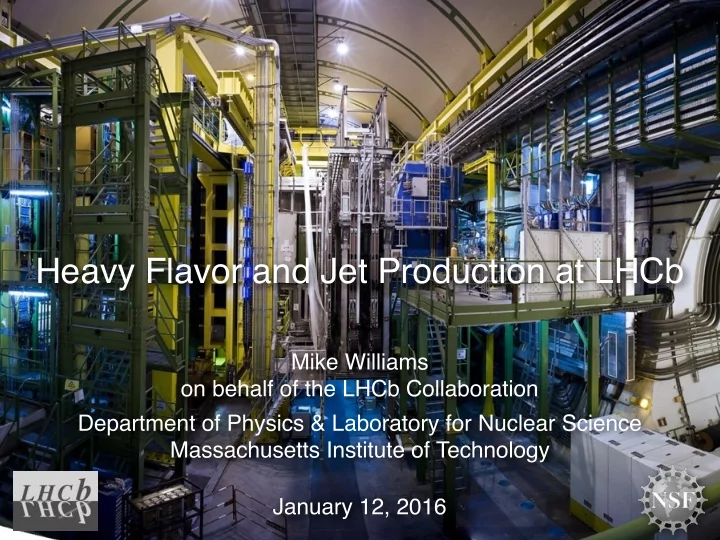
Heavy Flavor and Jet Production at LHCb
Mike Williams
- n behalf of the LHCb Collaboration
Heavy Flavor and Jet Production at LHCb Mike Williams on behalf of - - PowerPoint PPT Presentation
Heavy Flavor and Jet Production at LHCb Mike Williams on behalf of the LHCb Collaboration Department of Physics & Laboratory for Nuclear Science Massachusetts Institute of Technology January 12, 2016 The Large Hadron Collider Outline {
3
] c
[GeV
T
p 1/ 0.5 1 1.5 2 2.5 3 m] µ resolution [
x
IP 10 20 30 40 50 60 70 80 90 100 2012 data Simulation
LHCb
Momentum (GeV/c)
20 40 60 80 100
Efficiency
0.2 0.4 0.6 0.8 1 1.2 1.4
) > 0
K
Int.J.Mod.Phys. A 30(2015) 1530022
) µ → π (
DLL
℘
0.005 0.01
DLL
ε
0.2 0.4 0.6 0.8 1 DLL muDLL LHCb (a)
4
Plan to move to a triggerless-readout system in Run 3!
40 MHz bunch crossing rate
450 kHz h± 400 kHz µ/µµ 150 kHz e/γ
L0 Hardware Trigger : 1 MHz readout, high ET/PT signatures
Software High Level Trigger
12.5 kHz Rate to storage
Partial event reconstruction, select displaced tracks/vertices and dimuons Buffer events to disk, perform online detector calibration and alignment Full offline-like event selection, mixture
LHCb 2015 Trigger Diagram
Precision measurements benefit greatly from using the final (best) reconstruction in the online event selection -- need real- time calibration!
all tracks pT > 0.5 GeV (no IP requirements) same calibration constants used online &
full reconstruction, offline-like particle ID, track quality, etc.
Heavy use of machine learning algorithms throughout the Run 1 and Run 2 trigger. V.Gligorov, MW, JINST 8 (2012) P02013.
JINST 8 (2013) P04022
5
Cherenkov drift tube pixel silicon strip ECAL HCAL muon
6
Core physics program involves searching for BSM physics in the decays of heavy-flavor hadrons -- but their production is also of great interest!
x
6 −
10
5 −
10
4 −
10
3 −
10
2 −
10
1 −
10 1
]
2
[GeV
2
Q
1 10
2
10
3
10
4
10
5
10
6
10
7
10
LHCb ATLAS/CMS Tevatron HERA fixed target
LHCb probes unique regions of (x,Q) so there are many measurements we can (potentially) make that are sensitive to (largely unknown) PDFs*.
*PDFs means “parton distribution functions” throughout this talk.
Q2(x) = e±2yx2s
7
m(K−π+) [MeV/c2]
1800 1850 1900
Candidates / (1 MeV/c2)
50 100 150 ×103 D0 data Fit
LHCb √s = 13TeV
2 4 6 8 10 12 14 pT [GeV/c] 10−9 10−8 10−7 10−6 10−5 10−4 10−3 10−2 10−1 100 101 102 103 (d2σ)/(dydpT)·10−m [µb/(GeVc−1)] 2.0 < y < 2.5, m = 0 2.5 < y < 3.0, m =2 3.0 < y < 3.5, m =4 3.5 < y < 4.0, m =6 4.0 < y < 4.5, m =8
LHCb D0
√s = 13 TeV POWHEG+NNPDF3.0L FONLL GMVFNS )]
LHCb-PAPER-2015-041
<x1> ~ 0.05, <x2> ~ 2e-5 Results also published for D+, Ds, D* at both 7 and 13 TeV. σ(cc)[13TeV] shown @ EPS (2015) within a week of recording the data; it was measured using online-reconstructed data. Excellent probe of the small-x gluon PDF.
POWHEG+NNPDF [1506.08025], FONLL [1507.06197], GMVFNS [1202.0439]
[ps]
z
t
2 4 6 8 10
Candidates per 0.2 ps
1 10
2
10
3
10
4
10
5
10
=3.05 pb
int
L = 13 TeV, s LHCb c < 3 GeV/
T
p 2 < < 3.5 y 3 <
Data Total fit b
ψ J/ ψ Prompt J/ Wrong PV Background
8
The pseudo-lifetime distribution of J/ψ’s is fitted to determine both the prompt and “from b” content. LHCb has also measured production of many open- beauty meson and baryon species separately.
] c ) [GeV/ ψ J/ (
T
p
5 10
)] c ) [nb/(GeV/
T
p d y /(d σ
2
d
1 10
2
10
=3.05 pb
int
L = 13 TeV, s LHCb <2.5 y 2.0< <3.0 y 2.5< <3.5 y 3.0< <4.0 y 3.5< <4.5 y 4.0<
σ(bb)[13TeV] also shown at EPS, and previously measured at lower energies.
LHCb-PAPER-2015-037: JHEP 10 (2015) 172
tz =
pz ,
See http://lhcbproject.web.cern.ch/lhcbproject/Publications/LHCbProjectPublic/Summary_all.html for all LHCb publications.
9
See also Gauld et al [1511.06346] for updated prompt atmospheric neutrino flux predictions for IceCube constrained by LHCb prompt-charm data.
x
6 −
10
5 −
10
4 −
10
3 −
10
2 −
10
1 −
10
)
2
= 4 GeV
2
g ( x, Q 2 4 6 8 10 12 14 16
data
+-
,D no LHCb D data (wgt)
+-
,D with LHCb D data (unw)
+-
,D with LHCb D
=0.118
s
α NNPDF3.0 NLO
x
6 −
10
5 −
10
4 −
10
3 −
10
2 −
10
1 −
10
Percentage PDF uncertainty 20 40 60 80 100 120 140 160 180 200
data
+-
,D no LHCb D data
+-
,D with LHCb D
, NNPDF3.0 NLO
2
=4 GeV
2
) ) for Q
2
( g(x,Q Δ
Impact of 7 TeV prompt-charm* results on the low-x gluon PDF:
Gauld, Rojo, Rittoli, Talbert [1506.0825] *LHCb-PAPER-2012-041: Nucl. Phys. B871 (2013) 1
10
[GeV]
jet T
p
20 40 60 80 100 120 140
[1/GeV]
jet T
p d σ d σ 1
10
10
10
10
Data (stat.) Data (tot.) )
s
α ( O MSTW08, )
2 s
α ( O MSTW08, )
2 s
α ( O CTEQ10, )
2 s
α ( O NNPDF 2.3, POWHEG + PYTHIA:
= 7 TeV Data s > 10 GeV
jet T
p LHCb 1.2
Z
y
2.0 2.5 3.0 3.5 4.0 4.5
Z
dy σ d σ 1
0.0 0.2 0.4 0.6 0.8 1.0 1.2 1.4
Data (stat.) Data (tot.) )
s
α ( O MSTW08, )
2 s
α ( O MSTW08, )
2 s
α ( O CTEQ10, )
2 s
α ( O NNPDF 2.3,
POWHEG + PYTHIA: = 7 TeV Data s > 20 GeV
jet T
p LHCb
Jets @ LHCb: anti-kT, R=0.5, particle flow. First LHCb jet paper provides differential measurements of Z+jet production:
LHCb-PAPER-2013-058: JHEP 01 (2014) 33
σ(W+j)/σ(Zj) and σ(W-j)/σ(Zj) also measured integrated over LHCb acceptance for pT(j) > 20 GeV; these also agree with NLO SM predictions. Run 1 differential W+jet measurements are in preparation. Such measurements in Runs 2 & 3 will enable strongly constraining d/u at large-x.
LHCb-PAPER-2015-021 PRD 92 (2015) 052001 Farry, Gauld [1505.01399]
11
Use a SV-based algorithm to identify b and c jets (leveraging LHCb VELO):
[GeV]
cor
M SV
2 4 6 8 10
candidates
5000 10000
LHCb data b c udsg
candidates
200 400 600 800 1000
) udsg | bc BDT(
0.5 1
) c | b BDT(
0.5 1
LHCb data +jet D
light parton charm beauty Initial (no-tagging) sample: 70% light parton, 22% charm, 8% beauty.
example SV feature: “corrected mass”
JINST 10 (2015) P06013 LHCb-PAPER-2015-016
SV features used in 2 BDTs
Performance validated & calibrated using large heavy-flavor-enriched jet data
content; c-jet and b-jet yields each precisely determined simultaneously.
12
7TeV 8TeV
5 (Wj) [%] σ (Wq)/ σ
0.25 0.5 Charge Asymmetry LHCb MCFM (NLO) W+c W+b
Expect ~10x larger stats in Run 2; will be able to probe s vs s-bar PDFs using differential measurements of W+c. W+charm production probes the strange content of the proton. In the forward region, this includes large-x s vs s-bar.
PRD 92 (2015) 052001 LHCb-PAPER-2015-021
W + b-jet
qj qi b b W
W + c-jet
g s c W
13
(top) [fb] σ
100 200 300 400
7TeV 8TeV
LHCb MCFM (NLO)
σ(top)[7 TeV] = 239 ± 53 (stat) ± 33 (syst) ± 24 (theory) fb , σ(top)[8 TeV] = 289 ± 43 (stat) ± 40 (syst) ± 29 (theory) fb .
Results for σ(tt+t+t-bar): Top production in the forward region probes the large-x gluon PDF and may be more sensitive to BSM. LHCb made the first observation of forward top production in Run 1:
<x1> ~ 0.2, <x2> ~ 0.02
PRL 115 (2015) 112001, LHCb-PAPER-2015-022
Expect ~20x more stats in Run 2; will explore separating pair and single-top production, and differential measurements. Should reduce the large-x gluon PDF uncertainty by ~20% [Gauld, 1311.1810].
Kagan, Kamenik, Perez, Stone [1103.3747]
14
Boettcher, Ilten, MW [arxiv:1512.06666]
Whether there exists “intrinsic” (non-perturbative) charm content in the proton has long been debated. LHCb can say a lot here in Runs 2 and 3. Also effects Higgs production by ~2% (more for H+c), direct dark matter detection (assuming H exchange), and prompt atmospheric neutrino rates.
4.5
)
4.5
2 2.5 3 3.5 4 4.5
) Zj ( σ )/ Zc ( σ
0.04 0.06 0.08
CT14NNLO BHPS1 BHPS2 SEA1 SEA2
= 14 TeV s
Ldt = 15 fb
) Z ( y
2 2.5 3 3.5 4 4.5
CT14NNLO IC
1 2 3
g c c Z
g c c Z
15
g c c Z
et
c W
small-x gluon large-x gluon large-x d/u intrinsic charm s vs s-bar W
g g s
16
LHCb 7 TeV data SM H1504.02493L 100 GeV Axigluon
40 60 80 100 120 140 160
1 2 3 4 5 Mbb
_@GeVD
AC
b b@%D
Ab¯
b C ≡ N(∆y > 0) − N(∆y < 0)
N(∆y > 0) + N(∆y < 0),
b anti-b Di-heavy-flavor jet production provides a standard candle measurement, is useful for constraining tagging efficiencies, and probes BSM physics.
LHCb-PAPER-2014-023: PRL 113 (2014) 082003.
Expect much larger stats in Run 2; plan to also measure AC(cc), along with σ(bb) and σ(cc) differentially. y
Pomeron γ p p Υ(nS)
17
LHCb has published detailed differential measurements of ψ, ϒ, ηc, xc,b states. One of the more unique ones is via Central Exclusive Production:
σ(γp) (pb) W (GeV)
LHCb sensitivity
LHCb (b)
LO NLO B.G. bCGC Gauss LC bCGC H1 2000 LHCb run 1 ZEUS 1998/2009
101 102 103 104 102 103
LHCb-PAPER-2015-011: JHEP 09 (2015) 084
LHCb has also measured associated production of J/ψ + open charm and double open charm (c-c and c-cbar); these data are qualitatively consistent with double-parton scattering.
LHCb-PAPER-2012-003: JHEP 01 (2013) 90 LHCb-PAPER-2015-046
18
y
2 4
pPb
R
0.2 0.4 0.6 0.8 1 1.2 1.4 = 5 TeV
NN
s pPb
LHCb
EPS09 at NLO in Ref.[3]
(1S) Υ ψ Prompt J/
(1S) Υ LHCb, ψ LHCb, Prompt J/ from b ψ LHCb, J/
Cold nuclear matter effects studied in Pb-p vs p-Pb, each compared to reference p-p data, show a large suppression in the forward region:
Pb-p vs p-Pb LHCb-PAPER-2014-015: JHEP 07 (2014) 094 LHCb-PAPER-2013-052: JHEP 02 (2014) 72
LHCb recently took Pb-Pb data too and we expect our heavy-ion program to continue to expand in the coming years.
L=1.6/nb Ref [3] is Albacete et al [1301.3395]
19
In fixed-target mode, LHCb is a central-backward detector that probes energy densities between that of the SPS and RHIC. Data collected: p-He, p-Ne, p- Ar and Pb-Ne, Pb-Ar. LHCb developed the System for Measuring the Overlap with Gas to obtain a high-precision (1%) luminosity measurement by injecting a noble gas into the VELO to profile the beams -- but also permits running in fixed-target mode!
2
dimuon invariant mass (MeV/c 2900 3000 3100 3200 3300 3400 3500
2
Events / 16 MeV/c 20 40 60 80 100 120
LHCb Preliminary p-Ne Collisions
2
1.2 MeV/c ± = 19.4 σ
2
1.4 MeV/c ± mean = 3094.1 17 ± = 293
signal
N
E(CM)=110 GeV (~20 hours of running)
22
JINST 10 (2015) P06013 LHCb-PAPER-2015-016
) udsg | bc BDT(
0.5 1
) c | b BDT(
0.5 1
LHCb simulation
b ) udsg | bc BDT(
0.5 1
) c | b BDT(
0.5 1
LHCb simulation
c ) udsg | bc BDT(
0.5 1
) c | b BDT(
0.5 1
LHCb simulation
udsg
T T
(jet) [GeV]
T
p
20 40 60 80 100
efficiency in data/simulation
0.6 0.8 1 1.2 1.4
LHCb )-jet b,c (
(jet) [GeV]
T
p
20 40 60 80 100
SV-tag efficiency
0.2 0.4 0.6 0.8 1
LHCb
b
c
Efficiencies are for 0.3% light-jet mis-tag.
23
JINST 10 (2015) P06013 LHCb-PAPER-2015-016
BDT distributions for b-jet enriched data.
100 200 300 400 500 600 700 800 900
) udsg | bc BDT(
0.5 1
) c | b BDT(
0.5 1
LHCb data +jet B
100 200 300 400 500 600 700 800 900
) udsg | bc BDT(
0.5 1
) c | b BDT(
0.5 1
LHCb fit ) udsg | bc BDT(
0.5 1
candidates
2000 4000
LHCb data b c udsg ) c | b BDT(
0.5 1
candidates
1000 2000 3000
LHCb data b c udsg
[GeV]
cor
M SV
2 4 6 8 10
candidates
1000 2000 3000 4000
LHCb data b c udsg
[GeV]
cor
M SV
2 4 6 8 10
candidates
5000 10000
LHCb data b c udsg
candidates
corrected mass in data for (top) b-jet enriched and (bottom) heavy-flavor enriched.
7TeV 8TeV
5 (Wj) [%] σ (Wq)/ σ
0.25 0.5 Charge Asymmetry LHCb MCFM (NLO) W+c W+b
0.5 0.6 0.7 0.8 0.9 1
Candidates/0.05
20000 40000
Data W Z Jets
= 8 TeV s ,
+
µ )
µ
j (
T
p )/ µ (
T
p
0.5 0.6 0.7 0.8 0.9 1 20000 40000
= 8 TeV s ,
−
µ LHCb
√
24
PRD 92 (2015) 052001 LHCb-PAPER-2015-021
10 20 30 40 50 60 70 80 90
) udsg | bc BDT(
0.5 1
) c | b BDT(
0.5 1
LHCb data
[GeV]
cor
M SV
2 4 6 8 10
Candidates/0.5 GeV
500 1000
LHCb Data b c udsg
W from fits to muon isolation. Jet flavor from 2-D BDT fits. Run 1 results agree SM(CT10) predictions but stat limited. Expect much greater stats in Run 2; will be able to probe s vs s-bar PDFs using differential measurements.
25
Results SM prediction 7 TeV 8 TeV 7 TeV 8 TeV
σ(Wb) σ(Wj) × 102
0.66 ± 0.13 ± 0.13 0.78 ± 0.08 ± 0.16 0.74+0.17
−0.13
0.77+0.18
−0.13 σ(Wc) σ(Wj) × 102
5.80 ± 0.44 ± 0.75 5.62 ± 0.28 ± 0.73 5.02+0.80
−0.69
5.31+0.87
−0.52
A(Wb) 0.51 ± 0.20 ± 0.09 0.27 ± 0.13 ± 0.09 0.27+0.03
−0.03
0.28+0.03
−0.03
A(Wc) −0.09 ± 0.08 ± 0.04 −0.01 ± 0.05 ± 0.04 −0.15+0.02
−0.04
−0.14+0.02
−0.03 σ(W +j) σ(Zj)
10.49 ± 0.28 ± 0.53 9.44 ± 0.19 ± 0.47 9.90+0.28
−0.24
9.48+0.16
−0.33 σ(W −j) σ(Zj)
6.61 ± 0.19 ± 0.33 6.02 ± 0.13 ± 0.30 5.79+0.21
−0.18
5.52+0.13
−0.25
26
Inclusive W+jet agrees with NLO SM from MCFM.
) [GeV] j + µ (
T
p +jet) W ( N
2000 4000 6000 8000
LHCb Data SM
20 45 70 95
∞
) [GeV] j + µ (
T
p Charge Asymmetry
0.2 0.4 20 45 70 95
∞
LHCb Data SM ) [GeV] c + µ (
T
p ) c + W ( N
50 100 150 200
Data SM LHCb
20 45 70 95
∞
Same for W+c.
27
(top) [fb] σ
100 200 300 400
7TeV 8TeV
LHCb MCFM (NLO)
PRL 115 (2015) 112001 LHCb-PAPER-2015-022
ffiffi ffi
) [GeV] b + µ (
T
p ) W+b ( N
100 200
Data +top Wb Wb LHCb
20 45 70 95
∞
) [GeV] b + µ (
T
p Charge Asymmetry
0.2 0.4
Data +top Wb Wb LHCb
20 45 70 95
∞ σ(top)[7 TeV] = 239 ± 53 (stat) ± 33 (syst) ± 24 (theory) fb , σ(top)[8 TeV] = 289 ± 43 (stat) ± 40 (syst) ± 29 (theory) fb .
Data requires a top contribution (Wb validated in sidebands): Results for σ(tt+t+t):
_ _
28
Predicted Zc/Zj results shown above for LHCb for Runs (left) 2 and (right) 3. Potential impact on Higgs production in CMS/ATLAS show at right. For H+c (not shown), the effect of intrinsic charm is comparable to that of the SM charm Yukawa coupling!
BHPS1 BHPS2 SEA1 SEA2 0.95 1 1.05
H → gg CT14NNLO IC
0.95 1 1.05
H → VV
0.95 1 1.05
VH → pp
0.95 1 1.05
H t t → pp
2 2.5 3 3.5 4 4.5
) Zj ( σ )/ Zc ( σ
0.04 0.06 0.08
CT14NNLO BHPS1 BHPS2 SEA1 SEA2
= 13 TeV s
Ldt = 5 fb
∫
) Z ( y
2 2.5 3 3.5 4 4.5
CT14NNLO IC
1 2 3
2 2.5 3 3.5 4 4.5
) Zj ( σ )/ Zc ( σ
0.04 0.06 0.08
CT14NNLO BHPS1 BHPS2 SEA1 SEA2
= 14 TeV s
Ldt = 15 fb
∫
) Z ( y
2 2.5 3 3.5 4 4.5
CT14NNLO IC
1 2 3