Healthier and Wealthier, or Sicker and Poorer? Prospects for - - PDF document

healthier and wealthier or sicker and poorer prospects
SMART_READER_LITE
LIVE PREVIEW

Healthier and Wealthier, or Sicker and Poorer? Prospects for - - PDF document

Tricia Neuman January 13, 2014 Healthier and Wealthier, or Sicker and Poorer? Prospects for Medicare Beneficiaries Now and in the Future January 13, 2014 Alliance for Health Reform Tricia Neuman, Sc.D. Director, Program on Medicare Policy


slide-1
SLIDE 1

1

Healthier and Wealthier, or Sicker and Poorer? Prospects for Medicare Beneficiaries Now and in the Future

January 13, 2014 Alliance for Health Reform Tricia Neuman, Sc.D. Director, Program on Medicare Policy Kaiser Family Foundation

Monday, January 13, 2014

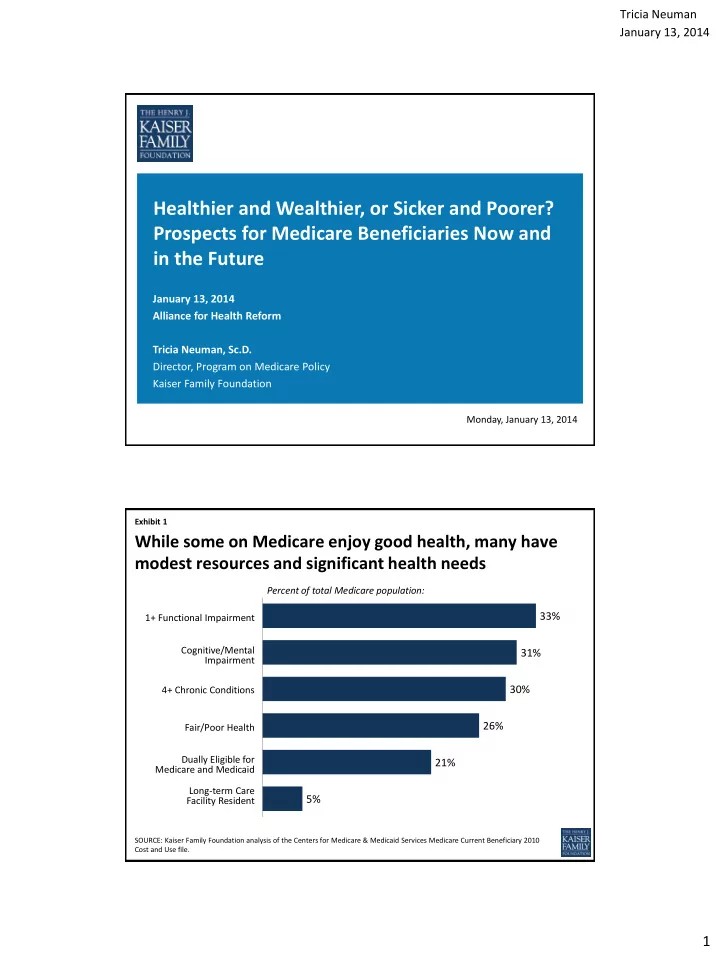
Exhibit 1

33% 31% 30% 26% 21% 5%

SOURCE: Kaiser Family Foundation analysis of the Centers for Medicare & Medicaid Services Medicare Current Beneficiary 2010 Cost and Use file.

While some on Medicare enjoy good health, many have modest resources and significant health needs

Percent of total Medicare population: 1+ Functional Impairment Cognitive/Mental Impairment 4+ Chronic Conditions Fair/Poor Health Dually Eligible for Medicare and Medicaid Long-term Care Facility Resident

Tricia Neuman January 13, 2014

slide-2
SLIDE 2

2

Exhibit 2 Housing $11,673 34% $5,087 15% Health Care $4,722 14% Food $5,189 15% Other $7,321 22% Housing $16,976 32% $9,660 18% $2,772 5% Food $7,890 15% Other $15,702 30%

SOURCE: Kaiser Family Foundation analysis of the Bureau of Labor Statistics Consumer Expenditure Survey Interview and Expense Files, 2012.

Even with Medicare and supplemental coverage, Medicare households spend far more than others on health expenses

Transportation Transportation Health Care

Non-Medicare Household Spending Medicare Household Spending

Average Household Spending = $53,000 Average Household Spending = $33,993

Exhibit 3

Budget and financing

  • Medicare is 16% of the federal budget and rising as a share of the budget and the

economy

  • Medicare faces long-term financing challenges, with fewer workers to support

retirees, and growing number of Medicare beneficiaries

Beneficiaries

  • Beneficiaries incur relatively high out-of-pocket expenses as a share of income

and household budgets (no limit on spending, dental, or long-term care)

  • Medicare’s benefit structure is complex (traditional Medicare); unclear how well

beneficiaries navigate private marketplace, but have many choices

Other challenges

  • Improving care management and targeting interventions to beneficiaries with the

greatest needs and highest costs

  • Setting fair payments to plans and providers (e.g. the SGR)

Medicare faces range of challenges

Tricia Neuman January 13, 2014

slide-3
SLIDE 3

3

Exhibit 4 $521 $570 $580 $635 $696 $725 $787 $819 $854 $943 $526 $565 $557 $592 $603 $622 $678 $703 $730 $803

$400 $500 $600 $700 $800 $900 $1,000 2010 2011 2012 2013 2014 2015 2016 2017 2018 2019

Medicare Baseline Spending (in $ billions)

Projected Medicare spending before ACA Projected Medicare Spending after ACA

Average annual growth rate, 2010-2019:

  • Projected spending before ACA: 6.8 percent
  • Projected spending after ACA: 4.8 percent

Projected Medicare spending has declined since the enactment of the ACA in 2010

NOTE: Estimates do not take into account future changes to the Sustainable Growth Rate formula to prevent reduction in fees. SOURCE: Medicare Baseline Spending before reform from CBO, March 2009 Baseline: MEDICARE; after reform from CBO, May 2013 Baseline: MEDICARE.

Exhibit 5

6.6% 6.9% 2.9% 2.5% 3.2% 5.0% 4.1% 2.1%

NOTE: *Assumes no reduction in physician fees under Medicare between 2012 and 2021. SOURCES: Medicare spending per capita from Boards of Trustees and Congressional Budget Office (CBO), Private health insurance spending per capita from the CMS National Health Expenditure data, GDP per capita from CBO and U.S. Census Bureau, historical CPI from the Bureau of Labor Statistics (BLS), and projected CPI from CBO.

On a per person basis, Medicare spending is projected to grow slower than private insurance

Actual (2000-2011) Projected (2012-2021)

Medicare spending per capita Private health insurance spending per capita GDP per capita CPI Medicare spending per capita* Private health insurance spending per capita GDP per capita CPI

Tricia Neuman January 13, 2014
slide-4
SLIDE 4

4

Exhibit 6

Savings Benefit Improvements

 Raise Medicare Part B and D premiums for beneficiaries with higher incomes  Strengthen financed protections for low- income beneficiaries  Introduce home health copayments (for all/new enrollees)  Provide new limit on out-of-pocket expenses under Parts A and B  Raise Part B deductible (for all/new enrollees)  Expedite closing of Medicare Part D “donut hole”  Impose premium surcharge for Medigap/retiree coverage; prohibit “first dollar” Medigap coverage  Restructure Medicare’s benefit design  Raise the age of Medicare eligibility  Premium support/ defined contribution

Several Medicare proposals could directly affect beneficiaries’ out-of-pocket costs

6

Tricia Neuman January 13, 2014