Healthcare for people with a learning disability- Getting it right - - PowerPoint PPT Presentation

healthcare for people with a learning disability getting
SMART_READER_LITE
LIVE PREVIEW

Healthcare for people with a learning disability- Getting it right - - PowerPoint PPT Presentation

Healthcare for people with a learning disability- Getting it right Clare Lucas Campaigns and Policy Officer Mencap What we will be talking about What is a learning disability ? Why is health an important issue for people with a

slide-1
SLIDE 1

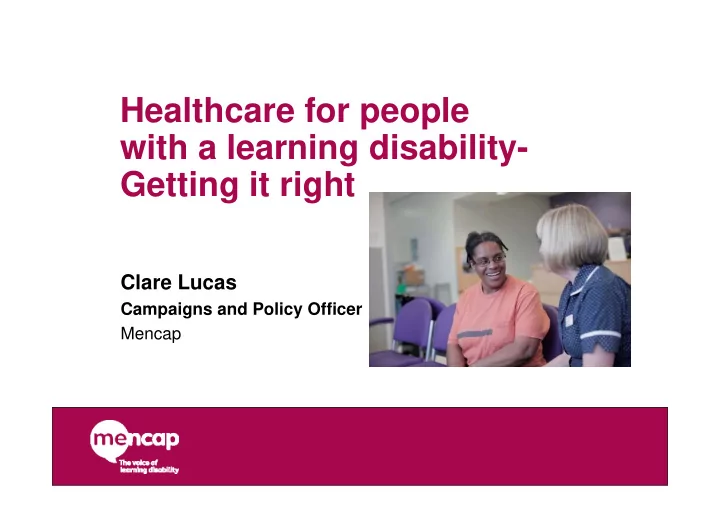
Healthcare for people with a learning disability- Getting it right

Clare Lucas

Campaigns and Policy Officer Mencap

slide-2
SLIDE 2

What we will be talking about

  • What is a learning disability?
  • Why is health an important issue for people

with a learning disability?

  • What happens when healthcare goes

wrong for people with a learning disability?

  • What does good healthcare look like?
  • What change is needed?
slide-3
SLIDE 3

What is a learning disability?

“a reduced intellectual ability and difficulty with everyday activities…which affects someone for their whole life. People with a learning disability tend to take longer to learn and may need support to develop new skills, understand complex information and interact with other people.”

slide-4
SLIDE 4

What causes a learning disability?

  • A learning disability occurs when the brain is still

developing - before, during or soon after birth.

  • Before birth things can happen to the central

nervous system (the brain and spinal cord) that can cause a learning disability. A child can be born with a learning disability if the mother has an accident or illness while she is pregnant, or if the unborn baby develops certain genes.

  • A person can be born with a learning disability if he
  • r she does not get enough oxygen during

childbirth, or is born too early.

  • After birth, a learning disability can be caused by

early childhood illnesses.

slide-5
SLIDE 5

Why do Mencap campaign on health?

  • People with a learning disability are at least twice

as likely as other people to go into hospital in a year

  • Those who go into hospital are twice as likely to

be admitted three times or more in that year

  • Their hospital stays are roughly 25% longer
  • People with a learning disability are 58 times

more likely to die before their 50th birthday

  • Mencap have had almost 100 avoidable deaths

reported to us since 2002

slide-6
SLIDE 6

Associated medical conditions

  • Epilepsy: 22% of people with a learning disability

compared to 1% in the general population

  • Dementia: 21.6% of people with a learning disability

compared to 5.7% of the general population

  • Schizophrenia: 3% of people with a learning disability

compared with 1% of the general population

  • Visual impairments: More likely (8.5 to 200 times) to

have vision impairment

  • Hearing impairment: 40% have hearing impairments
  • Poor dental hygiene and dental care with 36.5% of

adults and 80% of adults with Down’s syndrome having unhealthy teeth and gums

slide-7
SLIDE 7

Common problems when accessing healthcare

slide-8
SLIDE 8

What happens when healthcare goes wrong for people with a learning disability?

  • Where health care needs are greater, the

response should be greater

  • People with a learning disability have

increased health needs but continue to receive poorer health care

  • Mencap have heard many stories from

families about NHS failures

  • In some cases, poor healthcare was resulting

in people dying “prematurely”

slide-9
SLIDE 9
slide-10
SLIDE 10

Institutional discrimination

Institutional discrimination happens when the people working in a place or organisation do not:

  • value all people equally
  • understand that different people have different

needs

  • change the way they deliver a service so that

it meets different needs This happens for a long time and staff become used to it and do not notice it is wrong.

slide-11
SLIDE 11

Recent data: The Confidential Inquiry

  • The Confidential Inquiry looked at the deaths of 247

people with a learning disability

  • On average, men with a learning disability died 13

years earlier and women with a learning disability died 20 years earlier

  • 37% of the deaths could have been avoided with good

healthcare

  • Scaling up, this means 1,200 people with a learning

disability are dying prematurely every year. That’s almost 25 people per week.

  • Lots of people had died because their illnesses were

not diagnosed or treated properly

slide-12
SLIDE 12

What does good healthcare look like?

slide-13
SLIDE 13
slide-14
SLIDE 14
slide-15
SLIDE 15

What needs to change?

slide-16
SLIDE 16

Other things we want to see…

  • Standardisation of annual health checks
  • Better healthcare planning
  • Wider use of hospital passports; they save

lives!

slide-17
SLIDE 17

Other things we want to see…

  • Better data collection and the introduction of a

flagging system for patients with a learning disability

  • Better monitoring and regulation of healthcare

settings

  • Continued funding for the Public Health

Observatory and a Mortality Review

slide-18
SLIDE 18

Kyle’s Story

slide-19
SLIDE 19

What nurses and midwives can do?

  • Take the time to get to know their patients as people; see the

person, not the disability

  • Think of any reasonable adjustments that can be made
  • Check if patients have a hospital passport or health action plan
  • Use accessible language in written and spoken communication
  • Listen to the person and their family/carers
  • Learn about Mental Capacity Laws
slide-20
SLIDE 20

Useful resources

  • IHAL- http://www.improvinghealthandlives.org.uk/
  • Confidential Inquiry- http://www.bris.ac.uk/cipold/
  • GMC- http://www.gmc-uk.org/learningdisabilities/
  • RCGP- http://www.rcgp.org.uk/learningdisabilities
  • RCN- https://www.rcn.org.uk/learning_disabilities
  • EasyHealth- http://www.easyhealth.org.uk/
slide-21
SLIDE 21

For more information

Visit our website www.mencap.org.uk/deathbyindifference www.mencap.org.uk/gettingitright Or email clare.lucas@mencap.org.uk

slide-22
SLIDE 22

Any questions?