Health Canadas Food Chemical Safety Programs The responsibility for - - PDF document

health canada s food chemical safety programs the
SMART_READER_LITE
LIVE PREVIEW

Health Canadas Food Chemical Safety Programs The responsibility for - - PDF document

Health Canadas Food Chemical Safety Programs The responsibility for food safety ( Risk Assessment & Risk Management at the Federal level in Canada is of Chemical Contaminants in Food) shared between Health Canada John Salminen and the


slide-1
SLIDE 1

John Salminen Bureau of Chemical Safety, Food Directorate, Health Products and Food Branch, Health Canada

Health Canada’s Food Chemical Safety Programs (Risk Assessment & Risk Management

  • f Chemical Contaminants in Food)

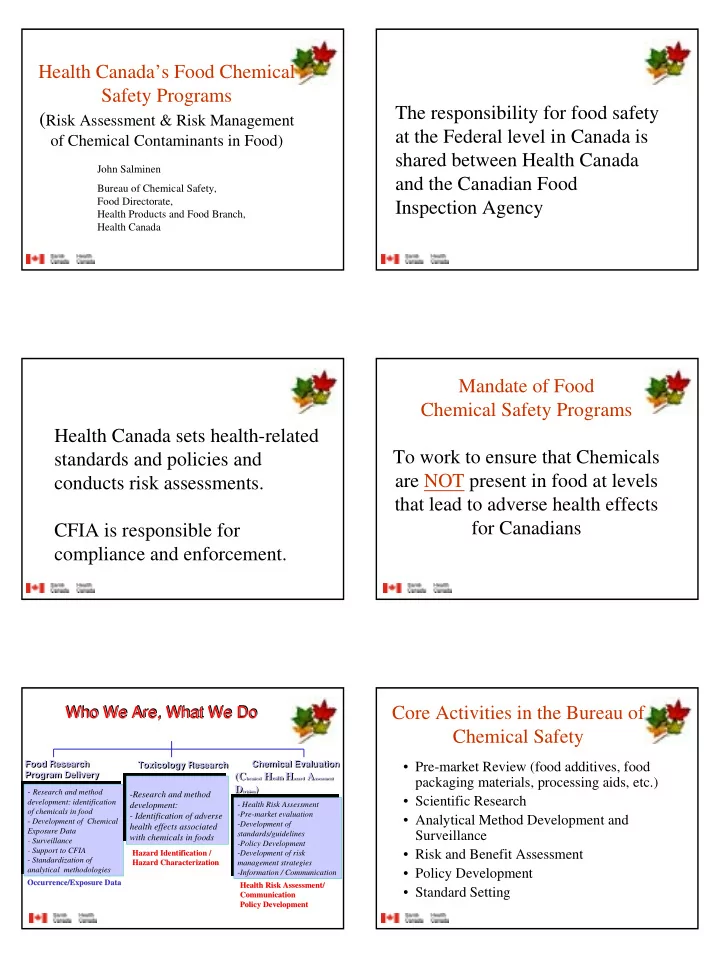
The responsibility for food safety at the Federal level in Canada is shared between Health Canada and the Canadian Food Inspection Agency Health Canada sets health-related standards and policies and conducts risk assessments. CFIA is responsible for compliance and enforcement. Mandate of Food Chemical Safety Programs To work to ensure that Chemicals are NOT present in food at levels that lead to adverse health effects for Canadians

Who We Are, What We Do Who We Are, What We Do Who We Are, What We Do

Toxicology Research Toxicology Research Chemical Evaluation

(Chemical Health Hazard Assessment Division)

Chemical Evaluation

(Chemical Health Hazard Assessment Division)

  • Research and method

development: identification

  • f chemicals in food
  • Development of Chemical

Exposure Data

  • Surveillance
  • Support to CFIA
  • Standardization of

analytical methodologies

  • Research and method

development: identification

  • f chemicals in food
  • Development of Chemical

Exposure Data

  • Surveillance
  • Support to CFIA
  • Standardization of

analytical methodologies

  • Research and method

development:

  • Identification of adverse

health effects associated with chemicals in foods

  • Research and method

development:

  • Identification of adverse

health effects associated with chemicals in foods

  • Health Risk Assessment
  • Pre-market evaluation
  • Development of

standards/guidelines

  • Policy Development
  • Development of risk

management strategies

  • Information / Communication
  • Health Risk Assessment
  • Pre-market evaluation
  • Development of

standards/guidelines

  • Policy Development
  • Development of risk

management strategies

  • Information / Communication

Food Research Program Delivery Food Research Program Delivery

Health Risk Assessment/ Health Risk Assessment/ Communication Communication Policy Development Policy Development Hazard Identification / Hazard Identification / Hazard Characterization Hazard Characterization Occurrence/Exposure Data Occurrence/Exposure Data

Core Activities in the Bureau of Chemical Safety

  • Pre-market Review (food additives, food

packaging materials, processing aids, etc.)

  • Scientific Research
  • Analytical Method Development and

Surveillance

  • Risk and Benefit Assessment
  • Policy Development
  • Standard Setting
slide-2
SLIDE 2

Chemicals That May Enter The Food Supply

  • Food Additives (preservatives, flavours)
  • Food Packaging Materials
  • Agrochemicals (Pesticides and Veterinary Drugs)
  • Natural Toxins (fungal, algal, microbial)
  • Contaminants (metals, POPs, etc…)
  • “Processing-induced” chemicals

(Acrylamide, Furan, Chloropropanols, etc.)

Pre-market Post- market

PMRA-VDD

Health Canada’s Decision Making Framework

Identify the Issue and its Context Involve Interested and Affected Parties Select a Strategy Identify and Analyze Options Assess Risks and Benefits Monitor and Evaluate Results Implement the Strategy

Risk Management Priorities for Environmental Contaminants. Reduce Exposure to:

  • persistent organic pollutants (POPs) (such

as Dioxins/Furans, PCBs, old pesticides);

  • emerging contaminants (such as PBDEs,

PFCs, etc.);

  • priority toxic elements (such as lead,

methylmercury and cadmium);

  • “ionic toxicants” (such as perchlorate).

Risk Management Options for Environmental Contaminants

  • Regulatory Tolerances in Specified Foods
  • Guidelines (e.g. action levels)
  • Codes of Practice
  • Advice to Consumers
  • Engagement of Food Producers and Food Industry

as part of HACCP plans

  • Regulation of Emissions to the Environment (e.g.

elimination of specific point sources of contamination)

  • Multiple Strategies

Lead in Food Risk Management Strategies Currently in Use

  • Established Regulatory Tolerances and

Guidelines

  • Codes of Practice
  • Changes to Food Production and Packaging

Practices

  • Reduction of Lead Emissions to the

Environment

  • Consumer Advisories

Methylmercury in Fish Risk Management Strategies

  • Consumer Advisories Targeting Sensitive

Sub-Groups of the Population

  • Guidelines or Regulatory Tolerances
  • Reduction of Mercury Emissions to the

Environment

slide-3
SLIDE 3

DRIVERS FOR EFFECTIVE RISK MANAGEMENT

  • Based on sound science (research,

surveillance / monitoring, risk assessment).

  • Effective risk communication at every stage
  • f the decision-making process.
  • Multiple strategies.
  • Realistic and achievable.
  • Measurable outcomes.

RISK MANAGEMENT CHALLENGES CHALLENGES

TO ENSURE THAT THE SELECTED RISK MANAGEMENT STRATEGIES HAVE THE INTENDED EFFECT AND DO NOT RESULT IN UNINTENDED NEGATIVE EFFECTS.

CHALLENGES

DIFFERENT RISK MANAGEMENT STRATEGIES FOR THE SAME CONTAMINANT IN DIFFERENT COUNTRIES MAY CONFUSE CONSUMERS.

CHALLENGES

PRIORITIES FOR RISK MANAGEMENT BASED ON SCIENCE DO NOT ALWAYS MATCH CONSUMER PERCEPTIONS OF WHAT OUR PRIORITIES SHOULD BE

CHALLENGES

INCREASING CALLS TO MEASURE OUTCOMES OR PERFORMANCE OF SELECTED RISK MANAGEMENT STRATEGIES

slide-4
SLIDE 4

These challenges illustrate the importance of

  • Ongoing research and surveillance
  • Accurate and timely risk assessments
  • Well thought out risk management

strategies

  • Clear and concise risk communication
  • Collaboration

Thank -you !

Thank-you ! Thank-you !