Head and Neck Cancers Beth Beadle, MD PhD Stanford, Radiation - - PDF document

head and neck cancers
SMART_READER_LITE
LIVE PREVIEW

Head and Neck Cancers Beth Beadle, MD PhD Stanford, Radiation - - PDF document

3/7/2017 Assi Assistant t t to Sess Session Chair Chair Christopher H. Chapman, MD MS UCSF, Radiation Oncology Resident Panel Membe nel Members Alain Algazi, MD UCSF, Medical Oncology Head and Neck Cancers Beth Beadle, MD


slide-1
SLIDE 1

3/7/2017 1

Head and Neck Cancers

Session Chair: Sue S. Yom, MD PhD

Department of Radiation Oncology University of California San Francisco

Assi Assistant t t to Sess Session Chair Chair

  • Christopher H. Chapman, MD MS – UCSF, Radiation Oncology Resident

Panel Membe nel Members

  • Alain Algazi, MD

UCSF, Medical Oncology

  • Beth Beadle, MD PhD

Stanford, Radiation Oncology

  • A. Dimitrios Colevas, MD Stanford, Medical Oncology
  • Patrick Ha, MD

UCSF, Head and Neck Oncologic Surgery

  • Chris Holsinger, MD

Stanford, Head and Neck Oncologic Surgery

  • Jed Katzel, MD

Kaiser Permanente, Medical Oncology

  • Shyam Rao, MD PhD

UC Davis, Radiation Oncology

  • Jonathan Reiss, MD MS

UC Davis, Medical Oncology

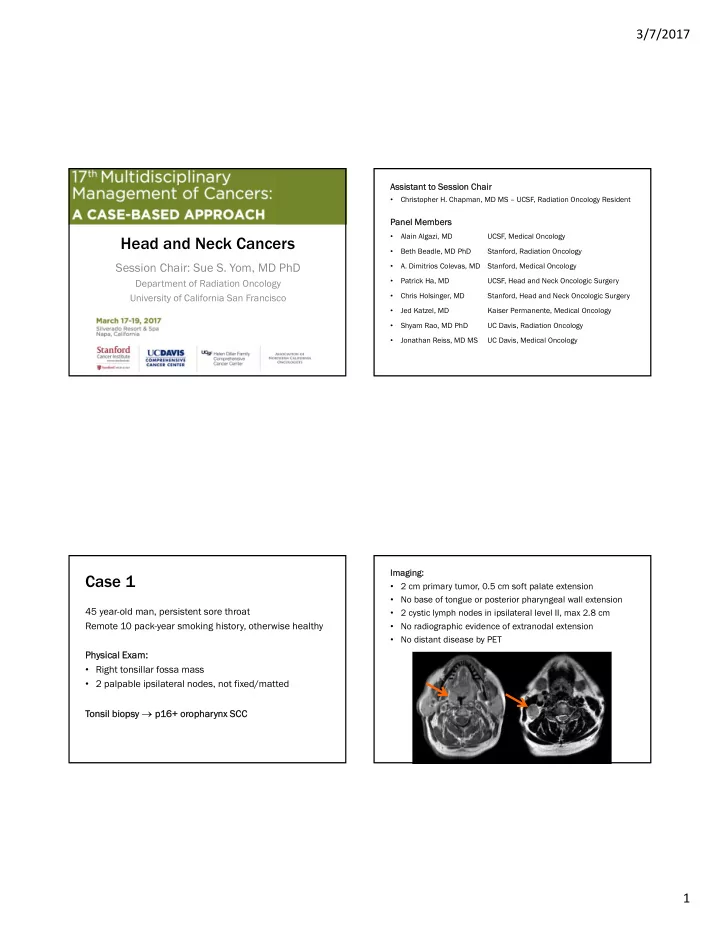
Case 1

45 year-old man, persistent sore throat Remote 10 pack-year smoking history, otherwise healthy Ph Physical Exam: ysical Exam:

  • Right tonsillar fossa mass
  • 2 palpable ipsilateral nodes, not fixed/matted

To Tonsil b biopsy  p1 p16+ or 6+ orop

  • pharynx SCC

SCC

Imagi Imaging:

  • 2 cm primary tumor, 0.5 cm soft palate extension
  • No base of tongue or posterior pharyngeal wall extension
  • 2 cystic lymph nodes in ipsilateral level II, max 2.8 cm
  • No radiographic evidence of extranodal extension
  • No distant disease by PET
slide-2
SLIDE 2

3/7/2017 2

ST STAGING

AJCC 7th Ed. AJCC 8th Ed. cT1 N2b M0 stage IVA cT1 N1 M0 stage I AJCC 8th ed. Clinical nodal stage: p16+ oropharynx

  • cN1

cN1: Ipsilateral node(s), all ≤ 6 cm

  • cN2

cN2: Bilateral/contralateral node(s), all ≤ 6 cm

  • cN3

cN3: Any node > 6 cm

ST STAGING

AJCC 7th Ed. AJCC 8th Ed. cT1 N2b M0 stage IVA cT1 N1 M0 stage I

cN0 cN0 cN1 N1 cN2 cN2 cN3 N3 cT0 cT0

I II III III

cT1 cT1

I I II II III III

cT2 cT2

I I II II III III

cT3 cT3

II II II II II II III III

cT4 cT4

III III III III III III III III Clinical Stage Grouping: p16+

  • ropharynx

8th Ed.

cN0 cN0 cN1 N1 cN2 cN2 cN3 N3 cT0 cT0

III III IV IVA IVB VB

cT1 cT1

I III III IV IVA IVB VB

cT2 cT2

II II III III IV IVA IVB VB

cT3 cT3

III III III III IV IVA IVB VB cT4a cT4a IV IVA IVA IV IVA IVB VB 7th Ed.

Question 1.1

This patient is not interested in surgical options. Treatment recommendation?

  • 1. Radiation with concurrent cisplatin
  • 2. Radiation with concurrent cetuximab
  • 3. Induction chemotherapy then carboplatin-RT
  • 4. Induction chemotherapy then cetuximab-RT
  • 5. Radiation alone
slide-3
SLIDE 3

3/7/2017 3

RTOG 10-16: Phase III Trial of Radiotherapy Plus Cetuximab versus Chemoradiotherapy in HPV-Associated OPSCC

OPSCC p16+ IHC All M0 stages p16 central review Stratification by T/N stage, KPS, Smoking Accelerated IMRT 70 Gy in 6 weeks Cisplatin 100 mg/m2 x 2c Accelerated IMRT 70 Gy in 7 weeks Cetuximab 8 doses RANDOMIZE

Paradigm

Paradigm Stage III/IV SCCHN

  • Oral cavity,
  • ropharynx,

hypopharynx, larynx

  • Expected N=330

R A N D O M I Z E Docetaxel Cisplatin 5-FU every 3 weeks, 3 cycles Docetaxel (every week for 4 wks) Daily/twice-daily RT (days 1-5) 6 weeks Carboplatin (every week) Daily RT (days 1-5) 7 weeks Cisplatin (weeks 1, 4) Daily/twice-daily RT (days 1-5) 6 weeks

CR PR

ICT CRT

DeCIDE

DeCIDE Chemotherapy and RT- naïve SCCHN

  • Expected N=400

R A N D O M I Z E Docetaxel (day 1) Cisplatin (day 1) 5-FU (days 1-5) every 3 weeks, 2 cycles Docetaxel (day 1) 5-FU (days 0-4) Hydroxyurea (days 0-4) Twice-daily RT (days 1-5) every 2 weeks, 5 cycles

ICT CRT

Two randomized phase III studies of induction + chemoRT vs chemoRT in U.S. : Paradigm DeCIDE

E1308: Phase II Trial of Induction Chemotherapy Followed Reduced-Dose Radiation and Weekly Cetuximab in Patients with HPV-associated Resectable OPSCC

Marur et al., J Clin Oncol 2016

All reduced dose patients (n=51) ≤ 10 pk-yr and < T4N2c (n=27) 2-yr PFS 80% 2-yr OS 94% 2-yr PFS 95% 2-yr OS 95%

80 patients with HPV/p16+ stage III-IV OPSCC IC cisplatin/paclitaxel/cetuximab x3c 70% CR  54 Gy / 27 frx with concurrent cetuximab 30% < CR  69.3 Gy / 33 frx with concurrent cetuximab All patients: 2-yr PFS 78%, 2-yr OS 91%

slide-4
SLIDE 4

3/7/2017 4

NRG HN-002: A Randomized Phase II Trial for Patients with p16 Positive, Non-smoking Associated, Locoregionally Advanced Oropharyngeal Cancer

OPSCC p16+ IHC ≤ 10 pk-yr smoking hx T1-2, N1-2b

  • r T3, N0-2b

p16 central review Stratification by unilateral vs. bilateral RT 60 Gy in 6 weeks Cisplatin 40 mg/m2 weekly 60 Gy in 5 weeks (no chemotherapy) RANDOMIZE 44 44% % of

  • f RTOG 1

OG 10-1

  • 16 popula

population

  • n eli
  • eligible. Clos

Closed t to accru accrual.

Patient changes his mind, now wants surge surgery: y: Trans ansoral surg urgical cal rese resect ction (T (TOR ORS) S) with ipsilateral selective neck dissection Final Final P Pathol tholog

  • gy:

y: 2.5 cm tumor, no PNI/LVI 4/25 +LN, largest 3 cm with 1 mm extra-nodal extension Clear margins (> 5 mm)

ST STAGING

AJCC 7th Ed. AJCC 8th Ed. pT2 N2b M0 stage IVA pT2 N1 M0 stage I AJCC 8th ed. Pathological nodal stage: p16+ oropharynx

  • pN1

pN1: 4 or fewer involved nodes

  • pN2

pN2: More than 4 involved nodes

  • pN3: …

pN3: … no pN3 f no pN3 for r p1 p16+ 6+

Number er o

  • f Po

Positiv sitive No Nodes is s is Sup Superior t to L Lymph N Node de Rati Ratio and A and AJCC CC N N Stagi Staging g for r Progno nosi sis o s of Surgically rgically Tr Treated H HNSCC Roberts et al., Cancer 2016 SEER analysis 12,437 patients treated 2004-2012

Overall Survival Overall Survival

slide-5
SLIDE 5

3/7/2017 5

ST STAGING

AJCC 7th Ed. AJCC 8th Ed. pT2N2bM0 stage IVA pT2N1M0 stage I

pN0 pN0 pN1 N1 pN2 pN2 pT0 pT0

I I I II

pT1 pT1

I I I I II

pT2 pT2

I I I I II

pT3 pT3

II II II II III III

pT4 pT4

II II II II III III Clinical Stage Grouping: p16+

  • ropharynx

8th Ed.

pN0 pN0 pN1 N1 pN2 pN2 pN3 N3 pT0 pT0

III III IV IVA IVB VB

pT1 pT1

I III III IV IVA IVB VB

pT2 pT2

II II III III IV IVA IVB VB

pT3 pT3

III III III III IV IVA IVB VB pT4a pT4a IV IVA IVA IV IVA IVB VB 7th Ed.

Question 1.2

  • 2.5 cm tumor, no PNI/LVI
  • 4/25 +LN, largest 3 cm with 1 mm extra-nodal extension
  • Clear margins (> 5 mm)

What adjuvant therapy would be recommended?

  • 1. Concurrent chemoradiation with CDDP 100 mg/m2 Q3 wks
  • 2. Standard radiation therapy alone (60-66 Gy)
  • 3. Dose de-escalated radiation alone (50 Gy)
  • 4. None/observation

EORTC 22931 / RTOG 9501 Combined Analysis Bernier et al., Head Neck 2005

ECOG 3311: Phase II Randomized Trial of TORS Followed by Low-Dose or Standard-Dose IMRT in Resectable p16+ Locally Advanced OPSCC

p16+ OPSCC cT1-3, N1-2b (No T1N1) TORS + Neck Dissection Lo Low Ri w Risk: pT1-2N0-1 Margin ≥ 3 mm Int Intermed rmediate: Margin < 3mm ≤ 1 mm ECE pN2a-b PNI LVI Hi High gh Ri Risk sk:

  • Pos. Margins

> 1 mm ENE ≥ 5 +LN R A N D O M I Z E Observation IMRT 50 Gy / 25 Fx IMRT 60 Gy / 30 Fx IMRT 66 Gy / 33 Fx CDDP 40 mg/m2 Qwk Unk Unknown: n: pN2c or N3 E3311 INV v.08/15/16 ecog-acrin.org

slide-6
SLIDE 6

3/7/2017 6

  • The patient receives adjuvant cisplatin chemoradiation
  • 6 months follow-up: new back pains
  • PE

PET-CT CT: 2 : 2 li liver m r metas tastases, ases, no bo bony metastasis tastasis

  • MRI Brain: no evidence of intracranial metastases
  • KPS 80%

Question 1.3

Systemic therapy choice?

  • 1. Docetaxel
  • 2. Cisplatin/5FU/Cetuximab
  • 3. Nivolumab
  • 4. Pembrolizumab

EXTREME

N = 442 Untreated recurrent or metastatic squamous-cell carcinoma of the head and neck 220 pts: cisplatin 100 mg/m2 or carboplatin AUC 5 mg/ml-min, plus fluorouracil 1000 mg/m2 x 4 days x 6 cycles 222 pts: same chemotherapy plus cetuximab 400 mg/m2 loading then 250 mg/m2 weekly until disease progression

Vermorken et al, N Engl J Med 2008; 359:1116-1127

Nivolumab for Recurrent Squamous-Cell Carcinoma of the Head and Neck

  • R. L. Ferris et al., NEJM, Nov. 2016
  • 361 patients
  • Progression within 6 months of

platinum chemotherapy

  • No brain metastases
  • Randomized to:

– nivolumab (3 mg/kg Q2wks) – other single agent therapy (MTX, docetaxel, cetuximab)

  • 1

1 year ar OS 36% vs. 1 OS 36% vs. 16.6% .6%

  • Grad

Grade 3-4 3-4 toxic xicity: 13% vs. % vs. 35% 35%

  • Greater effect if PD-L1 ≥ 1%

(non-significant)

slide-7
SLIDE 7

3/7/2017 7

Pembrolizumab

KEYNOTE-012

T.Y. Seiwert et al., Lancet Oncol 2016

  • N=60, recurrent/metastatic
  • All express PD-L1 > 1%
  • 38% HPV+, 85% tobacco hx
  • 70% had 2+ previous tx
  • Pembrolizumab monotherapy
  •  ORR 1

ORR 18%

  • 25% in HPV-positive
  • 14% in HPV-negative

KEYNOTE-055

  • J. Bauml et al., ASCO 2016
  • N=50 (prelim of 172)
  • All progressed on Pt/cetuximab
  • Median f/u 6.8 months
  • 84% had 2+ previous tx
  • Pembrolizumab monotherapy
  •  ORR 1

ORR 18%

  • 22% in HPV-positive
  • 16% in HPV-negative
  • 17% in PD-L1 > 1%
  • 8% in PD-L1 ≤ 1%

Case 2

30 year-old woman, hearing loss and trismus Ph Physic ysical al Ex Exam: am:

  • Middle ear effusion, pain with jaw opening
  • No cranial nerve deficits
  • Bilateral cervical lymphadenopathy
  • Nasopharygoscopy: friable mass at fossa of Rosenmüller

Biopsy  Undifferentiated carcinoma, EBV+ Imagi Imaging:

  • 3 cm right lateral nasopharygeal wall mass
  • Parapharyngeal extension and medial pterygoid muscle involvement
  • Bilateral cervical lymphadenopathy in levels II and III up to 3 cm

ST STAGING

AJCC 7th Ed. AJCC 8th Ed. cT4 N2 M0 stage IVA cT2 N2 M0 stage III

T2:

  • Parapharyngeal extension
  • Media

dial and lat and latera ral pt pter erygoids T4:

  • Further soft tissue extension
  • Pa

Parotid g tid gland

  • Intracranial, cranial nerves, orbit,

hypopharynx (unchanged) (N3a + N3b)  N3: node > 6 cm

  • r supraclavicular fossa

(defined as below cricoid)

J.J. Pan et al. Cancer, 2015

slide-8
SLIDE 8

3/7/2017 8

ST STAGING

AJCC 7th Ed. AJCC 8th Ed. cT4 N2 M0 stage IVA cT2 N2 M0 stage III

N0 N0 N1 N1 N2 N2 N3 N3 T0 T0

II II III III IV IVA

T1 T1

I II III III IV IVA

T2 T2

II II II II III III IV IVA

T3 T3

III III III III III III IV IVA

T4 T4

IV IVA IVA IV IVA IVA AJCC Stage Grouping: Nasopharynx

N0 N0 N1 N1 N2 N2 N3 N3 T0 T0

II II III III IVB IVB

T1 T1

I II III III IVB IVB

T2 T2

II II II II III III IVB IVB

T3 T3

III III III III III III IVB IVB

T4 T4

IV IVA IVA IV IVA IVB VB 7th ed. 8th ed.

Question 2.1

Treatment recommendation?

  • 1. Radiation with concurrent cisplatin
  • 2. Cisplatin-RT followed by cisplatin/5FU
  • 3. Induction cisplatin/5FU then cisplatin-RT
  • 4. Induction docetaxel/cisplatin/5FU then cisplatin-RT
  • 5. Radiation therapy alone
  • Y. Sun

Sun et al et al., Lanc ., Lancet Onco Oncol 2016

480 patients, stage III-IVB (except T3-4N0) All receive RT (median 70 Gy) + cisplatin (100 mg/m2 Q3 weeks) Randomized to ± 3 cycles induction TPF:

docetaxel 60 mg/m2, CDDP 60 mg/m2, 5FU 600 mg/m2 x 5 days

3-year OS: 86  92% p = 0.029 3-year DFFS: 83  90% p = 0.031 Ribassin-Majed et al., JCO 2016 5,144 patients in 20 trials 91% stage III-IVB Median follow-up 7.4 years HR for mortality (OS) vs. RT alone CRT: 0.77, 5-yr ARR 8% CRT-AC: 0.65, 5-yr ARR 12% IC-CRT: 0.81, 5-yr AB 6% (non-sig) HR for distant failure vs. RT alone CRT: 0.68, 5-yr AB 8% CRT-AC: 0.59, 5yr AB 11% IC-CRT: 0.44, 5yr AB 15%

slide-9
SLIDE 9

3/7/2017 9

Question 2.2

The patient receives concurrent cisplatin-RT Would you recommend plasma EBV DNA level testing?

  • 1. No
  • 2. Yes, before RT
  • 3. Yes, after RT
  • 4. Yes, before and after RT
  • 5. Yes, at recurrence

J-C Lin et al., New Engl J Med 2004

99 patients: neoadjuvant cisplatin/5FU then 70-74 Gy RT Pre-treatment: 94/99 patients with detectable plasma EBV DNA Post-treatment: 10/99 patients with detectable plasma EBV DNA

Question 2.3

She has a clinical complete response to therapy, but post- treatment plasma EBV DNA levels are detectable. Further treatment options?

  • 1. Observation only
  • 2. Cisplatin/5FU
  • 3. Gemcitabine/Paclitaxel
  • 4. Other

NRG HN-001: Randomized Phase II and Phase III

Studies of Individualized Treatment for NPC Based on Biomarker EBV DNA

Stage II-IVB NPC Detectable pre-treatment plasma EBV DNA IMRT 70 Gy / 33 Fractions Cisplatin 40 mg/m2/week Gemcitabine/Paclitaxel x 4c RANDOMIZE RANDOMIZE Control: Cisplatin/5FU x 3c Observation Post-CRT EBV DNA Det Detect ctabl able Post-CRT EBV DNA Und Undetect ctable able

slide-10
SLIDE 10

3/7/2017 10

She receives adjuvant cisplatin/5FU. 12 months after treatment:

  • Enlarged low left supraclavicular node
  • FDG-PET+ SCV and mediastinal LNs, LLL lung nodule
  • Plasma EBV DNA levels highly elevated

Question 2.4

Chemotherapy choice for metastatic disease?

  • 1. Cisplatin/5FU
  • 2. Cisplatin/gemcitabine
  • 3. Gemcitabine/carboplatin then adoptive T-cell transfer
  • 4. Pembrolizumab
  • L. Zhang
  • L. Zhang et al.

et al., Lance Lancet Oncol Oncology, 2016

362 patients: : 54% prior platinum, 27% prior 5FU Randomized to cisplatin/5FU or

  • r gemcitabine/cisplatin Q 3 weeks, up to 6x

Median follow-up 19.4 months

12-month PFS: 20% Gem/Cis vs. 6% Cis/5FU p < 0.0001 Median OS: 29.1 mo Gem/Cis vs. 20.9 mo Cis/5FU p = 0.0025 35 patients, first-line for metastatic disease Overall response rate 71.4%. 2-year overall survival 63%, 3-year OS 37% LMP2-specificity correlated with overall survival

slide-11
SLIDE 11

3/7/2017 11

KEYNOTE-028

  • C. Hsu et al., ESMO Asia 2015

Phase Ib 27 patien patients with NPC, with NPC, must express PD-L1 ≥ 1% Pembrolizumab 10 mg/kg Q2 weeks  2 years or progression Ov Overal erall resp respon

  • nse

se rat rate (mono (monotx) x) 26% 26%

Case 3

75 year-old man with history of numerous actinic keratoses

  • Presents with 2 cm left antihelix nodule:
  • No immunosuppression
  • No prior resections at this site
  • No palpable lymphadenopathy

Biopsy: W : Well-t

  • to-mo

modera derately ly diff. S . SCC Mohs resection:

  • 2.9 cm final deficit
  • Negative margins after 2 stages
  • 6 mm maximum thickness
  • Twig of perineural invasion

ST STAGING

AJCC 7th Ed. AJCC 8th Ed. pT2NxMx pT3NxMx AJCC 8th ed. cutaneous carcinomas: St Stage T3: T3:

  • >= 4 cm maximum dimension
  • Minor bone erosion
  • Perineural invasion (nerve > 0.1 mm)
  • Depth > 6 mm or beyond subcutaneous fat

(Does not apply to melanoma or Merkel cell carcinoma)

Question 3.1

Adjuvant therapy recommendations?

  • 1. None, observation only
  • 2. Radiation to primary site
  • 3. Radiation to primary site and ipsilateral neck
slide-12
SLIDE 12

3/7/2017 12

K.D. Brantsch et al., Lancet Oncology, 2008 Multivariate analysis of 615 patients with cutaneous SCC treated with surgery alone Best pred Best predic ictors of rs of locore regi gion

  • nal rec

recurre rrence nce: Desmoplastic growth (HR 16) Thickness > 6.0 mm (HR 6) Best pred Best predic ictors o rs of metast tastat atic d disea sease: Thickness > 6.0 mm (HR 4.8) Immunosuppression (HR 4.3) Tumor site = Ear (HR 3.6) Tumor width > 5 cm (HR 2.2) Desmoplasia or > 6.0 mm 3-yr LRRFS: 99% vs. 86% > 6.0 mm vs. < 2.0 mm 3-yr DMFS: 100% vs. 88%

No adjuvant therapy  surveillance with q3 months H&P 9 months later, palpable left parotid nodule US-guided FNA of 1.5 cm intraparotid LN: SCC SCC

 Superficial parotidectomy and ipsilateral selective neck dissection

  • 2/23 nodes involved with metastatic SCC

– 1 intraparotid node (1.5 cm) – 1 level II cervical node (1.0 cm) – No ENE

MRI and PET-CT: no other metastatic disease

Question 3.2

Adjuvant therapy recommendations?

  • 1. Radiation therapy alone
  • 2. Radiation with concurrent carboplatin
  • 3. Radiation with concurrent cetuximab

Post-Operative Skin Trial (POST) TROG 05.01 Post-op concurrent CRT versus RT

High-ris

  • risk p

post-o

  • op H

H&N SCC Any of:

  • T3-4 (no nose/EAC/lip)
  • pN2b-3 cervical LN
  • ENE
  • Intraparotid LN
  • In-transit metastases

R A N D O M I Z E Radiotherapy Alone 60-66 Gy in 2 Gy/frx Radiotherapy + Carboplatin 60-66 Gy in 2 Gy/frx Carboplatin AUC 2.0

Primary endpoint: Locoregional failure Closed to enrollment with 321 patients, currently maturing

slide-13
SLIDE 13

3/7/2017 13

He receives adjuvant RT alone (60 Gy in 30 frx). 18 months later, worsening hip and back pain. Imaging shows multiple bony metastases to pelvis and spine.

Question 3.3

Chemotherapy choice for metastatic disease?

  • 1. Paclitaxel
  • 2. Carboplatin doublet
  • 3. Cetuximab
  • 4. Pembrolizumab

Immunotherapy Case reports for cutaneous SCC

A.L.S. Chang et al., JAMA Dermatol, 2016 D.C. Tran et al., JAMA Dermatol, 2016 10 months 6 patients with unresectable/metastatic SCC, all immunocompetent All previously received carboplatin, paclitaxel, and/or cetuximab 5 received pembrolizumab, 1 nivolumab, Q 3 weeks 1 patient CR, 4 patients PR (figure), 1 patient progressive disease Progression free survival: median an 5. 5.5 5 month nths, ra , range nge 3 3 to 21 months nths

Case 4

60 year-old man with hoarseness, fixed neck mass 50+ pack-year smoking history, quit at presentation

La Laryngo ngoscop copy: Right supraglottic mass Involving false cord, piriform sinus Right arytenoid fixed, TVC not seen Left TVC: normal mobility Biops Biopsy: Moderately-diff. SCC No PNI No LVI

slide-14
SLIDE 14

3/7/2017 14

ST STAGING

AJCC 7th Ed. AJCC 8th Ed. cT3N2bM0 stage IVA cT3N3bM0 stage IVB AJCC 8 AJCC 8th

th Ed. Nodal

  • Ed. Nodal Stagin

Staging: For all r all primar primaries s ot

  • ther t

than p1 p16+ 6+ OPC and OPC and EB EBV+ NPC V+ NPC Clin Clinical al Ex Extra-N a-Nodal l Ex Extension (ENE) (ENE)  cN3b cN3b Must be definite ENE to count An Any pathol pathological al ENE ENE  Incre Increase pN pN stage b stage by +1 +1

ENEmi is ≤ 2 mm ENEma is > 2 mm

Question 4.1

Recap: T3 larynx cancer with indeterminate cartilage invasion and ipsilateral multiple nodes with extra-nodal extension Treatment recommendations?

  • 1. Surgery followed by chemoradiation
  • 2. Cisplatin + radiation
  • 3. Cetuximab + radiation
  • 4. Induction chemotherapy followed by radiation
  • 5. Induction chemotherapy followed by platinum-radiation
  • 6. Induction chemotherapy followed by cetuximab-radiation
  • J. Bonner et

Bonner et al al., 20 ., 2016 From original 424 patients, subset of 168 with larynx or hypopharynx cancer 90 received cetuximab-RT, 78 received RT alone (dose/fractionation MD’s choice)

3-year OS: 42% vs. 39% (NS) 3-year LFS: 37% vs. 29% (p = 0.17)

slide-15
SLIDE 15

3/7/2017 15

213 patients with stage III-IV laryngeal carcinoma Randomized to induction PF vs. TPF All received RT (70 Gy) ± concurrent chemo by institution (15-20% received) Ov Overa erall res response rat rate t to induc inductio ion: 80% 80% vs. 59% (

  • vs. 59% (p = 0.002

= 0.002) No sig. difference in 10-year OS (23-30%), LRC (21-28%), or DFS (19-25%)

GORTEC 2000-01: Long-Term Results of a Multicenter Randomized Phase III Trial of Induction Chemotherapy With Cisplatin, 5-fluorouracil, ± Docetaxel for Larynx Preservation

  • G. Janoray et al., J Natl Cancer Inst, 2016

10-year LP: 70% vs. 4 70% vs. 47% % (p = 0.01) 10-year LDFFS: 6 : 64% vs vs. . 37% % (p = 0.001)

TPF Induction  RT+Cetuximab

TREMPLIN Le Lefebvre et re et a al., JCO 2013 13 Spanish HNCG: T TTCC-200 2007/02 7/02 Mesía et al., IJROBP 2016

  • Randomized phase II
  • Stage II – IVA (89% III – IVA)
  • 56 patients (cetuximab arm)
  • Induction TPF: 85% response
  • 2-year LDFS = 72%
  • 3-year OS = 71%
  • 40-50% grade 3-4 toxicity
  • No significant differences from

TPF  RT+cisplatin arm

  • Single arm phase II
  • Stage III - IVA
  • 93 patients
  • Induction TPF: 82% response
  • 2-year LDFS = 72%
  • 3-year OS = 78%
  • 47% grade 3-4 toxicity

Question 4.2

For which advanced-stage laryngeal cancer patients do you

  • ffer larynx-preserving approach (chemo-RT)?
  • 1. Stage T3 and lower only
  • 2. T1-3 and select T4 patients
  • 3. Based on adequate laryngeal function regardless of stage
  • 4. Based on induction chemotherapy response regardless of

stage

Question 4.2

This patient (7th ed. cT3N2b) receives concurrent cisplatin-RT. At 4 weeks, complete clinical response in primary/nodes. Additional post-therapy disease status evaluation?

  • 1. PET-CT at 4-6 weeks
  • 2. PET-CT at 6-8 weeks
  • 3. PET-CT at 10-12 weeks
  • 4. PET-CT at 20-24 weeks
slide-16
SLIDE 16

3/7/2017 16

PET-NECK Trial: PET-CT Surveillance versus Neck Dissection in Advanced Head and Neck Cancer

  • H. Mehanna et al., N Engl J Med, 2016

564 HNSCC patients with N2a-3 disease (79% N2a-b) Randomized to planned neck dissection or PET-CT at 12 weeks post-CRT