SLIDE 2 HONOLULU COMMUNITY COLLEGE | LONG RANGE DEVELOPMENT PLAN 57
PHASE 1-KŌKEA STREET CAMPUS PHASE 1-MAIN CAMPUS
IMPLEMENTING THE PLAN: Phasing
Incremental development of the HCC vision
The Ultj mate Plan provides the facility and infrastructure requirements for HCC’s growth to a campus with 5,000 FTE students. It serves as a primary tool in guiding the orderly development
- f the future campus. Because the Ultj
mate Plan is so extensive and far-reaching, improvements will take place gradually, as determined by numerous factors including availability of tj me and funds, educatj
- nal program requirements,
and community demands. Incremental develop- ment provides the greatest degree of fl exibility and allows the campus to respond to changing external situatj
uence programming and operatj
Programmatj c and campus quality of life priori- tj es expressed by the HCC Administratj
campus community, together with careful analysis of existj ng buildings to remain and op- tj
- ns for building re-use, determine the most
appropriate phasing schedule for constructj
and renovatj
- n. Five development phases are
presented here. Phase 1 projects are antj cipated to be completed within about fi ve to ten years. Phases 2 to 5 represent a general sequencing of development; however no specifi c tj meframes are atu ributed to these later phases.
PHASE 1: ATTC and the Kōkea Gateway
Revitalizatj
- n of the campus is jump-started
with several near-term (approximately 5 to 10-year tj meframe) development prioritj es and antj cipated changes at the western edge of Main
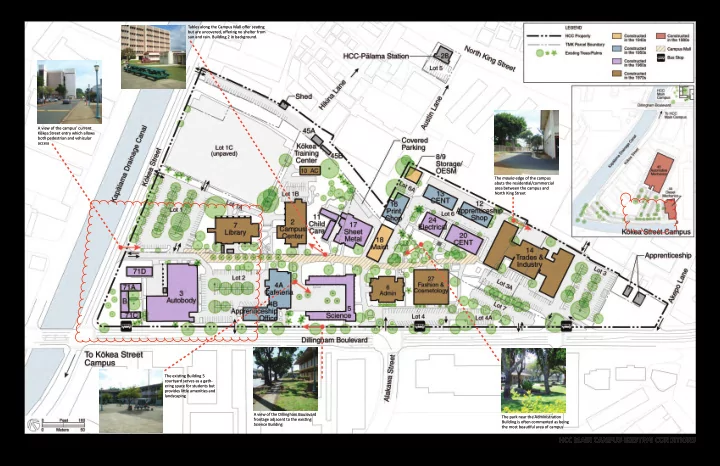
vely, these projects along the Kōkea Street frontage create a new “front door” for the campus – the Kōkea Gateway. Leading the way is constructj
art Advanced Technology and Training Center (ATTC), prominently sited along the redeveloped Campus Mall entrance on Kōkea Street. Follow- ing removal of the existj ng, malpositj
Body Building, the Kōkea Gateway plaza will be integrated with the City’s Kapālama Transit Statj
- n and transit plaza to provide seamless pe-
destrian movement between the statj
Campus Mall. Phase 1 improvements to the mall between Kōkea Street and Building 2 will cre- ate a more atu ractj ve, invitj ng, pedestrian-only
- environment. Mall improvements will be further
enhanced by the conversion of the mauka por- tj
ng Lot 2 to an open grassy, gathering area, shaded by existj ng monkeypod trees. The retained portj
- n of Lot 2 will be accessed
from Dillingham Boulevard. In preparatj
reuse of Building 5 when the Science programs relocate to the completed ATTC, the Building 5 courtyard improvements (per the College’s design competj tj
- n) could also be implemented
in Phase 1. Phase 1 projects include roadway and landscape improvements along Kōkea Street, as part of the ATTC project as well as improvements to parking lot 1C. Prior to constructj
select mahogany trees within the ATTC site will be relocated mauka along Kōkea Street adjacent to Lot 1C as an extension of the row of existj ng mahogany trees. Specifi c street improvements within the City’s right-of-way will be determined in consultatj
- n with the City, but will likely
include repaving, the additj
lanes, curbs, gutu ers, sidewalk and street trees. Lot 1C will be paved, striped, and landscaped, providing about 200 additj
help compensate for the stalls lost due to ATTC constructj
- n and greening of parking lot 2.
Changes on the Kōkea Street Campus during Phase 1 would include the constructj
Auto Body and Paintj ng facility near Buildings 43 and 44, as well as parking lot and landscape improvements to betu er serve the HCC automo- tj ve complex.