Haryana I rrigation Department Haryana I rrigation Department Ha - - PowerPoint PPT Presentation

haryana i rrigation department haryana i rrigation
SMART_READER_LITE
LIVE PREVIEW

Haryana I rrigation Department Haryana I rrigation Department Ha - - PowerPoint PPT Presentation

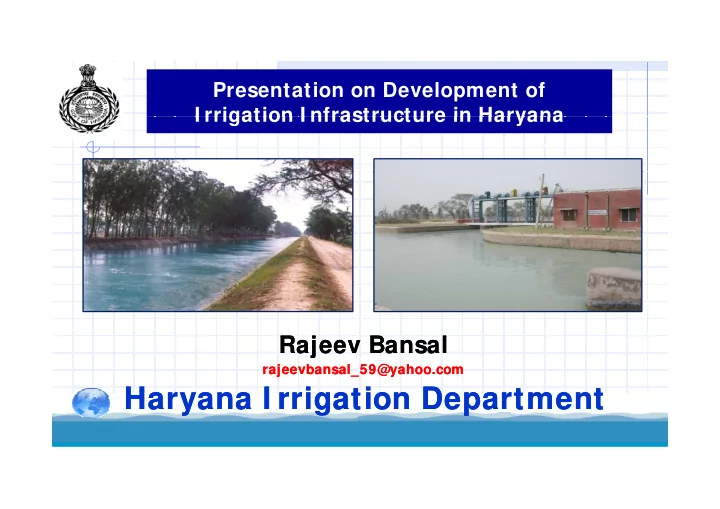
Presentation on Development of I rrigation I nfrastructure in Haryana I rrigation I nfrastructure in Haryana Rajeev Bansal R j R j Rajeev Bansal B B l l rajeevbansal_59@yahoo.com rajeevbansal_59@yahoo.com Haryana I rrigation Department


slide-1
SLIDE 1

Presentation on Development of I rrigation I nfrastructure in Haryana I rrigation I nfrastructure in Haryana

R j B l R j B l

Ha ana I igation Depa tment Ha ana I igation Depa tment

Rajeev Bansal Rajeev Bansal

rajeevbansal_59@yahoo.com rajeevbansal_59@yahoo.com

1

Haryana I rrigation Department Haryana I rrigation Department

slide-2
SLIDE 2

Distribution of Water World over

2 0% 2.50% 97.50%

Oceans Freshwater

2 Draft State Water Policy 2

slide-3
SLIDE 3

Distribution of Water World over

1% 30% 1% 69%

Ice Caps & Glaciers Ice Caps & Glaciers Groundwater Surfacewater

3 Draft State Water Policy 3

slide-4
SLIDE 4

Indian Scenario

  • Total Annual Precipitation – 4000 Trillion liters
  • Total Water Reserve – 1853 Trillion liters

Total Water Reserve 1853 Trillion liters

  • Total Usable Water – 1076 Trillion liters

v Surface Water – 64% v Groundwater – 36% v Groundwater – 36%

  • Usage

v Agriculture – 89% v Industry 6% v Industry – 6% v Domestic – 5%

  • Crops

Wh t 13% v Wheat – 13% v Rice – 22% v Sugarcane – 23%

4

  • Rice, Wheat & Sugarcane – 90% of India’s Crop Production

4

slide-5
SLIDE 5

Haryana State

  • Small state situated in north of India

which was

  • Small state situated in north of India, which was

carved out of the erstwhile state of Punjab in 1966.

  • Total area of the state is 4 4 million hectares
  • Total area of the state is 4.4 million hectares
  • About 3.9 million hectare area is arable.
  • Not bestowed with any perennial river.
  • Agriculture is the main source of livelihood

Agriculture is the main source of livelihood.

5

slide-6
SLIDE 6

Some More Facts

  • Population of the state is about 25 3 million
  • Population of the state is about 25.3 million.
  • 75% of the population engaged in agriculture.
  • Agriculture sector is the major user of water - 85%.
  • 30-40% yields higher than national average.

y g g

  • About 80% arable lands served by canals.

A i t it f i i ti i 75%

  • Average intensity of irrigation is 75%.

6

slide-7
SLIDE 7

Water Resources in Haryana

7

slide-8
SLIDE 8

Share of Water for Haryana in various rivers

River Share in Availability Agreement River Share in BCM Availability in BCM Agreement

Y 5 730 11 983 MOU b t t t t Yamuna 5.730 11.983 MOU between partner states (1994) Sutlej 5 427 17 281 Bhakra Nangal Agreement Sutlej 5.427 17.281 Bhakra Nangal Agreement (1959) Ravi- Beas 4.724 26.409 As per the Ravi Beas Tribunal Report

Total Share 15.881 56.173

8

slide-9
SLIDE 9

Historical Background

  • The history of development of canal irrigation dates to 1351 AD,

y p g , when Ferozshah Tughlak constructed Western Yamuna Canal.

  • The Mughal Emperor Akbar remodeled this canal in 1568 AD and

Shahajahan extended this canal in 1626 AD.

  • The British reconstructed Western Yamuna Canal and made it

se i eable in the pe iod 1817 1823 AD serviceable in the period 1817-1823 AD.

  • Subsequently, Bhakra Dam was constructed which brought the

waters of Sutlej River to the State through Bhakra Canal system waters of Sutlej River to the State through Bhakra Canal system.

  • Construction of Beas Sutlej Link augmented Bhakra reservoirs.

9

slide-10
SLIDE 10

Canal System

  • Haryana has an extensive irrigation network

y g

  • 59 main canals having length of about 1500 km

1326 di t ib t i & i h i l th f 12328 k

  • 1326 distributaries & minors having a length of 12328 km
  • 200 pump houses commissioned in the Lift Schemes.
  • About 3.05 Mha is covered by surface irrigation with

14370 km length of the canal network g

10

slide-11
SLIDE 11

Canal System

  • Bhakra Canal system – 1.383 Mha CCA in the north-

y western and western parts of Haryana.

  • Western Yamuna Canals system – 0 970 Mha CCA

in

  • Western Yamuna Canals system

0.970 Mha CCA in the north-eastern and central parts of Haryana.

  • Gurgaon Canal and Agra Canal systems

0 139 Mha in

  • Gurgaon Canal and Agra Canal systems – 0.139 Mha in

south-eastern parts of Haryana. Lift l 0 556 Mh i th t t f

  • Lift canals – 0.556 Mha in south-western parts of

Haryana bordering Rajasthan.

11

slide-12
SLIDE 12

Development of I rrigation I nfrastructure

  • Large

projects

  • f

development

  • f

irrigation g p j p g infrastructure after formation of Haryana.

  • Gurgaon

Canal Augmentation Canal & Lift Canals

  • Gurgaon

Canal, Augmentation Canal & Lift Canals through State funds from 1966-1977.

  • Haryana Irrigation Project I

II & NWMP funded by the

  • Haryana Irrigation Project-I, II & NWMP funded by the

World Bank 1977-1994. HWRCP i iti t d i 1994 ith j f

  • HWRCP

initiated in 1994 with major focus

  • n

rehabilitation of irrigation infrastructure.

12

slide-13
SLIDE 13

Development of I rrigation

2 50

I rrigated Area from Canals in MHa

2.13

2.00 2.50

ctares

1.31

1 00 1.50

Million Hec

0.50 1.00

Area in M

0.00 1966-67 1967-68 1968-69 1969-70 1970-71 1970-72 1972-73 1973-74 1974-75 1975-76 1976-77 1977-78 1978-79 1979-80 1980-81 1981-82 1982-83 1983-84 1984-85 1985-86 1986-87 1987-88 1988-89 1989-90 1990-91 1991-92 1992-93 1993-94 1994-95 1995-96 1996-97 1997-98 1998-99 1999-00 2000-01 2001-02 2002-03 2003-04 2004-05 2005-06 2006-07 2007-08 2008-09 2009-10 2010-11

A

13

1 1 1 1 1 1 1 1 1 1 1 1 1 1 1 1 1 1 1 1 1 1 1 1 1 1 1 1 1 1 1 1 1 1 2 2 2 2 2 2 2 2 2 2 2

slide-14
SLIDE 14

Lift I rrigation Schemes

Lift I rrigation System Lift I rrigation System

These schemes were d lif constructed to lift water upto 464 feet in stages to provide canal water by gravity flow to adversely sloping areas.

14

Pump House of JLN

slide-15
SLIDE 15

Canal Distribution Netwrok

15 15

Khubru Head – Off take of JLN Canal & other Channels

slide-16
SLIDE 16

Khubru Head

16 16

slide-17
SLIDE 17

Hathinikund Barrage

17 17

slide-18
SLIDE 18

Ottu Lake

18 18

slide-19
SLIDE 19

Recent I nitiatives

  • Bhakra Main Line – Hansi Branch – Butana Branch Multipurpose

Link Channel of 109 km length has been constructed at a cost of

` 392 cr. However, the channel not connected to Bhakra Main

Line due to legal issues Line due to legal issues.

  • Dadupur Shahbad Nalvi Canal Project – Construction has been

taken up at an estimated cost of ` 267 cr. The project envisages ta e up at a est ated cost o 6 c e p oject e sages to use 590 cusecs surplus flood water for irrigation and groundwater recharging.

  • Carrier Lined Channel –Carrier Lined Channel at a cost of `667cr.

to carry raw water for Haiderpur and Wazirabad Water Treatment Plants and for irrigation in Haryana area

19

Treatment Plants and for irrigation in Haryana area.

19

slide-20
SLIDE 20

NCR Channel

N C R Ch l C ti

` 279

Th h l h b N.C.R. Channel – Costing ` 279 cr. The channel has been constructed to meet with future water supply demands

  • f National Capital Region

20 20

  • f National Capital Region.
slide-21
SLIDE 21

Kaushalya Dam

Kaushalya Dam

` 217 00 cr

project was started in Kaushalya Dam – ` 217.00 cr. project was started in March, 2008 for providing drinking water to the Panchkula town

21 21

Panchkula town.

slide-22
SLIDE 22

I mprovement in Carrying Capacity of Canals

  • J.L.N. feeder increased to 2500 from 1500 cusecs.
  • The capacity of WJC Main Line Lower of Western

Yamuna Canal system increased from 13,500 to y , 19,557 cusecs. This will irrigate 2.4 lac acre additional land in Kharif alongwith groundwater recharge.

  • The capacity of Hansi Branch has been enhanced from

7,000 Cusecs to 8,000 Cusecs.

  • Capacity of Butana Branch has been enhanced from

3,600 Cusecs to 4,600 Cusecs.

22 22

slide-23
SLIDE 23

I mprovement in Carrying Capacity of Canals Repair and Rehabilitation of lined watercourses: p

  • Programme for water conservation through lining of

field channels is being vigorously pursued with active g g y p participation of farmers.

  • 7633 watercourses have been identified, which were

, constructed more than 20 years ago.

  • 2051 watercourses have been rehabilitated so far.
  • 3420 Water User Associations have been formed.

23 23

slide-24
SLIDE 24

Integrated Water Resources Management

  • A three-tier infrastructure created for the purpose.

An ape bod State Wate Reso ces Co ncil (SWRC) established

  • An apex body State Water Resources Council (SWRC) established

with the Hon’ble Chief Minister of Haryana in Chair and ministers and secretaries of related departments as members. and secretaries of related departments as members.

  • Water Conservation Mission (WCM) under the Chairmanship of

the Principal Secretary to the Chief Minister and secretaries all related departments to assist SWRC.

  • Special Water Conservation Cell (SWCC) with the FC & PS (I) in

Ch f f l & l S C & C Chair for infrastructural & logistic support to SWRC & WCM, implementation and monitoring.

  • Directorate of Water Resources in Haryana Irrigation Department

24

  • Directorate of Water Resources in Haryana Irrigation Department

for providing secretarial support to three entities.

slide-25
SLIDE 25

Water Conservation in Ancient India

  • The Indus Valley Civilization had one of the most sophisticated

b t l d t i th ld urban water supply and sewage systems in the world.

  • One of the oldest, water harvesting systems is found about 130

km from Pune along Naneghat in the Western Ghats km from Pune along Naneghat in the Western Ghats.

  • Houses in parts of western Rajasthan were built so that each

had a rooftop water harvesting system Rainwater from these had a rooftop water harvesting system. Rainwater from these rooftops was directed into underground tanks.

  • Underground baked earthen pipes and tunnels to maintain the

Underground baked earthen pipes and tunnels to maintain the flow of water for to transport it to distant places, are still functional at Burhanpur in Madhya Pradesh, Golkunda and Bijapur in Karnataka and Aurangabad in Maharashtra

25

Bijapur in Karnataka, and Aurangabad in Maharashtra.

25
slide-26
SLIDE 26

Pollution of Water Bodies

Only 26.8% of domestic and 60% of industrial y wastewater is treated in India Wastewater management plants in cities have a capacity

  • f approximately 6,000 MM litres per day

423 Class I cities treat just 29.2% of their wastewater. 499 Class II towns are able to treat just 3.7% of wastewater due to poor treatment infrastructure D lhi th ti l it l t t l th h lf f th Delhi, the national capital, treats less than half of the 3,267 MM litres of wastewater it generates every day

26 26

slide-27
SLIDE 27

Peoples’ Initiatives

  • The water

conservation cannot be made a success without people’s participation There are many success stories of peoples’ people s participation. There are many success stories of peoples initiatives in rural India.

  • Ralegan Siddhi, a small village in the district of Ahmednagar,

Ralegan Siddhi, a small village in the district of Ahmednagar, Maharashtra is one of the most successful examples of drought-

  • proofing. The transformation took place when Anna Hazare, took

i i i i & h ill d ld l i k h h d initiative & the villagers restored an old percolation tank that had fallen into disuse and had dried up. Monsoon rains filled the repaired tank and in the following year wells in the village swelled repaired tank and in the following year wells in the village swelled with water even in summer. Voluntary labor and public participation in funding were the highlights of this successful

27

experiment.

slide-28
SLIDE 28

Peoples’ Initiatives

  • Villages in the Alwar district of Rajasthan were witness to another

kind

  • f

pioneering effort Tarun Bharat Sangh under the kind

  • f

pioneering effort. Tarun Bharat Sangh under the leadership of Rajinder Singh, Magsasay Award winner, took it upon themselves to educate the villagers about the wisdom of ancient methods of water conservation. “Pani Yatras” were taken

  • ut through the villages.

P f h fi i d f h ill

  • Part of the finances required came from the villagers to ensure

greater involvement and interest. Over the years the villagers’ contribution and interest has risen and hundreds of villages have contribution and interest has risen and hundreds of villages have become self-sufficient in water.

  • Miraculously the river Aravari, that

had only been a fading

28

y , y g memory, started flowing again after about eight decades!

slide-29
SLIDE 29

Peoples’ Initiatives

  • Mahudi village in Dahod district of Gujarat used to face serious

water crisis year after year There was no drinking water in the water crisis year after year. There was no drinking water in the

  • wells. Farmlands had become useless. A local NGO, N M Sadguru

Water and Development Foundation stepped into this bleak scenario. With help from the Foundation the local Bheel population constructed percolation tanks and reservoirs. With constant recharging rivers that used to dry up after monsoons constant recharging, rivers that used to dry up after monsoons started flowing throughout the year.

  • Another NGO Saurashtra Gandhiji Gramodhar Trust has similarly
  • Another NGO, Saurashtra Gandhiji Gramodhar Trust has similarly

helped Gadhadha village in Bhavnagar district to overcome water

  • shortage. Villagers constructed small ponds, percolation tanks

29

and check dams. Water levels improved and crop yields

  • increased. Windmills have been installed for drinking water.
slide-30
SLIDE 30

Jai Hind Jai Hind

Rajeev Rajeev Bansal Bansal

30

Rajeev Rajeev Bansal Bansal

rajeevbansal_59@yahoo.com rajeevbansal_59@yahoo.com

30