SLIDE 1
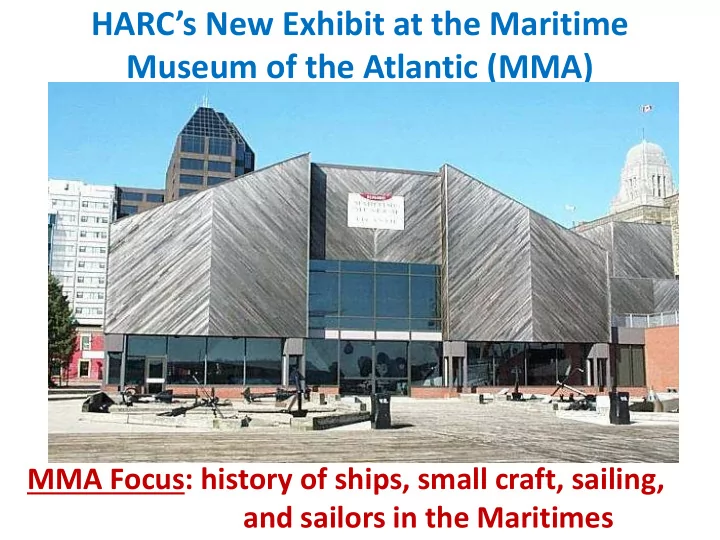
HARC’s New Exhibit at the Maritime Museum of the Atlantic (MMA)
MMA Focus: history of ships, small craft, sailing, and sailors in the Maritimes
SLIDE 2
MMA’s main exhibition hall. HARC exhibit is on balcony facing hall.
SLIDE 3 HARC’s Permanent MMA Exhibit
- Part A. A working modern amateur radio station
- -CW/SSB/Digital
- HF + 2m
- Part B. A working 1940s-1960s ship-board
commercial/navy “radio office”
- CW/AM/MCW
- 375 kc to 14.0 Mc
Antennas: -80/40 m doublet
- 40-10 m multiband vertical
- 2 m vertical
A large, new “Radio Office” with:
SLIDE 4 Radio at Sea: ended age-old isolation of ships out of sight of land
- Greatly aided navigation:
– accurate time for longitudes
– coastal beacons, RDF – WX forecasts
- RX and TX distress calls
- Coordination of ships at sea
- Links with land
“The SOS”
The radio office’s story for MMA visitors
SLIDE 5 Varied with: -time period,
- ship type and size,
- radio equipment used
What Type of Ship’s Radio Office Should Be Displayed?
1940s Marconi gear 1950s RCA Radiomarine gear
SLIDE 6 Heart of the HARC 1940-1960s ship radio office display: The Canadian Marconi CM-11 Ship Transmitter-Receiver
Why the CM-11?? “ “Remote” CM-11 on Haida
- all Canadian design and manufacture
- widely used 1942-1970s on ships + shore
- uses available tubes and 115 VAC
- I found two for free!!
CM-11 “vital statistics”
- TX + RX: 375-515 kc, 1.5-14.0 Mc
- RX ONLY: 78-550 kc, 14-30 Mc
- 23 tubes, Xtal or VFO frequency control
- AM, CW, MCW, RTTY
- OUTPUT: 30W AM, 70 W MCW, 100W CW
- WEIGHT: 479 lbs
SLIDE 7
1960s Radio #1 in RCN destroyer Haida: multiple listening posts with CSR-5s, and remote units to operate CM-11s in Radio #2
SLIDE 8 Sackville’s radio
locally operated CM-11
Tnx, Spud!
SLIDE 9 HMCS Swansea (1960)
De Spud!
SLIDE 10
Quebec Radio Museum storage: CM-11A (left), CM-11 (right) 72 years old 73 years old
SLIDE 11
“As received” finish on the power supply
SLIDE 12
May 2015: two CM-11s arrive in Canard!
SLIDE 13 CM-11 Restoration
- to good working order
- to original appearance
- with “period” accessories
- with clear description of
uses Goal:
SLIDE 14 The CM-11 Restoration:
- 1. Diasassemble (12 subunits)
- 2. Choose units to restore, cannibalize
- 3. Strip down, clean, re-paint
- 4. Obtain missing parts + accessories
- 5. Overhaul mechanically
- 6. Ohmmeter, tube + capacitor tester checks
- 7. Overhaul electrically
- 8. Assemble subunits (TX, RX, Tuner, + 3 P/S sections)
- 9. Apply power to subunits
- 10. Test/Troubleshoot and Align subunits
- 11. Apply power to complete CM-11 + Test
SLIDE 15
CSR-5A in original paint color
SLIDE 16
CM-11A Power Supply: 250 lbs!
SLIDE 17
SLIDE 18
SLIDE 19
SLIDE 20
SLIDE 21
SLIDE 22
SLIDE 23
SLIDE 24
SLIDE 25
SLIDE 26
SLIDE 27
SLIDE 28
SLIDE 29
SLIDE 30
SLIDE 31
SLIDE 32
SLIDE 33
SLIDE 34
SLIDE 35
SLIDE 36
The missing “Test Cable” and its snatch plugs
SLIDE 37
SLIDE 38
SLIDE 39
SLIDE 40
SLIDE 41
SLIDE 42
SLIDE 43
SLIDE 44
Room built for HARC radio displays
SLIDE 45
SLIDE 46
Amateur Station Ship’s Radio Office
SLIDE 47
1940s remote unit for CM-11 (for bridge, etc.)
SLIDE 48
Not quite finished.....
SLIDE 49
SLIDE 50
SLIDE 51 Tnx!
- Musee Quebequois de la Radio
– Jacques Hamel: VE2DJQ Gave us two CM-11s – Donald Courcy: VE1SS Lots of moving muscle for CM-11s HARC
- Erik Hein VE1JEH Transported the brutes from Sorel, QC to
Canard, NS! OTHER
- Tom Brent: CM-11 aficianado –575 kHz XTAL Filter
- Jerry Proc: VE3FAB -HAIDA Radio Room restorer/info +
manual source
- Bill Perry: Mr. Amphenol connector
- Wayne Blenkhorn: VE1BAB: key, decals, advice (former CM-
11 operator)
- Corey Mullins: MMA tech who built the Radio Office!
SLIDE 52
Listening in a ship’s radio office with the CM-11’s CSR-5 receiver
SLIDE 53 1940s -> 1960s Haida radio room
VE3FAB
SLIDE 54
Radio office #1 on Haida. Remote units control CM-11s
SLIDE 55 Radio Office #2 on Haida You can tell these CM-11s are mainly run in remote:
- no mill (typewriter)
- no key
SLIDE 56
CM-11--> TX-RX CSR-5 RX
CM-11 and second CSR-5 RX often used together
SLIDE 57
Combined Morse and radio training on the CSR-5 in WW2