Handbook of Workers Participation at Plant Level XIV Global Labour - - PowerPoint PPT Presentation

handbook of workers participation
SMART_READER_LITE
LIVE PREVIEW

Handbook of Workers Participation at Plant Level XIV Global Labour - - PowerPoint PPT Presentation

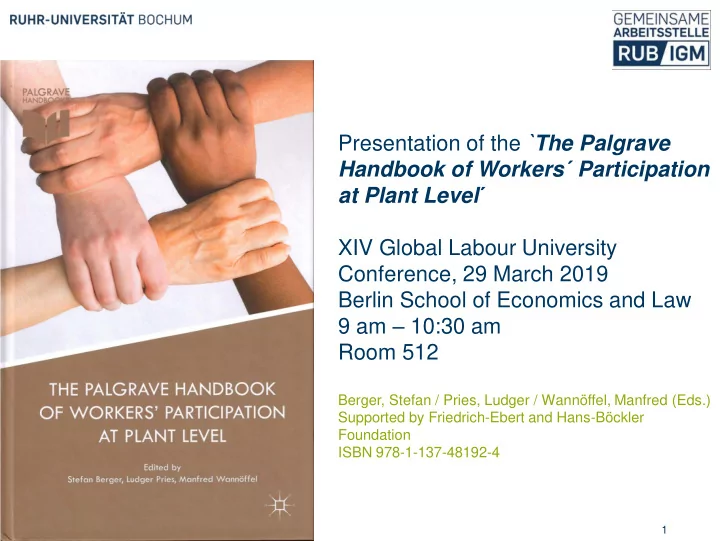
Presentation of the `The Palgrave Handbook of Workers Participation at Plant Level XIV Global Labour University Conference, 29 March 2019 Berlin School of Economics and Law 9 am 10:30 am Room 512 Berger, Stefan / Pries, Ludger /


slide-1
SLIDE 1

1

Presentation of the `The Palgrave Handbook of Workers´ Participation at Plant Level´ XIV Global Labour University Conference, 29 March 2019 Berlin School of Economics and Law 9 am – 10:30 am Room 512

Berger, Stefan / Pries, Ludger / Wannöffel, Manfred (Eds.) Supported by Friedrich-Ebert and Hans-Böckler Foundation ISBN 978-1-137-48192-4

slide-2
SLIDE 2

2

BACKGROUND

  • Foundation 1975 / 1979
  • Contract between Ruhr-

Universität Bochum (RUB) and IG Metall (Industrial Metal Union)

  • Central institute of RUB
  • Equally represented committee
  • Bridge between social science

and working world

ACTIVITIES

  • Transdisciplinary research
  • Learning Factories
  • Further education programs
  • Interdisciplinary lectures
slide-3
SLIDE 3

3

About the Handbook:

„Most people in the world spend the greater part of their life at their workplace“ (Berger/Pries/Wannöffel, p. 1)

  • This handbook specifically considers the structural social conflict within the

process of value adding.

  • Conflicts are the results of the critical relationship between the continuous

development of the main productive forces (technology, information, work,

  • rganization) and the social relations of production and services (private
  • wnership of their resources) in market-driven societies.
  • This relation is the structural base for the search of sustainable political

regulations of social conflicts between different social actors - employers, employees and their organizations – with contradicting economic and social interests.

  • From the editors point of view, labour conflicts are not just like any social,

religious or ecological contention but the structural dispute of market- driven societies.

slide-4
SLIDE 4

4

About the Handbook

  • Employees as citizens are the real actor bridges between the production

system and the civil society where employees enjoy certain political and civil rights.

  • Main challenges are how to incorporate political and civil rights of formal

political democracies into business organizations and how to transform formal political democracies into real social democracies through the institutionalization of workers´ participation rights.

  • Political democracies do not end at the doors of business organizations. Social

democracies have their starting point in the political regulation of the structural conflict between the continuous development of the main productive forces and the social relations within production and services systems.

  • Conceptually, this handbook are related to the concept of Industrial

Citizenship by Thomas Marshall who interpreted Industrial Citizenship as a central element to regulate market-driven market societies (Marshall, 1963).

slide-5
SLIDE 5

5

CONTENTS

PART I Overviews PART II Classic Theoretical and Historical Perspective on Workers´ Participation at plant level PART III Country Chapters PART IV Conclusion: Workers´ Participation at Plant Level and its Future

slide-6
SLIDE 6

6

PART I Overviews

  • 1. Workers´ Participation: Comparative Historical Perspectives

from the Nineteenth Century to the End of Cold War (Stefan Berger)

  • 2. Workers´ Participation at Plant Level in a Comparative

Perspective (Ludger Pries)

  • 3. Workers´ Participation at Plant Level : Conflicts,

Institutionalization Processes, an Roles of Social Movements (Manfred Wannöffel)

slide-7
SLIDE 7

7

  • 1. Workers´ Participation: Comparative Historical

Perspectives from the Nineteenth Century to the End of Cold War (Stefan Berger)

  • Historical view on workers’ participation at plant level in a comparative

perspective

  • Focus on the development of `social Partnership´ in the period from the first half
  • f the twentieth century via the era of the Cold War towards the 1980´s
  • `Varieties of Capitalism´ approach to explain the varieties of workers’

representation

  • Multi-factor explanation to understand the relative success or failure of models of

social partnership (characteristics of the state policy, political culture, influence of ideas, values and norms…)

  • Authoritarian traditions (formerly fascist Germany, Italy, Spain) vs. liberal

traditions (US, UK, Australia, Nordic states)

slide-8
SLIDE 8

8

  • 2. Workers’ Participation at Plant Level in a

Comparative Perspective (Ludger Pries)

  • Analytical framework for comparing different forms of contemporary workers’

participation between different regions and countries all over the world

  • After World War II and the experience of uncontrolled capitalism of

Auschwitz: great challenges regarding the implementation and extension of participative democracy at plants and enterprises

  • Crucial issues: arenas of collective bargaining, dominant actor groups, labor

regulation, sources of power, shared ideology, cognitive maps, different types

  • f conflict resolutions
  • Comparison of Germany and China, European Union member states
slide-9
SLIDE 9

9

  • 3. Workers’ Participation at Plant Level: Conflicts,

Institutionalization Processes, and Roles of Social Movements (Manfred Wannöffel)

  • Analysis of selected labour conflicts, practice of conflict solution, and

institutionalization processes of workers’ participation at plant level, the role of social movements, and their socio-political effects in different historical and national contexts

  • Three examples: Germany, England and the United States
  • Argumentation of the chapter is based on the methodological approach of

Gidden’s structuration concept  core thesis: political regulation / institutionalization does not come from above, rather always a result of social conflict resolution from below

slide-10
SLIDE 10

10

  • 3. Workers’ Participation at Plant Level: Conflicts,

Institutionalization Processes, and Roles of Social Movements (Manfred Wannöffel)

GERMANY:

slide-11
SLIDE 11

11

  • 3. Workers’ Participation at Plant Level: Conflicts,

Institutionalization Processes, and Roles of Social Movements

GERMANY:

slide-12
SLIDE 12

12

  • 3. Workers’ Participation at Plant Level: Conflicts,

Institutionalization Processes, and Roles of Social Movements (Manfred Wannöffel)

ENGLAND:

slide-13
SLIDE 13

13

  • 3. Workers’ Participation at Plant Level: Conflicts,

Institutionalization Processes, and Roles of Social Movements (Manfred Wannöffel)

UNITED STATES:

slide-14
SLIDE 14

14

  • 3. Workers’ Participation at Plant Level: Conflicts,

Institutionalization Processes, and Roles of Social Movements (Manfred Wannöffel)

CONCLUSION:

  • The changes in the regulation and structuring of labor and participation
  • pportunities have always been connected to deep labour conflicts, social

practice of conflict solution and institutionalization

  • Despite significant national differences, social movements are increasingly

important in supporting conflict resolution strategies at plant level

  • Legal structure of workers’ participation = extension of political democracy with

its civil and political rights of citizens to the sphere of economy in business

  • rganizations  Industrial Citizenship (Thomas Marshall 1963)
slide-15
SLIDE 15

15

PART II Classic Theoretical and Historical Perspective on Workers‘ Participation

  • Analysis of seminal authors and crucial texts on workers’ participation
  • Conceptual grands of workers’ participation at plant level are summarized in a

historical perspective

  • Insights into specific historical experiences of workers’ participation at plant

level

  • For example:
  • Thomas Haipeter presents Western European experiences of employees

participation tracing back the origins of this concept

  • György Széll presents the special case of Yugoslavia where workers’

participation within the Social Federal Republic was a central pillar of the

  • verall economic and societal model as such
slide-16
SLIDE 16

16

PART III Country Chapters

  • 18 Country Studies about the historical backgrounds, development, current

situation, and perspectives of workers’ participation / industrial democracy early industrialized countries late industrialized countries Great Britain Brazil France India Germany Indonesia US Mexico Italy Nigeria Japan South Africa Australia China Spain South Korea Czechia and Slovakia Russia

slide-17
SLIDE 17

17

PART IV Workers´ Participation at Plant Level and Its Future

  • `History matters´: For dealing with the structural conflict of social

participation in business it is essential to reflect the historical dimension

  • f workers’ participation to understand the origin of specific national

structures.

  • There is no one homogenous strategy of workers´ participation, that

can be applied to both early industrialized and late industrialized countries over the world. (Varieties of Capitalism)

  • Future of workers’ participation? Compromise between democracy

and capitalism is worldwide under pressure (Streeck)

  • Precarious and digital work outside plants and companies structures,

Growing influence of Platform economies (Amazon, Uber, etc.), Process of dissembedding of labour of social institutions

  • Market as a devil mill (Polanyi)
slide-18
SLIDE 18

manfred.wannoeffel@rub.de http://www.ruhr-uni-bochum.de/rub-igm/

Thank you very much for your attention!